

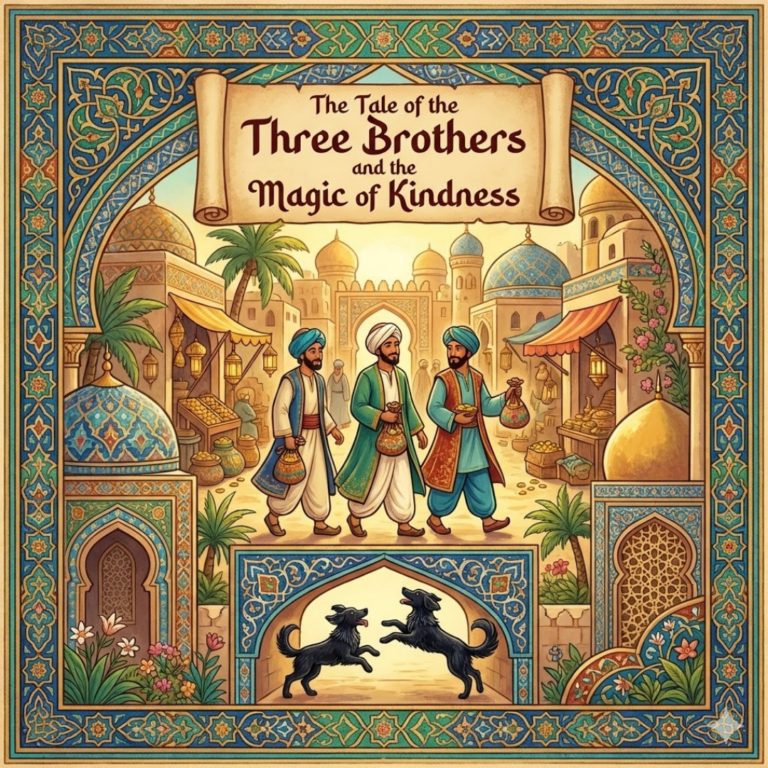
This moral story for children ages 6-12 combines entertainment with important values.
CHAPTER ONE: THE INHERITANCE
In the golden city of Basra, where minarets touched the clouds and the Tigris River flowed like liquid silver, there lived a wealthy merchant with three sons.
The eldest son, Mahmoud, was clever and bold, always dreaming of distant lands and great adventures. The middle son, Rashid, was practical and hardworking, content to tend the family business. And the youngest son, Yusef, had the kindest heart of the three—he could never pass a beggar without sharing his bread or see a stray cat without offering milk.
When their father passed away, he left each son an equal inheritance: three bags of golden sequins, enough to live comfortably for many years.
“Use this wealth wisely,” the father had written in his will. “Remember that gold can open many doors, but kindness can open hearts. And a heart is worth more than all the treasure in the world.”
Mahmoud immediately began planning adventures. “I shall travel to distant kingdoms!” he declared. “I shall find treasures beyond imagining and return a hundred times richer than I left!”
Rashid shook his head. “Brother, such dreams are dangerous. I shall stay here, invest wisely, and build our family’s fortune slowly and steadily.”
Yusef said nothing. He simply smiled and embraced his brothers, wishing them both well.
* * *
CHAPTER TWO: THE ELDEST BROTHER’S FATE
Mahmoud sold his shop and set sail across the sea. For a year, he traveled to exotic lands, seeking his fortune. He saw pyramids and deserts, jungles and mountains. He traded spices and silk, gems and gold.
But adventure, as their father had warned, can be treacherous. Pirates attacked his ship. Thieves stole his merchandise. A sandstorm buried his caravan. Within a single year, Mahmoud had lost everything.
Ashamed and broken, he made his way back to Basra. His fine clothes were now rags, his proud bearing now a shuffle. He stood outside Yusef’s shop—for Yusef had used his inheritance to open a small trading business—and wondered if his youngest brother would even recognize him.
The door opened, and there stood Yusef, his face lighting up with joy.
“Mahmoud! Brother! You’re alive!”
Before Mahmoud could explain his misfortune, Yusef had pulled him inside, called for hot food and clean clothes, and ordered a bath to be prepared.
“But I have failed, brother,” Mahmoud whispered, tears streaming down his weather-beaten face. “I have lost everything. I am not worthy of your kindness.”
Yusef took his brother’s hands. “You are my brother. That makes you worthy of everything I have. Rest now. Tomorrow we will talk about the future.”
That night, Yusef counted his earnings. Through careful management and honest trading, he had doubled his original inheritance. Without hesitation, he divided his wealth in half and gave one portion to Mahmoud.
“Start again, brother,” he said simply. “And know that my door is always open to you.”
* * *
CHAPTER THREE: THE SECOND BROTHER’S DOWNFALL
Emboldened by Yusef’s generosity, Rashid began to feel the stirring of his own dreams. “Perhaps I, too, should seek my fortune in distant lands,” he thought. “If Yusef can double his gold while staying home, imagine what I could do with adventure on my side!”
Despite warnings from both brothers, Rashid packed his bags and set off.
Like Mahmoud before him, Rashid faced the cruelty of fate. His ship was wrecked in a storm. His trusted business partner betrayed him. Bandits robbed him of his last copper coin.
One year later, almost to the day, another ragged figure appeared at Yusef’s door.
“Brother!” Rashid wept. “I did not listen. I thought I was smarter, more careful. But the world is harsh to those who travel alone.”
Again, Yusef welcomed his brother with open arms. Again, he shared his food, his home, and his gold.
“I have little left,” Yusef admitted quietly, “but what I have is yours. Take half, and begin anew.”
Mahmoud, now recovering and working in Yusef’s shop, marveled at his youngest brother’s generosity.
“Yusef, why do you give so freely? We took your gold, lost it, and still you give more?”
Yusef smiled. “Gold can be earned again. But brothers? Brothers are irreplaceable. If I had all the gold in the world but no family to share it with, I would be the poorest man alive.”
* * *
CHAPTER FOUR: THE PROPOSAL
For five years, the three brothers worked together, building Yusef’s small shop into a prosperous trading house. They were closer than ever, bound not just by blood but by gratitude and love.
Then one day, Mahmoud and Rashid came to Yusef with a proposal.
“Brother, we have been thinking,” Mahmoud began. “We have traveled the world and learned its dangers. But we have also learned its opportunities. With your wisdom to guide us, we could embark on a trading voyage together—and return with wealth beyond our dreams.”
“It is true that I failed alone,” Rashid added. “But together? The three of us together could accomplish anything!”
Yusef listened carefully. Part of him remembered his father’s words about kindness and hearts. Another part saw the excitement in his brothers’ eyes, the longing for adventure that he himself had never felt but could understand.
“I will think on it,” he said.
For five more years, his brothers asked the same question again and again. And for five more years, Yusef politely declined.
But finally, seeing how much it meant to them, Yusef agreed.
“Very well,” he said. “But first, let us prepare properly. I have saved four thousand golden sequins. One thousand for each of us to use on the journey, and one thousand I shall bury here at home, so that no matter what happens, we will have something to return to.”
The brothers embraced, and preparations began for the greatest adventure of their lives.
* * *
CHAPTER FIVE: THE VOYAGE
The ship they hired was sturdy, the crew experienced, the cargo valuable. For two months they sailed, trading at every port, watching their wealth grow.
At the port of Zanzibar, something unexpected happened.
As Yusef walked through the marketplace, examining spices and fabrics, a young woman approached him. She was beautiful but poorly dressed, her eyes filled with a mixture of hope and desperation.
“Kind sir,” she said softly, “I see that you have a gentle heart. I am alone in the world, without family or protection. If you would take me aboard your ship and marry me, I promise I will be the most devoted wife any man could wish for.”
Yusef was startled. “I—I know nothing about you,” he stammered.
“Then learn,” she replied simply. “Give me a chance to prove my worth. That is all I ask.”
Something in her eyes touched Yusef’s heart. Perhaps it was the same instinct that made him feed stray cats and share his bread with beggars. Perhaps it was something deeper—a recognition of a kindred spirit.
“What is your name?” he asked.
“Fatima,” she answered. “And I believe we were meant to meet.”
Against all logic, following only his heart, Yusef agreed to take her aboard. Within a week, they were married in a simple ceremony on the ship’s deck, with his brothers as witnesses and the stars as their canopy.
* * *
CHAPTER SIX: THE RETURN HOME
The voyage was blessed after that. Fair winds filled their sails. Good prices awaited their goods at every port. When the ship finally returned to Basra, the three brothers were wealthier than they had ever imagined.
But it was not the gold that made Yusef happiest. It was returning home with Fatima by his side, and with his brothers finally at peace.
“We could never have done this without you, Yusef,” Mahmoud said as they unloaded their treasures. “Your patience, your kindness, your faith in us—these were the true ingredients of our success.”
“You forgave us again and again,” Rashid added, his voice thick with emotion. “You never stopped believing we could change, could grow, could become better men.”
Yusef embraced them both. “We are brothers,” he said simply. “That is what brothers do.”
And when he looked at Fatima, who stood watching with a smile that seemed to hold ancient secrets, he understood something else. Love—whether for family or for a stranger who becomes family—is the only treasure that grows larger when you give it away.
* * *
CHAPTER SEVEN: THE MORAL OF THE TALE
Years later, when Yusef had become one of the most respected merchants in all of Basra, people would often ask him the secret of his success.
“I have made many wise investments,” Yusef would tell them, “but the wisest investment I ever made was in kindness.”
He would gesture to his brothers, now prosperous merchants in their own right, still partners in his trading house.
“When they had nothing, I gave them half of what I had. Some called me foolish. ‘They will waste it again,’ people said. ‘You are throwing your gold into the sea.’ But look at what that kindness built—a family, a business, a lifetime of happiness.”
He would look at Fatima, still beautiful, still mysterious, still the best decision he ever made.
“When I met her, she was a stranger asking for a chance. Some called me mad. ‘She could be anyone,’ they said. ‘You are trusting your heart to the unknown.’ But love always involves trust, always involves risk, always requires kindness.”
And then he would share his father’s final lesson—the words from the will that had guided him through every difficulty:
“Gold can open many doors, but kindness can open hearts. And a heart is worth more than all the treasure in the world.”
The three brothers lived long and happy lives, always generous, always kind, always there for each other. And when their children asked how they had become so fortunate, the brothers would smile and share the same simple truth:
Be kind. Be patient. Be generous with what you have.
For kindness is magic, and magic has a way of coming back to those who practice it.
Moral Lessons
- Be kind and generous, especially to family. Share what you have, forgive mistakes, and remember that love is the greatest treasure of all.
Test Your Understanding
1. What did the wealthy merchant’s father write in his will about using wealth?
2. What happened to the eldest brother Mahmoud when he traveled for adventure?
3. How did the youngest brother Yusef respond when his brothers returned with nothing?
4. How did Yusef meet his wife Fatima?
5. Why did Yusef say brothers are more valuable than gold?
6. What is the main moral lesson of this story?
Frequently Asked Questions
What is the moral lesson of The Tale of the Three Brothers and the Magic of Kindness?
What age is this story appropriate for?
How long does it take to read The Tale of the Three Brothers and the Magic of Kindness?
What culture does this story come from?
Can I use this story for teaching?
Frequently Asked Questions
What is The Tale of the Three Brothers and the Magic of Kindness about?
This moral story follows three brothers in ancient Basra who each inherit equal wealth from their father. The story explores how each brother uses his inheritance differently, with the youngest brother Yusef demonstrating that kindness and generosity create more lasting rewards than gold alone.
Is this story appropriate for young children at bedtime?
Yes, this story is perfect for children ages 6-12 as a bedtime story. It combines adventure and moral lessons in an engaging way, teaching important values about kindness, wisdom, and generosity without any scary or inappropriate content for young readers.
What moral lesson does this kindness story teach kids?
The story teaches children that while money and material wealth are useful, acts of kindness and generosity toward others create deeper, more meaningful rewards. It shows how helping others and having a generous heart leads to unexpected blessings and true happiness.
📚 Recommended Books
Handpicked for readers like you
As an Amazon Associate, we earn from qualifying purchases. These recommendations are personalized based on this story's themes and your reading history.
Who are the three brothers in this Middle Eastern tale?
The three brothers are Mahmoud (the eldest, who is clever and adventurous), Rashid (the middle son, who is practical and business-minded), and Yusef (the youngest, who has the kindest heart and always helps those in need).
What makes this different from other moral stories for children?
This story uniquely combines Middle Eastern culture with universal values, set in the beautiful city of Basra. It shows practical examples of how kindness works in real situations, making abstract moral concepts concrete and relatable for young minds.
