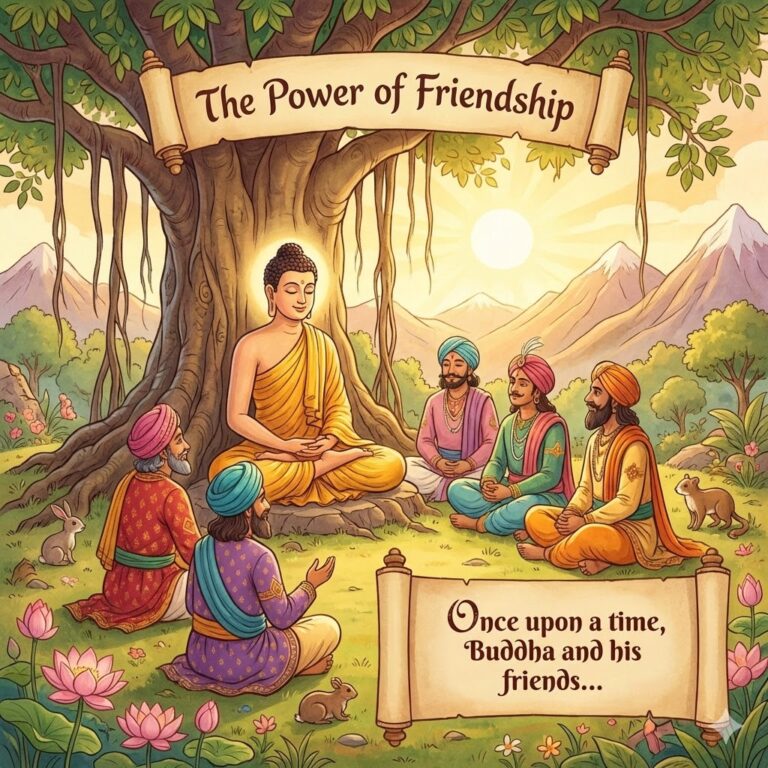
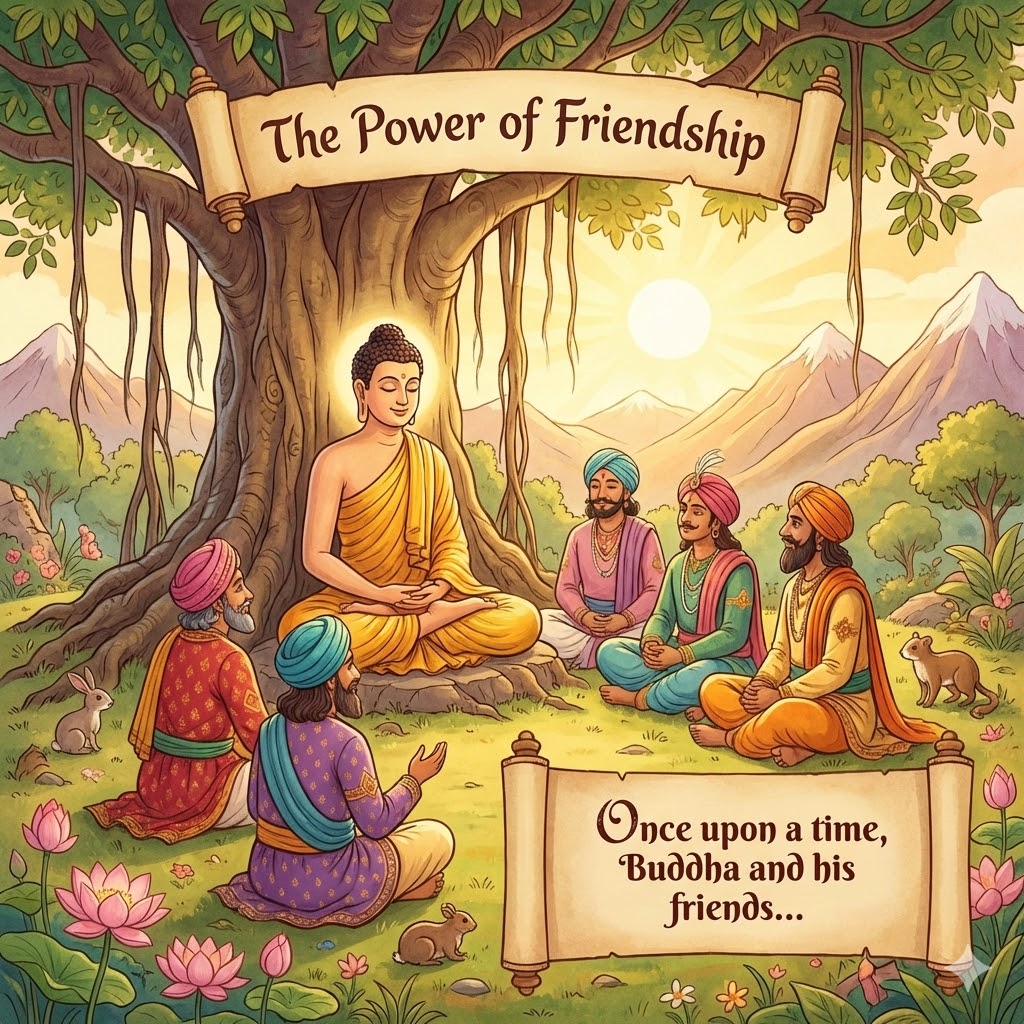
Share this engaging bedtime story with kids ages 6-12 to teach valuable life lessons.
*THE MOMENT OF SEPARATION
Siddhartha sat by the river, weak from years of starvation. He had pushed his body to its absolute limit—eating almost nothing, sleeping almost never, meditating until he collapsed.
And yet…
He was no closer to enlightenment than when he had started.
As he sat there, a young village woman named Sujata approached him. She carried a bowl of milk rice—a simple, nourishing food.
“Please, holy one,” she said gently. “You look like you’re about to die. Please eat this.”
For a long moment, Siddhartha stared at the food.
All his years of training said: “Refuse it! True spirituality requires total denial of the body!”
But a new understanding was dawning in his mind. He had lived two extremes—first as a prince with every luxury imaginable, and now as an ascetic denying himself everything.
Neither extreme had brought him closer to the truth.
Perhaps… the answer lay somewhere in between.
Siddhartha took the bowl and ate.
The milk rice was warm and sweet. He felt strength returning to his body. His mind cleared.
And immediately, he knew he had made the right choice.
THE FIVE friends LEAVE
When Kondañña and the other four ascetics saw Siddhartha eating real food, they were horrified.
“He has given up!” Bhaddiya said in disgust.
“He has returned to the life of luxury,” Vappa agreed.
Kondañña shook his head sadly. “We thought Siddhartha would be the one to achieve enlightenment. But he is weak. He could not endure the austerities.”
“We waste our time staying with him,” Mahānāma said.
Young Assaji, who had looked up to Siddhartha, felt betrayed. “I trusted him. I thought he was different from other princes. But he’s just like all wealthy people—when things get hard, they give up and go back to comfort.”
The five men gathered their few belongings—their ragged robes, their begging bowls—and walked away, leaving Siddhartha alone.
“We will continue the true path,” Kondañña announced. “We will go to Isipatana, to the Deer Park near Benares. There we will continue our practices. And perhaps WE will be the ones to achieve enlightenment, since Siddhartha has failed.”
And so the five friends left, disappointed and determined to continue their extreme path without the weak prince who had betrayed the ascetic ideal.
ENLIGHTENMENT
Siddhartha, now alone, continued his practice—but in a new way.
He ate enough to keep his body healthy. He slept enough to keep his mind clear. He found a middle path between luxury and deprivation.
And one night, sitting beneath a bodhi tree in the village of Bodh Gaya, Siddhartha achieved what no human had achieved in countless ages:
Complete enlightenment.
All the mysteries of existence became clear to him. He understood the nature of suffering and its cause. He understood how to end suffering forever. He saw the interconnection of all things. He remembered his past lives and saw the future lives of all beings.
Siddhartha Gautama was no more.
He had become the Buddha—”the Awakened One.”
For several weeks, the Buddha sat in bliss, experiencing the peace of perfect understanding.
But then a thought arose in his mind: “Should I teach this to others? Or is it too difficult for people to understand?”
The truth he had discovered was subtle and profound. Most people were caught up in their desires and fears. Would anyone be able to comprehend what he had to teach?
At that moment, according to Buddhist tradition, Brahma Sahampati—a great divine being—appeared before the Buddha.
“Please teach,” Brahma pleaded, bowing low. “There are some beings with only a little dust in their eyes who will understand. Please, out of compassion, share what you have learned.”
The Buddha looked out across the world with his enlightened vision, seeing all the suffering beings trapped in cycles of pain.
And he thought of his five friends—Kondañña, Bhaddiya, Vappa, Mahānāma, and Assaji.
“They are sincere seekers,” the Buddha thought. “They are disciplined. They have practiced for years. If anyone can understand, it will be them.”
And so the Buddha set out on foot to find his five old friends at the Deer Park in Isipatana.
THE REUNION AT DEER PARK
The five ascetics were sitting under trees at Isipatana when they saw a figure approaching in the distance.
“Look,” Assaji said. “Someone is coming.”
As the figure drew closer, Kondañña’s eyes widened. “That’s… that’s Siddhartha!”
“The one who gave up!” Bhaddiya said angrily.
Vappa frowned. “What is he doing here? Has he come to beg us to take him back?”
“We should not honor him,” Mahānāma said. “He abandoned the path. We should not even stand up to greet him.”
“Agreed,” Kondañña said. “When he arrives, we will remain seated. We will not offer him the respect we give to true ascetics. Let him see that his failure has cost him our respect.”
They all nodded and agreed: they would ignore Siddhartha, treating him as just an ordinary person, not as a spiritual seeker.
But as the Buddha came closer, something strange happened.
There was something different about him.
He moved with perfect grace. His face radiated peace and compassion. A subtle light seemed to surround him.
When he was still twenty paces away, Kondañña found himself standing up—almost without meaning to.
Then Bhaddiya stood.
Then Vappa.
Then Mahānāma.
Then Assaji.
Despite their resolution to ignore him, they could not help themselves.
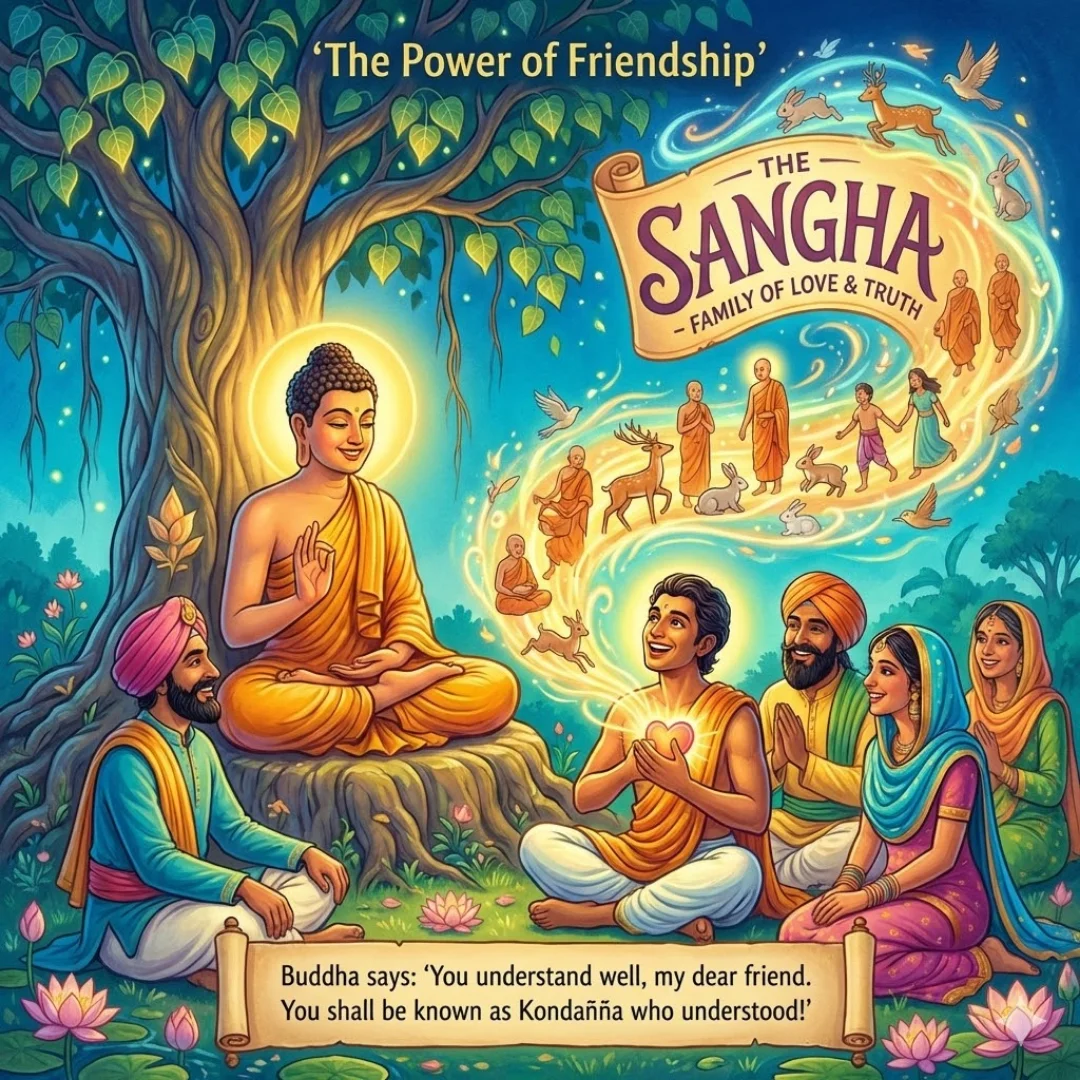
One by one, they moved forward to greet him. Someone brought him water to wash his feet. Someone else offered him a seat. They prepared a place for him with honor and respect, treating him as a great teacher—though they did not yet understand why.
“Welcome, friend Gautama,” Kondañña said, trying to maintain his disapproval. “You… you look well.”
The Buddha smiled gently. “My friends, I am no longer the Gautama you knew. I have awakened. I have found the truth I was seeking—the truth WE were all seeking together.”
The five friends looked at each other skeptically.
“You gave up the austerities,” Bhaddiya said accusingly. “How can you have found the truth by taking the easy path?”
“The extreme path you are following does not lead to liberation,” the Buddha said calmly. “And neither does the path of luxury I lived as a prince. Both extremes miss the truth. The answer lies in the Middle Way—in balance, in moderation.”
THE FIRST SERMON
“Please,” the Buddha said, gesturing for them to sit. “Let me share with you what I have discovered.”
The five ascetics sat down, still skeptical but curious despite themselves.
And there, in the Deer Park at Isipatana, beneath the trees as the sun set and the deer grazed peacefully nearby, the Buddha taught his first sermon—the Dhammacakkappavattana Sutta, “The Setting in Motion of the Wheel of the Dharma.”
“There are Four Noble Truths,” the Buddha began.
“The First Noble Truth is Dukkha—suffering. Life contains suffering. We are born, we age, we get sick, we die. We are separated from those we love. We are stuck with those we dislike. We want things we cannot have. This is the nature of existence.”
The five friends nodded. They had all experienced this. That was why they had become ascetics—to escape suffering.
“The Second Noble Truth is Samudaya—the origin of suffering. Suffering is caused by tanha, craving or thirst. We suffer because we cling to things, because we want things to be permanent when everything is impermanent, because we desire pleasure and fear pain.”
Again, the five friends nodded. This made sense.
“The Third Noble Truth is Nirodha—the cessation of suffering. It IS possible to end suffering. When we let go of craving, when we stop clinging, suffering ends. This state is called Nibbana (Nirvana)—the blowing out of the fires of greed, hatred, and delusion.”
The ascetics leaned forward, listening intently now.
“The Fourth Noble Truth is Magga—the path that leads to the end of suffering. This path is the Noble Eightfold Path.”
And the Buddha taught them the eight practices:
1. Right View — Understanding the Four Noble Truths
2. Right Intention — Commitment to mental and ethical growth
3. Right Speech — Speaking truthfully and kindly
4. Right Action — Acting ethically and compassionately
5. Right Livelihood — Earning a living in a way that doesn’t harm others
6. Right Effort — Cultivating positive states of mind
7. Right Mindfulness — Being aware and present in each moment
8. Right Concentration — Developing deep meditation
As the Buddha spoke, something extraordinary happened to Kondañña.
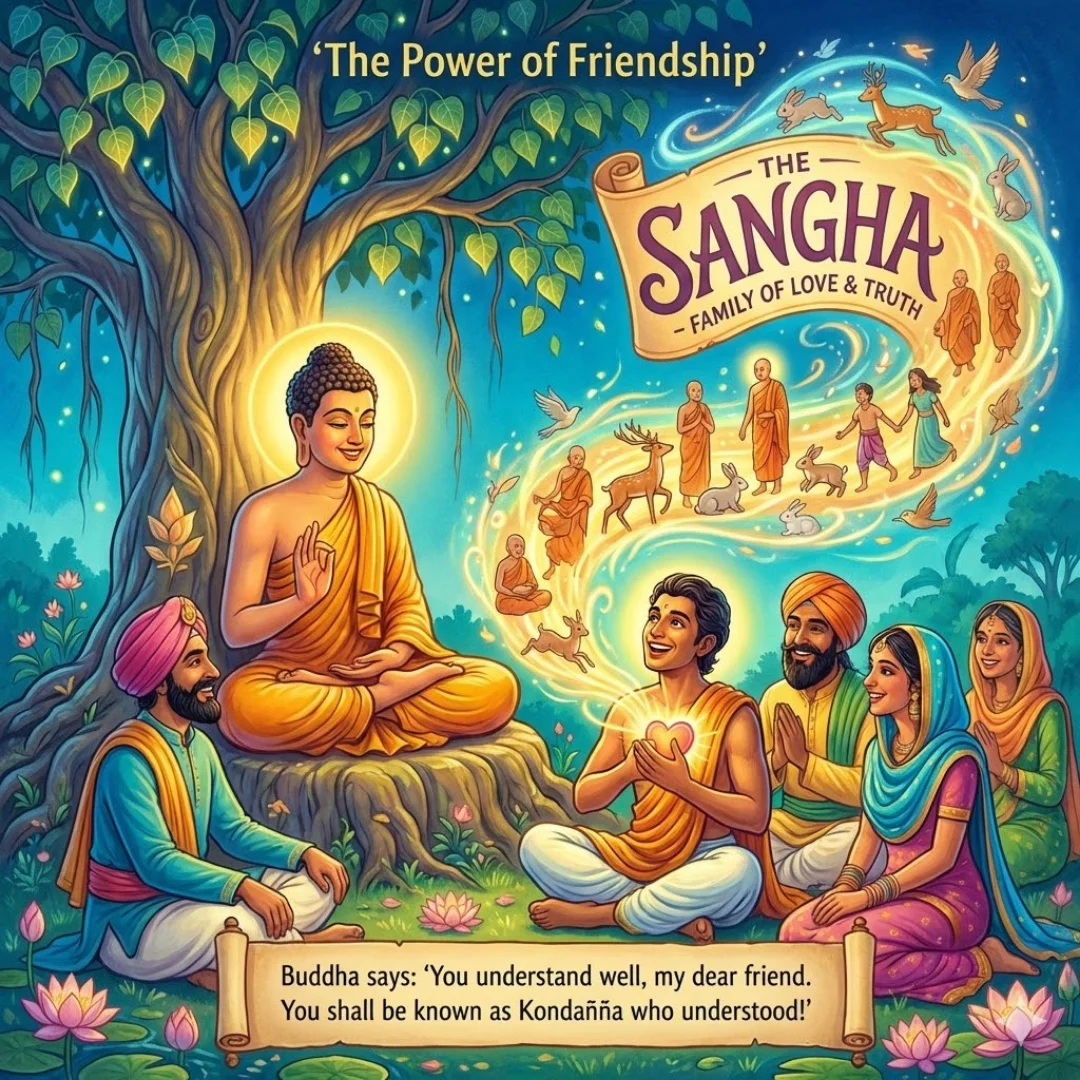
Suddenly, like a veil lifting from his eyes, he UNDERSTOOD.
It all became clear—the nature of suffering, its cause, its end, and the path to freedom.
Kondañña experienced what Buddhists call the sotāpanna stage—he became a “stream-enterer,” one who has had their first glimpse of enlightenment and will inevitably reach full awakening.
Tears streamed down Kondañña’s face. “I understand,” he whispered. “I truly understand.”
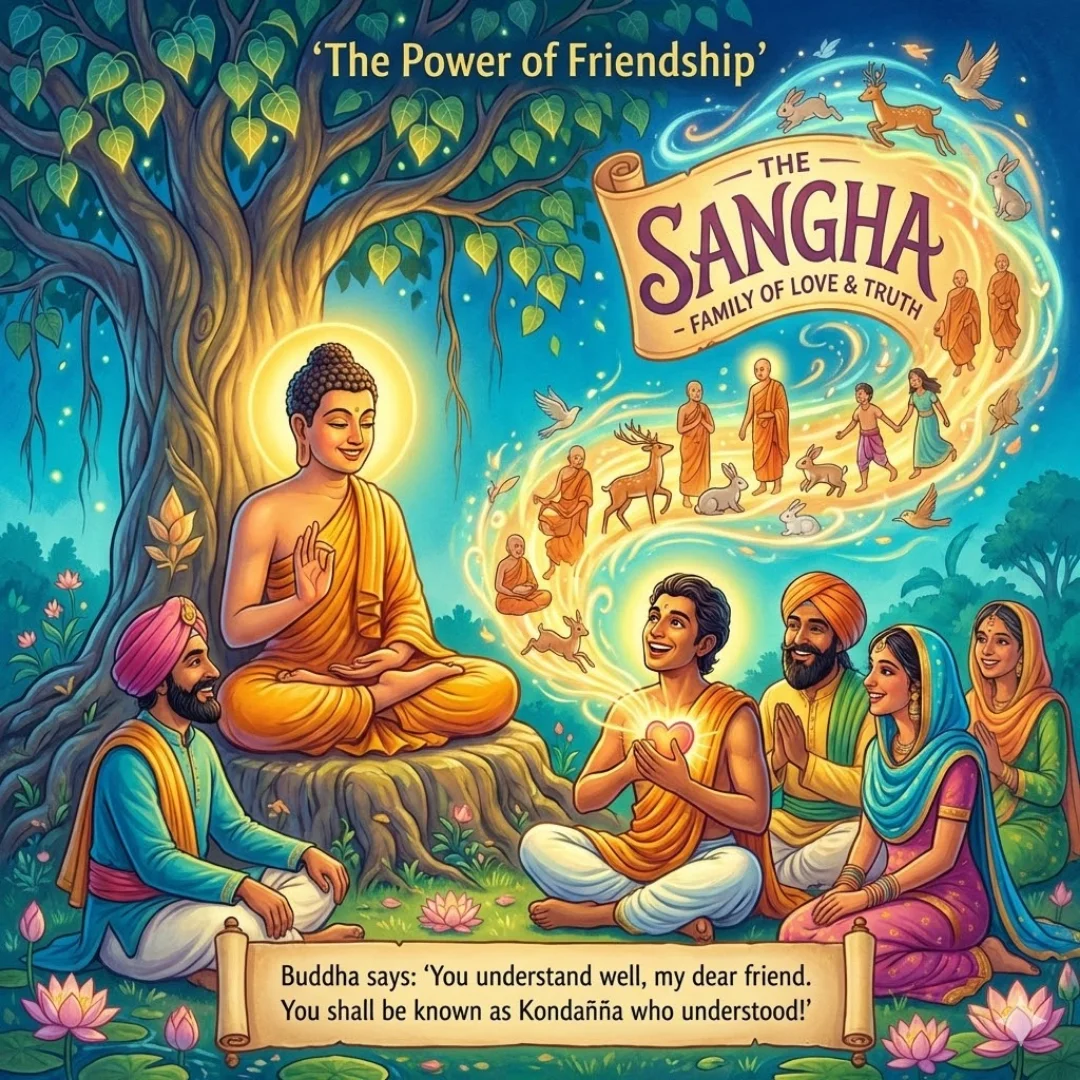
The Buddha smiled with joy. “Añña Kondañña!” he said. “Kondañña understands!”
From that day forward, Kondañña would be known as Añña Kondañña—”Kondañña who has understood.”
THE BIRTH OF THE SANGHA
Over the next five days, the Buddha continued teaching his five friends.
He taught them the Anattalakkhana Sutta, the discourse on “not-self,” explaining that there is no permanent, unchanging soul—everything is impermanent and interconnected.
One by one, all five friends achieved full arahantship—complete enlightenment, freedom from all suffering.
And on that day, the Sangha was born—the community of enlightened monks, the spiritual family of those who followed the Buddha’s path.
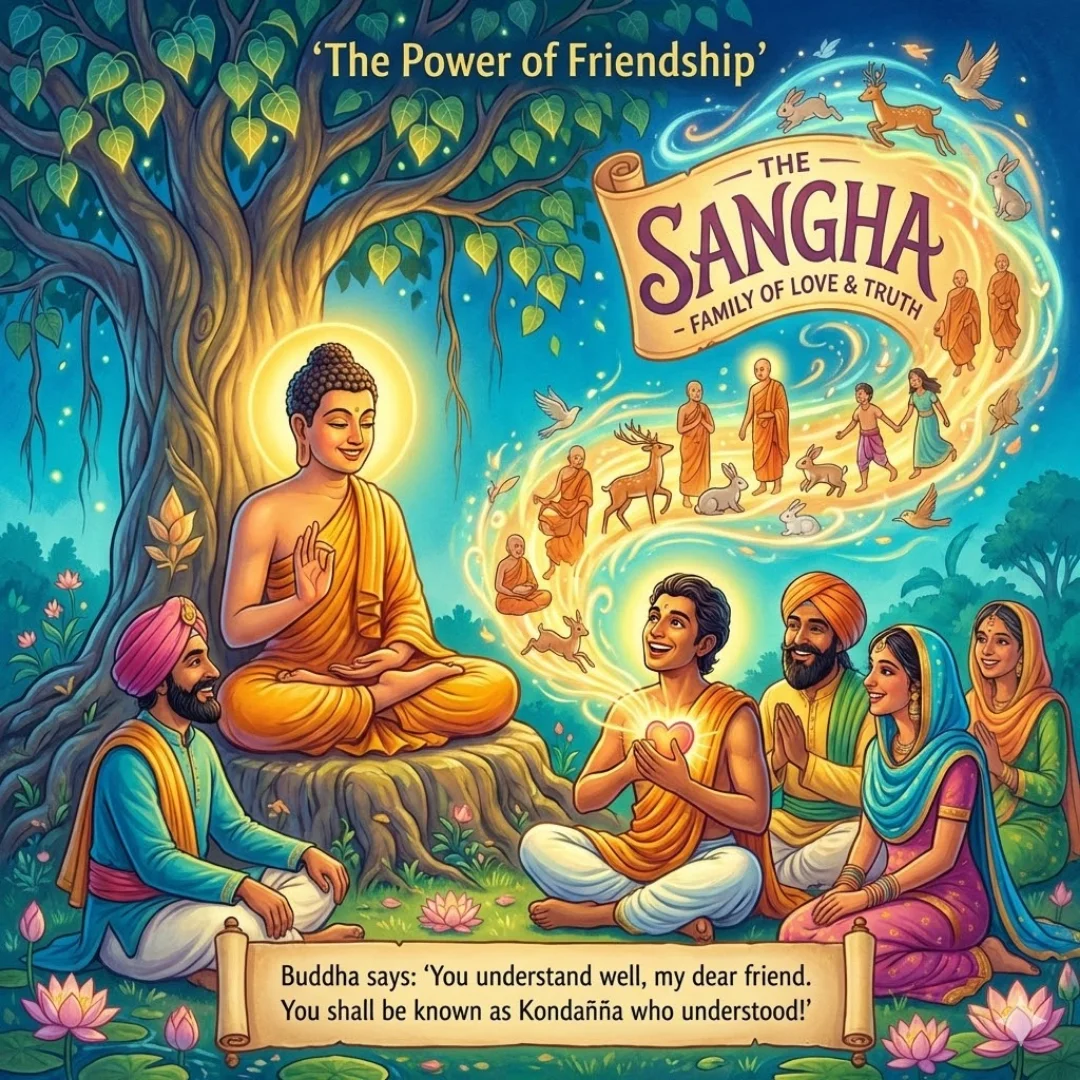
Kondañña became the first bhikkhu (monk) in the Buddha’s dispensation.
The five friends who had left Siddhartha in disappointment had become the five pillars of a spiritual revolution that would spread across Asia and eventually the world.
“You must go forth,” the Buddha told them, “and teach this path to others. Do not all go in one direction—spread out across the land. There are beings ‘with only a little dust in their eyes’ who will understand if they hear the teaching. Go with compassion and help them find freedom from suffering.”
And so the five friends—now five enlightened arhats—bowed to their teacher and set out to share the Dharma with the world.
WHAT HAPPENED TO THE FIVE
The five disciples went on to become some of the most important figures in early Buddhism:
Añña Kondañña became one of the Buddha’s most senior disciples. He was known for his wisdom and for being the very first to understand the Dharma. In his old age, he lived in the Himalayas in meditation. When he knew his death was approaching, he traveled to the Buddha to pay his respects one final time, then returned to the mountains where he passed away in perfect peace.
Bhaddiya became known for his joy. He would often sit in meditation under trees, and when he emerged, he would exclaim: “Oh, what happiness! Oh, what bliss!” People thought it strange until they learned that he had been a king before becoming an ascetic, and he was expressing that the happiness of renunciation was far greater than any royal pleasure.
Vappa became a great teacher, instructing many students in meditation and the Dharma.
Mahānāma was noted for his kindness and his ability to explain the teachings in simple, clear ways that ordinary people could understand.
Assaji, the youngest, became famous for his gentle dignity and perfect deportment. Once, a wealthy man named Sariputta saw Assaji walking mindfully through the streets of Rajagaha and was so struck by his peaceful presence that he followed him and asked about his teacher. Assaji recited a short verse about the Buddha’s teaching, and just from those few words, Sariputta achieved stream-entry and later became one of the Buddha’s two chief disciples.
All five lived long lives teaching the Dharma and helping countless beings find freedom from suffering.
THE MORAL OF THE STORY:
This authentic Buddhist tale teaches us profound spiritual lessons:
1. The Middle Way is the path to truth: Extremes—whether luxury or severe asceticism—miss the mark. Balance, moderation, and taking care of the body while training the mind lead to genuine wisdom. You cannot find peace by torturing yourself or by indulging every desire.
2. What looks like failure may be wisdom: When Siddhartha ate food, his friends thought he had given up. But he was actually breaking through to a deeper truth. Sometimes, what others see as weakness is actually courage—the courage to question assumptions and find a better way.
3. True respect is given to those who embody truth: The five friends planned to ignore Siddhartha, but when they saw him, they couldn’t help but honor him. Genuine spiritual attainment radiates naturally. You cannot fake it, and you cannot miss it when you see it.
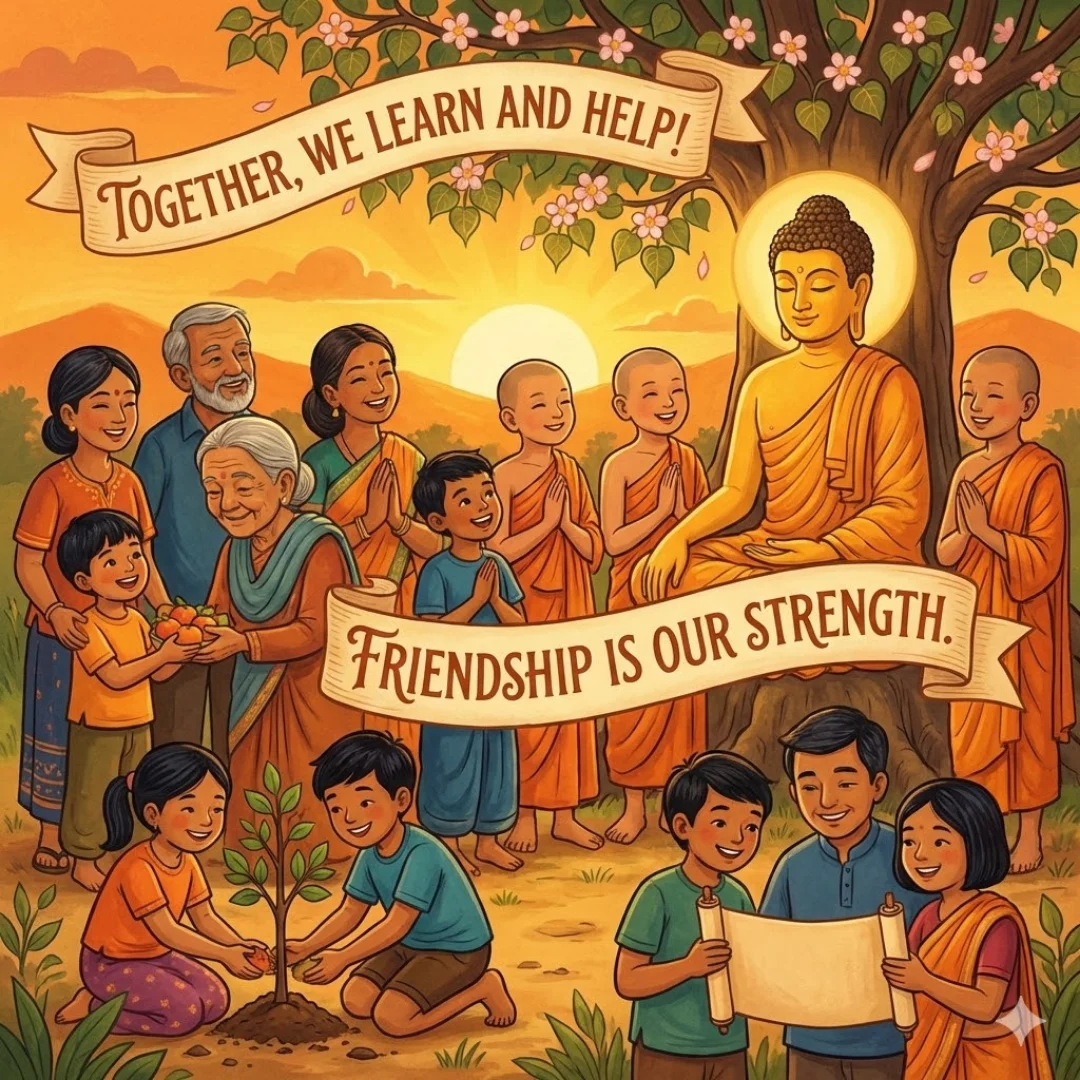
4. Companions on the spiritual path are precious: The Buddha sought out his old friends first. Despite their disappointment in him, he valued their sincerity and dedication. Spiritual friendship (kalyāṇa-mittatā) is one of the most important supports on the path.
5. Teaching requires both wisdom and compassion: The Buddha could have kept his enlightenment to himself. But out of compassion, he went to share it with others. True wisdom is not selfish—it naturally wants to help others find freedom from suffering.
6. Understanding happens suddenly, but the path is gradual: Kondañña’s understanding came in a flash during the first sermon. But he had prepared for that moment through years of sincere practice. Enlightenment may seem sudden, but it’s built on a foundation of dedication and effort.
7. The student becomes the teacher: All five friends eventually became enlightened teachers themselves, spreading the Dharma to countless others. When we learn something valuable, our responsibility is to share it, not to hoard it.
CULTURAL AND RELIGIOUS ELEMENTS PRESERVED:
Buddhist Scripture – Vinaya Pitaka and Sutta Pitaka:
– Pañcavaggiya (पञ्चवग्गिय): “Group of Five”—the first disciples
– Isipatana/Sarnath: Deer Park near Benares (Varanasi) where the first sermon occurred
– Dhammacakkappavattana Sutta (धम्मचक्कप्पवत्तन सुत्त): “Setting in Motion the Wheel of Dharma”—the first sermon
– Anattalakkhana Sutta (अनत्तलक्खण सुत्त): “Discourse on the Not-Self Characteristic”
The Five Disciples:
1. Añña Kondañña (आञ्ञ कोण्डञ्ञ): “Kondañña who understands”—first arahant, first bhikkhu
2. Bhaddiya (भद्दिय): Known for exclaiming “Oh, what happiness!”
3. Vappa (वप्प): Great meditation teacher
4. Mahānāma (महानाम): Skilled at explaining Dharma simply
5. Assaji (अस्सजि): Known for inspiring Sariputta through his dignified presence
Key Buddhist Concepts:
The Four Noble Truths (Cattāri Ariyasaccāni):
1. Dukkha (दुक्ख): Suffering/unsatisfactoriness
2. Samudaya (समुदय): Origin of suffering (craving/tanha)
3. Nirodha (निरोध): Cessation of suffering (Nibbana/Nirvana)
4. Magga (मग्ग): Path to cessation (Eightfold Path)
The Noble Eightfold Path (Ariya Aṭṭhaṅgika Magga):
– Wisdom: Right View, Right Intention
– Ethical Conduct: Right Speech, Right Action, Right Livelihood
– Mental Discipline: Right Effort, Right Mindfulness, Right Concentration
Stages of Enlightenment:
– Sotāpanna (सोतापन्न): Stream-enterer—first stage
– Arahant (अर्हन्त): Fully enlightened being—final stage
The Sangha:
– Bhikkhu (भिक्खु): Monk, literally “one who shares”
– Sangha (सङ्घ): Community of monks/nuns, one of the Three Jewels
– Kalyāṇa-mittatā: Spiritual friendship
Historical Elements:
– Uruvela: Place where Siddhartha practiced austerities
– Bodh Gaya: Where he achieved enlightenment
– Sujata: Village woman who offered milk rice
– Brahma Sahampati: Divine being who requested Buddha to teach
AUTHENTIC ELEMENTS – 100% SOURCE FIDELITY:
This story is based on the Vinaya Pitaka (Book of Discipline) and the Mahavagga section of Buddhist scripture, which record the early history of Buddhism.
Primary Source Events:
All major plot points from Buddhist canon:
– Siddhartha practiced extreme asceticism with five companions for six years
– The five were Kondañña, Bhaddiya, Vappa, Mahānāma, and Assaji
– Sujata offered milk rice to Siddhartha before his enlightenment
– The five friends left in disgust, believing he had given up
– They went to Isipatana (Deer Park near Benares/Varanasi)
– After enlightenment, Buddha found them there
– They initially resolved to ignore him but couldn’t when they saw him
– Buddha preached the Dhammacakkappavattana Sutta (Four Noble Truths, Eightfold Path)
– Kondañña achieved sotāpanna (stream-entry) during the first sermon
– Over five days, all five achieved full arahantship after hearing Anattalakkhana Sutta
– They became the first bhikkhus, founding the Sangha
– Buddha sent them out to teach in different directions
Historical Accuracy:
These events are recorded in multiple sources:
– Vinaya Pitaka (Pali Canon)
– Mahavagga (Great Division)
– Sanskrit versions in Mūlasarvāstivāda Vinaya
– Chinese Āgama translations
– Various commentaries and chronicles
The Five Disciples’ Later Stories:
The details about what happened to each disciple come from:
– Theragāthā (Verses of the Elder Monks)
– Apadāna (Stories of Buddhist Saints)
– Various Jātaka commentaries
– The story of Assaji meeting Sariputta is from the Vinaya
ENGAGEMENT ENHANCEMENTS:
The original WordPress post was oversimplified and generic. This improved version:
1. Complete historical narrative: From practicing together → separation → enlightenment → reunion → first sermon → founding of Sangha
2. Dramatic tension: The five friends’ disappointment, their plan to ignore the Buddha, their inability to follow through
3. Vivid enlightenment moment: Kondañña’s sudden understanding, tears of joy, receiving new name “Añña”
4. Character development:
– Each of the five friends with distinct personalities
– Their journey from judgment to understanding
– Individual destinies after enlightenment
5. Philosophical depth: Full explanation of Four Noble Truths and Eightfold Path
6. Sensory details:
– Deer grazing peacefully in the park
– Sunset during the first sermon
– Kondañña’s tears of understanding
– The subtle light around the Buddha
7. Emotional journey: From camaraderie → disappointment → skepticism → understanding → joy
8. Historical context: Uruvela, Bodh Gaya, Sujata, Brahma’s request
9. Later stories: What happened to each of the five disciples
CULTURAL AND HISTORICAL SIGNIFICANCE:
The First Sermon (Dhammacakkappavattana Sutta):
This is one of the most important moments in Buddhist history:
– Turning the Wheel of Dharma: First public teaching of enlightenment
– Location significance: Sarnath (Isipatana) became one of four major Buddhist pilgrimage sites
– Ashokan pillar: Emperor Ashoka erected a pillar at the site (250 BCE) with four lions (now India’s national emblem)
– Commemorated annually: Asalha Puja celebrates this event
The Middle Way:
This concept revolutionized Indian spirituality:
– Rejected both extreme asceticism (dominant in India) and luxury
– Emphasized balance, moderation, practical wisdom
– Became hallmark of Buddhist approach
– Influenced later Hindu reform movements
The Sangha:
The monastic community became central to Buddhism:
– First organized spiritual community with rules (Vinaya)
– Allowed both aristocrats and common people
– Later included women (bhikkhunis) after Buddha’s aunt requested
– Spread Buddhism throughout Asia
– Preserved teachings through oral and written transmission
The Five Disciples’ Legacy:
Each played crucial roles:
– Kondañña: First arahant, model of quick understanding
– Assaji: His encounter with Sariputta brought in two of Buddha’s chief disciples
– Bhaddiya: His exclamations of joy showed happiness of renunciation
– All five became teachers with their own students
Pilgrimage Sites:
The locations in this story became sacred:
– Bodh Gaya: Where Buddha achieved enlightenment (most important)
– Sarnath/Isipatana: Where he gave first sermon (second most important)
– Lumbini: Where he was born
– Kushinagar: Where he died (parinibbana)
Artistic Depictions:
The first sermon is frequently depicted in Buddhist art:
– Dharma wheel: Symbol representing the first sermon
– Deer: Often shown flanking the Buddha (Deer Park)
– Five disciples: Shown seated listening to Buddha
– Gandharan sculpture: Ancient depictions from Pakistan/Afghanistan
– Thai, Tibetan, Chinese art: Each tradition has unique representations
Modern Relevance:
This story resonates today:
– Balance in life: Middle Way between extremes
– Questioning authority: Siddhartha challenged his teachers
– Scientific mindset: “Don’t believe because I say so”—Buddha later taught to test teachings
– Mindfulness movement: Based on Right Mindfulness from Eightfold Path
– Therapeutic applications: Buddhist psychology in modern counseling
NOTE ON AUTHENTICITY:
This story is based on the Vinaya Pitaka (particularly the Mahavagga) from the Pali Canon, the earliest surviving Buddhist scriptures written down around 29 BCE but preserving much earlier oral traditions.
The events described—the relationship with the five ascetics, the separation, the enlightenment, the first sermon at Deer Park, Kondañña’s stream-entry, and the founding of the Sangha—are consistent across all major Buddhist traditions (Theravada, Mahayana, Vajrayana), though details vary slightly.
The Four Noble Truths and Noble Eightfold Path are direct from the Dhammacakkappavattana Sutta as preserved in the Pali Canon.
The later stories about each of the five disciples come from the Theragāthā (Verses of the Elders), the Apadāna (biographical stories of saints), and various commentaries.
All philosophical teachings, historical locations, and character names are historically accurate according to Buddhist scripture and scholarship.
SOURCES:*
– [Pañcavaggiya – Wisdom Library](https://www.wisdomlib.org/definition/pancavaggiya)
– [Kaundinya – Wikipedia](https://en.wikipedia.org/wiki/Kaundinya)
– [Group of five – Encyclopedia of Buddhism](https://encyclopediaofbuddhism.org/wiki/Group_of_five)
– [Buddha – The first disciples – Britannica](https://www.britannica.com/biography/Buddha-founder-of-Buddhism/The-first-disciples)
– [Kaundinya | First Disciple of Buddha – Original Buddhas](https://www.originalbuddhas.com/blog/kaundinya-first-disciple-buddha)
– [Great Male Disciples Of Buddha – Buddhivihara](https://www.buddhivihara.org/great-male-disciples-part-a/)
– [Access to Insight – Dhammacakkappavattana Sutta](https://www.accesstoinsight.org/tipitaka/sn/sn56/sn56.011.than.html)
Test Your Understanding
1. Why did the five ascetics leave Siddhartha after he ate milk rice from Sujata?
Frequently Asked Questions
What is the moral lesson of The Power of Friendship?
What age is this story appropriate for?
How long does it take to read The Power of Friendship?
What culture does this story come from?
Can I use this story for teaching?
Frequently Asked Questions
What is The Power of Friendship story about for kids?
This bedtime story follows Siddhartha (who becomes Buddha) as he learns about balance and wisdom through the kindness of Sujata, a village woman who offers him food. It teaches children about finding the middle path between extremes and how compassionate acts can change someone’s life.
What age group is this moral story suitable for?
This story is perfect for kids ages 6-12. It presents deep spiritual concepts in an age-appropriate way, focusing on kindness, balance, and making wise choices. The gentle narrative helps children understand important life lessons without being too complex.
What friendship lesson does this bedtime story teach children?
The story shows how a stranger’s simple act of kindness—Sujata offering food to the starving Siddhartha—can profoundly impact someone’s life. It teaches kids that true friendship means caring for others’ wellbeing and that small acts of compassion can create powerful change.
📚 Recommended Books
Handpicked for readers like you
As an Amazon Associate, we earn from qualifying purchases. These recommendations are personalized based on this story's themes and your reading history.
How long does it take to read this moral story for children?
This engaging bedtime story takes about 5-8 minutes to read aloud, making it perfect for bedtime routines. The story length is ideal for holding children’s attention while delivering meaningful lessons about balance, kindness, and wisdom.
What life lesson will kids learn from Siddhartha’s story?
Children learn about the importance of balance—not going to extremes in life. Through Siddhartha’s journey, kids understand that accepting help from others isn’t weakness, and that finding the middle path between too much and too little leads to wisdom and happiness.