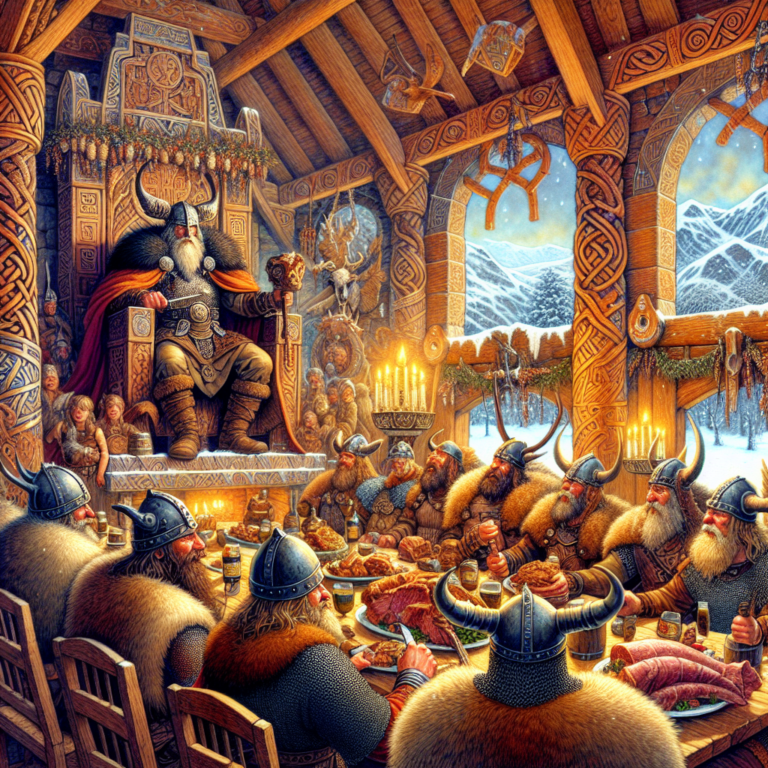
‘Thor’s Enigmatic Rune: A Tale of Patience and Perseverance’ is an educational moral story perfect for bedtime reading with children ages 6-12.
Chapter One: The Stone in the Forest
In the time when gods still walked the frozen lands of the North, when the great World Tree Yggdrasil stretched its branches across all Nine Realms, there lived the mighty Thor, son of Odin the Allfather. Thor was young then, not yet the thundering warrior of legend, but a restless boy with hair the color of sunset and a temper to match.
One morning, while the frost still glittered on the pine needles and the ravens Huginn and Muninn circled overhead on their endless quest for knowledge, young Thor wandered into a forest near Asgard. He was supposed to be practicing with his small training axe, but the woods called to him with mysteries far more interesting than another boring lesson.
Deeper and deeper he traveled, until the trees grew ancient and the sunlight filtered through in dusty golden beams. In a clearing carpeted with moss, he found something peculiar: a large stone, taller than himself, covered in strange markings.
Thor approached slowly, his heart beating faster. The stone seemed to hum with energy he could feel in his teeth. The markings carved into its surface looked like a combination of lines and angles, some straight, some crossed, some branching like the limbs of trees.
“What are you?” Thor whispered, reaching out to touch the cold surface.
The moment his fingers brushed the stone, a voice spoke in his mind. Not words exactly, but a feeling of ancient power, of secrets waiting to be understood, of riddles begging to be solved.
Excited, Thor ran home to show his father.
Chapter Two: The Wisdom of Odin
Odin Allfather sat upon his high seat Hlidskjalf, from which he could see across all Nine Realms. He had given one eye for wisdom and sacrificed himself on the World Tree for nine days and nights to learn the secrets of the runes. When Thor burst into the great hall of Valaskjalf, breathless and excited, Odin already knew what his son had found.
“Father! Father! I found a stone in the forest with strange markings! It spoke to me, I think, or maybe I imagined it, but it felt magical and I thought you might know what it means because you know everything and…”
Odin held up one weathered hand, silencing the torrent of words. A slight smile played at the corner of his mouth, half-hidden by his great gray beard.
“Sit down, my son. Catch your breath. Then show me what you found.”
Thor produced a piece of bark on which he had scratched copies of the strange markings. Odin examined them with his single eye, which seemed to hold the depth of the universe itself.
“These are runes,” Odin said. “Sacred symbols of power and meaning. I won them myself, long ago, at great cost.”
“What do they say?”
“This particular stone,” Odin replied, “is ancient even by my standards. It bears a message about wyrd, what some call fate or destiny. Would you like to learn to read it?”
Thor nodded eagerly.
Chapter Three: The Hard Path of Learning
But learning to read runes was not the quick adventure Thor had imagined. Odin explained that each rune was not simply a letter but a concept, a force, a fragment of the cosmic order. To truly understand runes, one had to understand the ideas they represented.
“This rune is called Fehu,” Odin said, drawing a shape like the letter F. “It represents wealth, but not only gold and cattle. It represents the beginning of journeys, the potential for growth, and also the danger of greed.”
Thor squinted at the simple lines. “How can one symbol mean so many things?”
“Because the universe is complex, and the runes capture that complexity. A sword can defend your family or murder an innocent. Fire can warm your hearth or burn your home. The runes teach us that nothing is simple, and wisdom lies in understanding all aspects of a thing.”
Day after day, Thor returned to study with his father. He learned Uruz, the wild ox, representing strength and health. He learned Thurisaz, the thorn, representing protection but also danger. He learned Ansuz, the god-rune, representing wisdom and communication.
But Thor grew frustrated. The runes were subtle, their meanings shifting depending on context. His warrior’s mind craved simple answers: this is good, that is bad, strike here, block there.
“I am no scholar!” Thor complained after yet another confusing lesson. “I am meant for battle, not books! Why must I learn these confusing symbols?”
Chapter Four: The Lesson of the Raven
Odin did not answer immediately. Instead, he whistled, and one of his ravens, Huginn, whose name means “Thought,” landed on his shoulder.
“Huginn,” Odin said, “tell my son what you have seen today.”
The raven cocked its head and spoke in a croaking voice that somehow conveyed images directly into Thor’s mind. “I have seen a farmer who planted wheat and prayed for sun, only to have his crop destroyed by drought. I have seen a warrior who sought glory in battle, only to die from a wound that seemed minor. I have seen a king who won every war but lost the love of his people through cruelty.”
“What does this mean?” Thor asked.
“It means,” Odin said, “that the universe does not care about our plans. We cannot control what happens to us. But we can control how we respond. The runes help us see the patterns, the possibilities, the web of connections that bind all things together. A man who can read the runes is not guaranteed victory, but he can face defeat with wisdom and dignity.”
Thor pondered this. “So the runes do not tell the future?”
“The future is not written in stone, my son, not even in runestones. Fate is like a river: it has a general direction, but there are many currents, many eddies, many paths the water might take. The runes help us see the currents, but we still must decide how to swim.”
Chapter Five: The Meaning Revealed
Weeks passed, then months. The seasons turned as they always do in Asgard, though time moves differently in the realm of gods. Thor continued his lessons, his frustration slowly transforming into fascination as the complexity of the runes revealed deeper and deeper layers of meaning.
Finally, Odin judged him ready to return to the forest stone.
They walked together through the ancient trees, father and son, the Allfather and the future god of thunder. When they reached the clearing, Thor approached the stone with new eyes.
“Read it,” Odin commanded.
Thor studied the runes, no longer seeing just scratches on rock but a message across time.
“‘The tree that bends in the storm survives,’” Thor read slowly. “‘The mountain that stands rigid crumbles. Patience is not weakness; it is strength that waits for the right moment. Perseverance is not stubbornness; it is wisdom that knows some journeys take longer than others.’”
He turned to his father. “This stone is about patience? About accepting that things take time?”
Odin nodded. “This stone was placed here by the Norns themselves, the three sisters who weave the tapestry of fate. They knew that one day, a young god with a fierce temper would find it and need its message.”
Thor looked back at the stone, then at his father. “You knew I would find this all along.”
“The runes showed me the possibility,” Odin admitted. “They could not tell me if you would have the patience to learn their meaning. That choice was yours alone.”
Chapter Six: The Gift of Understanding
As Thor grew into the mighty warrior of legend, he never forgot the lessons of the runestone. Yes, he became famous for his hammer Mjolnir and his battles against giants. Yes, his temper remained legendary, his lightning strikes terrifying to his enemies.
But those who knew him well saw the wisdom beneath the thunder. In council, Thor listened more than he spoke. In battle, he waited for the right moment to strike rather than rushing in blindly. And in times of defeat, he accepted his losses with dignity and learned from them.
Many years later, Thor placed his own runestone in a different forest, carved with a message for a future young god who might wander in and need guidance. His message read:
“The storm does not last forever. Neither does the calm. Learn to weather both with equal heart. The wise warrior is not the one who wins every battle but the one who knows which battles are worth fighting.”
And the runes hummed with power, waiting for the next young seeker to discover them.
Chapter Seven: The Eternal Message
The story of Thor and the runestone became legend among the Norse people. They told it on long winter nights when the fire crackled and the wind howled outside, reminding their children that even the mightiest gods had to learn patience.
The Vikings who sailed across the cold northern seas carried this lesson with them. When storms battered their ships, they remembered that the tree which bends survives. When voyages took longer than expected, they remembered that some journeys require perseverance. When they faced enemies who seemed unbeatable, they remembered to wait for the right moment.
And always, they carved runes on their ships, their weapons, their memorial stones, encoding messages for those who came after. For the Norse knew what young Thor learned in that forest clearing: that wisdom passed from one generation to the next is the greatest treasure of all, more valuable than gold, more lasting than fame, more powerful than any weapon.
The runes are still with us today, though few remember their original power. They appear on jewelry, in books, carved into decorations. But if you look closely, if you quiet your mind and let the symbols speak, you might hear the echo of Odin’s ancient voice, reminding you that patience and perseverance are not signs of weakness but the truest forms of strength.
Moral Lessons
- Patience and perseverance are forms of strength, not weakness. Understanding that some things take time, and that we cannot control everything that happens to us, only how we respond, is true wisdom.
Test Your Understanding
1Who is Odin in the story?
Frequently Asked Questions
What is the moral lesson of Thor’s Enigmatic Rune: A Tale of Patience and Perseverance?
What age is this story appropriate for?
How long does it take to read Thor’s Enigmatic Rune: A Tale of Patience and Perseverance?
What culture does this story come from?
Can I use this story for teaching?
Frequently Asked Questions
What is Thor’s Enigmatic Rune about?
Thor’s Enigmatic Rune is a Norse mythology-inspired moral story about young Thor discovering a mysterious rune in a forest near Asgard. The tale teaches children the values of patience and perseverance through Thor’s journey to uncover the rune’s secret. It’s written for kids ages 6-12 and works great as a bedtime story.
What age group is Thor’s Enigmatic Rune suitable for?
This story is perfect for children ages 6 to 12. It uses accessible language and an engaging adventure narrative to deliver meaningful life lessons about patience and perseverance, making it ideal for bedtime reading with young children or independent reading for older kids.
What moral lesson does the story of Thor’s Enigmatic Rune teach kids?
The story teaches children the importance of patience and perseverance. Through Thor’s experience with a mysterious rune, young readers learn that some challenges require time, focus, and determination to overcome — valuable life lessons delivered through an exciting Norse mythology adventure.
📚 Recommended Books
Handpicked for readers like you
As an Amazon Associate, we earn from qualifying purchases. These recommendations are personalized based on this story's themes and your reading history.
Is Thor portrayed as a hero in this children’s story?
In this story, Thor is shown as a young, restless boy before he became a legendary warrior. He has sunset-colored hair and a fiery temper, making him very relatable to children. The story follows his early journey toward wisdom, showing that even great heroes had to learn patience and perseverance.
Does the story include other Norse mythology characters besides Thor?
Yes, the story references several key figures from Norse mythology, including Odin the Allfather, Thor’s father, and the ravens Huginn and Muninn. The world of Yggdrasil and the Nine Realms also forms the backdrop, giving children a rich and imaginative introduction to Norse legends.