

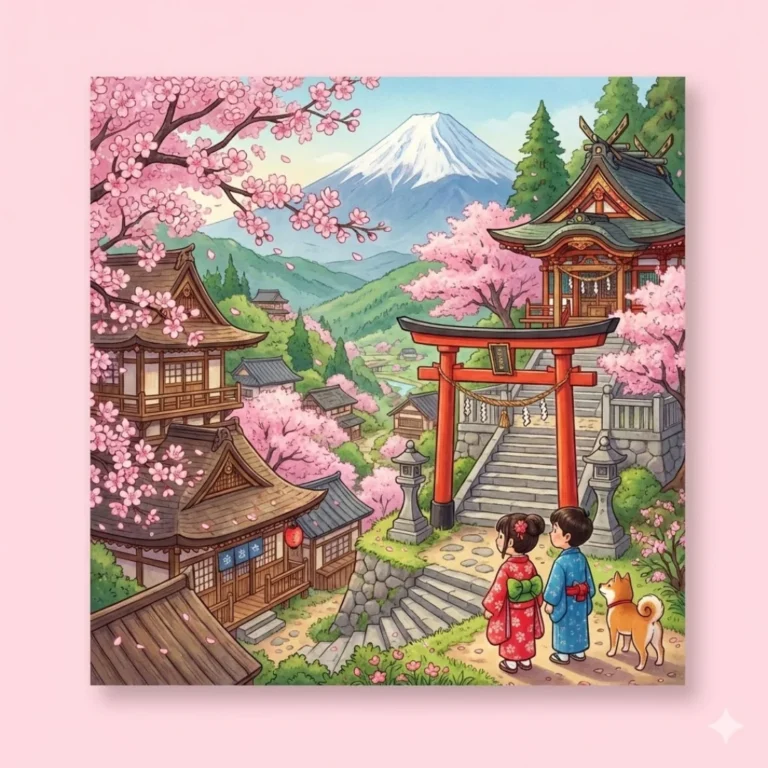
A boy born from a magical peach sets out with animal companions to defeat demons on a distant island. Through courage and compassion, he transforms enemies into friends, showing that true strength lies in understanding and kindness.
In a quiet village where the mountains touched the sky and the river sang its ancient song, an old woodcutter and his wife lived alone. Every morning, the man climbed the mountain paths to gather wood, while his wife washed clothes by the river where water flowed clear as starlight.
Their house was filled with gentle silences. They had no children, but they did not complain. The seasons turned, the cherry blossoms came and went, and they found peace in the rhythm of their days.
One afternoon, as the old woman knelt by the river scrubbing cloth, something extraordinary appeared. Floating downstream came a peach—but not an ordinary peach. It was enormous, glowing with a soft golden light, as if it carried the sun’s warmth within it.
“How strange and wonderful,” she whispered. “Perhaps this peach traveled from the far mountains, or from a tree that touches the stars themselves.”
She pulled the heavy peach from the water and carried it home, marveling at its weight and warmth.
That evening, as the old couple prepared to share the peach for dinner, it began to glow brighter. Then—crack!—the peach split open, and out stepped a baby boy, healthy and smiling, as if he had been waiting inside all along.
The old woman gasped and laughed. The old man’s eyes filled with tears. “A child,” he said softly. “After all these years, a child has come to us.”
“Not just any child,” his wife said, holding the baby close. “A child who traveled down the river from somewhere beyond. A gift from the world itself.”
They named him Momotaro, which means “Peach Boy,” and raised him with all their love.
Momotaro grew quickly, not just in size but in spirit. While other children played by the river, he would sit quietly on the mountainside, watching the clouds drift across the sky. He was gentle with small creatures and respectful to his elders, but inside him burned something bright and fierce—a sense of purpose, as if he knew he had come into the world for a reason.
By the time he was fifteen, Momotaro was stronger and braver than any young person in the village. His parents watched him grow with pride and a quiet sadness, knowing that someone with such light inside could not stay in one place forever.
One spring morning, terrible news arrived. A merchant stumbled into the village, exhausted and frightened.
“Demons!” he cried. “Oni from the island across the sea! They raid our villages, steal our treasures, and carry away our people. The whole land lives in fear!”
The villagers gathered in worried whispers. What could anyone do against demons? The oni were said to be as tall as trees, with red skin, wild hair, and clubs that could crush boulders.
But Momotaro stood quietly, listening. That night, he gazed up at the stars—those same stars that shone on Oni Island, on the frightened villages, on everything under the vast sky. And he understood.
“Mother, Father,” he said the next morning, “I must go to Oni Island and stop the demons. This is why I came into the world.”
His mother’s hands trembled as she prepared rice cakes for his journey, the finest she had ever made. His father carved him a walking stick from mountain wood.
“Come back to us,” his mother whispered.
“I will,” Momotaro promised. “When the world is right again, I’ll return.”
He set off down the mountain path, his heart steady and bright. The morning sun painted everything gold.
He had not walked far when he met a dog sitting by the roadside. The dog’s eyes were wise and sad.
“Where are you going, Momotaro?” the dog asked. (For in those days, when the world was younger, animals and humans shared the same language.)
“To Oni Island,” Momotaro replied, “to stop the demons who hurt innocent people.”
“A noble journey,” the dog said. “I too have wandered far and seen much suffering. If you share your rice cakes with me, I will join you. Every creature in this world is connected, and your fight is mine as well.”
Momotaro smiled and gave the dog a rice cake. “Welcome, friend.”
They walked together through the forest. Soon they met a monkey sitting in a tree, looking down at the world with bright, curious eyes.
“Where are you going, Momotaro?” the monkey called down.
“To Oni Island, to defeat the demons who steal and harm.”
The monkey swung down from branch to branch. “I have seen the suffering from my high perch in the trees,” he said. “The whole forest grieves. Share your rice cakes with me, and I will help you. Your courage gives me courage.”
Momotaro gave the monkey a rice cake, and now they were three.
As they crossed a wide meadow, a pheasant landed before them in a flutter of bright feathers. The bird’s eyes gleamed like jewels.
“Where are you going, Momotaro?” the pheasant asked.
“To Oni Island,” Momotaro said, “to restore peace.”
“I fly between earth and sky,” the pheasant said, “and I have heard the cries carried on the wind. Share your rice cakes with me, and I will fly with you. When one being suffers, all beings suffer. When one acts with compassion, the whole world becomes brighter.”
Momotaro gave the pheasant a rice cake, and now they were four—human, dog, monkey, and bird, united in purpose.
Together they journeyed to the sea, found a boat, and sailed across the waves. The ocean was vast and deep, but Momotaro felt no fear. He thought of his parents by the river, of the frightened villages, of all living things connected like stars in the same sky.
Oni Island rose from the sea like a dark mountain. At its peak stood a massive fortress with iron gates and walls made of stone. Skulls and bones decorated the gates—warnings to keep others away.
“This place is full of fear,” the dog growled.
“But we carry something stronger,” Momotaro said quietly. “Compassion and courage. Let us go forward.”
The pheasant flew up and over the walls, scouting the fortress. “I see them,” she called down. “The oni are having a feast, drunk on stolen wine, celebrating their wickedness!”
“Then we act now,” the monkey said, and scaled the walls with quick, clever hands. He opened the gates from inside.
The dog charged in, barking fiercely. The monkey swung through the halls, agile and fearless. The pheasant dove from above, sharp talons flashing. And Momotaro walked forward, steady as the mountains, his spirit blazing like the sun that had warmed the peach that carried him to his parents.
The oni were huge and terrible, with skin like red stone and voices like thunder. But they had grown lazy and cruel, and they did not expect this—four friends fighting as one, moving like dancers, like the wind, like water.
The biggest oni, their chief, roared and swung his iron club. But Momotaro did not flinch.
“Why do you hurt others?” Momotaro called out. “Don’t you know that every act of cruelty echoes through the world? That every theft, every harm, every moment of fear you create darkens not just others, but yourselves?”
The oni chief paused, confused. No one had ever spoken to him like this.
“We are strong,” the oni growled. “Why should we care?”
“Strength without compassion is just violence,” Momotaro said. “True strength protects. True courage serves others. Put down your weapons. Return what you’ve stolen. Promise to change. Or we will not stop.”
The dog, monkey, and pheasant stood beside Momotaro, fierce and true. And in that moment, something shifted. The oni saw themselves reflected in Momotaro’s clear eyes—saw what they had become.
One by one, the demons lowered their clubs.
“We surrender,” the chief finally said. “We will return everything. We will harm no one again. Please… teach us how to live differently.”
Momotaro’s heart filled with quiet joy. “Begin by serving those you have hurt,” he said. “Rebuild what you destroyed. Help those you frightened. Every act of kindness will transform you, little by little, like a flower opening to the sun.”
The oni brought out all the treasures they had stolen—gold, jewels, precious things taken from frightened people. But more importantly, they freed the prisoners they had captured, and they wept with shame and relief.
Momotaro, the dog, the monkey, and the pheasant loaded the treasures into their boat. But before they left, the oni chief approached.
“Thank you,” he said quietly, bowing low. “You defeated us not with hatred, but with understanding. You could have destroyed us, but you offered us a chance to change. We will remember this. We will become better.”
Momotaro bowed in return. “We are all connected,” he said. “When you heal, the whole world heals a little.”
The journey home was joyful. The ocean seemed brighter, the sky wider, as if the universe itself was celebrating. They returned the treasures to the villages, and the people wept with gratitude.
Finally, Momotaro climbed the mountain path to his parents’ house. The old woman was washing clothes by the river. The old man was coming down from the mountains. When they saw him, they dropped everything and ran.
“You came back,” his mother sobbed, holding him tight.
“You made the world right again,” his father said, his voice shaking with pride.
That night, as the four friends—Momotaro, the dog, the monkey, and the pheasant—sat together under the stars, they shared the remaining rice cakes and watched the sky.
“Look,” the pheasant said softly. “The stars are so far away, yet we see their light.”
“And we are small,” the monkey said, “yet today we changed the world.”
“Because we were together,” the dog said. “Because we cared.”
Momotaro smiled, thinking of the peach that had carried him down the river, of his parents’ love, of the oni who had chosen to change, of the vast, interconnected web of all living things.
“Everything matters,” he said quietly. “Every act of courage, every moment of compassion, every friendship—they all ripple out like waves across water, touching everything, connecting everything.”
The stars shone down on the small village, on the peaceful island, on the vast world, and on four friends who understood, at last, that they were part of something infinite and beautiful.
And in that understanding, there was peace.
Test Your Understanding
1Where did Momotaro come from?
2What did Momotaro share with the animals to gain their friendship?
3How many animal companions joined Momotaro on his quest?
4How did Momotaro defeat the oni?
5What did the oni do after they were defeated?
Frequently Asked Questions
What is the moral lesson of Momotaro: The Peach Boy?
What age is this story appropriate for?
How long does it take to read Momotaro: The Peach Boy?
What culture does this story come from?
Can I use this story for teaching?
Frequently Asked Questions
What is the story of Momotaro the Peach Boy about?
Momotaro is a classic Japanese folktale about a boy who is born from a giant magical peach found floating in a river by an old couple. He grows up to become a brave hero who sets out with animal companions — a dog, a monkey, and a pheasant — to defeat demons on a distant island and return their stolen treasure.
What is the moral lesson of Momotaro the Peach Boy?
The main lesson of Momotaro is that true strength comes from kindness, courage, and compassion rather than force alone. By treating even his enemies with understanding, Momotaro transforms foes into friends, showing children that empathy and teamwork are more powerful than aggression.
Is Momotaro a good story for young children?
Yes, Momotaro is a wonderful story for young children. It features gentle, relatable themes like friendship, bravery, and kindness, wrapped in a magical adventure. The story’s simple language and imaginative characters — including a boy born from a peach — make it engaging and easy for kids to follow.
📚 Recommended Books
Handpicked for readers like you
As an Amazon Associate, we earn from qualifying purchases. These recommendations are personalized based on this story's themes and your reading history.
Where does the Momotaro legend originally come from?
Momotaro is one of Japan’s most beloved and ancient folktales, believed to originate from the Edo period or earlier. The story has been passed down through generations as part of Japanese oral tradition and is considered a cultural icon, often among the first stories Japanese children hear.
Why does Momotaro share his dumplings with the animals in the story?
Momotaro shares his millet dumplings with the dog, monkey, and pheasant as a gesture of generosity and respect. In return, they pledge their loyalty and join his quest. This moment highlights a key theme of the story — that kindness and fairness inspire others to help you and build strong, lasting friendships.
