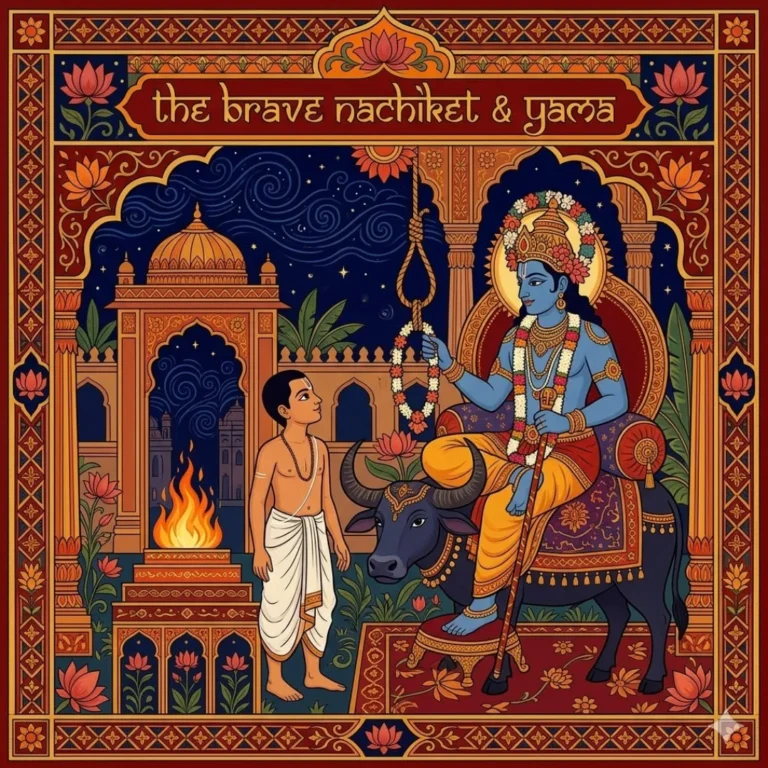
A fearless boy named Nachiketa journeys to the realm of death after his father’s angry words. There, he asks Yama, the Lord of Death, the ultimate question: what happens when we die? Through his courage and wisdom, Nachiketa learns that the true Self is eternal and cannot die.
In the days when questions still had power, and truth was more precious than gold, there lived a boy named Nachiketa whose heart was like a clear pond—reflecting everything it saw.
His father, the sage Vajasravasa, stood in the courtyard preparing for a great ceremony. All around, servants led away his possessions—cows, silver plates, embroidered cloths. The sage meant to give away everything he owned to gain spiritual merit.
But Nachiketa noticed something. The cows his father was giving away were old. Their ribs showed through their skin like the roots of ancient trees. They walked slowly, their eyes dim as fading stars.
“Father,” Nachiketa said softly, “these cows are tired and weak. How can giving away what you don’t want bring true merit? The gift that matters is the one that costs your heart.”
Vajasravasa did not answer. His mind was fixed on his ceremony, on the prayers and the rituals.
Nachiketa asked again. And again. His voice was gentle but persistent, like a stream that asks the mountain to listen.
Finally, his father’s patience broke like a dry branch. “You keep asking to whom I’ll give everything! Fine—I give YOU to Yama, the Lord of Death!”
The words hung in the air like thunder. Everyone gasped. But Nachiketa’s face remained calm as morning water.
“If you’ve given me, Father,” the boy said quietly, “then I must go where I’m given. Your word is sacred, even when spoken in anger.”
And so Nachiketa set out on the long road to the realm of death. He walked through forests where the trees grew darker and the birdsong faded. He crossed rivers that flowed backward, their waters silver as moonlight. He climbed mountains where the wind whispered secrets in languages older than human speech.
At last, he came to a great gate of shadows. This was the dwelling of Yama, the Lord of Death—the one who weighs every soul, who knows the exact measure of every life.
But Yama was not home. Perhaps he was walking the world, collecting those whose time had come. Perhaps he was in the stars, counting the grains of time.
Nachiketa sat down at the threshold to wait.
One day passed. The boy sat still as stone, watching the shadows shift across the sky.
Two days passed. He did not eat or drink, yet his eyes remained bright as the first morning.
Three days and three nights. Still, Nachiketa waited, patient as the earth that waits for rain.
When Yama finally returned, he found the boy sitting there, peaceful and unafraid. Death himself was amazed. No mortal had ever come to his realm willingly. No child had ever waited at his door with such courage.
“Forgive me, young one,” Yama said, his voice deep as ancient caves. “I have kept a guest waiting at my door—a terrible dishonor. To make amends, I grant you three wishes. Ask, and I shall answer.”
Nachiketa thought carefully, the way you think before choosing which stone to throw into a still pond.
“My first wish,” he said, “is that my father’s anger melts away like frost in sunlight. Let him welcome me home with love, not regret.”
Yama nodded. “It is granted. When you return, his heart will be soft as new grass. What is your second wish?”
Nachiketa gazed at the Lord of Death. “Teach me about the sacred fire—the ritual that builds a bridge to the heavenly realms. I wish to know the path that leads beyond sorrow.”
“A wise wish,” Yama said. “I will teach you the fire ceremony, the arrangement of stones, the proper offerings, the words that open the gates of heaven. In fact, I will name this sacred fire after you—the Nachiketa Fire—so all who use it remember the boy who dared to seek truth. Now, what is your third wish?”
This was the moment Nachiketa had been waiting for. His voice was steady, clear as a bell.
“When a person dies, some say the soul continues. Others say it vanishes like smoke. Some believe we return, others say we dissolve into nothingness. Lord of Death, you alone know the truth. What happens when we die? Where does the light inside us go?”
The shadows around Yama seemed to deepen. Even Death was silent for a long moment.
“Ask anything else, child,” Yama said finally. “Ask for a hundred years of life. Ask for kingdoms, elephants, treasures beyond counting. Ask to rule the stars themselves. But not this question. Even the gods struggle with this mystery.”
But Nachiketa shook his head gently. “What use is a long life if I don’t know what life truly is? What good are kingdoms that turn to dust? What value has gold when everything precious fades? You yourself taught me that when I waited three days without food or drink. Only truth lasts forever. Only understanding is worth carrying beyond this moment.”
A smile appeared on Yama’s face—perhaps the first true smile Death had smiled in a thousand years.
“You have passed the test, brave Nachiketa. Even when offered everything the world treasures, you chose wisdom. Very few souls—mortal or divine—have your courage. I will teach you the greatest secret.”
Yama’s voice became soft as falling leaves. “Listen carefully, for I will speak of the Self—the Atman—the eternal light within you.
“Your body is like a chariot,” Yama explained. “Your senses are the horses. Your mind is the reins. But there is a rider inside—a silent witness who watches all, who never changes, who cannot be burned by fire or dried by wind or cut by any sword.
“This rider—this Self—is not born when your body is born. It does not die when your body returns to earth. It is the same in a child as in an old sage. It is the same in a bird as in a mountain. It simply is, the way the sky simply is, regardless of what clouds pass through it.
“People fear death because they think they are the body. But the body is just clothing. You are not your clothing. You are the one who wears it for a season, then sets it down.
“When you truly know this—not just with your mind, but with your whole being—you become free. Free from fear. Free from sorrow. Free as the wind that blows where it wishes.
“The wise ones who realize this truth,” Yama continued, “see themselves in all creatures, and all creatures in themselves. How can they fear? What can harm them? They are the ocean, and the waves, and the sun that dances on the water.”
Nachiketa listened with his entire soul. Each word Yama spoke fell into his heart like seeds into good earth.
When the teaching was complete, Yama placed his hand on the boy’s head in blessing. “Go now, child. Return to your father. Live your life with this knowledge lighting your way. You have conquered death itself—not by running from it, but by understanding it.”
Nachiketa bowed deeply. Then he walked back up the long road he had traveled—through the mountains, across the silver rivers, through the darkening forests. But now, everything looked different. The same birds, the same trees, the same stones—yet all were shining with inner light.
When he reached home, his father ran to meet him, tears streaming down his face. The anger had melted completely, just as Yama had promised.
“My son!” Vajasravasa cried. “Forgive me! I spoke in foolish anger. I am so grateful you’ve returned.”
Nachiketa embraced his father. “There is nothing to forgive, Father. Your words sent me on the greatest journey. I have seen Death himself, and he has taught me that we never truly die. The light in you, in me, in all things—it cannot be extinguished.”
From that day forward, Nachiketa lived with wisdom beyond his years. He taught others about the eternal Self, about the deathless light within all beings. He showed them that courage means asking the hardest questions, and that truth is worth more than all the treasures in all the kingdoms of the world.
And sometimes, in the evening, when the sky turned the color of meditation, Nachiketa would sit quietly and remember his time with Yama. He would smile, knowing that he had nothing to fear—not from death, not from life, not from anything at all.
For he had learned the greatest secret: We are all made of light that cannot be destroyed. We are all part of the eternal song that sings through everything. And when we know this, really know it, we are free.
Test Your Understanding
1Why was Nachiketa troubled by his father’s ceremony?
2How long did Nachiketa wait at Yama’s door?
3What was Nachiketa’s first wish from Yama?
4Why did Yama try to convince Nachiketa to ask for something else instead of the truth about death?
5According to Yama, what is the Atman (the Self)?
Frequently Asked Questions
What is the moral lesson of Nachiketa and the Lord of Death?
What age is this story appropriate for?
How long does it take to read Nachiketa and the Lord of Death?
What culture does this story come from?
Can I use this story for teaching?
Frequently Asked Questions
What is the story of Nachiketa and the Lord of Death about?
The story of Nachiketa and the Lord of Death follows a brave young boy who ends up in Yama’s realm after his father speaks harsh words in anger. Nachiketa asks Yama the ultimate question about what happens after death and learns that the true Self is eternal and can never be destroyed.
Who is Nachiketa in Hindu mythology?
Nachiketa is a young boy from ancient Hindu tradition, featured in the Katha Upanishad. He is the son of the sage Vajasravasa and is celebrated for his extraordinary courage and wisdom. He boldly questions his father about a flawed ritual offering and later faces Yama, the Lord of Death, without fear.
What lesson does Nachiketa learn from Yama the Lord of Death?
Nachiketa learns that the true inner Self, known as the Atman, is eternal and cannot be killed or destroyed by death. Yama teaches him that what we think of as ‘dying’ only applies to the physical body, while the deeper Self lives on. It’s a profound lesson about the nature of life and soul.
📚 Recommended Books
Handpicked for readers like you
As an Amazon Associate, we earn from qualifying purchases. These recommendations are personalized based on this story's themes and your reading history.
Is the Nachiketa story suitable for kids?
Yes, the Nachiketa story is a wonderful tale for children. It teaches important values like honesty, courage, and the willingness to ask big questions. The story uses simple, vivid language to explore deep ideas about life and death in a way that is engaging and age-appropriate for young readers.
Why does Nachiketa go to the realm of death?
Nachiketa goes to the realm of death after questioning his father during a religious ceremony. When his father angrily declares he is giving Nachiketa to Yama, the boy takes the words seriously and journeys to Yama’s kingdom. His willingness to face death shows his remarkable fearlessness and curiosity.