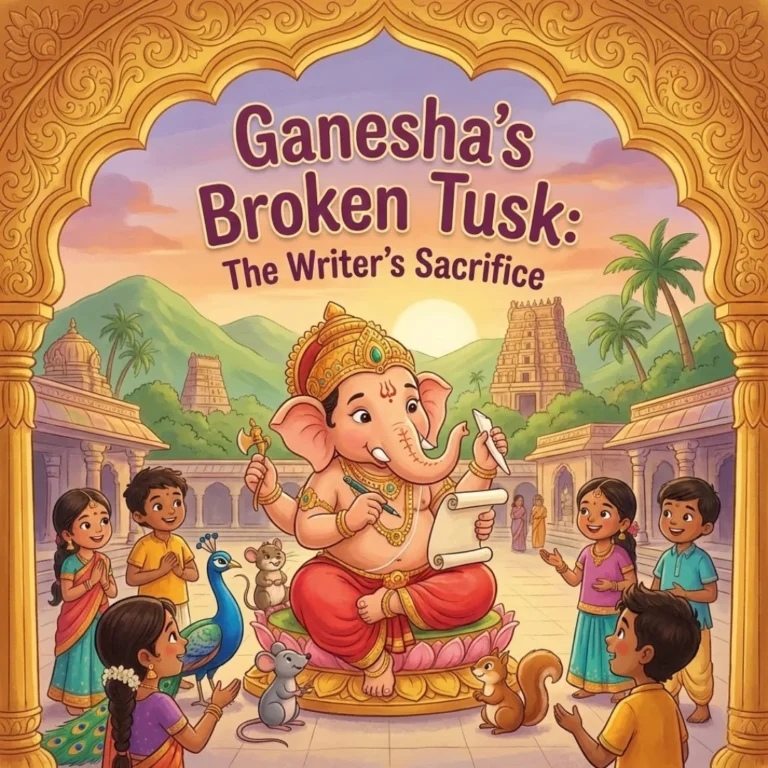
In the golden light of morning, when the world was still learning to tell its stories, the great sage Vyasa sat beneath a banyan tree with a worried heart. Inside his mind lived the greatest story ever told—the Mahabharata, a tale of heroes and kingdoms, of choices and consequences, of all the beautiful and terrible things that make us human.
But Vyasa had a problem. His story was like a river that would not stop flowing. It poured from his heart faster than his hands could write. He needed someone who could keep up with the rushing waters of his words, someone who would never tire, never pause, never let a single drop of wisdom fall to the ground and disappear.
Vyasa closed his eyes and called out to the heavens. “Who will help me give this story to the world?”
From the realm of the gods came Ganesha, the elephant-headed one, whose wisdom was as vast as the sky and whose kindness was as gentle as moonlight. He had heard many prayers before, but something in Vyasa’s voice made him understand: this was not just any story. This was truth itself, waiting to be born.
“I will write for you,” Ganesha said, settling himself on the earth, his great form casting a peaceful shadow.
But Vyasa, wise in the ways of the world, knew that even divine help needs a purpose strong enough to overcome all obstacles. He looked at Ganesha with eyes that had seen too much suffering caused by knowledge lost, by wisdom forgotten.
“I have one condition,” Vyasa said softly. “Once you begin, you must never stop. Not for rest. Not for food. Not for anything. If you pause even once, the thread of the story will break, and all will be lost.”
Some might have called this harsh. Some might have walked away. But Ganesha understood what Vyasa really meant: that some things in this world are too important to abandon halfway, that commitment isn’t just about starting—it’s about finishing, no matter what.
“I accept,” Ganesha said. “But you must promise me something in return. You must speak clearly. You must never say words so simple that they bore the soul, or so complex that they confuse the mind.”
Vyasa smiled. It was a fair bargain. And so they began.
The sage spoke, and Ganesha wrote. Words flowed like rivers, like wind, like time itself. Ganesha’s hand moved across the page with the grace of a dancer, capturing every syllable, every breath, every pause that held meaning.
Days passed. Then weeks. The pile of written pages grew taller and taller, a mountain of words that would teach generations yet unborn about courage and love, about duty and freedom, about the thousand small choices that make us who we are.
Then, in a moment that seemed to stop time itself, Ganesha’s pen snapped. The tip broke against the page, unable to continue.
Vyasa kept speaking. The words kept coming. The river could not be stopped.
For one heartbeat, two heartbeats, three—Ganesha sat perfectly still. In that moment of silence, he could have made many choices. He could have asked Vyasa to pause. He could have found another pen. He could have said that the condition was too harsh, that he needed a moment’s rest.
But Ganesha thought about all the children who would one day read these words and learn how to be brave. He thought about all the people who would find comfort in these stories when their own lives felt too heavy to bear. He thought about how wisdom, once lost, might never return.
And then, without hesitation, without drama, without asking anyone’s permission, Ganesha reached up and broke off his own tusk.
The sound was like a tree branch cracking in a storm. It must have hurt—of course it hurt. But Ganesha didn’t cry out. He simply took his tusk, dipped it in ink, and continued writing.
Vyasa’s voice never faltered, but tears rolled down his weathered cheeks. He had asked for commitment, yes. But he had never imagined such love, such dedication, such a profound understanding that some gifts to the world matter more than our own comfort.
They continued for weeks more. Ganesha wrote with his broken tusk, and every word carried something extra now—not just the story of ancient heroes, but the story of sacrifice itself, written in bone and determination.
When at last the Mahabharata was complete, when the final word was written and the final truth was told, Vyasa looked at Ganesha with infinite gratitude.
“Why?” he asked simply. “Why did you give so much?”
Ganesha touched the place where his tusk had been. It no longer hurt, but it would always remind him of this moment, this choice, this beautiful exchange of story for sacrifice.
“Because,” Ganesha said gently, “wisdom is not ours to keep. It belongs to everyone who will ever need it. And if keeping it safe means giving up something of myself, then that is not really a sacrifice at all. That is just love, taking the shape it needs to take.”
From that day forward, Ganesha was known as Ekadanta—the one with a single tusk. But those who truly understood saw it differently. They saw that he was whole in ways that went beyond the body. He was complete because he had given himself to something greater than himself.
And the Mahabharata? It lived on, teaching its lessons about dharma and choice, about the complex and beautiful struggle of being human. And in every word, in every line, there was a secret gift—the reminder that the greatest things we create often ask us to become greater ourselves.
Today, when people see images of Ganesha with his broken tusk, they remember: knowledge is precious, and those who preserve it are heroes in their own quiet way. They remember that finishing what we start, especially when it matters, is one of the most important things we can do. And they remember that love sometimes asks us to give more than we thought we could—and somehow, in the giving, we find that we have received even more.
The story lives on, as all true stories do, waiting for the next reader to discover its wisdom, waiting for the next person who needs to hear that sacrifice made with love is never truly a loss, but a transformation—of ourselves, of the world, of everything we touch.
Frequently Asked Questions
What is the moral lesson of Ganesha’s Broken Tusk: The Writer’s Sacrifice?
What age is this story appropriate for?
How long does it take to read Ganesha’s Broken Tusk: The Writer’s Sacrifice?
What culture does this story come from?
Can I use this story for teaching?
Frequently Asked Questions
Why did Ganesha break his own tusk?
Ganesha broke his tusk to use it as a writing instrument so he could transcribe the Mahabharata for the sage Vyasa without interruption. His pen had broken mid-dictation, and rather than pause and lose Vyasa’s flow of words, he sacrificed his own tusk — symbolising total dedication to preserving wisdom and knowledge.
What is the story of Ganesha’s broken tusk about?
The story of Ganesha’s broken tusk is about the sacred sacrifice required to bring great wisdom into the world. It teaches that true commitment sometimes means giving up something precious for a higher purpose. Ganesha’s willingness to break his tusk to transcribe the Mahabharata represents devotion, selflessness, and the value of preserving knowledge.
Who is the sage Vyasa and what is his connection to Ganesha?
Vyasa is the ancient Hindu sage credited with composing the Mahabharata, one of the world’s greatest epic poems. According to legend, he asked Ganesha to be his scribe because the story flowed too fast for ordinary hands to write. Together, they represent the partnership between inspired creativity and disciplined, tireless dedication.
📚 Recommended Books
Handpicked for readers like you
As an Amazon Associate, we earn from qualifying purchases. These recommendations are personalized based on this story's themes and your reading history.
What moral lesson does Ganesha’s broken tusk teach children?
Ganesha’s broken tusk teaches children that meaningful achievements often require personal sacrifice. It shows that when we are truly committed to something important, we give our best — even when it costs us. The story also encourages perseverance, quick thinking under pressure, and putting the needs of a greater good above personal comfort.
Is Ganesha’s broken tusk story suitable for kids?
Yes, the story of Ganesha’s broken tusk is wonderfully suitable for children. It uses vivid, accessible storytelling to introduce themes of sacrifice, wisdom, and dedication. The mythological setting makes it engaging and imaginative, while the moral is simple enough for young readers to understand and apply to their own lives.