

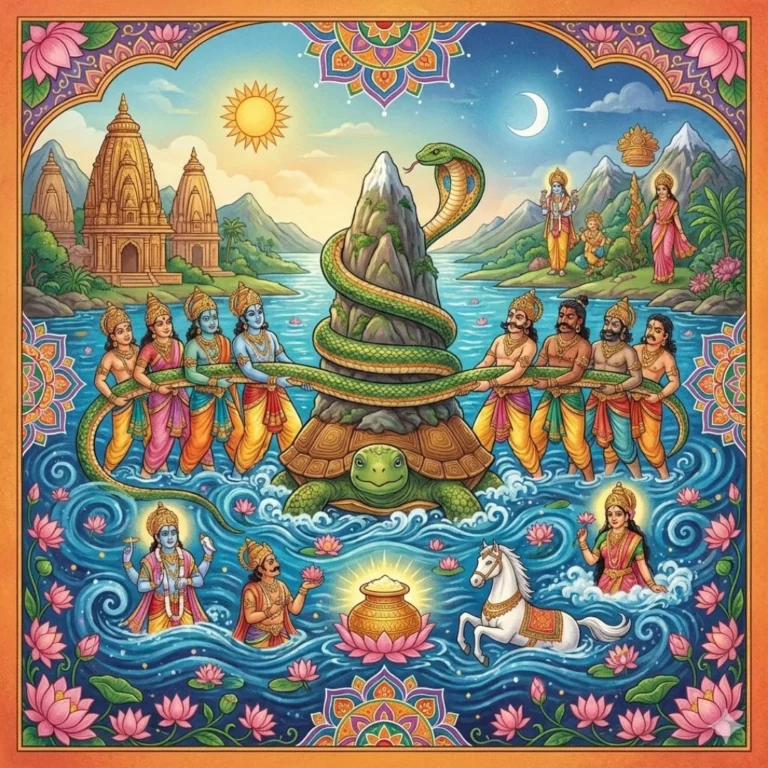
In those ancient days, the devas—gods of light and order—had grown weak. Their radiance dimmed like lamps running low on oil. They went to Lord Vishnu, the preserver of all things, who rested on the great serpent Shesha, watching the universe with eyes that held both wisdom and compassion.
“Great Lord,” they said, “we are fading. How can we restore our strength?”
Vishnu’s voice was like distant thunder rolling across summer skies. “Deep within the cosmic ocean lies amrita, the nectar of immortality. But to obtain it, you must churn the ocean as a farmer churns milk to make butter. This task is too great for you alone.”
“Then who shall help us?” asked Indra, king of the devas.
Vishnu’s answer surprised them all. “You must ask the asuras—your enemies—to help you.”
The devas gasped like wind through bamboo groves. Work with their enemies? The asuras, who brought chaos and darkness? How could such opposites ever cooperate?
But Vishnu smiled, for he understood what they could not yet see. “Great things are born when opposites meet, like rain and earth creating flowers. Without both of you working together, the ocean will never yield its treasure.”
So the devas went to the asuras, who ruled the depths and shadows. At first, the asuras laughed, their voices rumbling like rocks tumbling down mountainsides.
“Why should we help you?” demanded their king.
“Because,” said the devas, “the nectar belongs to neither of us alone. We must work together, or neither shall have it.”
The asuras considered this, stroking their dark beards. Finally, they agreed.
For their churning rod, they uprooted Mount Mandara, a mountain so tall its peak touched the clouds. For their rope, they asked the great serpent Vasuki, whose body could wrap around worlds. Vishnu himself took the form of a giant tortoise and dove beneath the waves, offering his shell as a base to hold the mountain steady.
The devas grasped one end of Vasuki, and the asuras took the other. Though enemies, they began to pull in rhythm—back and forth, back and forth—like the breathing of the earth itself.
The ocean churned and frothed. First came terrible poison that threatened to destroy all creation. Lord Shiva, in his compassion, swallowed the poison to save both gods and demons, holding it in his throat, which turned blue as midnight.
Still they churned, gods and demons together, their rhythm becoming a kind of dance. The ocean gave forth wonders: a wish-fulfilling cow, a divine elephant, a moon that would light the night sky. And finally, rising from the foam like dawn breaking over mountains, came Dhanvantari, the divine physician, holding a golden vessel filled with amrita.
Both devas and asuras reached for it, but Vishnu appeared, teaching them all a final lesson. The nectar was distributed with wisdom, and though conflict arose again, something profound had happened: enemies had worked together, and in doing so, had brought forth gifts that served the whole universe.
Sitting beneath a banyan tree that evening, a child asked her grandmother, “Why did Vishnu make enemies work together?”
The grandmother’s eyes twinkled like stars reflected in still water. “Because, little one, the ocean holds more than any one group can claim alone. When we put aside our differences and pull together toward a common good, we churn forth wonders that benefit all. Even those we call enemies may be partners we haven’t recognized yet.”
The child nodded, watching the sun set over distant waters, understanding that great things require great cooperation—even between those who seem most different.
Moral of the Story
Great achievements require cooperation, even between enemies
Frequently Asked Questions
What is the moral lesson of The Churning of the Ocean?
What age is this story appropriate for?
How long does it take to read The Churning of the Ocean?
What culture does this story come from?
Can I use this story for teaching?
Frequently Asked Questions
What is the Churning of the Ocean story about?
The Churning of the Ocean is an ancient Hindu myth about the gods (devas) and demons (asuras) working together to churn the cosmic ocean and retrieve amrita, the nectar of immortality. It explores themes of cooperation between opposites, sacrifice, and the balance between light and darkness to achieve a greater goal.
Why did the devas need to churn the ocean in the first place?
The devas had grown weak and were losing their divine power and radiance. Lord Vishnu advised them that the only way to restore their strength was to obtain amrita, the nectar of immortality, hidden deep within the cosmic ocean. The churning process was the only way to bring it to the surface.
Who helped the gods during the Churning of the Ocean?
Surprisingly, Lord Vishnu advised the devas to ask their enemies, the asuras (demons), for help. The task of churning the cosmic ocean was simply too enormous for the gods alone. This unlikely alliance between opposites — light and darkness — is one of the most fascinating aspects of the story.
📚 Recommended Books
Handpicked for readers like you
As an Amazon Associate, we earn from qualifying purchases. These recommendations are personalized based on this story's themes and your reading history.
What is amrita in Hindu mythology?
Amrita is the nectar of immortality in Hindu mythology. It is a divine substance believed to grant eternal life to whoever drinks it. In the Churning of the Ocean story, amrita is hidden deep within the cosmic ocean and can only be retrieved through the monumental effort of churning the waters.
What moral lesson does the Churning of the Ocean teach?
The story teaches that great achievements often require cooperation, even with those we consider opponents. It shows that balance between opposing forces — good and evil, order and chaos — can create something extraordinary. It also highlights the value of perseverance, trust, and looking beyond differences to achieve a shared purpose.
