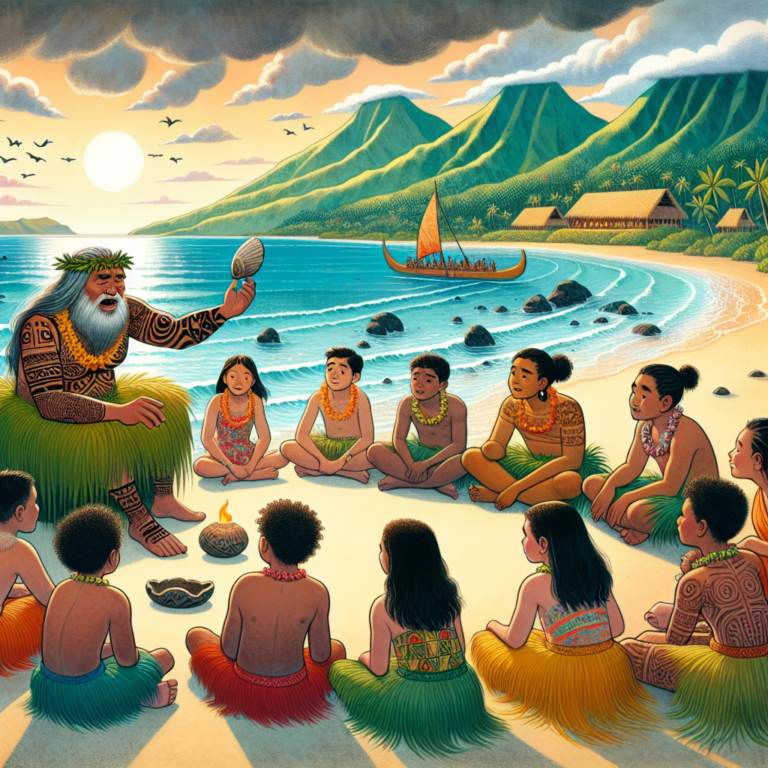
This moral story for children ages 6-12 combines entertainment with important values.
Chapter One: The Song of Beginning
Long before the islands rose from the sea, before the first star glittered in the sky, there was only Po, the primordial darkness. Po was not empty, though it held no light. It was full of potential, thick with the seeds of everything that would one day exist, like a mother heavy with child, waiting for the moment of birth.
In this ancient darkness, a sound began. Not thunder, not wind, but something more fundamental: a voice speaking words that had never been spoken, creating through the sheer power of naming. This was the Kumulipo, the Source of Deepest Darkness, the great chant that brought the universe into being.
“Born was Kumulipo in the night, born was Po’ele, the darkness,” the voice sang. “Born was the coral polyp, born was the starfish, born was the sea cucumber, born was the sea urchin.”
And with each name spoken, that creature came into existence, filling the dark waters with life.
On the island of Oahu, many generations later, an old storyteller named Kawai sat beneath a hau tree, surrounded by children from the village. Among them was a spirited girl named Leilani, whose name meant “heavenly flower,” and her younger brother Koa, named for the mighty koa tree.
“Tell us about the Kumulipo,” Leilani begged. “Tell us how everything began.”
Kawai smiled, her weathered face creasing like the bark of the tree above them. “The Kumulipo is not just a story,” she said. “It is a song, over two thousand lines long, that our ancestors memorized and passed down through generations. It tells us where we come from and reminds us that we are connected to everything.”
Chapter Two: The Sixteen Eras
Kawai began to chant softly, her voice carrying the rhythm of ancient ceremonies.
“The Kumulipo divides creation into sixteen eras,” she explained. “The first eight happened during Po, the time of darkness, when things existed but were not yet fully formed. The last eight happened during Ao, the time of light, when the world as we know it came to be.”
Koa looked up at the bright blue sky. “So the world was dark before it was light?”
“Yes, little one. In the darkness, simple things were born first: plants of the sea, then animals of the sea, then plants of the land. Each era built upon the last, like adding layers to a feather cloak. The chant names hundreds of creatures, each one essential to the world.”
Leilani closed her eyes, trying to imagine a time before light. “It must have been frightening.”
“Perhaps for some. But for the Hawaiians, Po was not a place of fear. It was a place of beginnings, of ancestors, of dreams. We believe that our kupuna, our ancestors, still dwell in Po, watching over us. When we sleep, we visit them. When we die, we return to them.”
Chapter Three: The Hero Maui
As Kawai continued her teaching, she wove in the tale of Maui, whose adventures were among the most beloved in Hawaiian tradition.
“Maui was born in one of the later eras,” Kawai said, “when gods still walked among humans. He was a kupua, a being of supernatural power, but he was also mischievous and curious, always questioning, always testing limits.”
“Like me!” Koa announced proudly.
“Indeed. Maui asked the question every child asks: ‘Why?’ Why is the sky so low? Why are the days so short? Why must there be darkness at all? But instead of simply asking, Maui acted. He raised the sky so people could stand tall. He slowed the sun so there was time for work. He even tried to conquer death itself.”
“Did he succeed?” Leilani asked.
Kawai’s expression grew thoughtful. “That story teaches a hard lesson. Maui attempted to enter the body of Hina-nui-te-po, the goddess of death, hoping to reverse death forever. But he failed and lost his own life. Even the greatest hero cannot overcome everything. Some forces are beyond even the bravest spirit.”
Chapter Four: The Meeting with Pele
“But my favorite story,” Kawai continued, “is when Maui encountered Pele, the goddess of fire and volcanoes. It teaches us about respect for forces greater than ourselves.”
The children leaned closer, for they all knew Pele. They had felt the ground shake with her anger, had seen the red glow of her fires against the night sky, had walked across land that her power had created.
“Maui was proud of his accomplishments,” Kawai narrated. “He had done things no other god or human had ever done. So when he heard that Pele commanded the greatest power of all, the fire that creates and destroys, he decided to test himself against her.”
“He traveled to her home in Kilauea, where the earth breathes smoke and rivers of stone flow like water. ‘Great Pele!’ he called out. ‘I am Maui, who has raised the sky and tamed the sun! Come forth and see what a true hero can do!’”
“That was rude,” Leilani observed.
“Very rude. And Pele was not pleased. She emerged from the volcano in her most terrifying form, wreathed in flame, her hair a cascade of fire. ‘You dare challenge me in my own domain?’ she roared. ‘I will teach you the meaning of power!’”
Chapter Five: The Dance of Fire and Courage
“The battle that followed shook the entire island,” Kawai said, her voice rising with excitement. “Pele hurled rivers of lava, and Maui dodged and weaved. She sent clouds of ash, and he called upon the winds to blow them away. She opened cracks in the earth beneath his feet, and he leaped from rock to rock with supernatural speed.”
Koa was bouncing with excitement. “Did Maui win?”
“Listen carefully. For hours they fought, neither able to defeat the other. Finally, exhausted, they both paused. And in that moment of stillness, something unexpected happened. Maui looked at Pele, truly looked, and saw not just a rival but a creator.”
“‘Your power is magnificent,’ he said, and he meant it. ‘Without your fires, there would be no islands. My people would have nowhere to live. I have been a fool to challenge you.’”
“Pele, in turn, looked at Maui and saw not just an arrogant demigod but a protector of humanity. ‘Your courage is remarkable,’ she admitted. ‘You alone have dared to face me. Perhaps we are not enemies after all.’”
“And so, instead of destroying each other, Maui and Pele reached an understanding. She would continue to create new land with her fires, and he would continue to help humans thrive upon it. They found harmony not through conquest but through mutual respect.”
Chapter Six: The Lesson of the Kumulipo
The sun was beginning to set, painting the sky in shades of orange and pink that reminded Leilani of the fires Kawai had described.
“What does this teach us?” Kawai asked the children.
Leilani thought carefully. “That we should respect things more powerful than us?”
“Yes. What else?”
Koa scrunched up his face in concentration. “That even heroes make mistakes?”
“Also true. But there is something deeper.” Kawai spread her arms wide, encompassing the ocean, the mountains, the sky. “The Kumulipo teaches us that everything is connected. The coral that was born in the first era created the reef that protects our shores. The fish that were born in the second era feed our families. The trees that were born later give us wood for canoes and shade for rest.”
She lowered her voice to nearly a whisper. “And we humans, who came near the end of the sixteen eras, have a responsibility to all that came before. We are not the rulers of nature; we are its family. Pele, Maui, the sea, the stars, even the tiny coral polyps, they are all our relatives.”
Chapter Seven: Singing the Future
As darkness settled over the island, Kawai taught the children a simple portion of the Kumulipo. Their young voices joined with hers, tentative at first, then stronger, carrying the ancient words into the warm night air.
“O ke au i kahuli wela ka honua,” they chanted. “O ke au i kahuli lole ka lani…” (At the time when the earth became hot, at the time when the heavens turned about…)
When they finished, Leilani asked one more question. “Aunty Kawai, if the Kumulipo names everything that exists, does it name us too?”
Kawai’s eyes sparkled with pride. “The Kumulipo names the generations that came before us, all the way back to the gods themselves. When you have children, and your children have children, those names will continue. The song never truly ends, Leilani. We are all still being sung into existence, every moment of every day.”
She rose to her feet, joints creaking like the branches of the hau tree. “Remember this when you are grown. The world is not yours to use however you wish. It is a gift from your ancestors, held in trust for your descendants. Treat it with aloha, with love and respect, and it will sustain your family for generations to come.”
The children walked home through the soft darkness, the words of the Kumulipo still echoing in their minds. Above them, the stars wheeled slowly across the sky, the same stars that had guided their ancestors across thousands of miles of ocean, the same stars that would guide their descendants into the future.
And somewhere in the distance, a volcano rumbled softly, as if Pele herself was humming along with the eternal song of creation.
Moral Lessons
- We are all connected to nature and to each other. Respecting the forces greater than ourselves and understanding our place in the great story of creation leads to harmony, while pride and disrespect lead to conflict.
Test Your Understanding
1Who is Maui in the story?
Frequently Asked Questions
What is the moral lesson of Maui’s Reverence: The Mighty Power of Nature’s Song?
What age is this story appropriate for?
How long does it take to read Maui’s Reverence: The Mighty Power of Nature’s Song?
What culture does this story come from?
Can I use this story for teaching?
Frequently Asked Questions
What is Maui’s Reverence: The Mighty Power of Nature’s Song about?
It’s a moral story for children ages 6-12 set in ancient Hawaiian culture. The story follows siblings Leilani and Koa as they learn about the Kumulipo, the sacred Hawaiian creation chant, through an elder storyteller named Kawai. It blends Hawaiian mythology with important values about respecting the power of nature.
What is the Kumulipo in Hawaiian culture?
The Kumulipo is an ancient Hawaiian creation chant, sometimes called the Source of Deepest Darkness. It tells how the universe came into being through the power of spoken words and naming. According to tradition, as each creature was named in the chant, it came into existence, filling the world with life.
Is the Mighty Power of Nature’s Song appropriate for young children?
Yes, the story is specifically written for children ages 6-12. It combines entertaining storytelling with meaningful moral lessons, making it both educational and engaging. The Hawaiian mythology is presented in an accessible, child-friendly way that sparks curiosity about nature and indigenous culture.
📚 Recommended Books
Handpicked for readers like you
As an Amazon Associate, we earn from qualifying purchases. These recommendations are personalized based on this story's themes and your reading history.
What values does this children’s story teach?
The story focuses on reverence for nature and the power of words, drawn from authentic Hawaiian cultural traditions. Through the characters of Leilani and Koa, young readers learn about respect, the importance of storytelling, and how indigenous cultures understood humanity’s deep connection to the natural world.
What is Po in Hawaiian mythology?
Po refers to the primordial darkness in Hawaiian mythology — the state of the universe before creation. Rather than being empty, Po was described as full of potential, holding the seeds of all life. It is from Po that the Kumulipo chant began, setting creation in motion and bringing the world into existence.