

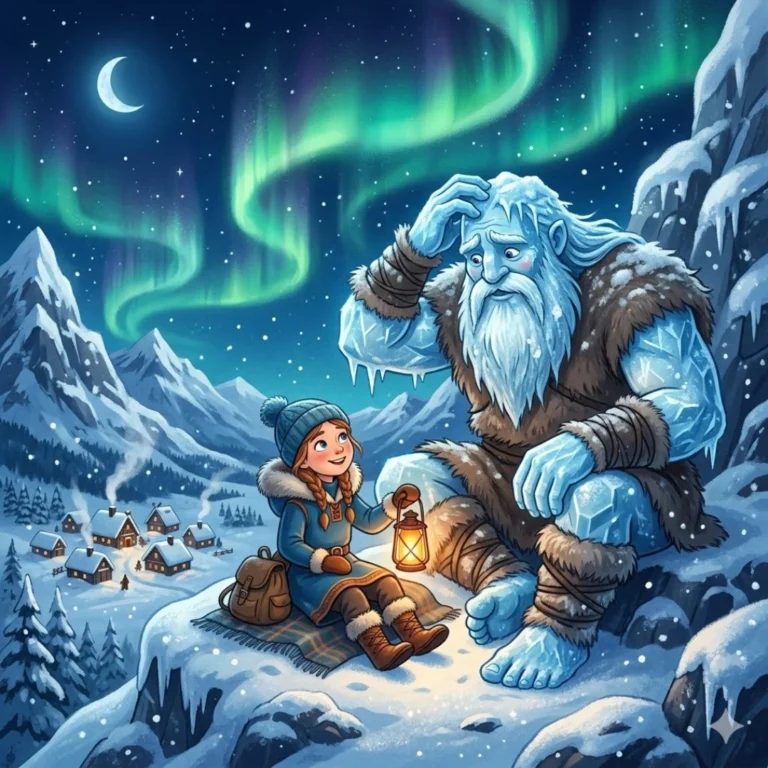
Now, this is the sort of story where a frost giant makes a mistake, which is the best kind of story to tell in winter when the wind is doing its worst outside and you are warm inside with someone you trust, which is where you should be.
The frost giant’s name was Ymir-the-Little, which was ironic because he was quite large. He was the youngest of the frost giants of Utgard and he was nine hundred years old, which for a frost giant is approximately the age at which they are still occasionally clumsy and sometimes wrong about things. He had white hair like frozen waterfalls and eyes the color of sky just before a blizzard and he generally spent his winters sitting in a mountain and thinking large, cold thoughts.
He did not have friends. Frost giants rarely do, partly because of the freezing-whatever-they-touch problem and partly because they tend to be unavailable during the winter months, which is when friendship is most necessary.
The mistake he made was this: he sneezed.
It was an enormous sneeze, as frost giant sneezes are, and it sent a blizzard howling across the valley below his mountain and buried the village of Kaupstad under two meters of snow in the middle of October, which was not kind, though it was not intentional.
In the village of Kaupstad lived a girl called Sigrid, who was eleven years old and possessed of the particular combination of stubbornness and warmth that is very common in the Norse fjords and very useful in all situations.
Sigrid’s family had the warmest house in the village. This was not because they were rich but because Sigrid’s father knew exactly how to build a fire and Sigrid’s mother knew exactly how to make a house hold heat, and these skills were passed down in their family like good knives.
When the blizzard hit, Sigrid’s house was warm and her neighbors’ house was not.
The neighbors – old Erik and his wife Astrid – had their roof partially cave in under the snow. They were old and the cold was serious and Sigrid and her family did what you do in the Norse lands when your neighbor’s roof caves in: you bring them inside and make room.
Two more families arrived in the same situation by nightfall. Sigrid’s house, which was not large, held twelve people through the storm.
On the second day, when the snow was still falling and the world had gone very white and still, Sigrid decided to go and look at the thing that had snowed on them.
Her mother said: “Absolutely not.”
Her father said: “Wait at least for the storm to ease.”
The storm eased on the third morning. Sigrid put on every piece of clothing she owned and went up the mountain.
Ymir-the-Little was sitting on his usual rock looking sorry, in the way that very large things sometimes look when they have done something too big to fully apologize for.
“Was that you?” said Sigrid.
The frost giant looked at her. She was extremely small from his perspective – a bundled child on the snow below him, face red from cold, chin set at a determined angle.
“It was a sneeze,” he said. His voice sounded like ice cracking on a lake: startling but not threatening once you got used to it.
“You buried our village.”
“I know. I’m sorry.”
Sigrid stood in the snow and looked at him for a long time. She had not expected sorry. She had expected a frost giant to be either terrifying or dismissive. Sorry was neither of those things.
“We had to fit twelve people in our house,” she said.
“Is everyone all right?”
She hadn’t expected that either. “Yes. Cold and crowded but fine.” She paused. “You’re not what I thought you’d be.”
“What did you think I’d be?”
“More frightening and less apologetic.”
Ymir-the-Little made a sound that might have been a laugh, muffled by the cold. “I am frightening. I just sneezed by accident, which is hard to be frightening about.”
“Can you do something about it? The snow?”
He thought about this. “I can pack it more solidly, so the roofs bear weight better. I can redirect the wind for the next week so no more comes. I cannot take back what I sent.”
“Those are useful things,” said Sigrid.
Ymir-the-Little packed the snow and redirected the wind. It took him most of the day and he was slightly winded at the end, which for a frost giant is remarkable.
Sigrid had stayed. She had sat on a rock and watched and occasionally said things like “that corner is still loose” and “the Eriksons’ house needs the most help, it’s the one with the collapsed section” and “you’ve missed a bit on the east side.”
Ymir-the-Little found this extremely unusual. Nobody had ever sat and watched him work and offered practical observations before. His siblings simply expected results.
“You didn’t have to stay,” he said.
“You were fixing our village,” said Sigrid. “Seemed rude to leave.”
She came back the next week. Just to see how he was, she said, which was unusual because nobody generally worried about how frost giants were, and he found he did not know what to do with it, and ended up offering her a piece of glacier ice that glowed faintly blue in the interior and tasted of ancient cold, which was his best hospitality.
She visited through the rest of the winter. She brought him news of the village – who had repaired which roof, how old Erik’s wife was recovering from the cold she’d caught, whether the fishing had started again in the harbor. He found these details, which had no relevance to frost giants whatsoever, genuinely interesting.
He told her what the sky looked like from his mountain at night, which was different from what it looked like from the valley. He told her which directions the storms came from and what they smelled like in advance, which she found practically useful and reported to the village fishermen.
In the spring, when he retreated to his mountain thinking for the warmer months, he left her a gift: a small piece of carved ice that did not melt in the hand, that felt always like the first cool air of a clear winter morning.
Sigrid kept it all her life. It outlasted every summer, which ice rarely does.
Friendship, she understood, is like that. The kind that survives the winter – that forms in the worst conditions and finds its shape in the cold – lasts longer than any other sort.
The Moral of This Story
A friend who stays in winter is worth more than a hundred who come in summer
About This Story’s Culture
Norse frost giants (Jotnar, singular Jotun) are major figures in Norse mythology, representing the primordial forces of chaos and cold that the Norse gods (Aesir) contend with. Ymir is the name of the primordial frost giant in Norse cosmology from whose body the world was made. Utgard is the realm of the giants in Norse mythology. The setting of a Norse fjord village (kaupstad means trading settlement) with communal winter survival is authentic to Viking Age Scandinavia. The cultural values of hospitality (taking in neighbors), practical community response to crisis, and gift exchange as relationship-building are all authentic Norse cultural elements. The non-melting ice gift echoes the magical gifts common in Norse saga tradition.
Key Story Elements
- Sigrid – an eleven-year-old Norse girl from the warm house who goes to confront the frost giant
- Ymir-the-Little – nine hundred years old, clumsy, genuinely sorry, not at all what Sigrid expected
- The accidental blizzard and the community response: twelve people in one warm house
- Milne’s cozy oral warmth: ‘this is the sort of story to tell in winter when you are warm inside’
- Sigrid staying to watch and offer practical observations – the first person to treat him like someone
- The winter friendship: Sigrid bringing village news, Ymir sharing storm-reading knowledge
- The piece of ice that never melts – the gift that survives all summers
Frequently Asked Questions
What is the story of Sigrid and the Frost Giant about?
Sigrid and the Frost Giant is a Norse-inspired children’s story about an unlikely friendship between a young girl and Ymir-the-Little, a clumsy nine-hundred-year-old frost giant. Built around themes of friendship and making mistakes, it’s a warm winter tale suited for kids ages 6 to 12 and takes about 8 to 10 minutes to read.
What age group is Sigrid and the Frost Giant’s Mistake written for?
The story is written for children aged 6 to 12. The language is warm and conversational, making it great for reading aloud together, though confident younger readers can enjoy it independently too.
Is the Frost Giant in this story a villain?
Not exactly. Ymir-the-Little is more clumsy and lonely than villainous. He’s the youngest frost giant of Utgard and still occasionally wrong about things — which is very relatable. The story treats his mistake as the starting point for something unexpectedly good, rather than a reason to be afraid of him.
📚 Recommended Books
Handpicked for readers like you
As an Amazon Associate, we earn from qualifying purchases. These recommendations are personalized based on this story's themes and your reading history.
What lesson does the frost giant story teach children?
The story explores friendship, kindness, and how mistakes can actually bring people — or people and frost giants — closer together. It gently shows kids that being different or getting things wrong doesn’t have to mean being alone, which makes it a lovely read for building empathy.
Is this frost giant story based on real Norse mythology?
It draws on Norse mythology for its setting and atmosphere, including frost giants from Utgard, a place mentioned in genuine Norse legends. However, Sigrid and Ymir-the-Little are original characters created in the spirit of that tradition, making the story feel mythic while being entirely new.
