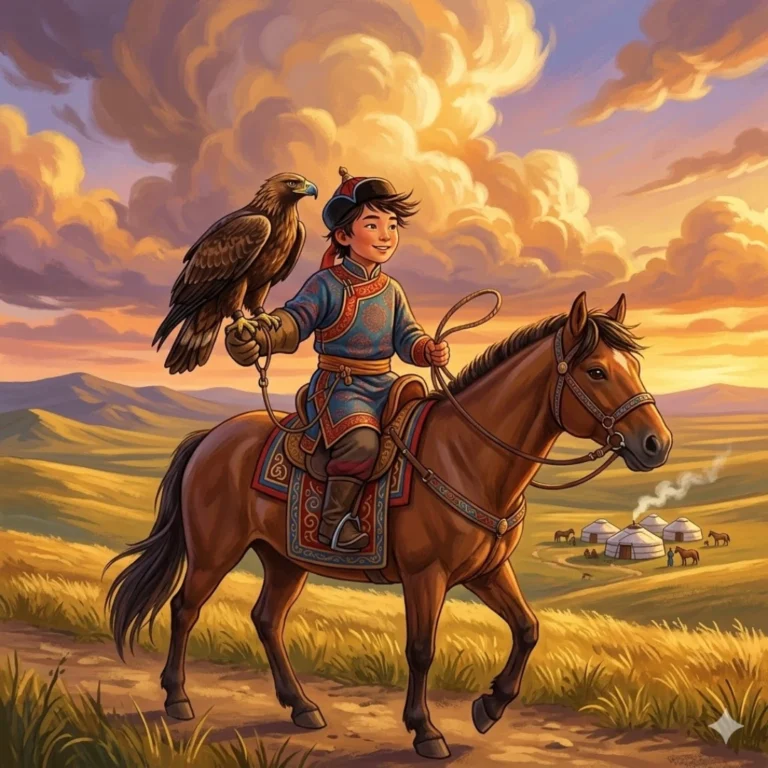
THE EAGLE’S PROMISE
The storm came without warning, as storms on the great Mongolian steppe always do.
One moment the sky was a blazing sheet of blue above the endless grasslands, and the next, black clouds boiled up from the northwest like an army charging over the horizon. Ten-year-old Bataar stood outside his family’s ger and felt the wind shift against his face — cold, fierce, and smelling of ice.
“Khurel!” he shouted, spinning toward the leather-gloved perch beside the ger’s door. “Something is coming!”
The golden eagle turned her great amber eyes toward the boy. She was magnificent — nearly a meter from beak to tail, her bronze-and-mahogany feathers ruffling now as the wind strengthened. Bataar’s father, old Darkhan, had trapped her as a chick three years ago, and since that first day she had been Bataar’s responsibility to feed and train. She was not just a hunting bird. She was his partner, his pride, and — though he would have blushed to say it aloud — his closest friend.
Khurel spread her vast wings and let out a sharp, piercing cry.
“I know,” Bataar said grimly. “I know.”
But the storm was not his only worry. His younger sister, nine-year-old Narantsetseg, had ridden out to the eastern pasture two hours ago to bring home their small herd of horses before sunset. She had not returned. And now the sky was turning the colour of a bruise, the temperature plummeting, and the first howl of the dzud — the killer blizzard of the steppe — was rising in the distance like a wolf’s moan.
Bataar did not hesitate. He ran to where his own horse, a stocky grey gelding named Thunder, stood nervously stamping by the hitching post. He pulled on his thick deel coat, the long quilted robe his mother had stitched from dark blue felt, and fastened the sash tight. He seized his riding gloves and, in one practiced motion, lifted Khurel from her perch onto his left fist.
“Bataar!” His mother appeared in the ger doorway, her face pale. “The storm —”
“Narantsetseg is still out there, Eej,” Bataar said. Mother. The word came out steady, though his heart was galloping faster than any racehorse at Naadam. “I will bring her back.”
His mother pressed her lips together. She knew, as all steppe people know, that an argument wasted precious minutes. She ducked back inside and reappeared with a small leather pouch of dried meat and a flask of airag, the tangy fermented mare’s milk that gave warmth to cold bellies.
“Tengri protect you,” she whispered, pressing her forehead briefly to his. Sky Father, watch over my son.
Bataar swung into the saddle one-handed, Khurel balanced on his raised fist, and kicked his horse into a gallop.
The steppe opened before him like a sea — immense, golden-brown, breathtakingly flat in every direction but for the distant purple smudge of the Khangai mountains. Under normal skies it was the most beautiful sight in all the world. Now it was a vast, treacherous emptiness as the storm swept in from the north, driving stinging grit before it. Bataar bent low over his horse’s mane and rode hard.
“Find her, Khurel!” he called above the rising wind.
The eagle was restless on his fist, turning her head sharply left and right. Eagles do not hunt in storms — every burkitshi, every eagle hunter, knows this. But Khurel was not merely hunting today. Bataar could feel the tension in her talons, gripping his thick glove with unusual intensity, as though she understood the stakes were far greater than a fox or a hare.
The first real gust hit them like a wall. Thunder staggered sideways, and Bataar clung on with his knees, riding the way his father had taught him — balanced, fluid, part of the horse. He squinted into the swirling dust.
“Naraa!” he bellowed. “NARANTSETSEG!”
Only the wind answered.
Khurel suddenly twisted on his fist and screamed — a high, electric cry that cut straight through the storm’s roar. She was staring southeast, every feather pressed flat by the gale, her amber eyes fixed on something Bataar could not yet see.
“What is it? Show me!” He turned Thunder southeast and gave him his head.
They found Narantsetseg a quarter-mile on. She was crouched behind a small rocky outcrop, arms wrapped around her knees, her red deel soaked and her face white with cold. Three of the family’s horses huddled around her, pressing their warm flanks against her like a living wall — the loyal animals sheltering their young mistress the only way they knew how.
“Bataar!” She scrambled upright, nearly falling. “I lost the path — the dust — I could not see —”
“You found shelter. That was smart.” Bataar swung down from the saddle and grabbed her hands. They were like ice. He stripped off one of his own gloves and forced it onto her right hand. “Can you ride?”
“Yes. Yes, I can ride.”
“Then take Thunder. I will take Shorkhoi.” He pointed to the most reliable of the loose horses, a compact bay mare who had been calm through worse than this.
Narantsetseg grabbed his arm. “What about the other horses? We cannot leave them!”
Bataar looked at the animals — two more mares and a young colt, all wide-eyed and trembling. A horse on the Mongolian steppe is never abandoned. It is food, transport, wealth, and companion. To a nomadic family, losing horses to a storm could mean disaster through the long, brutal winter.
“Khurel will help,” Bataar said. He lifted his fist and looked the eagle in the eye. She stared back with that fierce, unblinking gaze that had always made him feel she understood far more than any bird should. “Stay with them,” he said. “Guide them home.”
It was an impossible thing to ask. Eagles did not herd horses. Khurel had been trained to hunt — to spot prey from hundreds of metres in the air, to stoop at terrific speed, to grip and hold. She had never been asked to do this.
Khurel screamed once, short and sharp. Then she launched herself from his fist into the teeth of the gale.
“Bataar —” Narantsetseg started.
“Ride!” he commanded, boosting her up onto Thunder. He vaulted onto Shorkhoi, gathered the leads of the two mares, and pushed after the colt.
What followed was the longest, most desperate ride of Bataar’s life. The blizzard struck in full force. Snow and ice came near-horizontal, turning the world into a howling white blindness. He could barely see Thunder’s grey rump two metres ahead. He could not see the ger, could not see the mountains, could not see anything but churning white.
But ahead of them, swooping low even in that terrifying gale, wings beating with furious power, Khurel flew.
The golden eagle cried out every few seconds — a piercing, rhythmic call that cut through the storm like a signal fire through fog. The horses followed the sound instinctively, their hooves finding the frozen ground, their breath steaming in great white clouds. The young colt panicked once and tried to bolt sideways, and Khurel dove at it — not to strike, but to sweep low and wheel sharply, turning the colt back on course with the sweep of her enormous wings. Twice, three times, she did this, herding the frightened animal like a sheepdog made of bronze feathers and wild courage.
“Incredible,” Narantsetseg gasped, when Bataar pulled alongside her. “She’s incredible!”
“She always has been!” Bataar shouted back, and for the first time since the storm had struck, he felt something warm move through him — not just the cold blood of fear, but something fiercer. Pride. Gratitude. A feeling that had no single word but that every person on the great steppe understood in their bones.
The ger appeared out of the whiteness like a miracle — round and golden, its smoke-hole glowing, his mother’s silhouette visible at the door. She gave a great cry when she saw them and ran forward, grabbing Thunder’s bridle with both hands.
“Get inside, get inside!” she commanded.
They drove the horses into the small shelter corral and fought the gate closed against the wind. Bataar’s fingers were numb, his face stinging, his legs trembling from the hours of hard riding. But every horse was safe. Narantsetseg was safe.
He looked up. Khurel was circling overhead, a dark cross-shape against the screaming white sky, riding the vicious updrafts with impossible grace. He raised his arm.
She dropped from the sky like a bronze thunderbolt and landed on his fist — hard, urgent, her grip fierce and certain. She folded her wings and turned those burning amber eyes on his face.
“Thank you,” Bataar said quietly. The words felt too small. He pressed his forehead gently against the top of her warm, feathered head — the way a rider thanks a horse, the way a son thanks a father, the way one friend thanks another when words are not enough. “Thank you.”
Khurel made a sound he had never heard from her before. Not her hunting cry, not her alarm scream. Something softer. Something that settled into his chest like an ember.
Inside the warm ger, with the storm raging harmlessly against the thick felt walls, Bataar’s mother poured hot tea and pressed dried cheese into his hands. Narantsetseg sat wrapped in blankets, colour flooding back into her cheeks. Their father, who had come in from the other pasture just ahead of the worst of the storm, listened to the story with his eyes growing wider and then very still.
When Bataar finished, Darkhan was quiet for a long moment.
“A burkitshi and his eagle are bound by trust,” he said at last. “We train them, yes. We feed them. But an eagle is not a dog, not a horse. She obeys when she chooses. She stays when she decides to stay.” He looked at Khurel, who sat calmly on her indoor perch now, preening one great wing with her beak. “What your eagle did today — that was not training. That was a choice.”
“She knew we needed her,” Bataar said.
“Yes.” His father met his eyes. “And she came. That is the whole of it. That is everything.”
Outside, the dzud howled on through the night, battering the ger and piling snow against the walls. But inside, the fire was bright, the family was whole, and on her perch by the door, the great golden eagle sat with folded wings and quiet dignity — a friend who had made a promise without words and had kept it completely, in the most difficult hour, when it mattered most of all.
And that, the steppe will tell you, is the truest kind of loyalty there is.
The Moral of This Story
Real friends stand by each other in the most difficult times
About This Story’s Culture
This story draws on authentic Mongolian nomadic traditions, including the burkitshi eagle-hunting practice of western Mongolia, where trained golden eagles form deep bonds with their handlers over years of partnership. The dzud — a severe winter storm or freeze-thaw cycle that can devastate livestock herds — is a real and feared phenomenon on the Mongolian steppe that nomadic families have faced for centuries. Traditional elements such as the felt ger dwelling, the deel coat, airag (fermented mare’s milk), and the Tengriist invocation of sky god Tengri are woven naturally into the narrative to reflect the spiritual and material culture of Mongolia’s nomadic heritage.
Key Story Elements
- Golden eagle (Khurel) as loyal companion and hero of the rescue
- Mongolian dzud (blizzard) as the dramatic adventure challenge
- Traditional burkitshi (eagle hunting) culture authentically depicted
- Young protagonist Bataar showing courage and selflessness for his sister
- Horses as sacred and irreplaceable to nomadic family survival
- The ger (yurt) as the warm, safe home on the open steppe
- Loyalty theme expressed through action under extreme hardship
Frequently Asked Questions
What is The Eagle’s Promise story about?
The Eagle’s Promise is a Mongolian folktale-style story about a ten-year-old boy named Bataar and his golden eagle, Khurel. Set on the vast Mongolian steppe, the story explores themes of friendship, loyalty, and responsibility as a sudden storm tests the bond between the boy and his magnificent bird.
What age group is The Eagle’s Promise suitable for?
The Eagle’s Promise is written for children aged 6 to 12. With an 8 to 10 minute reading time, it works well as a bedtime story or classroom read-aloud. The themes of friendship and loyalty make it a great conversation starter for kids and parents alike.
What tradition or culture does The Eagle’s Promise come from?
The Eagle’s Promise draws from Mongolian tradition and culture. It features authentic details like a family ger, life on the Mongolian steppe, and the real practice of eagle hunting, where nomadic families raise and train golden eagles as hunting partners passed down through generations.
📚 Recommended Books
Handpicked for readers like you
As an Amazon Associate, we earn from qualifying purchases. These recommendations are personalized based on this story's themes and your reading history.
What lesson does The Eagle’s Promise teach children?
The Eagle’s Promise teaches children about the value of friendship, loyalty, and keeping your word — even when it’s difficult. Through Bataar’s relationship with his golden eagle Khurel, young readers learn that true bonds are built on trust, care, and responsibility over time.
Are golden eagles really trained by people in Mongolia?
Yes! Mongolian eagle hunters, known as berkutchi, have trained golden eagles for over 4,000 years. Eagles are typically caught as chicks and raised by their handlers. This ancient tradition is especially prominent among Kazakh communities in western Mongolia and is still practised today.