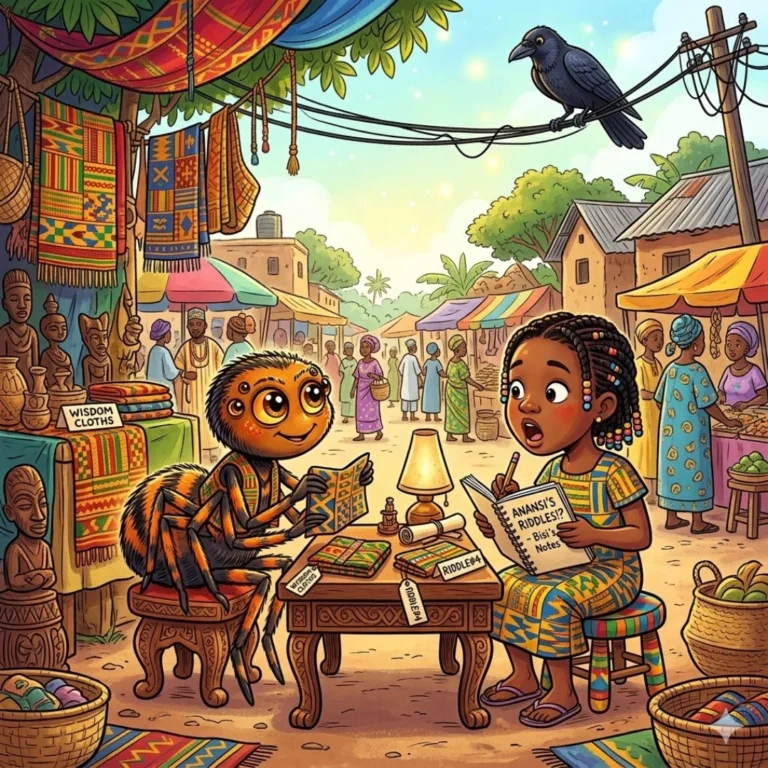
The Riddle Market opened on Tuesdays, which was either a very good day or a very bad day to sell riddles, depending entirely on what you thought Tuesdays were for.
It was not, to be clear, a market where you could buy an answer. That would have been far too simple and rather defeated the point. At the Riddle Market of Ile-Ife, you could buy a riddle, carry it home, think about it for however long was necessary, and then – if you solved it – bring the answer back the following Tuesday for inspection. If the riddlemaster agreed your answer was correct (or at least interestingly wrong in a way that suggested you had thought very hard), you received a credit for the next riddle.
This had been going on for, according to the riddlemaster himself, four hundred and seven years, which either was or was not true, depending on how you measured time.
The riddlemaster was Anansi.
Now, Anansi is a spider. You perhaps knew this already. He is the wisest and most impossible creature in all of West African story, and he has been buying and selling stories – and sometimes riddles, and sometimes the same thing – since the beginning of the world, or thereabouts. He is approximately the size of a very large mango at any given moment, though he can be smaller or larger when he needs to be, which is often. His eight eyes are the color of dark amber, and they look at you in the way of something that finds you deeply interesting, which should make you pay attention.
A girl called Abike, who was ten years old and had seven cousins and an opinion about everything, came to the Riddle Market one Tuesday because she had heard about it from the woman who sold cassava at the roadside, who had heard about it from the cassava’s previous owner, which was getting into complicated sourcing.
Abike was not looking for wisdom. She was looking, to be honest, for a way to win an argument. She and her cousin Wale had been arguing since Thursday about whether a tortoise is faster than a thought, and she felt strongly that a very good riddle might settle it decisively in her favor.
“What is the price?” she asked Anansi, who was sitting on a very small table in the way that spiders who are also riddlemasters tend to sit: with great certainty and eight alert eyes.
“The price,” said Anansi, “is the right question. Ask the wrong question and you may not have a riddle at all.”
Abike considered this. “What are the riddles about?”
“That is the wrong question. Try again.”
Abike considered harder. “What kind of person buys your riddles?”
Anansi tilted. He had a way of tilting that suggested all eight eyes were reassessing you simultaneously. “Better. But still not right. You are asking about other people. Ask about yourself.”
Abike drummed her fingers on the table. “What do I need from a riddle?”
All eight eyes went very still.
“Now that,” said Anansi, “is an excellent question. What DO you need?”
Abike opened her mouth to say: a way to win an argument. Then she closed it again. Because – and this was annoying – the question had changed something. What did she need from a riddle? Not the same as what she wanted from one.
“I want to win an argument with my cousin,” she said slowly. “But I think I actually need… to know if the argument is worth winning.”
“And is it?”
“Whether a tortoise is faster than a thought?” She thought about it. “Probably not.”
“Probably,” agreed Anansi, in the tone of someone who knows the answer and finds that knowing the answer is not the point. “In that case, here is your riddle. Free of charge, because you earned it.”
He produced – from where, exactly, it was not clear, possibly from one of his eight legs – a small piece of folded cloth. She unfolded it. Written in ink the color of midnight: I travel faster than any thought, yet cannot move. I show you the world, yet have no eyes. I am always where you look for me and never where you do not. What am I?
Abike read it three times.
“I don’t know,” she said.
“Good,” said Anansi. “Come back when you do.”
She went home and did not think about tortoises at all. She thought about the riddle.
She thought about it while she helped her mother with dinner (I travel faster than any thought: lightning? Sound? The wind?). She thought about it while she did homework (yet cannot move: a stone? A mountain? A printed page?). She thought about it while she was falling asleep (I show you the world yet have no eyes: a mirror? A window?).
A window!
She sat up. A window travels nowhere – it stays in one place. But through it you see the whole world. It has no eyes but shows you everything. And it is always where you look for it and never where you’re not looking.
She lay back down.
But a window could not travel faster than any thought.
She went back to sleep unsatisfied, which is the correct way to go to sleep when you are working on something difficult.
On Friday she had a new idea: the answer was a story. A story travels faster than any thought because it jumps from mind to mind the moment it is told. It cannot move – stories don’t have feet. It shows you the world through other people’s eyes, which are not its own eyes. And it is always where you are thinking about it and never where you aren’t.
She went back on Tuesday.
“A story,” she told Anansi.
All eight amber eyes went very still again. Then he did something she had not seen him do before: he laughed. It was a spider’s laugh, which sounded nothing like a human’s laugh and somehow exactly like one.
“How did you arrive there?”
She told him. The window. Going to sleep unsatisfied. The Friday morning logic of it.
“The window answer was not wrong,” he said. “It was incomplete. That is the most interesting kind of wrong there is.” He tilted. “Why is the story better?”
“Because a story includes the window,” said Abike. “A story can be everything the window shows you, plus everything the window can’t.”
Anansi was quiet for a moment in the specific way of someone who has heard something they expected but are still pleased to hear.
“You may have another riddle,” he said. “Or you may go home and tell your cousin about this one. That is also an option.”
Abike thought about Wale, who was stubborn and smart and would definitely argue about whether a story could travel faster than a thought.
“I’ll take another riddle,” she said.
“Good,” said Anansi. “The asking is the point. You have understood that now.”
The Riddle Market runs every Tuesday. If you want to find it, ask yourself first what you need from a riddle, not what you want.
That is already the beginning.
The Moral of This Story
Wisdom is not knowing all answers but knowing which questions to ask
About This Story’s Culture
Anansi (also Ananse or Kwaku Anansi) is the spider trickster figure at the center of Akan mythology from Ghana, who spread across West Africa and the Caribbean via the transatlantic slave trade. In Yoruba-speaking Nigeria, the spider trickster tradition has deep roots and Anansi stories are told across all of West Africa. Ile-Ife is considered the sacred ancestral city of the Yoruba people, the place where the Yoruba believe civilization originated. The Yoruba philosophical tradition of Ifa divination, practiced by babalawo priests, uses riddles, proverbs, and poetic verses called odu as vehicles for wisdom transmission. The name Abike is an authentic Yoruba female name meaning ‘born to be cherished.’ Wale is a common Yoruba male name (short form of various longer names).
Key Story Elements
- Abike – a ten-year-old Yoruba girl who comes for an argument-winning tool and finds something bigger
- Anansi the spider riddlemaster – eight amber eyes, four hundred years of riddles, Carroll-style impossible logic
- The Riddle Market of Ile-Ife that runs on Tuesdays – a whimsical institution with serious purpose
- The right question vs the wrong question: Anansi’s pricing system that teaches asking
- The riddle itself: what travels faster than thought but cannot move (a story)
- The window answer – incomplete but not wrong – the most interesting kind of wrong
- Abike choosing another riddle over resolution: the asking is now understood as the point
Frequently Asked Questions
What is Anansi’s Riddle Market about?
Anansi’s Riddle Market is a wisdom-themed children’s story set in Ile-Ife, where the trickster spider Anansi runs a magical market selling riddles — not answers. Readers follow characters who must solve their purchased riddles and return the following Tuesday with their best answer. It’s a fun, thought-provoking tale for kids aged 6 to 12.
Who is Anansi in this story?
Anansi is a spider from West African and Yoruba storytelling tradition, famous for being the wisest and most cunning creature in folklore. In this story, he serves as the riddlemaster of a magical Tuesday market, challenging visitors with riddles that test their thinking and creativity.
What age group is Anansi’s Riddle Market suitable for?
The story is recommended for children aged 6 to 12. It takes around 8 to 10 minutes to read aloud, making it a great bedtime story or classroom read. The language is playful and accessible while still stretching young readers’ thinking with clever riddles and wisdom themes.
📚 Recommended Books
Handpicked for readers like you
As an Amazon Associate, we earn from qualifying purchases. These recommendations are personalized based on this story's themes and your reading history.
What tradition or culture does this story come from?
The story is rooted in the Yoruba tradition of West Africa. Anansi himself is a beloved figure across West African and Caribbean folklore. The setting references Ile-Ife, a city of deep cultural significance in Yoruba history, giving the story a rich and authentic cultural grounding.
What lesson or theme does Anansi’s Riddle Market teach children?
The central theme is wisdom — specifically that thinking hard and creatively matters more than finding quick, easy answers. The market rewards effort and original thinking, even when an answer is ‘interestingly wrong.’ It encourages children to value curiosity, persistence, and the joy of working through difficult problems.