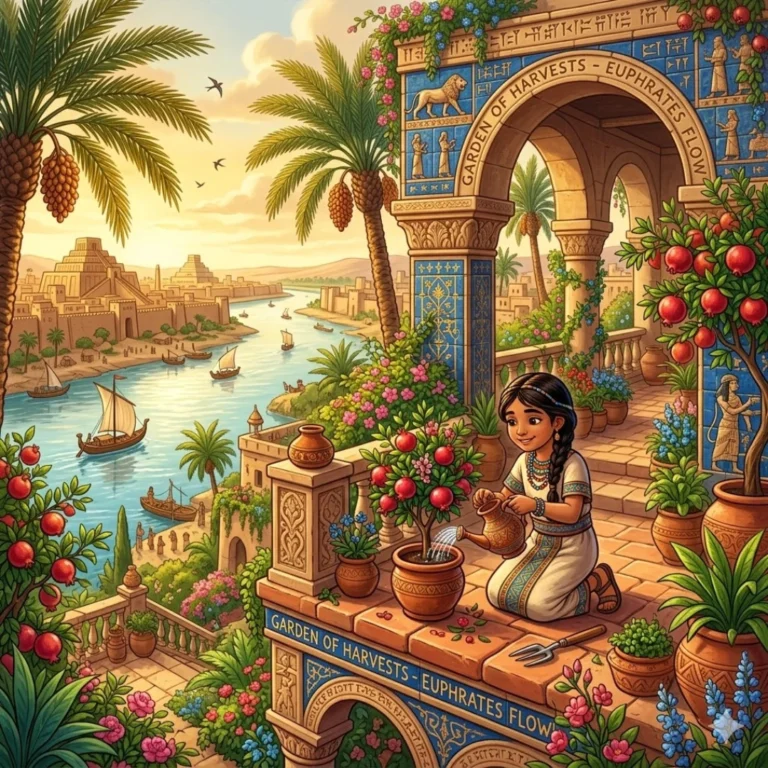
The morning Ninsun turned ten years old, she decided that nothing in all of Nippur was good enough.
She sat at the edge of the great irrigation canal her grandfather had helped dig, dangling her bare feet above the water. The canal was wide and slow, carrying the Euphrates River’s breath all the way from the distant mountains to the barley fields below. Its surface caught the early sun in little diamonds of light that winked and scattered like scattered lapis lazuli beads. But Ninsun did not notice the diamonds. She was busy frowning.
“The festival bread was too dry,” she said to no one in particular. “And the date wine was too sweet. And my new robe has only one blue thread in the hem, not two.”
A small brown sparrow landed beside her on the clay bank. It tilted its head at her.
“What are you looking at?” Ninsun muttered.
The sparrow said nothing, as sparrows do, and hopped away.
Ninsun had lived all her life in the shadow of the great ziggurat of Nippur, whose four terraced steps rose so high they seemed to brush the belly of the sky. Her father was a scribe who pressed cuneiform signs into wet clay tablets, recording the grain tithes owed to the temple. Her mother wove linen on a great wooden loom, making cloth so fine it shimmered like water when the lamplight touched it. They were not rich in gold, but they were rich in the way that mattered in the river lands — they had a canal that held water, fields that grew barley, a date palm whose fruit was sweet in summer and sweeter dried in winter, and a house with three rooms and a small courtyard where a pomegranate tree dropped its red flowers every spring.
Ninsun did not think of any of this as a gift. She thought of it only as what was.
That afternoon, restless and bored, she wandered further along the canal bank than she had ever gone before, past the place where the reed cutters worked, past the place where the washerwomen spread their linen on the warm clay, past a stand of tall papyrus that swayed like slow dancers in the river wind. She was looking for something she could not name — something better than what she had.
The papyrus gave way to a break in the reeds she had never noticed, and through it she caught a glimpse of green so deep and layered it stopped her feet.
She pushed through.
The garden on the other side was unlike anything she had seen in Nippur’s narrow streets or even in the temple precincts at the top of the ziggurat. It was enclosed by mud-brick walls so old they had softened at the corners, and every surface was draped in climbing vines thick with violet flowers. Inside, the air was cooler by ten degrees, holding the smell of wet soil and cedar resin and something sweeter she could not name. Date palms rose in a circle at the center, their fronds interlaced high above to form a living roof. Beneath them, rose bushes bloomed in colors she had not known roses could be — deep red, pale gold, the exact soft pink of the inside of a shell. Pomegranates hung low and heavy. Figs split their skins with sweetness. A small channel of water ran along the wall, feeding everything, murmuring to itself.
And sitting cross-legged on a low cedar bench at the garden’s heart was an old woman.
She was small and brown as river clay, with white hair coiled on top of her head held by a pin of real lapis lazuli, blue as the midday sky over the Euphrates. She wore a robe the color of new grass, and in her lap sat a clay bowl in which she was mixing something that smelled of honey and crushed herbs.
“You took longer than I expected,” the old woman said, without looking up. “I have been waiting since sunrise.”
Ninsun stopped. Her heart beat hard. “Waiting — for me?”
“For a child who needed to see this garden, yes.” The old woman looked up then, and her eyes were the same dark amber as the resin that dripped from cedar trees. “Come and sit. I do not bite, and the bench is wide enough for two.”
Ninsun sat, because something in the garden made her feel she was supposed to, the way you feel when you step inside the temple and the incense fills your nose and the tall darkness makes you quiet.
“Whose garden is this?” Ninsun asked. “I have never seen it before.”
“It has always been here,” the old woman said. “Not everyone who passes finds the door. Only those who are looking, even if they do not know what they are looking for.” She reached down and lifted a single rose — the pale gold one — and held it out. “Tell me what you smell.”
Ninsun took the rose and breathed in. It smelled the way the river smelled after rain, but also the way her mother’s hair smelled on festival mornings, and also something entirely itself that she had no words for. “I don’t know how to describe it,” she said.
“That is a good answer,” the old woman said, pleased. “The ones who say it smells simply like a rose have stopped paying attention. Look at it now. Tell me what you see.”
Ninsun looked. The petals were not one color but layered — palest ivory at the center deepening to gold at the edges, with veins so faint they were like writing pressed too lightly into clay. A tiny drop of dew still sat in the innermost fold, and when she tilted the bloom, it rolled but did not fall.
“It is like a cup that holds the morning in it,” Ninsun said, surprising herself.
The old woman smiled. It changed her whole face. “Now you are seeing. Ishtar, the Lady of Heaven, planted the first garden when the world was young. She said: I will make the earth beautiful so that my children will know they are loved. Every flower, every fruit, every reed that sings in the river wind — all of it is her letter to you, written fresh each day.”
“I never thought about it that way,” Ninsun said slowly. “I thought things just — grew. Because they do.”
“And why do they grow?” the old woman asked. “The seed knows nothing. The water does not care. And yet — here is the pomegranate.” She reached up and cupped a heavy red fruit in one hand without pulling it from the branch. “Here is the fig. Here is the date palm that gives you sweetness in every season, even when the barley field sleeps under the summer heat. Did you do anything to deserve these?”
Ninsun was quiet. She thought about the festival bread she had called too dry, the date wine too sweet. She thought about the robe with only one blue thread.
“No,” she said finally. “I didn’t.”
“Then they are a gift,” the old woman said simply. “Every gift that is not named is forgotten. Every gift that is forgotten might as well not exist, even if it is sitting right in front of you.” She let go of the pomegranate and looked at Ninsun steadily. “You walked past your canal this morning without seeing the sun in it. You ate bread without tasting it. You dressed in cloth your mother wove with her own hands and did not think of her hands at all.”
Ninsun felt something shift in her chest, like a clay jar being slowly righted. “How did you know about this morning?”
The old woman only smiled and did not answer. She pressed the clay bowl of herbs into Ninsun’s hands instead. “Smell this.”
Ninsun breathed in — cedar and river mint and something warm like the ground after summer rain. It was the smell of home, she realized. The smell of Nippur. The smell of her own life.
“I want to show you something,” the old woman said, rising. She moved to the garden wall and pressed her palm flat against the old mud brick. The vines parted as if they were curtains. Beyond the wall, through an opening that had not been there a moment before, Ninsun could see — not the canal bank she had come from, but a broader view, as if she stood suddenly on top of the ziggurat itself.
She saw Nippur spread below in the amber late-afternoon light. She saw the canals running like silver threads stitching the brown fields together. She saw the barley, green and stirring in the wind. She saw the date palms in their rows. She saw the cooking fires beginning to glow in the courtyards as families gathered for the evening meal. She saw her own house — the three rooms, the small courtyard, the pomegranate tree that even now was dropping its first red flowers of the year.
She saw her mother on the rooftop, watching the same sunset, one hand shading her eyes.
“She is looking for you,” the old woman said softly. “She has been looking for an hour.”
Ninsun’s throat tightened. “I should go home.”
“Yes. But take something with you.” The old woman plucked a single gold rose from the nearest bush and tucked it behind Ninsun’s ear with gentle, careful fingers. “Not the flower — that will fade by morning. Take the way of seeing. Look at your canal tomorrow as if you have never seen water before. Eat your bread as if you have never tasted grain. Touch your mother’s weaving and think of the hands that made it. The gratitude does not have to be spoken aloud every time, little one. Sometimes it is enough to simply — notice. To let the gift land.”
“Who are you?” Ninsun asked.
But the old woman was already turning back into the garden, and the vines were falling closed behind her, and the gap in the reed bed through which Ninsun had come was right there, wide and clear, leading back to the canal bank and the early evening and the smell of her mother’s cooking drifting on the river wind.
Ninsun ran. Not because she was afraid but because she was suddenly, fiercely glad to be going home.
Her mother found her at the canal’s edge, washing her dusty feet in the water. The last light was low and golden on the Euphrates, and the water held it like a bowl holds honey.
“Where were you?” her mother asked, and her voice had worry in it and also relief.
“I found a garden,” Ninsun said. “An old woman showed me things.”
Her mother looked at her daughter’s face, which was different in some way she could not quite name. Then she noticed the flower tucked behind Ninsun’s ear — pale gold, already losing its petals to the evening breeze, but still fragrant. She had never seen a rose that color anywhere near Nippur.
“Come and eat,” she said at last, and held out her hand.
Ninsun took it. And as they walked back to their house with its three rooms and its pomegranate tree, Ninsun noticed the weight of her mother’s hand, warm and real and particular as a clay tablet pressed with a single name. She noticed the smell of the barley bread and the cool evening air carrying the sound of the canal’s steady murmur. She noticed the first star appearing above the ziggurat’s top step, hard and bright as a chip of lapis lazuli set in the darkening sky.
She noticed.
And in the noticing, every ordinary thing became, for a moment, astonishing.
That night, before she slept, Ninsun pressed her palm to the mud-brick wall of her room and said, very quietly, to no one and to everything: “Thank you.”
Somewhere, perhaps, a garden heard her.
And in the morning, the canal was full of diamonds again.
The Moral of This Story
Count your blessings and be thankful for what you have
About This Story’s Culture
This story is set in the ancient city of Nippur, one of the most important religious and cultural centers of Mesopotamia (in modern-day Iraq), home to the great ziggurat temple complex. Ishtar, the Mesopotamian goddess of love, beauty, and fertility, was worshipped throughout ancient Sumer and Babylon and was closely associated with gardens, flowers, and the abundance of the earth. Authentic details woven throughout include the Euphrates River irrigation canals, cuneiform tablet-writing as a profession, lapis lazuli as a treasured blue gemstone, date palms as a staple food source, and the distinctive mud-brick architecture of Mesopotamian homes and temples.
Key Story Elements
- Ancient Nippur city setting with authentic ziggurat temple and irrigation canals
- Ishtar (Mesopotamian goddess of love and beauty) as the spiritual presence behind the magical garden
- Lapis lazuli, cedar wood, date palms, pomegranates, and figs as authentic Mesopotamian cultural details
- Young protagonist Ninsun who takes her blessings for granted
- A magical enclosed garden with a wise elder figure who teaches through gentle observation and questions
- The transformative moment of seeing Nippur from above and recognizing the beauty of her own life
- Gratitude emerging naturally through wonder and noticing
Frequently Asked Questions
What is The Garden of Ishtar’s Gift about?
The Garden of Ishtar’s Gift is a Mesopotamian-inspired children’s story about a girl named Ninsun who learns gratitude and appreciation. Set in ancient Nippur near the Euphrates River, it follows her journey from dissatisfaction to thankfulness, making it a meaningful read for kids aged 6 to 12.
What age group is The Garden of Ishtar’s Gift suitable for?
This story is written for children aged 6 to 12, with an estimated reading time of 8 to 10 minutes. The language is accessible and engaging for younger readers, while the moral themes of gratitude and appreciation offer enough depth to spark thoughtful conversations with older kids too.
What moral lesson does The Garden of Ishtar’s Gift teach children?
The central theme is gratitude and appreciation. The story gently shows children how focusing only on what’s wrong — like Ninsun complaining about dry bread or her robe — means missing the beauty around you. It encourages kids to pause, notice, and feel thankful for everyday blessings.
📚 Recommended Books
Handpicked for readers like you
As an Amazon Associate, we earn from qualifying purchases. These recommendations are personalized based on this story's themes and your reading history.
Is this story based on real Mesopotamian mythology?
Yes, The Garden of Ishtar’s Gift draws on Mesopotamian tradition, referencing real historical details like the city of Nippur, the Euphrates River, and the ziggurat. Ishtar is an authentic Mesopotamian goddess, making this story a great way to introduce children to ancient cultures through engaging storytelling.
What does Ishtar represent in this children’s story?
In Mesopotamian mythology, Ishtar is a powerful goddess associated with love, nature, and abundance. In this story, her gift likely symbolises the natural world’s generosity. She serves as a divine guide helping young Ninsun discover gratitude by opening her eyes to the wonders she has been taking for granted.