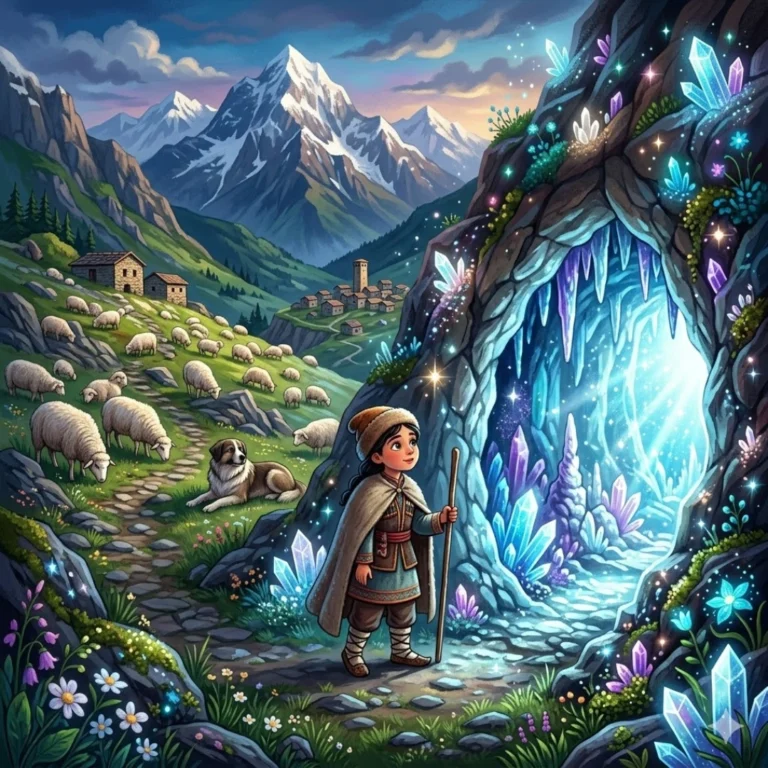
High in the Caucasus Mountains, where the peaks wear clouds like woolly hats and the rivers sing in three-part harmony all by themselves, there lived a shepherd boy named Giorgi who had a flock of forty sheep, a wooden flute, and a most peculiar habit: he could not tell a lie.
Not a small one. Not a large one. Not even the comfortable, cottony sort that people tell when the truth feels too sharp at the edges. Every time Giorgi tried, his tongue would tie itself into a knot so tight that no false words could squeeze past it. His grandmother said it was a blessing. The older boys in the village said it made him boring at games. Giorgi himself had not quite decided.
One morning in early autumn, when the mountain air tasted of pine needles and distant snow, Giorgi led his sheep up a path he had never taken before. The path was narrow and wound between enormous boulders that leaned together overhead like old men sharing a secret. His sheep walked in a tidy line, their bells making a music that echoed in the strange, hollow way that sounds do when something unusual is about to happen.
That was when he saw the cave.
It was not a dark cave, which was the first surprise. It glittered. Every surface of it sparkled with crystals — not the pale, milky sort that sometimes turn up in riverbeds, but crystals of every colour imaginable: rose and gold and deep violet and a particular shade of blue that Giorgi had no word for, being the exact colour of honesty itself, if honesty had a colour. The entrance was shaped rather like a door, though no carpenter had cut it. It simply was a door-shape, and it stood open, and from inside came a warm light and a faint sound, very much like Georgian polyphonic singing — the mravaljhamier, the many-voiced harmony — except there seemed to be no singers.
Giorgi’s sheep stopped walking and looked at him.
“I know,” he said to them. “I see it too.”
He left the sheep on the grassy slope — they were sensible sheep and rarely wandered — and walked toward the glittering entrance. Just as his foot crossed the threshold, something happened. The crystals nearest to him chimed, a single clear note, like a bell finding its voice for the first time.
“Who enters?” said a voice.
It came from everywhere and nowhere, the way mountain echoes do. Giorgi looked around and saw, sitting on a ledge of rose-coloured crystal, a creature about the size of a large cat but shaped rather like a small person, with eyes that were entirely golden and a beard made of woven light.
“My name is Giorgi,” said the boy. “I am a shepherd. I followed a path I had not tried before, and I found this cave, and I came in because I was curious. That is the whole truth of it.”
The golden-eyed creature tilted its head. Its beard-of-light swayed.
“Most who find this place say they came seeking treasure,” it remarked. “Or that they were sent by a great king. Or that they have journeyed forty days and forty nights and barely survived.”
“I have been walking since breakfast,” Giorgi said honestly. “It has been perhaps two hours. I had bread and cheese and a handful of walnuts. I am not a great king’s messenger. I did not know this cave existed before I saw it. I am sorry if that is disappointing.”
The creature laughed. It was a high, bright sound, like sunlight striking crystal. “Disappointing! Oh, quite the opposite. Come in properly, then. Most cannot cross the threshold at all. The crystals know, you see. They ring for truth and they go dark for lies, and in four hundred years only eleven people have been allowed inside.”
Giorgi stepped further into the cave and understood at once what the creature meant. The crystals nearest to him blazed with colour, as if greeting him. They hummed with a soft, many-voiced harmony — that was where the singing came from, he realised. The cave itself was singing.
“What is this place?” Giorgi asked, turning slowly to take it all in. The ceiling rose high above him, shaped in arches that no human architect could have managed, and every surface breathed with shifting light.
“It is the Cave of Spoken Truth,” the creature said, floating down from its ledge to hover at Giorgi’s eye level. “Once, long ago, when Amiran was young and the mountains were still learning their heights, a great Dev — a giant with a heart the size of a thunder-cloud and a temper to match — tried to hide something here. Something valuable. He covered the walls with crystals to conceal it, and the crystals, being made of old mountain-magic, absorbed every truth and every lie spoken near them for centuries. Now they can tell the difference at once. They ring for truth. They go dark for lies. And whatever treasure the Dev hid…”
The creature paused dramatically.
“…is still here. No one has found it, because no one honest enough to enter has ever known where to look. And everyone who knew where to look was not honest enough to enter.”
Giorgi considered this puzzle. It had the feeling of a riddle that wanted to be solved.
“Where should I look?” he said.
“Ah,” said the creature, its golden eyes gleaming. “That is the question. I will give you three questions you may ask me, and I will answer each one truthfully. Choose carefully.”
Now, another sort of boy might have asked at once: “Where is the treasure?” But Giorgi had a thoughtful nature, the kind that comes from long days alone on mountainsides with sheep for company and the wind for conversation.
“First question,” he said slowly. “Is the treasure something that would help only me, or something that could help many people?”
The creature blinked its golden eyes, surprised. “Many people. An entire village, in fact. That is why the Dev hid it — he did not want humans to have it.”
“Second question,” said Giorgi. “If I find it, will I have to keep it secret?”
“No. It only works if it is shared. That is rather the point of it.”
Giorgi nodded. He looked around the cave, at the crystals ringing softly with their many-voiced song. He thought about his village — about old Tamar, the tamada at every supra feast, who always said that the best toast was the one that thanked the guest, because a guest was a gift from God. He thought about the polyphonic singing on feast days, the way the three voice-parts wove together into something none of them could make alone. He thought about the qvevri jars buried in the earth to make wine, the way the best things needed patience and darkness and time before they came into their full goodness.
“Third question,” he said at last. “What must I do to find it?”
The creature smiled, and its beard-of-light shone very brightly. “Tell the truth about what you most want. Not what you think you should want. Not what sounds noble. What you actually, truly want.”
Giorgi was quiet for a moment. He could feel the crystals listening, their facets angled toward him like small bright ears.
“What I most want,” he said, and his voice was so steady and honest that three crystals near him burst into brilliant rose-gold light, “is for my grandmother to stop worrying about whether there is enough food this winter. She tries to hide it, but I see her counting the stores. I want there to be enough. For everyone in the village, not just us. I want nobody to be hungry when it gets cold.”
For a long moment the cave was silent.
Then the singing grew louder — a full, rich, three-part harmony that filled every corner and set the crystals chiming all at once. And in the very centre of the cave floor, which Giorgi had taken for solid rock, a seam of light appeared. It widened into a crack. The crack opened like a door — like the entrance to the cave, shaped by no carpenter but perfectly fitted for its purpose.
Inside was a spring.
Not a spring of water, though it looked like one. It was a spring of something gold and slow-moving, and where it touched the air it became grain — golden wheat and dark barley and small red pomegranate seeds — forming and falling and collecting in great heaps that glittered in the crystal light.
“The Dev’s hoard,” the creature said softly, landing on Giorgi’s shoulder, its weight no more than a snowflake. “Grain that never runs out. Enough for a village, as long as the village shares it. That was the condition the mountains put on it long ago. Share it, and it multiplies. Hoard it, and it vanishes overnight.”
Giorgi stared at the impossible spring for a very long time.
“I will need a cart,” he said at last. “And I should explain to the village elders where it comes from. All of it. The whole truth. They will think I have gone strange in the head, probably.”
“Probably,” agreed the creature cheerfully.
“But I will tell them anyway.”
“Yes,” said the creature. “That is why you were allowed in.”
Giorgi fetched a cart, and he told the village elders everything — the winding path, the glittering entrance, the golden-eyed creature, the three questions, and his answer to the last one. Some of them did think he had gone strange. Old Tamar, the tamada, listened with her eyes half-closed, the way she did when she was thinking hard, and then she stood and lifted her cup.
“A toast,” she announced, in the voice she used at every supra feast, the voice that meant everyone must listen. “To our Giorgi, who wanted enough for everyone before he wanted anything for himself. And who told the truth when a comfortable lie would have been so much easier to explain.”
That winter, and every winter after, the village had enough. The spring in the Crystal Cave flowed as long as the grain was shared, which it was, freely and gladly, because the elders had heard Giorgi’s true account and believed it, and belief — like honesty — has a way of multiplying the good things it touches.
Giorgi went back to the cave sometimes, on early autumn mornings when the mountain air tasted of pine needles and distant snow. The crystals always chimed when he crossed the threshold. The creature with the beard-of-light was always somewhere on its rose-coloured ledge.
“You could ask for something for yourself, you know,” it said once. “You have more than earned it.”
“I know,” said Giorgi. He sat down on a crystal ledge and took out his wooden flute. “But there is enough. That was all I wanted.”
He played, and the cave sang along in three-part harmony, and the crystals rang with a clear and steady light, and outside on the grassy slope his forty sheep grazed in the afternoon sun, their bells keeping perfect time.
And that, as any tamada worth his cup will tell you, is the best kind of story to toast: the one where the honest person finds that the truth was the key all along, and the door it opened was better than anything a lie could have unlocked.
The Moral of This Story
Honesty builds trust and opens doors that lies keep forever shut
About This Story’s Culture
This story draws on several authentic Georgian cultural traditions: the Dev figures from Georgian mythology (giant demon-beings who oppose humanity), the Amiran legend (Georgia’s Prometheus-like chained hero), and the supra feast tradition with its tamada (toastmaster) who delivers ceremonial toasts at communal gatherings. The UNESCO-listed Georgian polyphonic singing tradition (mravaljhamier, meaning ‘many-voiced’) is integrated into the cave’s magic, reflecting how deeply music is woven into Georgian identity. The grain-spring that multiplies only when shared echoes Georgia’s ancient agricultural heritage and the communal values of a culture where ‘the guest is a gift from God’ is a living proverb.
Key Story Elements
- Crystal cave that glows for truth and goes dark for lies
- Georgian Caucasus mountain setting with mist, peaks, and pine forests
- Whimsical creature with a beard of woven light as the cave guardian
- Three questions mechanic drawing on Georgian and folk tale tradition
- Supra feast tradition and tamada (toastmaster) as community pillars
- Polyphonic singing (mravaljhamier) woven into the cave magic
- Dev (Georgian mythological giant-demon) as the ancient villain who hid the treasure
Frequently Asked Questions
What is The Crystal Cave and the Honest Shepherd about?
It’s a Georgian folktale about a shepherd boy named Giorgi who is physically unable to tell a lie. When he discovers a mysterious crystal cave high in the Caucasus Mountains, his honesty is tested in unexpected ways. The story explores how telling the truth, even when it’s difficult, can lead to wonderful rewards.
What age group is The Crystal Cave and the Honest Shepherd suitable for?
This story is written for children aged 6 to 12. It takes around 8 to 10 minutes to read aloud, making it a great bedtime story or classroom read. The language is warm and playful, so younger children enjoy hearing it read to them while older kids can tackle it independently.
What is the main lesson or moral of this honesty story for kids?
The story teaches children that honesty is a strength, not a weakness. Even when the truth feels uncomfortable or earns you mockery, staying truthful builds trust and can open doors that lies never could. It gently shows kids that integrity has its own kind of magic.
📚 Recommended Books
Handpicked for readers like you
As an Amazon Associate, we earn from qualifying purchases. These recommendations are personalized based on this story's themes and your reading history.
Where does the story of the honest shepherd come from?
The story is rooted in the Georgian storytelling tradition from the Caucasus region. Georgia has a rich heritage of mountain folktales featuring brave, virtuous young heroes. This story draws on that tradition, blending vivid Caucasus landscapes with timeless moral themes familiar across many cultures.
Why can’t Giorgi the shepherd boy tell a lie?
In the story, whenever Giorgi tries to say something untrue, his tongue literally ties itself in a knot and no false words can come out. His grandmother calls it a blessing, while village boys think it makes him dull. Giorgi himself isn’t sure yet — but the crystal cave will help him find out.