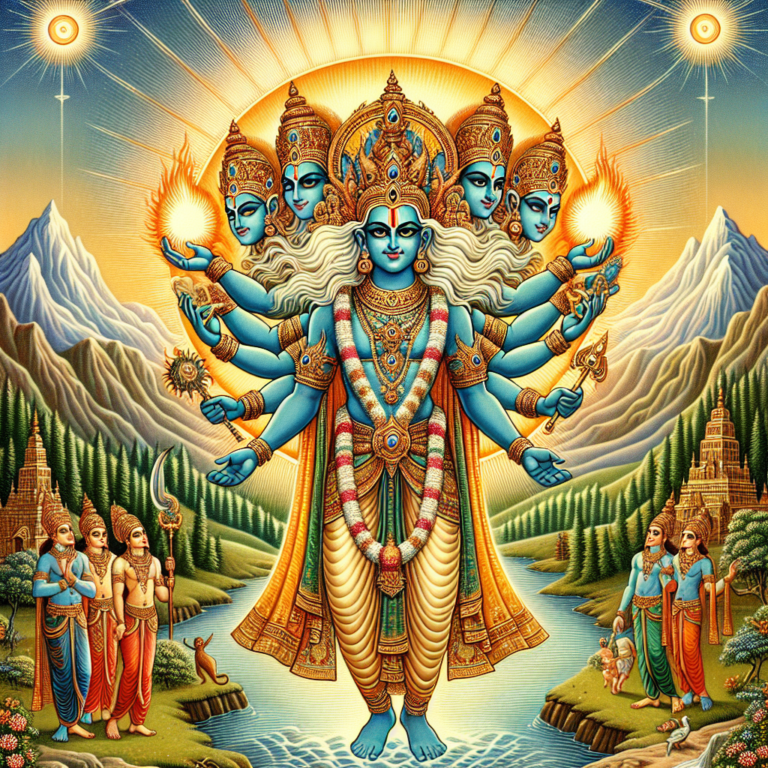
This bedtime story for kids, ‘Surya Deva’s Radiant Journey to Righteousness and Love’, teaches children ages 6-12 about important moral values.
High above the world, in a chariot of blazing gold pulled by seven celestial horses, rides Surya Deva, the Sun God.
Every morning, he begins his journey across the sky. His chariot is driven by Aruna, the god of dawn, who has the body of a man but no legs—for his story, too, is a tale of ancient mystery. The seven horses, each a different color of the rainbow, pull the chariot from east to west, bringing light and warmth to every corner of the world.
Surya’s light does not merely illuminate—it gives life. Plants turn their faces toward him, drinking his energy. Farmers time their planting by his journey. Scholars mark the hours by his position. Even the gods themselves honor him, for without his light, all of creation would fall into cold darkness.
But Surya is more than just the physical sun. He is the symbol of truth, for just as his light reveals all things hidden in shadow, truth reveals all things hidden by lies. He is the symbol of duty, for just as he rises every morning without fail, we too must fulfill our responsibilities without excuses.
In ancient India, great dynasties traced their lineage back to Surya Deva. They called themselves the Surya Vamsha—the Solar Dynasty—and their stories fill the pages of the Hindu Puranas.
Among all the stories of devotion in Hindu tradition, few are as moving as the tale of young Dhruva.
Dhruva was a prince, the son of King Uttanapada. But his father had two wives, and Dhruva’s stepmother, Suruchi, was jealous and cruel. She wanted only her own son to inherit the throne.
One day, when Dhruva was only five years old, he tried to climb onto his father’s lap. But Suruchi stopped him.
“Get away!” she said harshly. “Only my son may sit on the king’s lap. If you want to sit there, you should have been born to me instead. Go pray to Lord Vishnu to be born as my son in your next life!”
The little boy looked to his father for help, but Uttanapada was too weak to stand up to his wife. He said nothing.
Heartbroken, Dhruva ran to his own mother, Suniti. “Mother,” he cried, “why does my stepmother hate me? Why won’t father protect me?”
Suniti held her son close. “My dear child, Suruchi spoke cruelly, but perhaps there is wisdom hidden in her words. Lord Vishnu is the protector of all beings. If you truly seek happiness and security, perhaps you should seek him.”
Now, Suniti did not expect her five-year-old son to actually go off and seek the Lord. But Dhruva was not an ordinary child.
Without telling anyone, Dhruva left the palace and walked into the forest.
For a five-year-old, the forest was a frightening place. Wild animals roared in the darkness. Strange sounds echoed through the trees. But Dhruva was determined. He would find Lord Vishnu and ask him for a place so high that no one could ever look down on him again.
As he walked, he met the sage Narada, a divine musician who traveled between the heavenly and earthly realms.
“Where are you going, little one?” Narada asked kindly.
“I am going to find Lord Vishnu,” Dhruva said firmly.
Narada smiled, but there was sadness in his eyes. “Child, the path to Vishnu is not easy. Sages spend lifetimes in meditation and still do not see him. You are only a boy. Why not go home to your mother?”
“I cannot,” Dhruva said. “I have been treated unjustly, and I will not rest until I find the Lord and receive his blessing.”
Narada saw the fire of determination in the boy’s eyes—a fire that could not be extinguished by warnings or obstacles. So instead of discouraging him further, the sage taught Dhruva a sacred mantra: “Om Namo Bhagavate Vasudevaya”—”I bow to Lord Vasudeva (Vishnu), the Supreme Being.”
“Repeat this mantra with all your heart,” Narada said, “and the Lord will surely appear to you.”
Dhruva sat beneath a tree and began to meditate.
At first, he meditated for one month, eating only fruits and berries every few days. Then he meditated for another month, eating only dry leaves and water. Then for another month, drinking only air. His tiny body grew thin, but his spirit grew stronger.
The other beings of the forest watched in amazement. Even the gods in heaven became aware of the extraordinary child whose meditation was so powerful that the cosmic order itself began to shake.
“Who is this?” they asked. “What kind of child can generate such spiritual power?”
At first, the gods sent obstacles to test him. Demons appeared in terrifying forms, trying to scare him away. Wild animals approached, growling and threatening. But Dhruva sat unmoved, his mind fixed on Lord Vishnu.
Then, after months of the most intense meditation, Lord Vishnu himself appeared before the boy.
The god was magnificent—four-armed, holding a conch shell, a discus, a mace, and a lotus flower. His skin was the color of rain clouds, and his eyes were filled with infinite compassion.
“Dhruva,” Vishnu said gently, “I know why you came. You sought power and position because you were hurt by your stepmother’s words. But look at what you have achieved. Your devotion has moved even me. Ask for any boon, and I will grant it.”
Dhruva looked up at the Lord, and tears streamed down his face.
“Lord,” he said, “when I began this journey, my heart was full of anger and jealousy. I wanted to be higher than everyone else. I wanted revenge against those who hurt me.
“But now, after months of meditation, after feeling your presence in my heart, those desires seem so small. I came looking for broken glass, and you have offered me a diamond. What could I possibly ask for that would be greater than having seen you?”
Vishnu smiled, for this was the answer he had hoped for.
“Dhruva, you began with impure motives, but through devotion, you have purified yourself. This is the power of bhakti—loving devotion. It transforms the seeker even as the seeker seeks.
“I will give you something greater than any kingdom on earth. I will place you in the heavens as an eternal star—the Pole Star, around which all other stars revolve. You will be the fixed point in the sky, the guide for travelers and sailors, unchanging and unwavering. For millions of years, you will shine, and your devotion will inspire countless souls.”
And so it was. Dhruva returned home briefly to rule righteously, but eventually he ascended to the heavens, becoming the star we call Polaris or the Pole Star. Even today, it remains fixed in the northern sky while all other stars seem to circle around it.
The sage continued telling stories of the Solar Dynasty to those who would listen.
“You see,” he explained, “all these tales teach us about Dharma—righteous living. But what is Dharma? It is not just a set of rules. It is a way of being.”
He gave examples:
“Dharma for a student is to learn with humility and respect the teacher. Dharma for a teacher is to give knowledge freely and honestly. Dharma for a parent is to protect and guide their children. Dharma for a king is to rule with justice and care for all subjects.
“Dharma is doing your duty, whatever that duty may be, with full dedication and without selfish attachment to the results.”
One young listener raised his hand. “But how do we know what our Dharma is?”
The sage nodded approvingly. “A good question. Look at who you are, where you are, and what needs to be done. Are you a brother? Then support your siblings. Are you a student? Then study diligently. Are you a friend? Then be loyal and kind.
“Your Dharma is not always dramatic. Sometimes it is simply doing small things well. The farmer who grows food for others fulfills Dharma. The doctor who heals fulfills Dharma. The mother who raises good children fulfills Dharma.
“The great heroes of the Solar Dynasty—they did not seek glory. They simply did what was right, whatever the cost.”
“And what of Karma?” another listener asked.
“Karma,” the sage said, “is the law of action and consequence. Every action we take creates a ripple that eventually returns to us. Good actions bring good results. Harmful actions bring suffering.
“But karma is not punishment. It is education. When we suffer the consequences of our choices, we learn. When we enjoy the fruits of our good deeds, we are encouraged to continue on the right path.
“The stories of the Puranas show karma at work. The king who rules with justice enjoys prosperity and peace. The tyrant who oppresses his people faces rebellion and defeat. Not as revenge, but as the natural consequence of their choices.”
He paused and looked at the setting sun.
“Surya Deva rises every morning because that is his Dharma. He does not ask for thanks or reward. He simply does his duty. And because he fulfills his Dharma perfectly, the world continues to exist.
“This is what we learn from the Sun God and his descendants: do your duty, live righteously, and trust that the universe will unfold as it should.”
As the sun set and the first stars appeared, including the Pole Star, the sage offered a final teaching.
“Surya Deva is more than a god in the sky. He is a symbol of the divine light within each of us. Just as the sun illuminates the outer world, there is an inner sun—the atman, the soul—that can illuminate our inner world.
“When we live according to Dharma, when we understand Karma, when we cultivate devotion like young Dhruva, that inner light grows brighter. We become like the stars—sources of light for others.
“The Solar Dynasty produced great kings and sages. But the true message of their lineage is this: we all carry divine light within us. We all have the potential to shine.”
The listeners looked up at the night sky, where countless stars glittered—the Imperishable Ones, as the ancients called them.
And in the north, steady and unmoving, Dhruva’s star shone on, a reminder that even a five-year-old child, armed only with determination and devotion, could achieve the eternal.
These ancient Hindu tales teach several important lessons.
*First, our motives can be transformed through spiritual practice. Dhruva began with a desire for revenge and power, but through devotion, he discovered something far greater. This teaches us that it is never too late to purify our intentions.
Second, determination and devotion can move even the gods. A five-year-old boy achieved what sages could not, simply because his commitment was absolute. This reminds us that age and circumstances matter less than the strength of our resolve.
Third, Dharma is about fulfilling our duties with dedication. The sun rises every day without expecting thanks. We too can live in such a way—doing what is right simply because it is right.
Fourth, Karma teaches through consequence, not punishment. Our actions shape our futures. By choosing good actions, we create good futures for ourselves and others.
This retelling faithfully preserves authentic Hindu beliefs and stories:
The Puranas are ancient Hindu texts containing cosmology, genealogies, and legends. The story of Dhruva comes primarily from the Vishnu Purana and Bhagavata Purana, among the most important of these texts.
Surya (the Sun God) is one of the oldest deities in Hindu tradition, mentioned in the earliest Vedic texts. The Surya Vamsha (Solar Dynasty) includes legendary kings like Rama, hero of the Ramayana.
These are fundamental concepts in Hindu philosophy. Dharma is righteous living according to one’s duties and cosmic order. Karma is the law that actions have consequences that return to the actor.
The story of Dhruva exemplifies bhakti—loving devotion to God as a path to liberation. This became one of the most popular forms of Hindu spirituality.
– Surya Deva: The Sun God in Hindu tradition, representing truth, light, and the source of life
– Surya Vamsha: The Solar Dynasty, lineage of kings descended from the Sun God
– Dharma: Righteous living, cosmic order, moral duty according to one’s role and nature
– Karma: The law of action and consequence; the idea that our deeds shape our futures
– Bhakti: Loving devotion to God as a spiritual path
– Dhruva: The devoted boy who became the Pole Star through his meditation and devotion to Vishnu
– Vishnu: One of the principal deities in Hinduism, the preserver and protector of the universe
– Purana: Ancient Hindu texts containing myths, legends, and religious teachings
– Atman: The individual soul or self, which is ultimately one with the divine
1. Dhruva started with anger and a desire for revenge, but ended with spiritual peace. Have you ever had negative feelings that changed into something better over time? (Emotional growth, transformation)
2. The sage says Dharma is different for different people depending on their role. What might your Dharma be right now as a student, a sibling, or a friend? (Personal duty, ethics)
3. Karma means our actions have consequences. How might remembering this change how we treat others? (Responsibility, cause and effect)
4. Why do you think Dhruva, a five-year-old child, could do what even great sages could not? (Determination, sincerity, purity of heart)
5. The Pole Star remains fixed while other stars seem to move. What things in your life are fixed and unchanging, even when other things change? (Values, constants, stability)
– Vishnu Purana – One of the eighteen major Puranas of Hindu tradition
– Bhagavata Purana – Major Purana focusing on Vishnu and his avatars
– Dimmitt, Cornelia, and J.A.B. van Buitenen, “Classical Hindu Mythology”
– Academic resources on Hindu dharma and karma concepts
This story preserves the tales of the Solar Dynasty from the Hindu Puranas, introducing children to the concepts of Dharma (righteous living), Karma (action and consequence), and Bhakti (devotion), while sharing the inspiring story of young Dhruva, who through determination and devotion became an eternal star.*
Test Your Understanding
1Who was Priya Vrata?
Frequently Asked Questions
What is the moral lesson of Surya Deva’s Radiant Journey to Righteousness and Love?
What age is this story appropriate for?
How long does it take to read Surya Deva’s Radiant Journey to Righteousness and Love?
What culture does this story come from?
Can I use this story for teaching?
Frequently Asked Questions
What is the story of Surya Deva’s radiant journey about?
Surya Deva’s radiant journey is a bedtime story for kids ages 6-12 that follows the Sun God as he travels across the sky in his golden chariot. The story teaches important moral values like truth, duty, righteousness, and love through the adventures and lessons of the Hindu solar deity.
What moral values does Surya Deva’s story teach children?
Surya Deva’s story teaches children about righteousness, truth, duty, and love. Just as the Sun God rises every morning without fail, kids learn the importance of fulfilling responsibilities. His light symbolises how truth reveals what is hidden, encouraging honesty and integrity in everyday life.
Who is Surya Deva and why is he important in Hindu mythology?
Surya Deva is the Hindu Sun God who rides a blazing golden chariot pulled by seven rainbow-coloured horses across the sky each day. He is considered vital to all creation, giving life to plants, guiding farmers, and symbolising truth and duty. Even other gods honour him for his essential role.
📚 Recommended Books
Handpicked for readers like you
As an Amazon Associate, we earn from qualifying purchases. These recommendations are personalized based on this story's themes and your reading history.
Is Surya Deva’s radiant journey suitable as a bedtime story for young kids?
Yes, this story is specifically written as a bedtime story for children aged 6 to 12. It uses gentle, imaginative storytelling to introduce kids to ancient mythology while weaving in meaningful life lessons about love, righteousness, and responsibility in a way that is easy to understand and enjoy.
Who is Aruna and what role does he play in Surya Deva’s journey?
Aruna is the god of dawn and serves as the charioteer who drives Surya Deva’s golden chariot across the sky. Uniquely, Aruna has the body of a man but no legs. His presence signals the start of each new day, and his own story carries its own sense of ancient mystery and wonder.