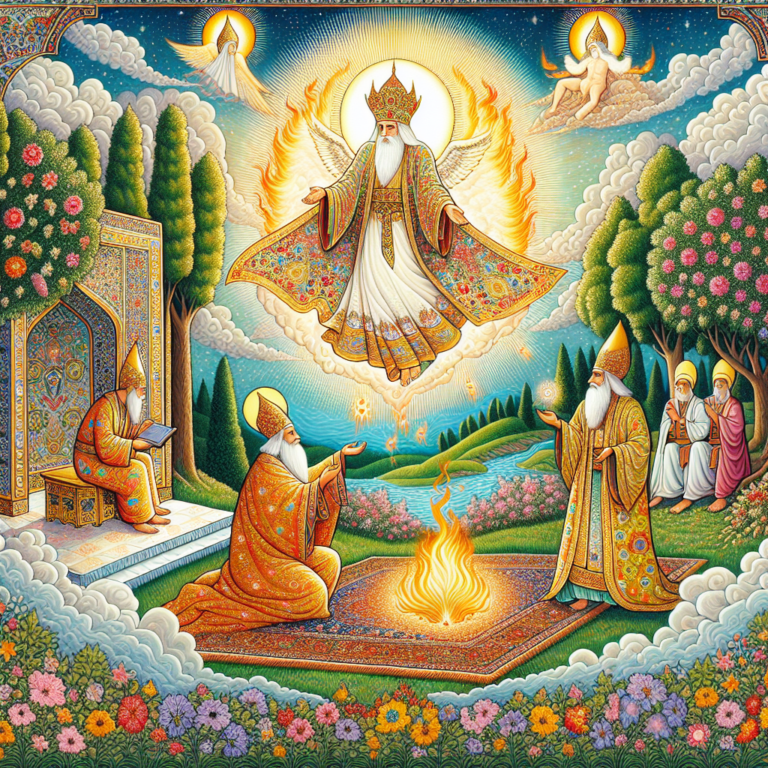
This moral story for children ages 6-12 combines entertainment with important values.
Chapter 1: The First King
In the time before time was counted, when the world was young and the sun never set, there ruled a king unlike any other. His name was Yima, son of Vivanghat, and he was the first man to wear the crown.
But Yima was not interested in crowns.
He walked among his people not as a ruler looking down, but as a shepherd among his flock. He knew the names of the farmers’ children. He listened to the complaints of the woodcutters. He sat with the elderly, learning songs that would otherwise be forgotten.
“Why do you waste your time with common people?” his advisors would ask. “You are the Shah! You should be planning conquests, building monuments, making history!”
Yima would smile his gentle smile. “What good is a king who does not know his people? What good is a monument if the people who built it go hungry? My grandfather’s glory is forgotten, but the kindness/” title=”More stories about kindness”>kindness he showed is still told in stories. That is the legacy I choose.”
Under Yima’s rule, the land flourished. Harvests were bountiful. Sickness was rare. Children grew strong. Animals multiplied until the world seemed almost too full of life.
It was, people said, a golden age.
But golden ages, like all things, have their endings.
Chapter 2: The Voice from Heaven
One morning, as Yima walked through a meadow bright with flowers, the sky grew suddenly bright – brighter than usual, which was saying something, for the sun never fully set in those days.
A figure appeared before him, radiant and terrible in its beauty. It was not quite a man, not quite a flame, but something between and beyond both.
“Yima, son of Vivanghat,” the figure spoke, and its voice was like thunder gentled to a whisper. “I am Ahura Mazda, the Lord of Wisdom, the Creator of All That Is Good.”
Yima fell to his knees, not from fear but from awe. He had always believed in the Wise Lord, but believing and seeing are different things entirely.
“I have watched you,” Ahura Mazda continued. “You have ruled well. Your people prosper. Your kindness has pleased me.”
“Thank you, Lord,” Yima whispered. “Whatever I have done, I have done only to serve.”
“I know. That is why I come to you now with a great task.” The divine figure paused. “I wish you to carry my law to humanity. To become my prophet, my voice among the people.”
Yima felt the weight of this offer pressing upon him like a physical force. To speak for the Creator! To shape the beliefs of all mankind!
And yet…
“Great Lord,” Yima said, his voice trembling, “I am honored beyond measure. But I must speak truth. I am a simple king, good at ruling, good at caring for my people. But I do not have the wisdom or the words to teach your law. I would surely fail you.”
A long silence followed. Yima feared he had given offense. But when Ahura Mazda spoke again, there was warmth in the words.
“Humility/” title=”More stories about humility”>Humility,” the Lord said. “So rare, especially in kings. You could have seized glory, Yima, but instead you spoke your limits. This is wisdom greater than you know.”
Chapter 3: A Different Task
“I will not force upon you a burden you cannot carry,” Ahura Mazda continued. “Instead, I offer you a task more suited to your gifts. I need a guardian.”
“A guardian, Lord?”
“A guardian of life itself. Will you watch over my world? Will you care for my creatures – human and animal, great and small? Will you protect them, help them flourish, keep them from harm?”
Yima’s heart leaped. This was something he knew how to do. This was an extension of everything he already loved.
“With all my heart, Lord. This task I gladly accept.”
Ahura Mazda extended his hand, and in it were two golden objects: a ring and a dagger.
“Take these. The ring represents authority – use it wisely. The dagger represents responsibility – use it only when necessary. With these tools, you shall expand the earth when it grows too crowded, making room for all life to thrive.”
Yima took the sacred objects, feeling power flow through him like warm water.
“Care for my creatures, Yima. They are all precious to me.”
And with those words, the divine presence faded, leaving Yima alone in the meadow with the weight of guardianship upon his shoulders.
Chapter 4: The Years of Growth
Three hundred years passed.
Under Yima’s protection, life multiplied beyond imagining. Flocks of sheep covered the hillsides like clouds come to earth. Herds of cattle shook the ground with their numbers. Birds filled the sky in such abundance that their shadows cooled the land.
And humanity grew too. Villages became towns. Towns became cities. Families became nations.
The world, quite simply, was running out of room.
Yima went to the southern edge of his kingdom, where the grass met the sand, and there he performed the first of his great acts as guardian. Pressing the ring against the earth and striking it with the golden dagger, he commanded the world to grow.
And it did. The land stretched and swelled, expanding by a third, creating new valleys and meadows where none had existed before.
Three hundred more years passed, and once again, the world grew crowded. Once again, Yima expanded it, this time toward the east.
And three hundred years after that, he expanded it again, creating room for all the life that flourished under his care.
But there was something Yima did not know – something coming from the north, where the light never fully reached, where cold and darkness nursed an ancient grudge against the warmth of life.
Chapter 5: The Warning
Ahura Mazda appeared again, and this time, his radiance was dimmed with sorrow.
“Yima,” he said, “you have served well. But I come with terrible news.”
Yima bowed his head. “Whatever it is, Lord, we will face it.”
“A great winter is coming. Not a winter like any your people have known – not a season that passes with the turning of the sun. This winter will be endless. Snow will fall thick as mountains. Cold will kill everything it touches. It is the weapon of Angra Mainyu, the Destructive Spirit, and even I cannot stop it entirely.”
Yima felt ice form around his heart. “All life… will die?”
“All life above ground, exposed to the cold, yes. But there is hope.” Ahura Mazda’s voice grew urgent. “You must build a Vara – an enclosure, a sanctuary beneath the earth. Within it, you must gather the best of every species. The finest men and women. The healthiest cattle, dogs, and sheep. Seeds from every plant. Everything needed to rebuild the world when the winter ends.”
“But Lord – who shall I choose? How can I decide which creatures are worthy of being saved?”
“Not which are worthy,” Ahura Mazda corrected gently. “All are worthy. You must choose which are healthy, which can reproduce, which can carry the future on their backs. This is not judgment, Yima. This is care. The care a father shows when he saves his children from a burning house.”
Chapter 6: The Building of the Vara
Yima worked for decades on the great Vara.
It was not merely a hole in the ground – it was an underground kingdom. Streets were laid out in three rings, like the growth patterns of a tree. Houses were built with windows that drew light from magical sources, for there was no sun underground.
Into this sanctuary, Yima brought pairs of every creature. He did not simply choose the largest cattle or the fastest horses – he chose with love and careful thought. The gentle cow who had nursed orphaned calves. The brave dog who had warned villages of wolves. The sheep whose wool was warmest, the goat who could survive on the poorest grass.
He gathered seeds from every plant – not just the crops that humans ate, but the flowers that fed the bees, the trees that sheltered the birds, the wild grasses that held the soil together.
And he gathered people: farmers who knew the land, healers who understood medicine, storytellers who carried history in their memories, musicians who could lift spirits in dark times.
“Why musicians?” his advisors asked. “Surely carpenters and blacksmiths are more important?”
“When the world is cold and dark,” Yima replied, “it is music that reminds us why we want to survive. Do not underestimate the soul’s needs alongside the body’s.”
Chapter 7: The Endless Winter
The winter came.
From the north, it rolled like a white wave, swallowing forests and mountains and rivers. Snow fell for days without stopping. Then weeks. Then months.
Above ground, the world died.
But beneath it, in the Vara, life continued. The magical light kept the plants growing. The careful planning kept the people fed. And Yima walked among his sanctuary every day, checking on the animals, comforting the frightened, reminding everyone that this too would pass.
Years went by. Generations were born in the Vara who had never seen the sun. They knew the stories of the world above – the blue sky, the green forests, the warm rain – but to them, these were legends, tales from a time before their time.
And yet the stories kept hope alive.
“Grandfather,” a child would ask, “will we ever see the sun?”
“Yes, little one,” the elders would answer. “King Yima promised that one day, the winter will end, and we will return to the world above. He saved us so that we might save the future.”
Chapter 8: The Return
No one knows exactly how long the winter lasted. Some say years. Some say centuries. Time moves strangely underground.
But one day, Yima climbed the long stairs to the Vara’s entrance and pushed against the door. It did not budge.
He pushed harder. Still nothing.
Fear gripped his heart. Had the snow piled so high that they were trapped forever?
Then, from outside, came a sound: dripping. Water running. Ice melting.
Yima pushed once more, and the door burst open. Warm air rushed in – the first warm air in living memory. And there, climbing over the retreating snow, was the sun.
Yima wept.
He wept for the world that had died. For the creatures that had not survived. For the people lost to the cold.
But he also wept with joy. Because what he had saved was enough. Enough to start again. Enough to rebuild. Enough to fill the empty world with life once more.
The people emerged blinking into the light. The animals bounded out into meadows already greening with new growth. Seeds were planted, houses were built, and the world began again.
And though Yima would not live forever – no man does – his legacy did. The world he had saved remembered him as the Guardian of All Creatures. The king who was humble enough to admit his limits, but brave enough to accept a task he could fulfill.
And somewhere, in the light beyond the sky, Ahura Mazda smiled.
Moral Lessons
- True leadership means knowing your limits and serving others before yourself; the greatest legacy is not what we build for ourselves, but what we preserve for those who come after.
Test Your Understanding
1Who is Yima in the story?
Frequently Asked Questions
What is the moral lesson of Yima’s Humble Quest: The Guardian of All Creatures?
What age is this story appropriate for?
How long does it take to read Yima’s Humble Quest: The Guardian of All Creatures?
What culture does this story come from?
Can I use this story for teaching?
Frequently Asked Questions
What is the story of Yima’s Humble Quest about?
Yima’s Humble Quest is a moral story for children ages 6-12 about Yima, the first king, who chooses compassion and humility over power and conquest. Instead of ruling from a distance, he walks among his people, listens to their needs, and builds a legacy of kindness rather than monuments.
What age group is Yima’s Humble Quest suitable for?
This story is written for children between the ages of 6 and 12. It combines engaging storytelling with important values like humility, empathy, and servant leadership, making it a great read-aloud for younger children and an independent read for older kids.
What moral lessons does Yima the Guardian of All Creatures teach?
The story teaches children that true leadership means serving others, not seeking glory. Yima shows that knowing your people, listening to their struggles, and acting with kindness leaves a more lasting legacy than conquests or monuments.
📚 Recommended Books
Handpicked for readers like you
As an Amazon Associate, we earn from qualifying purchases. These recommendations are personalized based on this story's themes and your reading history.
Is Yima a real historical or mythological figure?
Yes, Yima is a figure from ancient Persian mythology, mentioned in the Avesta, the sacred texts of Zoroastrianism. He is traditionally described as a legendary king who protected humanity and created a paradise on earth, making him a rich source for moral storytelling.
Why should kids read moral stories like Yima’s Humble Quest?
Moral stories help children develop empathy, critical thinking, and strong values in an entertaining way. Stories like Yima’s Humble Quest show kids that qualities like kindness and humility matter more than wealth or status, lessons that stay with them long after the story ends.