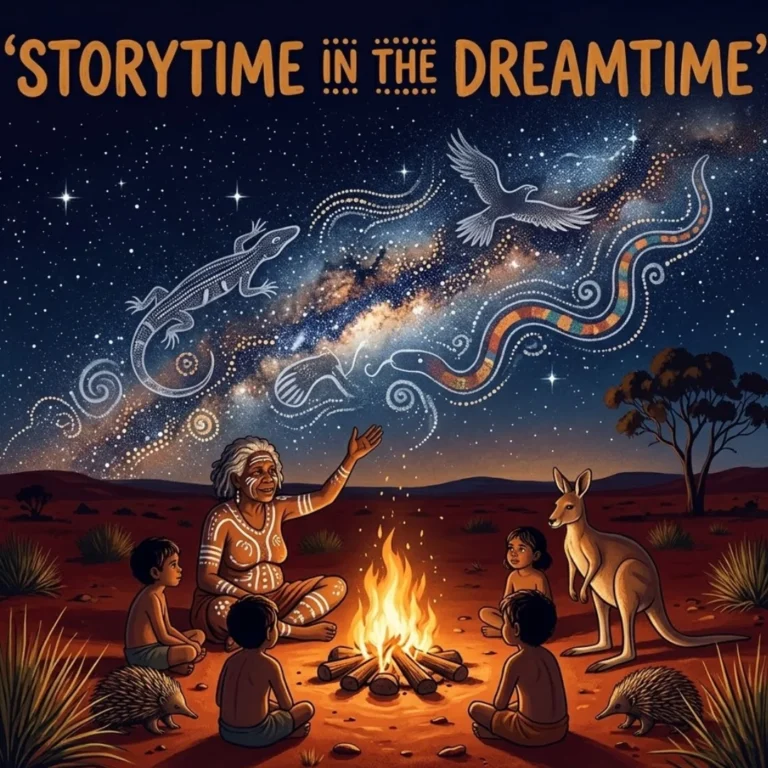
‘Wisdom Whispers: Journey Through Australia’s Magical Fables’ is an educational moral story perfect for bedtime reading with children ages 6-12.
Chapter One: The Hidden Library
In the heart of a great monastery, where ancient bells rang at dawn and monks walked in peaceful meditation, there lived a young boy named Ananda. He was ten years old, with curious eyes that sparkled like morning dewdrops, and he loved nothing more than listening to stories.
One monsoon evening, while rain pattered against the temple roof like tiny drums, the head monk, Venerable Sariputra, gathered the children in the meditation hall. The old monk’s robes were the color of autumn leaves, and his smile carried the warmth of a thousand suns.
“Tonight,” Venerable Sariputra began, his voice soft yet clear as a temple bell, “I shall tell you about the Jataka tales, the most precious treasure our monastery keeps.”
“What are the Jataka tales, Venerable One?” asked Ananda, leaning forward eagerly.
“They are the stories of the Buddha’s many lives before he became the Awakened One,” the monk replied, his eyes twinkling. “You see, children, the Buddha did not become wise in a single lifetime. He practiced kindness, courage, and wisdom through hundreds of lifetimes, sometimes as a prince, sometimes as a merchant, and sometimes even as an animal.”
The children gasped. “An animal?” whispered a small girl named Maya.
“Indeed! The Buddha once lived as a noble elephant, a wise monkey, a brave deer, and even a humble rabbit. In each life, he taught others the path of goodness through his actions.”
Chapter Two: The Story of the Generous Rabbit
Venerable Sariputra closed his eyes, and his voice took on a melodic quality, as if the story were singing itself through him.
“Long, long ago, in a forest where silver streams danced between ancient trees, there lived a small white rabbit named Sasa. Unlike other rabbits who thought only of finding the tastiest clover, Sasa spent his days helping others. He would share his food with hungry travelers and comfort lost animals in the dark woods.
One day, the great god Sakka decided to test the animals of the forest. Disguised as a hungry old traveler, he approached Sasa’s friends, the monkey, the jackal, and the otter. Each animal brought him food: the monkey offered mangoes from the highest branches, the jackal brought a pot of milk-curd he had found, and the otter caught fresh fish from the stream.
When Sakka came to the little rabbit, Sasa’s heart sank. He had no mangoes to pick, no milk to offer, no fish to catch. Rabbits could only eat grass, and surely grass was no meal for a hungry traveler.
But Sasa’s heart burned with the desire to help. Looking at the old man’s weary face, the rabbit made an extraordinary decision.
‘Dear traveler,’ Sasa said, ‘please build a fire. I have something to give you.’
When the flames crackled to life, the little rabbit prepared to leap into the fire, offering his very body as food for the hungry stranger. But just as Sasa jumped, the fire became cool as snow, and the old traveler transformed into the radiant god Sakka!
‘Noble one,’ Sakka said, his eyes bright with tears, ‘your generosity knows no bounds. You were willing to give everything you had to help another. This sacrifice shall never be forgotten.’
And so, Sakka painted the image of the noble rabbit on the face of the moon, where it remains to this very day. In many parts of Asia, when children look up at the full moon, they can see the outline of that generous little rabbit who was willing to give everything for others.”
Chapter Three: The Children Learn to See
Ananda sat in silence, his heart full of wonder. “So when we see the moon, we see the Buddha?”
Venerable Sariputra nodded gently. “In a way, yes. The rabbit was one of the Buddha’s previous lives. This is what the Jataka tales teach us, that goodness is built one small act at a time, across many, many lifetimes.”
“Are there more stories?” Maya asked, her voice hushed with awe.
“There are hundreds upon hundreds! Let me tell you of the time the Buddha was born as a wise monkey king who saved his tribe by stretching his body as a bridge across a dangerous river. Or the time he was a noble elephant who let hunters take his precious tusks rather than harm them. Or when he was a prince named Vessantara, who gave away everything he owned, even his children, to practice perfect generosity.”
“Why would he give away his children?” asked a boy named Rahul, troubled by this.
Venerable Sariputra smiled kindly. “That is a very wise question. The Jataka tales do not always give us easy answers. They ask us to think deeply about what generosity truly means, what attachment truly costs us, and how we can learn to love all beings as our own family. The stories challenge us to grow.”
Chapter Four: The Six Volumes of Wisdom
“The Jataka tales were first written down long ago,” the monk continued, “and they fill six great volumes. Scholars from a place called Cambridge, far across the seas, spent many years translating these ancient stories so that children all around the world could learn from them.
The first volume contains tales of simple virtues, stories about honesty, kindness, and telling the truth. They are like the first steps on a long journey.


The second volume goes deeper, sharing stories about patience and endurance, about how the Buddha-to-be learned to remain calm even when others were cruel or unjust.
The third volume teaches about energy and effort, showing how the future Buddha never gave up, even when tasks seemed impossible.
The fourth volume speaks of meditation and mindfulness, how the Buddha learned to quiet his mind and see clearly.
The fifth volume reveals stories of wisdom, where clever thinking and deep understanding helped solve problems that seemed unsolvable.
And the sixth volume contains the grandest tales of all, stories of perfect virtue that inspire us to reach for our highest selves.”
Chapter Five: The Deer King’s Sacrifice
“Tell us one more story, please!” the children begged.
Venerable Sariputra chuckled warmly. “Very well. This tale comes from the third volume, and it speaks of courage and leadership.
Long ago, there lived two herds of golden deer in a royal park. One herd was led by a magnificent stag named Nigrodha, who was the Buddha-to-be. His coat shone like burnished gold, and his antlers rose like the branches of a sacred tree.
The king of the land loved to hunt, and he would ride into the park with his arrows, causing terror among the deer. Each day, many deer died in panic, trampled by their own herd or struck by the king’s arrows.
Nigrodha could not bear to see his people suffer so. He approached the king with a daring proposal: ‘Great King, if you must have deer meat, let us send one deer each day to your kitchen. This way, you will always have your meat, but the herd will not live in constant fear.’
The king, impressed by the deer’s wisdom and courage, agreed.
Each day, the deer drew lots to determine who would go to the royal kitchen. One day, the lot fell upon a pregnant doe. She was terrified, not for herself, but for the baby growing inside her.
‘Please,’ she begged the other herd’s leader, ‘let someone else go in my place. When my baby is born, I will take my turn.’
But the other leader refused. ‘The lot has chosen you. Everyone must take their turn.’
When Nigrodha heard of this, his heart filled with compassion. Without hesitation, he said, ‘I will go in her place.’
The king was astonished when he saw the magnificent golden stag kneeling before him, offering his own life for a simple doe. ‘Why would you do this?’ the king asked. ‘You are the leader of your herd!’
‘A true leader does not ask others to sacrifice what he himself is unwilling to give,’ Nigrodha replied. ‘This doe carries a new life. How can I ask her to die when I can take her place?’
The king’s heart was so moved that he freed Nigrodha, the doe, all the deer in the park, and eventually all animals in his kingdom. He became a just and compassionate ruler, known throughout the land for his kindness.”
Chapter Six: The Lesson Blooms
As Venerable Sariputra finished speaking, the rain outside had stopped. Stars began to peek through the clouds, and somewhere in the darkness, a nightingale sang.
“Children,” the monk said softly, “the Jataka tales teach us that becoming good is a journey, not a destination. Each kind act you perform, each time you choose honesty over deception, each moment you show patience instead of anger, you are walking the same path the Buddha walked.
You need not be perfect today. You need not be wise tomorrow. But with each small act of goodness, you build something beautiful within yourselves, just as a temple is built one brick at a time, just as a garden grows one seed at a time.”
Ananda looked up at the night sky, where the moon was rising, round and silver. For a moment, he thought he could see the outline of a small rabbit, generous and brave, shining down upon the world.
“I understand now,” Ananda whispered. “Every day is a chance to practice being good.”
Venerable Sariputra placed a gentle hand on the boy’s head. “And that understanding, dear child, is worth more than all the gold in a thousand kingdoms.”
The children walked home that night under the moonlit sky, their hearts full of stories and their minds bright with new understanding. They had learned that the path to wisdom was paved not with magic or miracles, but with simple acts of kindness, courage, and love.
Moral Lessons
- Greatness is not achieved in a single moment but built through countless small acts of kindness, patience, and courage across a lifetime. Every day offers new opportunities to practice virtue.
Test Your Understanding
1Who translated the first volume of the Jataka tales?
Frequently Asked Questions
What is the moral lesson of Wisdom Whispers: Journey Through Australia’s Magical Fables?
What age is this story appropriate for?
How long does it take to read Wisdom Whispers: Journey Through Australia’s Magical Fables?
What culture does this story come from?
Can I use this story for teaching?
Frequently Asked Questions
What age group is Wisdom Whispers: Journey Through Australia’s Magical Fables suitable for?
Wisdom Whispers is designed for children aged 6 to 12 years old. It works wonderfully as a bedtime story, combining engaging characters and magical fables with meaningful moral lessons that are easy for kids in this age range to understand and enjoy.
What are Australian magical fables and where do the stories in this post come from?
The magical fables in this journey draw on rich storytelling traditions, blending ancient wisdom tales like the Jataka stories with imaginative narratives. These fables explore themes of kindness, courage, and wisdom through relatable characters, making moral lessons accessible and memorable for young readers.
What moral lessons do children learn from these wisdom fables?
Children learn core values such as kindness, courage, patience, and the importance of lifelong learning. The stories show that wisdom isn’t gained overnight but through repeated practice and good choices, helping kids understand character-building in a fun, story-driven way.
📚 Recommended Books
Handpicked for readers like you
As an Amazon Associate, we earn from qualifying purchases. These recommendations are personalized based on this story's themes and your reading history.
What are the Jataka tales mentioned in the story?
The Jataka tales are ancient stories about the Buddha’s many past lives before he became the Awakened One. Each tale highlights virtues like generosity, honesty, and compassion. They are among the world’s oldest moral fables and form a key part of the wisdom shared in this post.
Can I use Wisdom Whispers as a bedtime story for my child?
Absolutely! Wisdom Whispers is specifically crafted as a bedtime reading experience. Its calm, gentle storytelling style, soothing characters like the wise monk Venerable Sariputra, and short chapters make it ideal for winding down while sparking meaningful conversations about values and life lessons.