Share this engaging bedtime story with kids ages 6-12 to teach valuable life lessons.
## Chapter One: Islands Born from the Sea
In the beginning, there was only Po – the darkness, the void, the time before time.
Then came movement in the darkness. The first stirrings of life emerged from the deep waters, and generation after generation of beings came into existence, each one more complex than the last. This is what the Kumulipo tells us – the sacred chant that remembers how everything began.
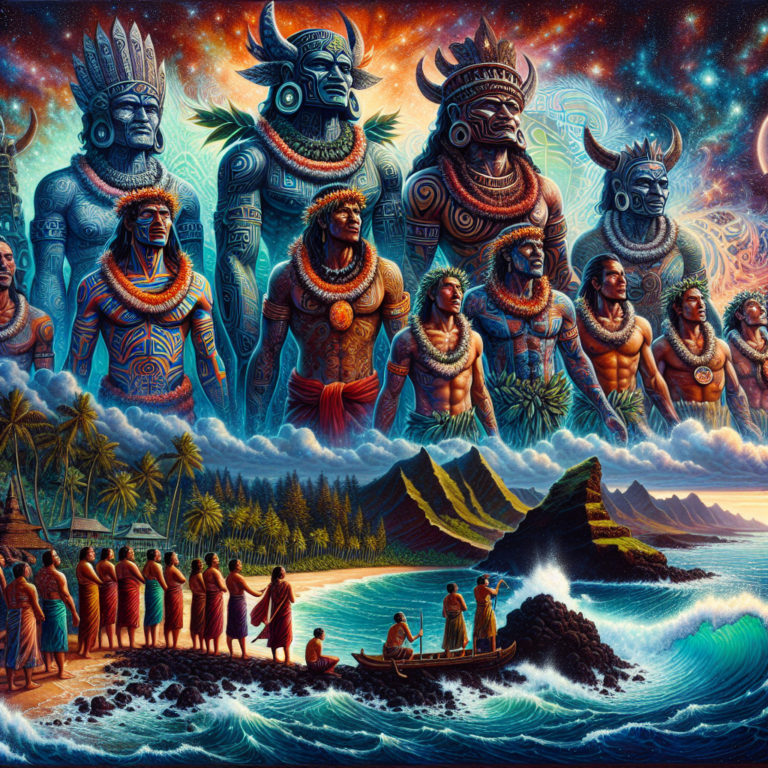
From the sea came the land. Islands rose from the volcanic fire beneath the waves, pushed up by Pele, the goddess whose temper makes the earth shake and the lava flow. First Kane, then Maui, then Oahu, then Kauai – each island a gift, a new homeland for the children of Polynesia.
And on these islands, the Hawaiian people built their world.
They learned to read the stars and the currents, sailing their great double-hulled canoes across thousands of miles of open ocean. They learned to cultivate taro in flooded paddies and catch fish with hooks carved from bone. They built temples called heiau where they honored their gods and ancestors. They developed a society based on kapu – sacred laws that maintained balance between humans, nature, and the spirit world.
Through all of this, one force flowed like an invisible river: mana.
Mana is the spiritual energy that exists in all things – in the rocks and trees, the ocean and sky, the animals and the people. Some things have more mana than others. A great chief has mana. A skilled navigator has mana. A warrior who has won many battles has mana. Even objects can hold mana – a war club that has seen victory, a canoe that has crossed the ocean, a fishhook that has caught many fish.
And of all the beings in Hawaiian legend, no one understood mana better than the demigod Maui.
## Chapter Two: The Boy Who Was Thrown Away
Maui’s story begins with rejection.
His mother, Hina, was a goddess – or some say a very sacred chiefess – of great beauty and power. When she gave birth to her fifth son, he was tiny and strange-looking, born before his time. Thinking he would not survive, Hina wrapped him in a bundle of her own hair and cast him into the sea.
But Maui did not die.
The ocean spirits took pity on the abandoned baby. Jellyfish cushioned him. Sea foam warmed him. And the great ancestor spirits, the aumakua, watched over him until the waves washed him ashore on a distant beach, where he was found and raised by an old couple.
This beginning shaped everything Maui would become. Because he started with nothing – no family, no status, no mana of his own – he had to earn everything through his own cleverness and determination. He could not rely on being born great. He had to make himself great.
As he grew, Maui showed remarkable gifts. He was quick-witted and resourceful, always thinking of new ways to solve problems. He was also stubborn and proud, unwilling to accept that anything was impossible.
When he was old enough, he discovered the truth about his birth and set out to find his real mother. He found her, and she eventually accepted him, but he never forgot that he had been discarded. That memory drove him to prove himself again and again, to accomplish feats that no one else could accomplish.
## Chapter Three: The Gift of Fire
The first of Maui’s great deeds was capturing fire for the people.
In those days, humans had no fire. They ate their food raw and shivered through cold nights. Only the mud hens – sacred birds who served the fire goddess – knew the secret of making flame. But they refused to share it with humans.
Maui decided to change that.
He approached the mud hens with a clever plan. Day after day, he would hide and watch them, trying to learn their secret. But every time he got close, the birds would hide their fire-making materials and pretend to be doing something else.
So Maui tried a different approach. He made a dummy that looked like himself and placed it where the birds could see it. While they watched the fake Maui, the real Maui crept up behind them.
Still, the birds were too clever. They spotted him and hid their secret.
Maui tried trick after trick, each one more cunning than the last. The birds countered every move. It became a battle of wits between the demigod and the divine birds, each side trying to outthink the other.
Finally, Maui realized he had to be more patient than he had ever been before. He waited and watched for months, letting the birds grow comfortable, letting them forget to be careful. And at last, when their guard was completely down, he caught them in the act of making fire.
“Teach me,” he said, “or I will wring your necks.”
The birds, terrified, showed him how to rub certain sticks together to create the spark, how to nurture that spark into a flame, how to control fire and make it serve human needs.
Maui brought this gift to the people. From that day forward, they could cook their food, warm their homes, and light their way through the darkness. And whenever they gathered around a fire, they remembered Maui, who had been clever enough and patient enough to steal a gift from the gods.
## Chapter Four: Snaring the Sun
But Maui’s most famous deed was capturing the sun.
In those days, the sun raced across the sky too quickly. It rose at dawn and plunged into the sea at dusk, giving the people barely enough time to accomplish their daily tasks. Women could not finish drying their tapa cloth before darkness fell. Farmers could not tend all their fields. Fishermen had to cut their voyages short.
Maui’s mother Hina complained about this constantly. “The days are too short!” she would cry. “I cannot finish my work!”
Maui listened to his mother’s complaints and made a decision. He would slow down the sun.
Everyone laughed at him. Slow down the sun? The sun was a god – La or Kala, the giver of life and light. No mortal or even demigod could challenge such a being.
But Maui began to prepare.
First, he gathered the strongest ropes he could find. When those proved too weak, he convinced his mother and his sisters to cut their own hair – sacred and full of mana – and weave it into ropes of supernatural strength.
Then he traveled to Haleakala, the “House of the Sun” – the great volcano on the island of Maui where the sun began its daily journey. He hid in a cave near the summit and waited.
At dawn, as the first rays of the sun peeked over the rim of the crater, Maui struck. He cast his ropes of braided hair around the sun’s rays, snaring them one by one.
The sun roared with fury. “How dare you! I am a god! Release me!”
But Maui held firm. His arms burned. His hands blistered. But he did not let go.
“You must slow down,” Maui said. “You must give my people more time in the day.”
“Never!” the sun bellowed, pulling with all its might.
The struggle lasted for what seemed like ages. The world hung in a strange half-light, neither day nor night, while god and demigod wrestled for dominance.
Finally, exhausted and beaten, the sun agreed. “Very well,” it said. “I will cross the sky more slowly – but only for part of the year. In the summer, I will take my time. In the winter, I will be quick.”
And that is why, to this day, summer days are long and winter days are short. Because once, a demigod who refused to accept “impossible” held onto a god until he got what his people needed.
## Chapter Five: Lifting the Sky
Another of Maui’s great deeds was raising the sky.
In the earliest times, the sky hung so low that people had to crawl on hands and knees. They could not stand up straight. Plants could not grow tall. Everything was crushed and cramped beneath the weight of the heavens.
Maui decided to fix this.
He found a place where the sky touched the earth and began to push. He pushed with all his strength, with all his mana, with every bit of power his demigod heritage gave him.
At first, nothing happened. The sky was impossibly heavy, the weight of all the stars and clouds pressing down.
But Maui did not give up. He pushed and pushed, day after day, week after week. Slowly, imperceptibly at first, the sky began to rise.
Higher and higher he pushed it, until people could stand. Higher still, until trees could grow tall. Higher again, until birds could fly.
At last, the sky was lifted to where it belongs – high above the mountains, far above the clouds, making room for all the life that would flourish beneath it.
And even today, when you look up at that vast expanse of blue, you are looking at Maui’s accomplishment. He held up the heavens so that we could walk tall beneath them.
## Chapter Six: Fishing Up the Islands
Perhaps the strangest of Maui’s deeds was fishing up the Hawaiian Islands from the bottom of the sea.
According to legend, the islands did not always exist as we know them. Some were submerged beneath the waves, hidden from human sight and reach.
Maui had a magical fishhook – some say made from the jawbone of his own grandmother, given willingly as a gift of mana. This hook had the power to catch anything, no matter how large or deep.
One day, Maui convinced his brothers to take him far out to sea for a fishing trip. “But you must not look back,” he warned them. “No matter what happens, keep paddling and do not look behind you.”
His brothers agreed, not knowing what Maui planned.
When they reached the deep ocean, Maui cast his magical hook into the water. Down, down, down it sank, past where fish swim, past where light reaches, all the way to the ocean floor.
And there, it caught something – not a fish, but the land itself.
“Paddle!” Maui commanded his brothers. “Paddle as hard as you can!”
The brothers paddled with all their might. Behind them, though they could not see it, a great mass was rising from the deep – land that had been submerged since the beginning of time, now being pulled to the surface by Maui’s magic.
But just as the land was about to break free of the water, one of the brothers could not resist. He looked back.


The spell was broken. The fishhook snapped. The land that had been rising fell back into the sea – all except for the peaks, which became the islands we know today.
“If only you had not looked back,” Maui said sadly, “the islands would be one great land, connected and whole. Instead, they are scattered – beautiful, but separated.”
And so the Hawaiian Islands remain, eight main peaks rising from the sea, the visible parts of what Maui almost lifted completely from the ocean floor.
## Chapter Seven: The Meaning of Mana
A young girl named Kiele sat on the beach, listening to her grandmother tell these stories of Maui.
“Tutu,” Kiele said (for this is what Hawaiian children call their grandmothers), “why are Maui’s stories so important? He lived so long ago.”
Her grandmother smiled, the wrinkles around her eyes deepening like the channels waves carve in sand.
“Maui’s stories teach us about mana,” she said. “Do you know what mana is?”
“Power?” Kiele guessed.
“Yes and no,” her grandmother said. “Mana is spiritual power, but it is not like the power of muscles or weapons. It is the power that comes from right relationship – with the land, with the ancestors, with the gods, with yourself.
“When Maui captured fire, he showed that mana comes from patience and cleverness, not just strength.
“When he snared the sun, he showed that mana comes from persistence, from not giving up even when the task seems impossible.
“When he lifted the sky, he showed that mana comes from service – from wanting to help others, not just yourself.
“And when he fished up the islands, he showed that mana is connected to the land itself, to our home, to where we come from.”
## Chapter Eight: The Many Faces of Maui
“But Tutu,” Kiele said, “in some stories Maui seems selfish. He tricks people. He doesn’t always do what he’s told.”
Her grandmother nodded. “That is also part of what Maui teaches us. He is not a perfect hero. He is complicated, like all of us.
“Maui is a trickster. He uses cleverness instead of following rules. Sometimes this is good – like when he stole fire for people. Sometimes it is not so good – like when his curiosity or pride gets him in trouble.
“The Hawaiians did not make their heroes perfect because perfect heroes teach us nothing. Maui shows us that we can accomplish great things even if we are not perfect. That our flaws do not disqualify us from greatness.
“He also shows us that the greatest mana comes from serving others. When Maui acts for himself alone, his stories end in failure or trouble. When he acts for his family, his people, humanity – that is when he succeeds.”
## Chapter Nine: The Legacy of the Navigator
Kiele thought about this for a while, watching the waves roll onto the beach.
“Is mana real?” she asked finally. “Or is it just in stories?”
Her grandmother turned to look at the ocean, that vast expanse that her ancestors had crossed in their double-hulled canoes.
“What do you think?” she asked. “Our ancestors sailed thousands of miles across open ocean, with no maps, no compasses, no GPS. They read the stars, the currents, the behavior of birds, the colors of the clouds. They found these islands, scattered across the largest ocean on Earth, and they thrived here.
“How did they do it? How does anyone do impossible things?
“I believe they did it with mana. With the spiritual power that comes from connection – to their traditions, to each other, to the gods, to the land and sea they depended on.
“You can call it something else if you like. You can call it faith, or courage, or determination. But the Hawaiians called it mana, and I think they were right.
“When you are connected to something larger than yourself – your family, your culture, your land – you become capable of things you could never do alone. That is mana. It is as real today as it was in Maui’s time.”
## Chapter Ten: The Fire That Never Dies
As the sun began to set over the Pacific, painting the sky in the same colors the fire goddess Pele wears in her volcanic displays, Kiele’s grandmother told her one more story.
“There is a saying in Hawaiian: ‘The calabash of the ancestors never empties.’
“Do you know what that means?
“It means that the wisdom, the courage, the mana of those who came before us is still available to us. It does not run out. Every time we remember their stories, honor their memory, follow their teachings, we are drinking from that calabash.
“Maui lived long ago – or maybe he is just a story, a symbol of all the things Hawaiians value. It does not matter. What matters is what his stories teach us:
“That cleverness can overcome brute strength.
That persistence can move the unmovable.
That service to others is the highest purpose.
That we are connected to the land, the sea, the sky, and each other.
“When you face a challenge that seems impossible, remember Maui holding the sun. When you need patience, remember Maui watching the mud hens month after month. When you are tempted to give up, remember Maui pushing the sky, inch by inch, until it was high enough for people to stand.
“The mana of the ancestors flows through you. You are connected to everyone who came before you, everyone who sails the great ocean of life. You are not alone, and you are not powerless.
“That is the gift Maui left us. That is the gift of Hawaii.”
## Chapter Eleven: Carrying the Mana Forward
Kiele looked out at the ocean as the first stars began to appear. The same stars her ancestors had used to navigate across the Pacific. The same stars Maui might have seen when he fished up the islands.
“Tutu,” she said, “how do I get mana? How do I become strong like Maui?”
Her grandmother took her hand.
“You already have mana, child. It was born in you – the heritage of your people, the connection to your land, the love of your family. It flows through you like a river, even when you are not aware of it.
“But mana can grow stronger, or it can weaken. It depends on how you live.
“When you respect your elders and learn from their wisdom – mana grows.
When you care for the land and sea instead of just taking from them – mana grows.
When you face challenges with courage and cleverness – mana grows.
When you use your strength to help others, not just yourself – mana grows.
“And when you remember where you come from – the islands, the ocean, the ancestors, the gods – you connect to a mana greater than any one person could hold alone.
“This is the way of Hawaii. This is what Maui taught us. This is your inheritance.”
## Chapter Twelve: The Endless Ocean
That night, Kiele dreamed of Maui.
She dreamed she was sailing with him in a great double-hulled canoe, across an ocean that stretched forever in all directions. The stars wheeled overhead like the turning of a great navigator’s map. The wind filled the sails with invisible power.
“Where are we going?” she asked.
“Forward,” Maui said with a grin – that famous trickster smile that had charmed gods and fooled enemies. “Always forward. That is the only direction that matters.”
“But the ocean is so big,” Kiele said. “How will we know where to go?”
“The stars will guide us. The currents will carry us. The birds will show us when land is near. Everything we need is already here – we just have to pay attention.”
He looked at her with eyes that held the sparkle of the sun he had once captured.
“Your ancestors crossed this ocean with nothing but their wits and their mana. They found islands that no one knew existed. They built a civilization at the edge of the world. Do you think you cannot do great things too?”
Kiele woke as the dawn light touched her window. The dream faded, but the feeling remained – a warmth in her chest, a certainty in her heart.
She was connected to something ancient and powerful. The mana of her ancestors flowed through her. The stories of Maui were not just entertainment – they were guides, instructions, inspirations.
The calabash of the ancestors never empties.
And somewhere out on the endless ocean, beyond the horizon where the sun rises each morning, the spirit of Maui still sails – still capturing fire, still snaring the sun, still fishing up new possibilities from the depths – waiting for those with enough courage and cleverness to join him.
The voyage continues.
It always continues.
E mau ke ea o ka aina i ka pono.
The life of the land is perpetuated in righteousness.
Moral Lessons
- Spiritual power (mana) comes from our connections – to our heritage, our land, our community, and the values handed down by our ancestors. Cleverness and persistence can overcome seemingly impossible obstacles. The greatest use of power is service to others. Our ancestors’ wisdom remains available to us whenever we choose to remember and honor it.
Test Your Understanding
1Who is Maui in the story?
Frequently Asked Questions
What is the moral lesson of Maui’s Quest for the Mighty Mana?
What age is this story appropriate for?
How long does it take to read Maui’s Quest for the Mighty Mana?
What culture does this story come from?
Can I use this story for teaching?
Frequently Asked Questions
What is Maui’s Quest for the Mighty Mana about?
Maui’s Quest for the Mighty Mana is a bedtime story for kids ages 6 to 12 rooted in Hawaiian mythology. It follows the hero Maui on a journey to discover mana, a sacred spiritual force, while exploring themes of courage, respect for nature, and Hawaiian cultural traditions like the Kumulipo creation chant.
What does mana mean in Hawaiian culture?
In Hawaiian culture, mana is a powerful spiritual force that flows through all living things, people, nature, and the spirit world. It represents divine authority, strength, and life energy. In this story, mana serves as a central life lesson, teaching children that inner power comes from respect, balance, and honoring one’s heritage.
What age group is this bedtime story best suited for?
This story is written specifically for children ages 6 to 12. The language is accessible and engaging for younger readers, while the rich Hawaiian mythology and moral themes offer enough depth to keep older kids thoughtfully entertained. It works well as both a read-aloud and an independent bedtime read.
📚 Recommended Books
Handpicked for readers like you
As an Amazon Associate, we earn from qualifying purchases. These recommendations are personalized based on this story's themes and your reading history.
What life lessons does Maui’s Quest for the Mighty Mana teach kids?
The story teaches children valuable lessons about courage, perseverance, respect for nature, and the importance of cultural heritage. Through Maui’s journey, kids learn that true strength comes from within and that living in balance with the world around you is a source of real power.
Is Maui’s Quest for the Mighty Mana based on real Hawaiian mythology?
Yes, the story draws from authentic Hawaiian mythology and traditions, including references to Pele the volcano goddess, the sacred Kumulipo creation chant, and the concept of kapu — the ancient Hawaiian system of sacred laws. These real cultural elements give the story historical depth while making it educational for young readers.