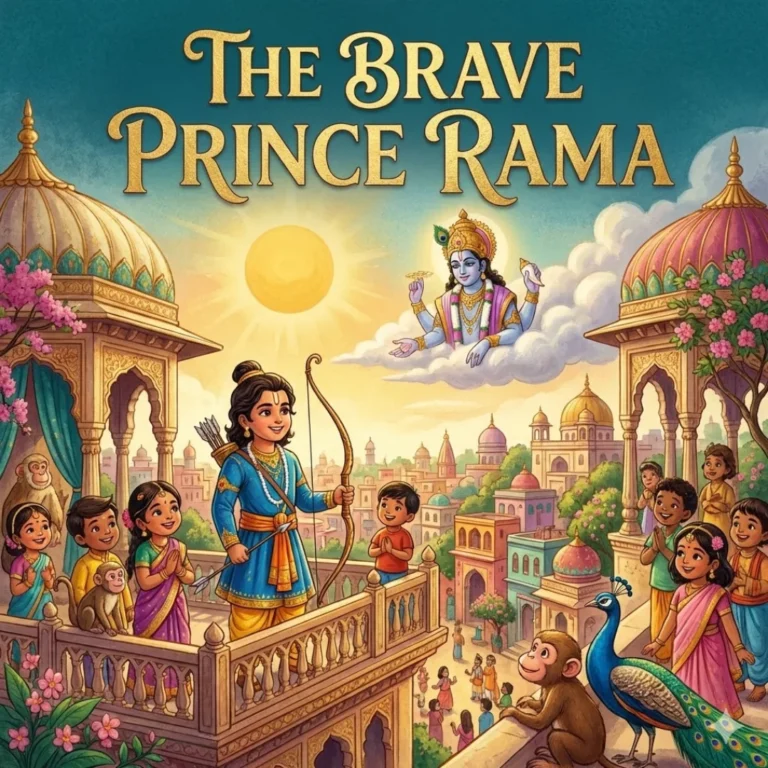
Share this engaging bedtime story with kids ages 6-12 to teach valuable life lessons.
THE BIRTH OF A DIVINE PRINCE
Long ago, in the ancient kingdom of Kosala, there stood the magnificent city of Ayodhya. Its name meant “the unconquerable,” and indeed, it was a city of splendor and righteousness. The kingdom prospered under the rule of King Dasharatha, a mighty warrior of the Solar Dynasty who had conquered many enemies and earned the favor of the gods.
Yet despite all his power and prosperity, King Dasharatha carried a deep sorrow in his heart. He had three beloved queens – Kausalya, Kaikeyi, and Sumitra – but no sons to inherit his throne and continue his lineage. As he grew older, his worry deepened.
The wise sage Vasishtha, who served as the royal priest, advised the king to perform the Ashvamedha Yajna, a powerful horse sacrifice ceremony that would please the gods. Dasharatha agreed, and the grand ritual was conducted with all proper rites and tremendous devotion.
The gods, witnessing the king’s sincerity, were moved. But they also had a greater purpose in mind. The demon king Ravana of Lanka had become so powerful through his austerities that he had received boons making him invincible against gods and celestial beings. He terrorized the three worlds, disturbing the sacred rituals of sages and upsetting the cosmic balance between good and evil. The gods approached Lord Vishnu, the preserver of the universe, seeking help.
“Lord,” they pleaded, “only you can save creation from Ravana’s tyranny. He cannot be killed by gods or demons, for he has obtained protection from us all. But in his arrogance, he did not seek protection from humans, whom he considered too weak to threaten him. We beg you to take birth as a human and restore dharma to the world.”
Lord Vishnu agreed. He would incarnate as the son of Dasharatha, dividing himself into four parts to be born as four princes who would exemplify every aspect of dharma.
When the sacred fire ceremony concluded, Agni, the fire god, emerged from the flames holding a golden vessel filled with divine nectar. “King Dasharatha,” Agni proclaimed, “the gods have answered your prayers. Give this nectar to your queens, and you shall be blessed with sons who will make your name immortal.”
The king’s joy knew no bounds. He gave half the nectar to Kausalya, a quarter to Kaikeyi, and a quarter to Sumitra. In due time, all three queens gave birth. Kausalya bore Rama, who was Lord Vishnu himself. Kaikeyi gave birth to Bharata. And Sumitra had twin sons, Lakshmana and Shatrughna.
The day of Rama’s birth, celebrated as Rama Navami, was marked by auspicious signs throughout the kingdom. The sun shone with special brilliance, flowers bloomed out of season, and celestial music filled the air. The people of Ayodhya rejoiced, for they sensed that something extraordinary had blessed their land.
THE EDUCATION OF PRINCES
The four brothers grew up together in the palace of Ayodhya, receiving education befitting royal princes. Sage Vasishtha taught them the Vedas, ethics, governance, and the arts of war. But even among these exceptional princes, Rama stood out.
Rama was not just skilled in archery, swordsmanship, and warfare – he was the very embodiment of virtue. He spoke truth always, respected his elders, treated everyone with kindness regardless of their status, and followed dharma in every action. His younger brother Lakshmana was devoted to him above all else, while Bharata and Shatrughna shared an equally strong bond.
The turning point in Rama’s youth came when the great sage Vishwamitra arrived at Ayodhya’s gates. This sage, who had transformed himself from a warrior king into one of the greatest Brahmarishis through thousands of years of penance, sought King Dasharatha’s help.
“Your Majesty,” Vishwamitra said, “demons led by Tataka, Maricha, and Subahu are disrupting the sacred yajnas in the forest. I need your son Rama to protect the rituals and destroy these evil beings.”
Dasharatha was torn. Rama was only sixteen years old. How could he send his beloved son into such danger? But Vasishtha counseled him, “Great king, Rama is no ordinary prince. Send him with Vishwamitra. This is his destiny, and through this journey, his true nature will be revealed.”
Reluctantly, Dasharatha agreed. Rama and Lakshmana accompanied Vishwamitra into the forest. There, the sage taught them powerful celestial weapons and divine knowledge. When the demons attacked the sacred ritual, Rama’s divine nature manifested. He defeated Tataka with a single arrow, drove away Maricha with the Manavastra weapon, and destroyed Subahu. The sages were saved, and Rama earned the blessings of all the holy men.
WINNING SITA’S HAND
Vishwamitra then took the young princes to the kingdom of Mithila, ruled by King Janaka. This wise king had found an extraordinary girl while plowing a field for a ritual – she had emerged from the earth itself, and he raised her as his daughter, naming her Sita.
Sita was no ordinary princess. She was the avatar of Goddess Lakshmi, who had descended to Earth to be the consort of Lord Vishnu’s incarnation. But King Janaka, knowing her divine nature, had set an impossible condition for her marriage: only he who could string the great bow of Lord Shiva, an ancient weapon of immense power, could win her hand.
Many mighty kings and princes had tried and failed. The bow was so heavy that it took hundreds of men just to move it into the hall. No one had even been able to lift it, let alone string it.
When Rama entered the hall and saw Sita, their eyes met, and both recognized their eternal connection. Rama approached the bow, and as he lifted it with ease, the assembled crowd gasped in amazement. As he bent the bow to string it, the ancient weapon, unable to withstand the divine power flowing through Rama, broke with a thunderous sound that echoed across the three worlds.
King Janaka, overjoyed, gave Sita’s hand to Rama. The wedding was celebrated with great splendor, and Rama returned to Ayodhya with his beloved wife. Lakshmana married Sita’s sister Urmila, and Bharata and Shatrughna married Sita’s cousins Mandavi and Shrutakirti. The four brothers and their wives lived in harmony and joy in Ayodhya.
THE TERRIBLE PROMISE
Years passed in happiness. King Dasharatha, now aged and ready to retire, decided to crown Rama as the next king. The entire kingdom rejoiced at this news, for everyone loved Rama and knew he would be a just and compassionate ruler.
But fate had other plans.
Long ago, during a battle, Queen Kaikeyi had saved King Dasharatha’s life. In gratitude, he had promised her two boons – any two wishes she desired. Kaikeyi, who truly loved Dasharatha and Rama, had saved these boons, seeing no need to use them.
However, Kaikeyi had a maidservant named Manthara, a twisted soul who harbored jealousy in her heart. When she heard that Rama would be crowned king, Manthara poisoned Kaikeyi’s mind with lies and manipulations.
“Don’t you see?” Manthara hissed. “Once Rama becomes king, your son Bharata will be nothing! You will lose all power and influence. Use your two boons now! Ask the king to crown Bharata as king instead, and send Rama into exile for fourteen years!”
At first, Kaikeyi refused, for she loved Rama like her own son. But Manthara’s poison worked slowly, filling her mind with fears and insecurities. Finally, Kaikeyi succumbed to the manipulation.
She went to the “anger chamber” and lay on the floor, removing her ornaments as if in mourning. When Dasharatha came to her, concerned, she demanded her two boons: that Bharata be crowned king, and that Rama be exiled to the forest for fourteen years.
The words struck Dasharatha like arrows. He fell to his knees, begging her not to ask for this. “Ask for my kingdom, ask for my life, but do not send Rama away! The people need him, I need him! Without Rama, this kingdom will be like a body without soul!”
But Kaikeyi, now fully under the spell of Manthara’s poison, remained firm. And Dasharatha, bound by his sacred word as a king, could not refuse.
RAMA’S ACCEPTANCE
When Rama was summoned and told of Kaikeyi’s demand, everyone expected him to protest or show anger. But Rama simply smiled peacefully.
“Father,” he said, “a king’s word is sacred. You promised Queen Kaikeyi two boons, and she has every right to claim them. I will gladly go into exile. Dharma must be upheld at all costs. Let there be no delay – I will leave for the forest today itself.”
Rama’s mother Kausalya wept, the people of Ayodhya were stunned, and even Kaikeyi felt a twinge of guilt seeing Rama’s gracious acceptance. But Rama remained firm in his devotion to dharma.
Sita, when she heard the news, immediately declared, “Where Rama goes, I go. A wife’s place is by her husband’s side, whether in a palace or in the wilderness. I will accompany him to the forest.”
Rama tried to dissuade her, explaining the hardships of forest life. “The forest is dangerous, with wild animals and harsh weather. Stay here in comfort and safety.”
But Sita replied with words that echo through the ages: “To be away from you would be a greater hardship than any physical danger. The forest will be paradise if I am with you, and the palace would be a prison if I am separated from you.”
Lakshmana too refused to stay behind. “Brother, you are my life itself. I cannot live without serving you. Let me accompany you and protect you and Sita in the forest.”
And so, despite everyone’s pleading, the three of them prepared to leave for fourteen years of exile. Rama gave away all his possessions to the poor, changed his royal garments for simple bark cloth, and bid farewell to his grieving family and the weeping citizens of Ayodhya.
King Dasharatha, heartbroken, could not bear the separation. Within days of Rama’s departure, the aged king died, crying out his son’s name with his last breath.
LIFE IN THE FOREST
Rama, Sita, and Lakshmana crossed the river Ganges and entered the vast Dandakaranya forest. Despite the hardships, they found peace in the simple life of forest-dwellers. Rama and Lakshmana built a beautiful hermitage, and they lived in harmony with nature and the sages who inhabited the forest.
The sages welcomed them with joy, for Rama protected them from the demons who terrorized the forest. These rakshasas, under the command of Ravana, would attack the hermitages, disrupt sacred rituals, and harm innocent ascetics. Rama vowed to protect all righteous beings from these attacks.
For nearly fourteen years, they lived this way, moving from place to place through the forest, always protecting the innocent and upholding dharma.
SITA’S ABDUCTION
The turning point came when they were living in Panchavati, near the Godavari river. One day, a demoness named Shurpanakha, sister of Ravana, saw Rama and was struck by desire for him. She attempted to seduce him, but Rama gently refused, saying he was devoted only to his wife. Enraged, Shurpanakha attacked Sita. Lakshmana intervened and cut off her nose and ears as punishment for attacking his sister-in-law.
Humiliated, Shurpanakha fled to Lanka and told her brother Ravana about Sita’s unparalleled beauty. Ravana, who was already consumed by lust and pride, decided he must have Sita for himself.
Through treachery and deception, using his minister Maricha who took the form of a golden deer, Ravana lured Rama and Lakshmana away from their hermitage. Then, disguised as a wandering sage, Ravana approached Sita. When she came out to offer him alms, he revealed his true form and forcibly abducted her, carrying her away in his flying chariot toward Lanka.
When Rama and Lakshmana returned and found Sita gone, Rama’s grief was profound. For the first time, the embodiment of perfect dharma showed the depth of human emotion – he wept, he raged, he despaired. But then he gathered himself, for he knew that as a warrior and as an avatar, he had a duty to fulfill.
THE SEARCH AND THE ALLIANCE
In their search for Sita, Rama and Lakshmana entered the kingdom of Kishkindha, land of the vanaras. There they met Hanuman, the devoted son of the wind god, and through him formed an alliance with Sugriva, the exiled vanara king.
Rama helped Sugriva defeat his brother Vali and reclaim his kingdom. In return, Sugriva ordered his entire vanara army to search for Sita. It was Hanuman who, in an incredible leap of faith and devotion, crossed the southern ocean and discovered Sita imprisoned in Lanka.
Hanuman’s meeting with Sita renewed her hope. He gave her Rama’s ring as a token and promised that Rama would come to rescue her. Hanuman then set fire to parts of Lanka and returned to tell Rama where Sita was held.
THE GREAT WAR
With the help of the vanara army, Rama built a bridge across the ocean to Lanka – a feat of engineering that amazed even the gods. The army crossed over, and the great war began.
The war was long and terrible. Many brave warriors on both sides fell. Ravana’s brother Vibhishana, who had pleaded with Ravana to return Sita and avoid war, eventually joined Rama’s side, for he knew his brother had abandoned dharma.
Rama faced Ravana’s mighty son Indrajit, who had defeated even Indra, the king of gods. He fought Kumbhakarna, Ravana’s giant brother who was as large as a mountain. Finally, Rama faced Ravana himself in single combat.
The battle between Rama and Ravana lasted for days. Ravana had ten heads and twenty arms, wielding divine weapons obtained through years of penance. But Rama, guided by his dharmic purpose and armed with celestial weapons given by the gods, proved superior. Finally, Rama invoked the Brahmastra, a weapon created by Brahma himself, and aimed it at Ravana’s heart.
The arrow struck true, and the great demon king fell. As Ravana lay dying, his demon nature left him, and his original wisdom returned. He recognized Rama’s divinity and asked forgiveness, which Rama granted, for a true warrior respects his enemy even in victory.
THE RETURN AND CORONATION
With Ravana defeated and Sita rescued, Rama’s mission was complete. The fourteen years of exile had also ended. Rama, Sita, Lakshmana, and Hanuman flew back to Ayodhya in the Pushpaka Vimana, Ravana’s flying chariot.
The reunion with Bharata was deeply emotional. Throughout the fourteen years, Bharata had refused to sit on Ayodhya’s throne. Instead, he had placed Rama’s sandals on the throne and ruled as Rama’s representative, waiting for his brother’s return.
Rama was finally crowned king of Ayodhya. His rule, known as Rama Rajya, became legendary as the perfect governance – a time when dharma was perfectly observed, when there was no crime, no poverty, no injustice. Everyone lived in prosperity and happiness. The rains came on time, crops flourished, and even death came only when people were ready, not through disease or accident.
Rama ruled not as a divine being demanding worship, but as an ideal king who served his people. He made decisions based on dharma, listened to his subjects, and ensured justice for all. His life became the template for righteous living – he was the perfect son who honored his father’s word, the perfect husband devoted to his wife, the perfect brother who loved his siblings, the perfect king who served his people, and the perfect warrior who fought only for dharma.
THE ETERNAL LESSON
The story of Rama teaches us that true bravery is not just physical courage in battle, but the moral courage to do what is right even when it is difficult. Rama faced many challenges: he gave up his rightful throne without complaint, endured years of exile with grace, fought terrible enemies to protect righteousness, and ruled with wisdom and compassion.
He showed that one can face life’s greatest injustices without losing one’s integrity, that duty to family and dharma comes before personal desires, and that even in the darkest times, holding fast to righteousness will ultimately lead to victory.
Rama’s story is not just an ancient tale, but a living guide for how to live with honor, courage, and compassion. When we face difficult choices, when we must choose between what is easy and what is right, we can remember Rama and find the strength to choose the path of dharma.
Moral Lessons
- True bravery means having the moral courage to follow dharma (righteousness) even when it requires great sacrifice. By staying true to our principles, treating others with compassion, and standing up for what is right, we can overcome any challenge and inspire others to do the same.
Test Your Understanding
1. Why did the gods approach Lord Vishnu asking him to incarnate on Earth?
Frequently Asked Questions
What is the moral lesson of The Brave Prince Rama?
What age is this story appropriate for?
How long does it take to read The Brave Prince Rama?
What culture does this story come from?
Can I use this story for teaching?
Frequently Asked Questions
Who is Prince Rama and why is he called the brave prince?
Prince Rama is the heroic main character of the ancient Indian epic Ramayana. He’s called brave because of his courage in facing demons, his dedication to righteousness, and his willingness to sacrifice for others. He’s considered a divine prince born to restore balance in the world.
What is The Brave Prince Rama story about?
This bedtime story for kids tells how Prince Rama was born to King Dasharatha of Ayodhya after the gods answered the king’s prayers for a son. The story explains Rama’s divine birth and his destined role in defeating the demon king Ravana who was terrorizing the world.
Is this Prince Rama story suitable for children?
Yes, this moral story is specifically designed for kids ages 6-12. It teaches valuable life lessons about courage, righteousness, and devotion while sharing fascinating tales from ancient Indian culture in an age-appropriate, engaging way that makes perfect bedtime reading.
📚 Recommended Books
Handpicked for readers like you
As an Amazon Associate, we earn from qualifying purchases. These recommendations are personalized based on this story's themes and your reading history.
What lessons can children learn from this story?
Children learn about devotion, perseverance, and faith through King Dasharatha’s determination to have a righteous heir. The story teaches kids about the importance of good conquering evil, divine justice, and how sincere prayers and devotion are rewarded by higher powers.
Where does this story come from?
This story comes from the Ramayana, one of ancient India’s greatest epic poems that’s been told for thousands of years. It contains timeless wisdom about duty, honor, and righteousness that continues to inspire children and families around the world with its moral teachings.