Vishwamitra: The King Who Became a Sage
This bedtime story for kids, ‘Vishwamitra: The King Who Became a Sage’, teaches children ages 6-12 about important moral values.
Once upon a time, there was a mighty king named Kaushika.
He was a Kshatriya—a member of the warrior caste, born to rule and fight. His armies were vast. His kingdom was prosperous. His strength was legendary.
King Kaushika had everything a man could want: power, wealth, respect, and glory.
But one day, a chance encounter would change his life forever—and begin a spiritual journey that would last thousands of years.
THE MEETING WITH VASISHTHA
One afternoon, King Kaushika was hunting in the forest with his entire army—thousands of soldiers, hundreds of chariots, elephants, and horses.
As the sun began to set, they came upon a peaceful ashram (hermitage) surrounded by trees and flowers. The ashram belonged to Vasishtha, one of the greatest Brahmin sages in all of India—a man of immense spiritual power.
Vasishtha welcomed the king warmly. “Please, Your Majesty, rest here for the night. Allow me to offer you and your entire army hospitality.”
King Kaushika laughed. “Sage Vasishtha, you are kind, but I have brought thousands of men with me. How can a simple hermit possibly feed such a vast army?”
Vasishtha smiled gently. “Please, allow me to try.”
The sage led them to a clearing, where a beautiful cow grazed peacefully. Her name was Nandini—a divine cow, one of the wish-fulfilling cows born from the ocean of milk during the churning of the cosmic ocean.
Vasishtha approached Nandini and whispered to her: “Dear Nandini, we have royal guests. Please provide food for the king and all his army.”
And then, something miraculous happened.
From Nandini came an endless feast—mountains of rice, rivers of milk, delicious vegetables, sweet fruits, rich desserts. Enough food appeared to feed the entire army ten times over, and it was the most delicious food any of them had ever tasted.
King Kaushika watched in amazement.
When everyone had eaten their fill, the king approached Vasishtha. “This cow is extraordinary. I have never seen such power. Sage Vasishtha, I want this cow. Name your price—gold, jewels, land, anything. I must have Nandini for my kingdom!”
Vasishtha shook his head gently. “I am sorry, Your Majesty, but Nandini is not for sale. She is essential for my spiritual practices and for feeding the students at my ashram.”
“Everything has a price,” the king insisted. “I will give you a thousand ordinary cows in exchange.”
“No, Your Majesty.”
“Ten thousand cows!”
“No, Your Majesty.”
“One hundred thousand cows and half my kingdom!”
“Your Majesty,” Vasishtha said firmly, “there is no amount of wealth that can buy Nandini. She stays with me.”
King Kaushika’s face darkened with anger. “Then I will take her by force! I am a king! You are just a Brahmin with no army, no weapons, no power!”
He signaled to his soldiers, who seized Nandini and began dragging her away.
THE POWER OF THE BRAHMIN
Nandini cried out in distress, calling to Vasishtha for help.
Vasishtha closed his eyes and meditated for just a moment. Then he opened them and spoke a single word—a mantra, a sacred syllable of power.
Instantly, Nandini broke free from the soldiers. And then, from her body, an entire army appeared—fierce warriors made of divine energy, wielding weapons of light.
King Kaushika’s vast army charged at these mystical warriors.
But within minutes, the king’s entire force was defeated. His soldiers lay scattered across the ground, unconscious but unharmed. His chariots were overturned. His elephants had fled.
And King Kaushika himself stood alone, humiliated, defeated—not by another king’s army, but by a single old Brahmin with a cow.
Vasishtha looked at him with compassion. “Your Majesty, go in peace. I wish you no harm. But understand this: the spiritual power of knowledge and devotion is far greater than the physical power of armies and weapons.”
King Kaushika stood there, trembling—not with fear, but with a sudden, overwhelming realization.
All my life, I have built power through strength and wealth. But this Brahmin has power I cannot even comprehend—power that comes from within, from spiritual practice, from connection to the divine.
If I truly want power—REAL power—I must become like Vasishtha.
I must become a Brahmin.
And in that moment, King Kaushika made a decision that would change his life forever.
He renounced his throne, his kingdom, his armies, and his identity as a warrior king.
He walked away from everything he had ever known.
And he began the most difficult journey of his life: the journey to transform himself from a Kshatriya warrior into a Brahmin sage.
THOUSANDS OF YEARS OF PENANCE
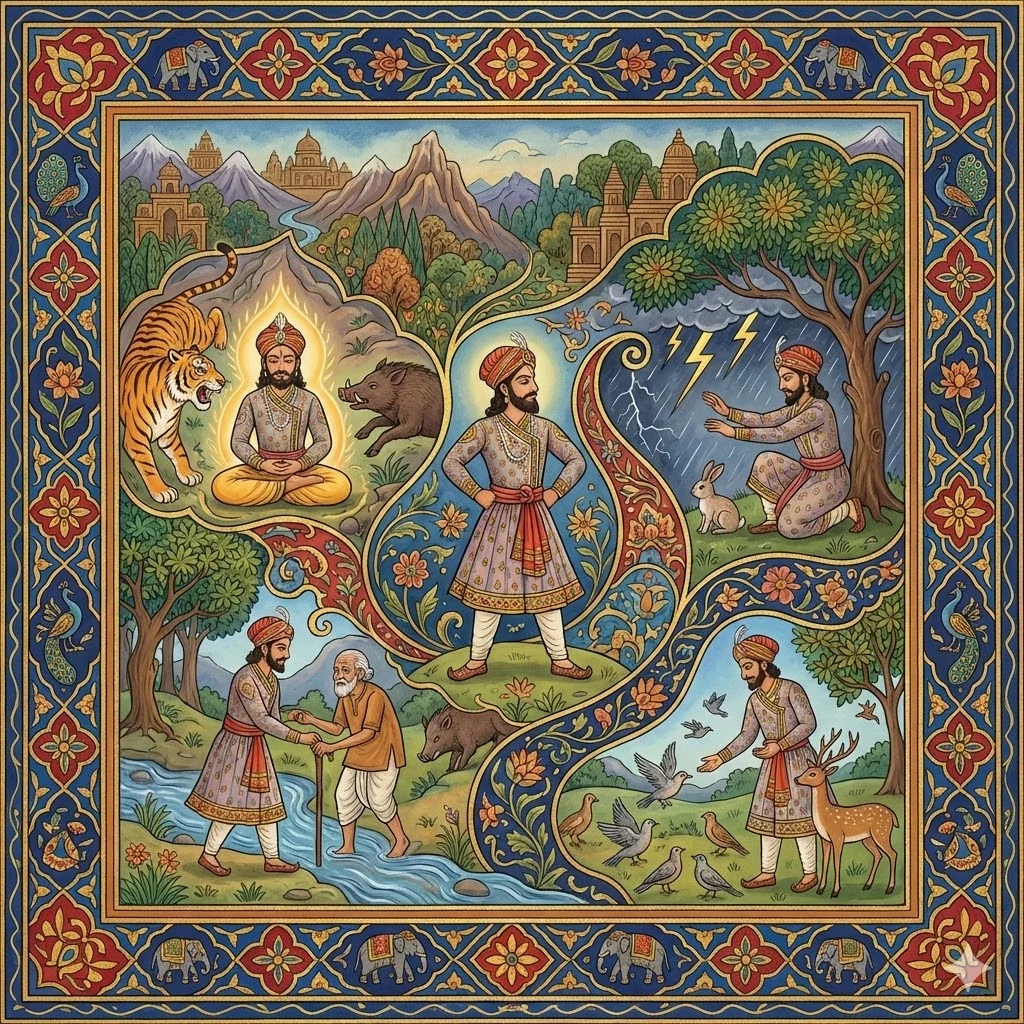
Kaushika—who now called himself Vishwamitra, meaning “friend of all”—went deep into the forest.
He began practicing tapas (austerities)—extreme spiritual disciplines meant to purify the soul and generate spiritual power.
He meditated for years without moving.
He fasted for months, eating only a single grain of rice per day—then only water—then only air.
He stood on one leg for decades, weathering rain, heat, and cold without shelter.
He practiced such severe self-discipline that his body became thin as a skeleton, his hair grew long and matted, his skin was burned by the sun.
But still, he was not satisfied. Because when the gods tested his spiritual status, they called him “Rajarshi”—a royal sage, one who was spiritually advanced but still carried the essence of a king.
Vishwamitra wanted more. He wanted to be recognized as a full Brahmarishi—a Brahmin sage of the highest order, equal to Vasishtha himself.
So he continued his practice, even more intensely.
THE TEMPTATION OF MENAKA
After thousands of years of meditation, Vishwamitra’s spiritual power had grown so immense that the gods began to worry.
What if he becomes more powerful than us? they wondered. What if his austerities give him the power to overthrow heaven itself?
So Indra, king of the gods, devised a plan to break Vishwamitra’s concentration.
He sent Menaka, the most beautiful of the apsaras (celestial nymphs), to tempt the sage.
Menaka descended to earth and appeared in the forest where Vishwamitra meditated. She danced and sang, moving with grace and beauty beyond anything mortal.
For thousands of years, Vishwamitra had resisted every temptation—hunger, thirst, heat, cold, pain. His concentration had been unbreakable.
But when he opened his eyes and saw Menaka, something stirred in his heart.
He was, after all, a former king who had once enjoyed all the pleasures of royal life. And Menaka’s beauty was beyond anything in the mortal world.
Vishwamitra’s concentration broke.
He spent several years with Menaka, and together they had a daughter named Shakuntala (who would later become an important figure in the Mahabharata).
But eventually, Vishwamitra realized what had happened. The gods had tricked him. He had lost thousands of years of spiritual progress because of a moment of weakness.
He was furious—at the gods for their deception, at Menaka for distracting him, but most of all at himself for failing.
“I will not be defeated!” he vowed. “I will begin again, and this time, NOTHING will break my concentration!”
And so Vishwamitra returned to his practice, more determined than ever.
He meditated for another thousand years.
This time, when the gods sent distractions, he did not even notice them.
This time, when demons tried to disturb his peace, he remained perfectly still.
This time, nothing could shake him.
BRAHMARISHI AT LAST
After many thousands of years of the most intense spiritual practice imaginable, something extraordinary happened.
The sky opened up, and Brahma himself—the creator god, the highest being in the universe—appeared before Vishwamitra.
“Vishwamitra,” Brahma said, his voice echoing through the cosmos, “you have proven yourself. You have transformed from a Kshatriya king into a Brahmin sage through sheer determination and devotion. I now grant you the title you have earned: Brahmarishi—a Brahmin sage of the highest order.”
Vishwamitra bowed low, tears streaming down his face.
But he needed one more thing—the recognition of his old rival.
And at that moment, Vasishtha himself appeared.
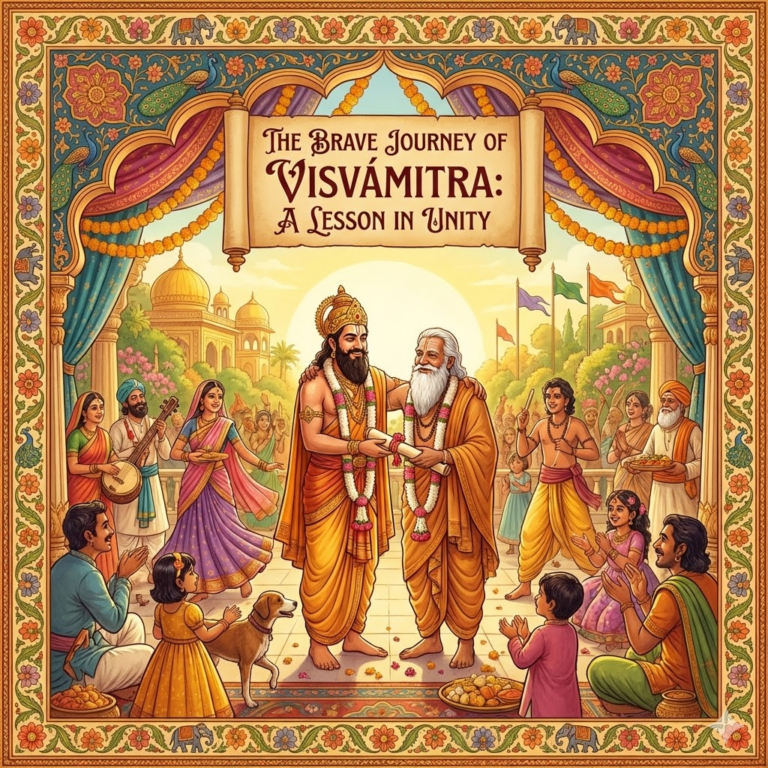
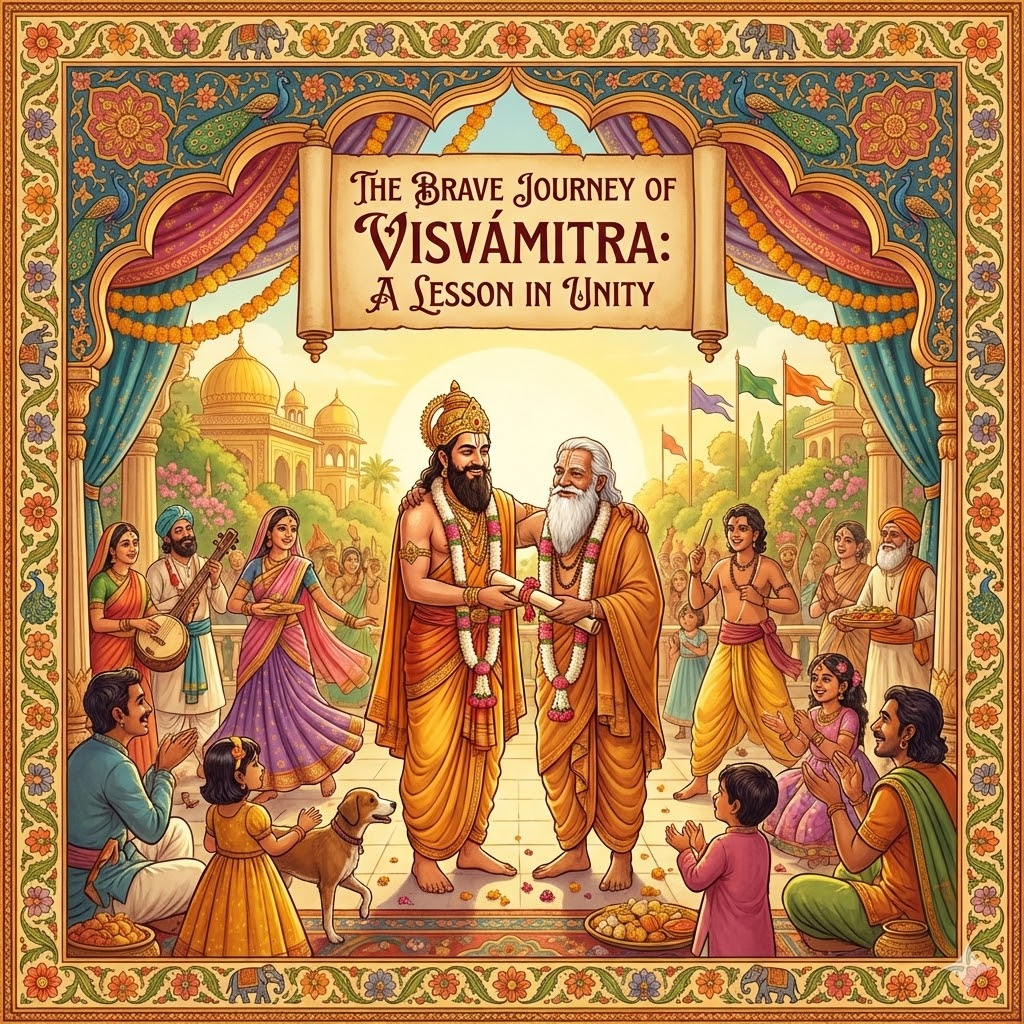
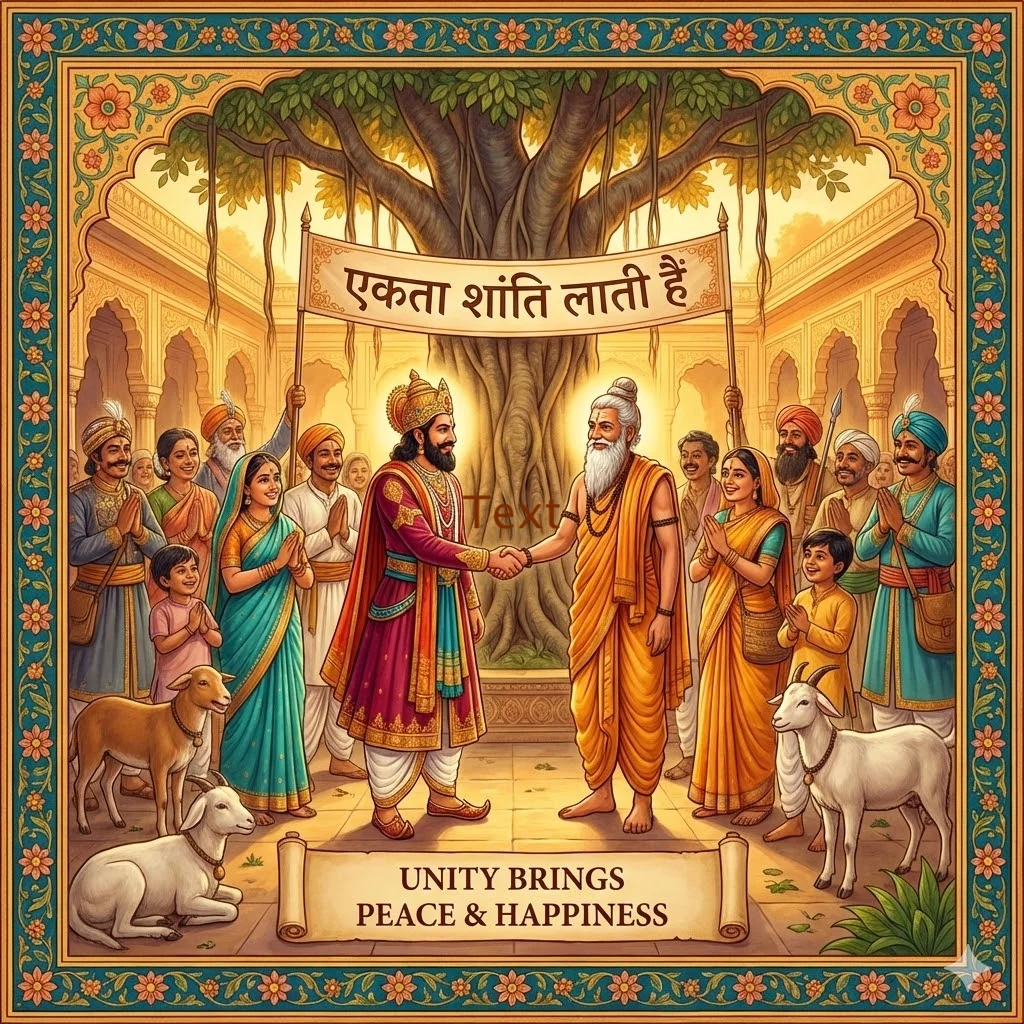
The great sage looked at Vishwamitra and smiled. “My friend,” Vasishtha said, embracing him, “you have done what few have ever done. You have changed your very nature through will and practice. I recognize you as a Brahmarishi, my equal and my brother in the spiritual path.”
Vishwamitra had achieved his goal.
He was no longer King Kaushika the warrior.
He was now Maharishi Vishwamitra, one of the greatest sages in all of India.
THE TEACHER OF RAMA
Many years later, Vishwamitra’s knowledge and power would serve a divine purpose.
When Prince Rama (who was actually Lord Vishnu incarnated as a human) was still a young man, Vishwamitra came to King Dasharatha’s palace in Ayodhya.
“I need your sons Rama and Lakshmana to come with me,” Vishwamitra said. “There are demons in the forest who are disturbing the sages and preventing our sacred rituals. Only Rama has the power to defeat them.”
Dasharatha was reluctant—Rama was still so young! But he trusted the great sage and allowed his sons to go.
Vishwamitra became Rama’s first teacher and guide. He taught Rama and Lakshmana advanced weapons techniques, divine mantras, and spiritual wisdom.
Under Vishwamitra’s guidance, Rama defeated the demoness Tadaka and her sons Maricha and Subahu, protecting the forest sages.
Later, Vishwamitra took Rama to the kingdom of Mithila, where Rama would win the hand of Sita by breaking the great bow of Shiva—setting in motion the events of the Ramayana.
Vishwamitra also composed what would become one of the most sacred verses in all of Hinduism: the Gayatri Mantra:
Om Bhur Bhuvah Svah
Tat Savitur Varenyam
Bhargo Devasya Dhimahi
Dhiyo Yo Nah Prachodayat
(A prayer for divine illumination to enlighten the mind)
This mantra is still chanted daily by millions of Hindus worldwide, more than 3,000 years after Vishwamitra first composed it.
THE MORAL OF THE STORY:
This sacred Hindu tale teaches us profound truths about transformation and spiritual power:
1. True power comes from within: King Kaushika had armies and wealth, but Vasishtha defeated him with spiritual power. Real strength isn’t about physical force—it’s about inner development, knowledge, and connection to something greater than ourselves.
2. Change is possible, but requires extreme effort: Vishwamitra achieved what seemed impossible—changing his very nature from warrior to sage. But it took thousands of years of dedication. Real transformation isn’t easy or quick.
3. Humility opens the door to growth: Kaushika could have remained bitter after his defeat. Instead, he admitted Vasishtha had something greater and sought to learn it. When we can admit someone else has wisdom we lack, we open ourselves to learning.
4. Setbacks are part of the journey: When Menaka distracted Vishwamitra, he had to start over. But he didn’t give up—he learned from his mistake and became even stronger. Failure is not the end; it’s a lesson.
5. Recognition must come from within first: Vishwamitra needed Brahma’s acknowledgment and Vasishtha’s acceptance, but he had to become a true sage in his heart first. External validation means nothing without internal transformation.
6. Spiritual knowledge surpasses worldly knowledge: The king gave up his throne for wisdom. In Hindu philosophy, moksha (spiritual liberation) is valued above artha (wealth) and kama (pleasure). What we know is more important than what we own.
7. Teachers prepare us for our destiny: Vishwamitra’s entire journey prepared him to be Rama’s guide. Sometimes our struggles are preparation for a purpose we don’t yet understand.
Frequently Asked Questions
What is the moral lesson of Vishwamitra: The King Who Became a Sage?
What age is this story appropriate for?
How long does it take to read Vishwamitra: The King Who Became a Sage?
What culture does this story come from?
Can I use this story for teaching?
Frequently Asked Questions
Who was Vishwamitra in Hindu mythology?
Vishwamitra was originally King Kaushika, a powerful Kshatriya ruler with vast armies and wealth. After a life-changing encounter with the sage Vasishtha, he embarked on a thousands-year spiritual journey to transform from a warrior-king into one of Hinduism’s greatest sages. His story is popular among moral stories for children teaching perseverance.
What moral lesson does the Vishwamitra story teach kids?
The Vishwamitra story teaches children about transformation, perseverance, and the power of spiritual growth. It shows how someone can completely change their life path through dedication and hard work, moving from material power to spiritual wisdom, making it an inspiring educational story for kids ages 6-12.
Is Vishwamitra a good bedtime story for kids?
Yes, Vishwamitra makes an excellent bedtime story for kids ages 6-12. It combines adventure, mythology, and moral lessons in an age-appropriate way. The story teaches important values like perseverance and spiritual growth while being engaging enough to hold children’s attention before sleep.
📚 Recommended Books
Handpicked for readers like you
As an Amazon Associate, we earn from qualifying purchases. These recommendations are personalized based on this story's themes and your reading history.
What happens when King Kaushika meets Sage Vasishtha?
When King Kaushika encounters Sage Vasishtha at his forest ashram, this meeting becomes the catalyst that changes his entire life. The encounter reveals to the king that spiritual power can be greater than material wealth and military strength, beginning his transformation into the sage Vishwamitra.
How long did Vishwamitra’s spiritual journey take?
According to the story, Vishwamitra’s spiritual journey from king to sage took thousands of years. This extraordinarily long timeline emphasizes the dedication and persistence required for true spiritual transformation, showing children that meaningful change takes time, effort, and unwavering commitment to one’s goals.