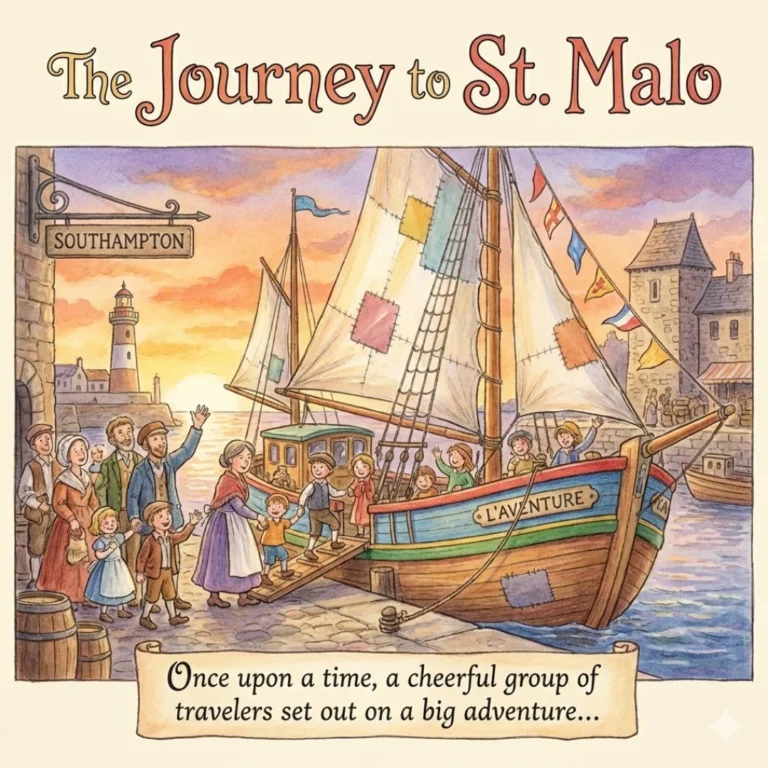
‘The Journey to St. Malo’ is an educational moral story perfect for bedtime reading with children ages 6-12.
The City Between the Sea and the Sky
Chapter One: The Voyage Begins
Marie was eleven years old and had never seen the sea.
She had lived her whole life in Paris, in a tall stone house on a quiet street, surrounded by the clatter of carriages and the cries of street vendors. Her father was a silk merchant who traveled constantly, and her mother had passed away when Marie was very young. Marie had been raised by her aunt, a kind but nervous woman who believed that children should be seen and not heard, and certainly never allowed to have adventures.
But now everything had changed. Marie’s father had decided that she was old enough to travel with him, and their destination was Saint-Malo, the famous corsair city on the coast of Brittany.
“Saint-Malo!” Aunt Bernadette had gasped when she heard the news. “That den of pirates and rogues? Surely you cannot take a young girl there!”
“They are corsairs, not pirates,” Marie’s father had replied with a smile. “Licensed by the King himself. Besides, Saint-Malo is the finest port in France. Marie needs to see the world beyond Paris.”
And so, on a gray autumn morning, Marie found herself in a coach rattling across the French countryside, watching fields and forests and small villages pass by outside the window. Her heart danced with excitement, even as part of her worried about what she might find.
What was the sea like? Were the Malouins really as wild as the stories said? Would she be brave enough to face whatever adventures awaited?
Chapter Two: First Sight of the Walls
After two days of travel, the coach climbed a small hill, and Marie had her first glimpse of Saint-Malo.
She gasped.
The city rose from the sea like something from a fairy tale. Great gray walls, taller than any she had seen even in Paris, encircled a mass of stone buildings crowned with pointed roofs. Church spires and towers thrust upward toward the cloudy sky. And all around the city, stretching to the horizon in every direction, was the sea.
The sea! Marie pressed her face against the coach window, drinking in the sight. It was gray-green and restless, covered with white-crested waves that rolled endlessly toward the shore. She could see ships in the harbor, their masts like a forest of bare trees, their sails furled as they rested at anchor.
“That’s Saint-Malo,” her father said proudly. “The corsair city. The city that has never been conquered. The Malouins have a saying: ‘Ni Francais, ni Breton, Malouin suis.’ Neither French nor Breton, I am Malouin.”
“They don’t consider themselves French?” Marie asked, surprised.
“They consider themselves Malouins first,” her father explained. “They are fiercely proud and fiercely independent. They answer to the King, but they bow to no one. That independence has made them the finest sailors and the bravest fighters in all of Europe.”
The coach descended toward the city gates, and Marie felt as if she were entering another world.
Chapter Three: Inside the Walls
The cobblestone streets of Saint-Malo were narrow and winding, hemmed in by tall houses of gray granite. The air smelled of salt and fish and tar, and everywhere Marie looked, she saw evidence of the sea: coils of rope stacked outside warehouses, barrels of salted cod being rolled along the streets, sailors in striped shirts laughing and singing in taverns.
Marie and her father were staying at the home of Monsieur Guillaume Duval, one of the wealthiest shipowners in the city. His house was tall and elegant, with large windows that looked out over the harbor.
“Welcome, welcome!” Monsieur Duval boomed as they arrived. He was a large man with a weathered face and hands like ship’s anchors. “And this must be young Marie! Tell me, mademoiselle, what do you think of our city?”
“It’s wonderful,” Marie said, finding her voice. “I’ve never seen anything like it.”
“Ha! Of course you haven’t. There is nowhere else like Saint-Malo in all the world. We are surrounded by enemies, battered by storms, threatened by the English at every turn, and yet here we stand, unconquered and unbroken. That is the Malouin spirit!”
Marie was introduced to Monsieur Duval’s family: his wife, a gentle woman with kind eyes; his son, a young man who was away at sea; and his granddaughter, Jeanne, who was exactly Marie’s age.
Jeanne was unlike any girl Marie had ever met. She wore her dark hair in a practical braid, and her dress was simple and sturdy rather than fashionable. Her eyes sparkled with curiosity and confidence.
“Have you ever been on a ship?” Jeanne asked Marie within five minutes of meeting her.
“No,” Marie admitted, feeling suddenly inadequate.
“Would you like to? My grandfather’s ship, the Belle Emeraude, is in harbor. I could show you around!”
Marie looked at her father, who nodded with a smile. “Go on. But stay with Jeanne, and don’t fall overboard.”
The two girls ran off together, and Marie’s adventure truly began.
Chapter Four: The Belle Emeraude
The Belle Emeraude was beautiful.
She was a frigate, Jeanne explained, built for speed and maneuverability. Her hull was painted dark green, and her name, meaning “Beautiful Emerald,” was written in gold on her stern. Her three masts towered overhead, draped with complex rigging that looked like a giant’s spider web.
“My grandfather was a corsair,” Jeanne said proudly as they walked along the deck. “He captured seventeen English ships before he retired. This was his ship.”
“A corsair,” Marie repeated, testing the word. “Like a pirate?”
“No!” Jeanne said firmly. “Pirates are outlaws. They attack anyone and keep everything for themselves. Corsairs are authorized by the King. We only attack enemy ships during wartime, and we share the prizes with the crown. It’s completely legal and honorable.”
She showed Marie the captain’s cabin, filled with maps and instruments. She showed her the galley where the cook prepared meals for the crew. She showed her the cannons, now cold and silent, that once blazed in battle.
“Would you like to climb to the crow’s nest?” Jeanne asked with a mischievous grin.
Marie looked up at the dizzying height of the main mast. The crow’s nest was a small platform near the very top, accessible only by climbing the rope ratlines that stretched up the mast.
“I… I don’t know if I can,” she admitted.
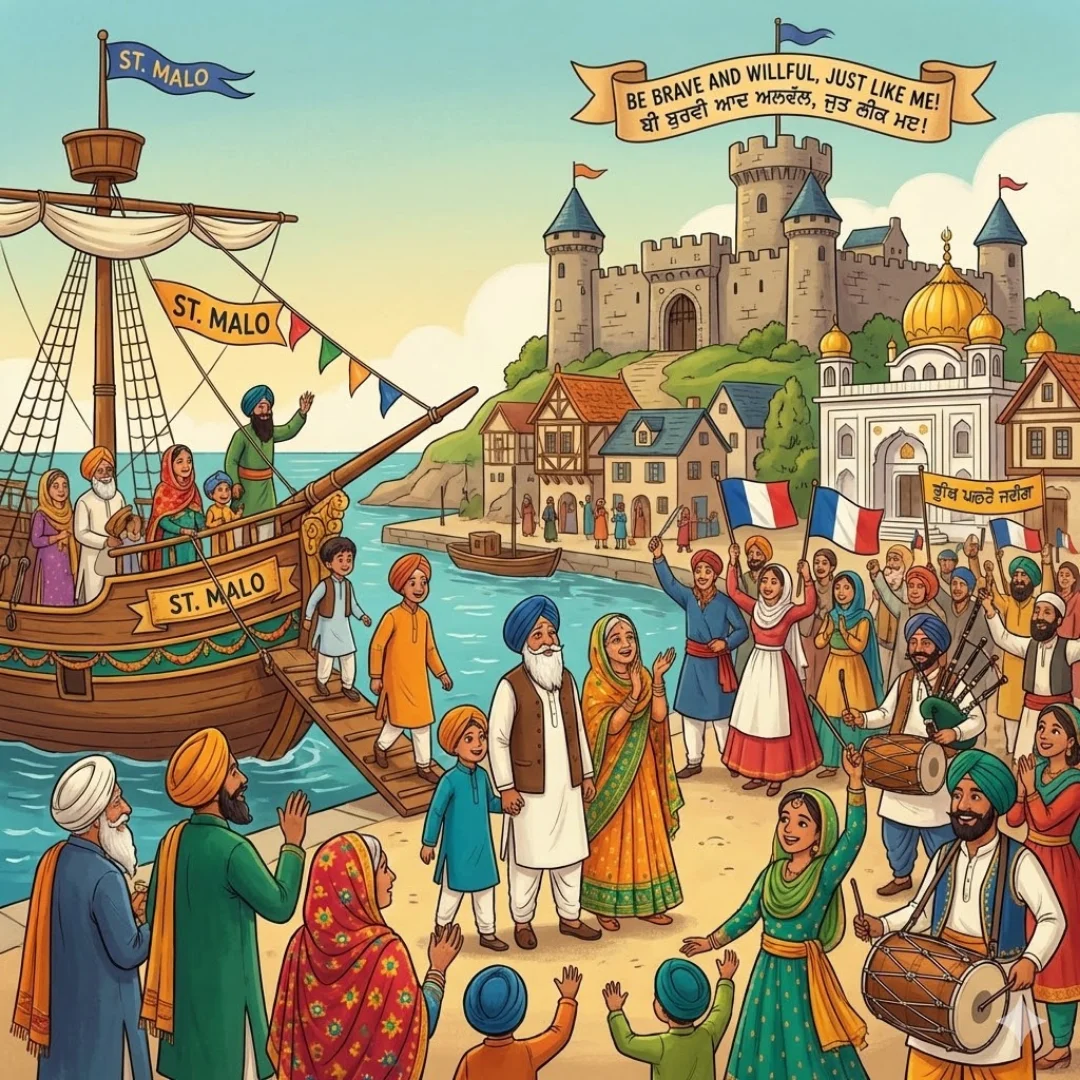
“That’s all right,” Jeanne said, not unkindly. “It took me a long time to learn. Courage isn’t about having no fear. It’s about trying even when you’re afraid.”
Those words stayed with Marie long after they returned to the Duval house for dinner.
Chapter Five: The Storm
That night, a terrible storm struck Saint-Malo.
Marie woke to the sound of howling wind and crashing waves. Lightning flickered outside her window, illuminating the roiling sea. She had never heard anything so loud, so powerful.
She crept to the window and looked out. What she saw took her breath away.
The waves were enormous, rising up like mountains of water before smashing against the city walls. Spray flew so high that it splashed against the upper windows of the houses. The ships in the harbor strained at their anchors, tossing like toys in a bathtub.
And then Marie saw something that made her heart stop: a ship, smaller than the Belle Emeraude, was being driven toward the rocks at the base of the wall. She could see tiny figures on deck, struggling against the storm.
She threw on her dress and ran downstairs. The Duval family was already awake, gathered in the parlor with worried faces.
“A fishing boat,” Monsieur Duval was saying grimly. “The Petite Mouette. Old Jean-Pierre’s boat. They must have been caught out when the storm hit.”
“Can nothing be done?” Marie’s father asked.
“In this storm? Any rescue boat would be dashed to pieces before it reached them.”
Marie felt sick. Those sailors were going to die, and no one could help them.
But then she noticed that Jeanne was gone.
Chapter Six: Jeanne’s Courage
Marie found Jeanne at the top of the city wall, near the lighthouse. The girl was tying a rope around her waist, preparing to climb down the outside of the wall toward the rocks below.
“Jeanne! What are you doing?” Marie shouted over the wind.
“There’s a chance!” Jeanne shouted back. “If I can reach the rocks, I can throw them a line! They can use it to pull themselves to safety!”
“That’s insane! You’ll be killed!”
“Maybe. But if I don’t try, they definitely will be killed. That’s not a choice, Marie. That’s what being a Malouin means.”
Marie stood frozen in the howling wind and rain. Everything she had been taught told her to stay safe, to go back inside, to let the adults handle this. But Jeanne was already climbing over the wall, and she was alone.
Courage isn’t about having no fear. It’s about trying even when you’re afraid.
“Wait!” Marie grabbed the other end of the rope. “I’ll anchor you! If you fall, I’ll pull you back up!”
Jeanne stared at her for a moment, then nodded. “All right. Together, then.”
Chapter Seven: The Rescue
What followed was the most terrifying hour of Marie’s life.
She braced herself against the wall, the rope wrapped around her waist and arms, as Jeanne climbed down the slick stones toward the churning sea below. Every time a wave crashed against the rocks, Marie was certain her friend would be swept away. Every time lightning flashed, she saw Jeanne’s small figure clinging to the stone like a determined spider.
But Jeanne made it. She reached a ledge just above the water line and began swinging a weighted rope toward the struggling ship.
It took five tries. Five times the line fell short or was caught by the wind. But on the sixth attempt, a sailor on the Petite Mouette caught it.
One by one, the sailors used the rope to pull themselves across the gap between the ship and the rocks. It was slow and terrifying work, but eventually, all five men were safe on the ledge with Jeanne.
Then came the hardest part: climbing back up.
Marie pulled with all her strength as Jeanne guided the exhausted sailors up the wall. Her arms felt like they were being torn from their sockets. The rain lashed her face and the wind tried to tear her from her position. But she did not let go.
Finally, as the first light of dawn began to color the sky, the last sailor hauled himself over the wall. Jeanne came last, her face white with cold and exhaustion, but grinning with triumph.
“We did it,” she gasped. “Marie, we did it!”
Marie could only nod, too tired and too overwhelmed to speak.
Chapter Eight: The Malouin Spirit
The story of the rescue spread through Saint-Malo like wildfire. By afternoon, everyone in the city knew about the two girls who had saved the crew of the Petite Mouette.
Marie found herself the center of attention, which made her deeply uncomfortable. She hadn’t done it for praise. She had done it because it was right.
That evening, Monsieur Duval gathered the household in the parlor. Old Jean-Pierre, the captain of the Petite Mouette, was there too, his weathered face wet with tears of gratitude.
“What you two did last night,” Monsieur Duval said solemnly, “that is the essence of what it means to be a Malouin. It is not about seeking danger. It is not about reckless bravery. It is about seeing someone in need and refusing to stand by when you might help.”
He turned to Marie. “You came here from Paris, a stranger to our ways. But last night, you showed the heart of a true Malouin. Our city’s motto is ‘Neither French nor Breton, I am Malouin.’ But I think perhaps we should add: ‘A Malouin is anyone who faces the storm to help their fellow human.’”
Marie felt tears prick her eyes. “I was so scared,” she admitted. “The whole time, I was terrified.”
“Of course you were,” Monsieur Duval said gently. “Only a fool feels no fear. But you did not let your fear stop you. You held that rope and you did not let go, even when every instinct told you to run. That, my dear, is courage.”
Jeanne squeezed Marie’s hand. “Partners in adventure,” she whispered.
Marie squeezed back. “Partners in adventure.”
Chapter Nine: The Castle’s Secret
Before Marie left Saint-Malo, Jeanne took her to see one last thing: the castle that guarded the entrance to the harbor. It was ancient, built centuries ago, and on one of its towers was an inscription that Jeanne said every Malouin child learned by heart.
“Quic en groigne, ainsi sera, car tel est mon plaisir,” Marie read, struggling with the old French.
“It means ‘Grumble who may, it shall be so, for such is my pleasure,’” Jeanne translated. “It was put there by the Duchess Anne of Brittany, who built this tower. People complained that she was spending too much money, that she was being too ambitious. She put up this inscription to say: ‘Complain all you like. I know what I’m doing, and I’m going to do it anyway.’”
“That sounds very stubborn,” Marie observed.
“It is stubborn! But it’s also brave. Sometimes, being brave means ignoring the people who tell you something is impossible. Sometimes it means trusting your own judgment even when others doubt you.”
Jeanne pointed out to sea, where ships were sailing in and out of the harbor, their sails bright against the gray sky.
“Every one of those ships is captained by someone who had to believe in themselves,” she said. “Every voyage is a risk. Every storm could be the last. But the Malouins sail anyway, because the world is too big and too wonderful to stay safe on shore.”
Marie nodded slowly. She thought about her life in Paris, about the quiet house and the careful routines. It had been safe, but it had also been small.
“I want to come back,” she said suddenly. “I want to learn to sail. I want to climb to the crow’s nest. I want to be a Malouin.”
Jeanne grinned. “Then you will. Because you’ve already proven you have the heart for it.”
Chapter Ten: The Journey Home
The coach that carried Marie back to Paris felt different from the one that had brought her to Saint-Malo. The seats were the same, the rattling wheels were the same, but Marie was not the same.
She sat by the window, watching the Breton countryside give way to the forests and farms of inland France, and she thought about everything she had experienced.
She had seen the sea. She had walked on the deck of a corsair ship. She had stood against a storm and helped save five lives. She had made a friend who showed her what courage really meant.
And she had learned something important about herself: she was braver than she had ever known.
When they arrived in Paris, Aunt Bernadette was waiting at the door, her face pinched with worry.
“My dear child! You look exhausted! What happened? Was it terrible? Did those pirates frighten you?”
Marie smiled and kissed her aunt’s cheek. “They’re corsairs, not pirates. And no, they didn’t frighten me. They inspired me.”
That night, as Marie lay in her familiar bed in her familiar room, she could still hear the sound of the waves crashing against the walls of Saint-Malo. She could still feel the rope in her hands, still see Jeanne’s determined face climbing down into the storm.
And she made herself a promise.
She would return to Saint-Malo. She would learn to sail. She would become the kind of person who faced storms instead of hiding from them.
Because she had learned the most important lesson of all: courage is not about having no fear. Courage is about acting despite fear, about holding on when everything tells you to let go, about being willing to face the unknown because the world is too big and too wonderful to stay safe on shore.
And in the quiet Paris night, Marie smiled, knowing that her adventure was only beginning.
Epilogue: The Malouin Way
Saint-Malo still stands today, its gray walls rising from the sea just as they did centuries ago. Though the corsairs are gone, their spirit lives on in every Malouin.
Visitors who walk the city streets can still see the tall stone houses, the ancient castle, and the harbor where ships once sailed to raid the enemies of France. They can walk along the walls and look out at the sea that gave the Malouins their strength and their character.
And if they listen carefully, they might hear the echo of an old saying, passed down through generations of this remarkable city:
“Ni Francais, ni Breton, Malouin suis.”
Neither French nor Breton, I am Malouin.
Which really means: I am someone who faces challenges head-on. I help those in need. I believe in myself even when others doubt me. I know that courage is not the absence of fear but the determination to act despite it.
Anyone can be a Malouin, regardless of where they were born. All it takes is the willingness to face the storms of life with bravery, compassion, and an unbreakable spirit.
Moral Lessons
- True courage is not the absence of fear but the determination to act despite it. When we help others in need, we discover strength we never knew we had. Believing in ourselves, even when others doubt us, is the beginning of all great adventures.
Test Your Understanding
1. What is Saint-Malo’s famous motto, and what does it mean?
Frequently Asked Questions
What is the moral lesson of The Journey to St. Malo?
What age is this story appropriate for?
How long does it take to read The Journey to St. Malo?
What culture does this story come from?
Can I use this story for teaching?
Frequently Asked Questions
What is ‘The Journey to St. Malo’ story about?
The Journey to St. Malo follows eleven-year-old Marie from Paris who travels with her father to the historic corsair city of Saint-Malo in Brittany, France. Having never seen the sea before, Marie embarks on an adventure that takes her from her sheltered life to discover the world beyond her familiar surroundings.
What age group is this bedtime story suitable for?
This educational story is perfect for children ages 6-12. The content is age-appropriate with gentle adventure themes and moral lessons that make it ideal for bedtime reading. Parents can comfortably share this story with elementary school-aged children who enjoy tales of discovery and courage.
Where is Saint-Malo and why is it important in the story?
Saint-Malo is a historic walled port city in Brittany, France, famous for its corsairs – licensed privateers who worked for the French crown. The city represents adventure and the wider world beyond Marie’s sheltered Parisian life, symbolizing her journey from childhood safety to growing independence.
📚 Recommended Books
Handpicked for readers like you
As an Amazon Associate, we earn from qualifying purchases. These recommendations are personalized based on this story's themes and your reading history.
Is this story appropriate for bedtime reading with kids?
Yes, this moral story is specifically designed for bedtime reading with children. It features gentle adventure themes without scary content, making it perfect for winding down before sleep. The story encourages curiosity about the world while providing comfort and security.
What life lessons does Marie learn during her journey?
Marie’s adventure teaches valuable lessons about courage, curiosity, and stepping outside one’s comfort zone. She learns that the world beyond familiar surroundings holds wonder and opportunity, while discovering her own strength and independence through travel and new experiences.