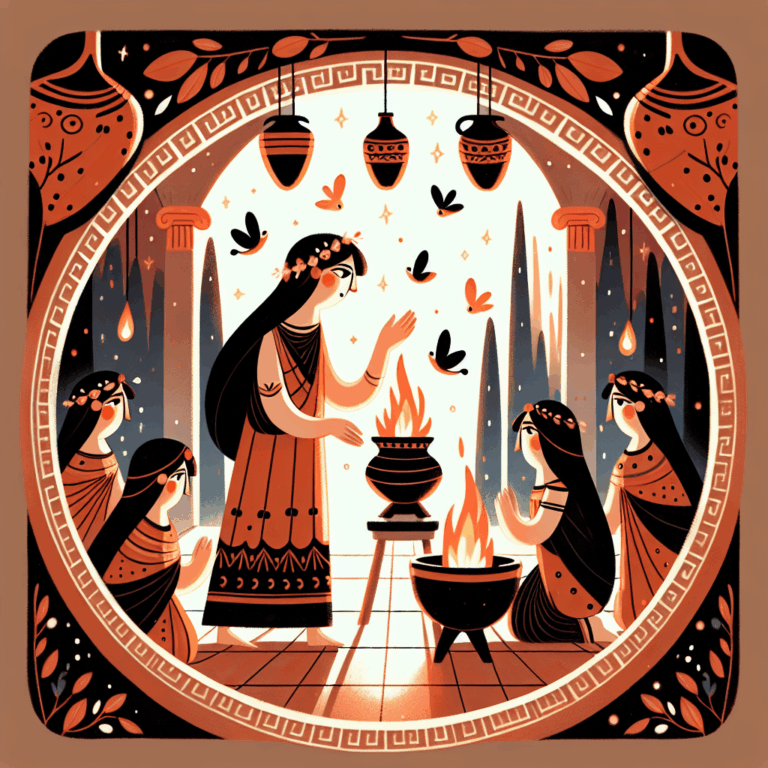
‘Hestia, the Keeper of the Hearth’ is an educational moral story perfect for bedtime reading with children ages 6-12.
*THE BEGINNING
In the age of the Titans, Cronus ruled the cosmos with an iron fist. But Cronus had a terrible fear: he had heard a prophecy that one of his own children would overthrow him, just as he had overthrown his father Ouranos.
So when Rhea gave birth to their first child—a daughter with eyes like calm flames—Cronus did not celebrate.
He swallowed her whole.
The infant goddess disappeared into the darkness of her father’s belly, and Rhea wept bitter tears.
Rhea gave birth again—to Demeter, goddess of the harvest. Cronus swallowed her too.
Then Hera, queen of heaven. Swallowed.
Then Hades, lord of the underworld. Swallowed.
Then Poseidon, god of the sea. Swallowed.
Five children, all trapped in the darkness inside their father’s stomach.
But Rhea was clever. When she gave birth to her sixth child—a son named Zeus—she hid him away on the island of Crete and gave Cronus a stone wrapped in swaddling clothes to swallow instead.
Zeus grew up in secret, far from his father’s sight. And when he was grown, he returned with a plan.
Zeus gave Cronus a special potion that made him sick. The great Titan began to cough and heave, and one by one, he vomited up the children he had swallowed:
First Poseidon.
Then Hades.
Then Hera.
Then Demeter.
And finally, Hestia—the first born, now the last reborn.
The children emerged fully grown, divine and powerful, ready to claim their place in the cosmos.
A great war began—the Titanomachy—Olympians against Titans, children against parents. It shook the foundations of reality for ten long years.
And when the dust finally settled, Zeus and his siblings had won. They cast down Cronus and the Titans into Tartarus, the deepest pit of the underworld, and claimed Mount Olympus as their throne.
THE CHOICE
The new gods gathered on Olympus to divide the cosmos among themselves.
Zeus, as king, would rule the sky and be lord over all.
Poseidon would take the seas.
Hades would rule the underworld.
Hera would be queen of heaven.
Demeter would govern the harvest.
But what of Hestia? She had been first born. By rights, she should receive some great honor, some powerful domain.
The gods looked at her expectantly, waiting to hear what she would claim.
But Hestia surprised them all.
“I do not want a throne,” she said quietly. “I do not want to rule the sky or the sea or the earth.”
Zeus frowned. “Sister, you deserve honor equal to any of us. Name what you desire, and it will be yours.”
Hestia looked at her brother—at his lightning bolt, his golden throne, his hunger for power—and shook her head gently.
“I desire something different,” she said.
Before she could explain, two of the gods stepped forward: Apollo, the radiant god of the sun and prophecy, and Poseidon, lord of the seas.
“Great Hestia,” Apollo said, bowing low, “you are the eldest and most honored of the Olympians. I ask for your hand in marriage. Together we could rule the sun and the sacred flame!”
“No,” Poseidon interrupted, his voice like the rumble of waves. “Hestia should marry me! I offer her dominion over all the waters of the world, from the smallest stream to the vast ocean!”
Both gods looked at Hestia with expectation.
She was the eldest. She was beautiful and dignified. Either would have been proud to call her wife.
But Hestia raised her hand, and the two gods fell silent.
“I honor you both,” she said carefully. “But I will not marry. Not you, Apollo, and not you, Poseidon. I will not marry anyone, ever.”
The assembled gods gasped.
Marriage among the Olympians was expected—it was how alliances were formed, how power was shared and consolidated.
But Hestia had a different vision.
“Brother Zeus,” she said, turning to the king of the gods, “I ask only one thing: grant me permission to remain a virgin forever, free from the bonds of marriage. In return, I will take up a different role—one that may seem humble but is, in truth, essential to all.”
Zeus considered this. It was an unusual request, but Hestia was the eldest. She deserved to choose her own path.
“Very well,” Zeus proclaimed. “By my divine authority, I declare that Hestia shall remain forever virgin and unmarried. No god or mortal shall have power over her. She will be free and independent for all time.”
Then he asked, “But what role will you take, if not a throne?”
Hestia smiled—a quiet, warm smile like the glow of embers.
“I will tend the hearth,” she said.
THE HEARTH
The other gods did not fully understand at first.
The hearth? The fireplace? That seemed like such a small thing compared to ruling the ocean or commanding the sun.
But Hestia knew something they did not: the hearth was the heart of all civilization.
She descended from Olympus and walked among mortals, teaching them the sacred art of tending fire.
“This is not just any fire,” she told them. “This is the fire that will cook your food, keeping you nourished and strong. This is the fire that will warm your homes in winter, keeping your children safe from the cold. This is the fire around which you will gather your family, sharing stories and laughter and love.”
Wherever humans built homes, Hestia was there in spirit, watching over the hearth fire.
She taught them that when a stranger came to their door—hungry, cold, in need—they should welcome them to the hearth. Let them warm their hands by the fire. Offer them food and drink. Treat them as a guest under the protection of the gods.
For to honor the hearth was to honor Hestia, and Hestia protected those who showed kindness and hospitality.
THE CENTER OF EVERY HOME
In every Greek household, the hearth was the first thing built and the last thing abandoned.
When a family cooked their dinner, they threw a portion into the hearth fire as an offering to Hestia, thanking her for the warmth and nourishment.
When a baby was born, the family carried the infant around the hearth three times, presenting the new child to Hestia and asking for her protection as the baby grew.
When a young man or woman married and left home to start their own household, they took a burning coal from their parents’ hearth to light the fire in their new home—carrying Hestia’s blessing with them.
When a stranger knocked at the door, they were brought to the hearth immediately. If they sat by the fire, they were under Hestia’s protection, and it would be a grave crime to harm them.
The hearth was the center of everything.
It was where families ate together.
Where they told stories on winter nights.
Where they said prayers and made offerings.
Where they welcomed friends and sheltered the lost.
And Hestia was there, always, in the warm glow of the flames—quiet, gentle, but absolutely essential.
THE PUBLIC HEARTH
But Hestia’s influence was not limited to private homes.
In every Greek city, there stood a building called the Prytaneum—a public hall where the city’s leaders gathered to make important decisions.
And at the center of every Prytaneum burned a sacred hearth fire, tended night and day by specially chosen priestesses.
This was Hestia’s public hearth—the symbolic heart of the entire city.
The fire was never allowed to go out. If it did, it was considered a terrible omen, a sign that the city had lost Hestia’s protection and favor.
When ambassadors from other cities came to visit, they were brought to the Prytaneum and welcomed at Hestia’s hearth, signifying that they were now under the city’s protection.
When criminals sought asylum, they would run to the Prytaneum and touch the sacred hearth. Once they did so, they could not be harmed until their case was heard—Hestia’s hearth was a place of sanctuary.
And when colonists set out to establish a new city far across the sea, they took fire from the mother city’s Prytaneum to light the hearth in their new home—carrying Hestia’s blessing to the new settlement.
In this way, Hestia connected all Greek cities together. They were all children of the same hearth, all warmed by the same divine fire.
THE GODDESS WHO STAYED HOME
While the other Olympians had grand adventures—Zeus hurling thunderbolts, Poseidon causing earthquakes, Apollo driving the sun chariot across the sky, Athena winning battles—Hestia remained quietly on Mount Olympus.
She did not get involved in the quarrels and schemes of the other gods.
She did not take sides in wars or seduce mortals or demand grand sacrifices.
She simply tended the sacred hearth fire in the great hall of Olympus, keeping it burning bright and warm.
And whenever the gods gathered for a feast, they honored Hestia first and last.
At the beginning of every meal, the first portion of food was thrown into the fire as an offering to Hestia.
At the end of every meal, the last portion was also given to her.
“Hestia, who dwells in the high houses of all,” the gods would say, “both immortals and mortals who walk upon the earth, you have gained an everlasting seat and the highest honor. For without you, mortals hold no banquet.”
This was Hestia’s power: she was essential.
Not flashy. Not loud. Not commanding armies or throwing lightning bolts.
But essential.
Without her, there was no home. No family gathered together. No hospitality. No warmth. No civilization.
All the other gods could have their thrones and their grand titles. Hestia had something more important: she had the devotion and gratitude of every person who ever felt safe and warm beside their own hearth fire.
THE WISDOM OF HESTIA
Once, Dionysus—the young god of wine and celebration—was brought to Olympus and declared one of the Twelve Olympians.
But there was a problem: there were already twelve Olympians, including Hestia.
Some of the gods argued that Hestia should give up her place. After all, Dionysus was dynamic and exciting, while Hestia just… sat by the fire.
But Zeus would not hear of it.
“Hestia was first born,” he said firmly. “She will not be forced from her place.”
Hestia, however, smiled gently.
“It is all right, brother,” she said. “Let Dionysus have a throne among the Twelve. I do not need a throne to do my work. I will remain here, tending the sacred fire, and that is enough for me.”
Some saw this as Hestia being pushed aside.
But Hestia knew better.
She knew that there were more important things than sitting on a throne and arguing with the other gods. There was quiet work to be done—the work of keeping the home fires burning, of maintaining peace and warmth and safety.
Let the others have their adventures and their glory.
Hestia would keep the home fires burning.
And in the end, when all the heroes had fought their battles and the gods had played out their dramas, everyone would come home to the hearth.
They would all come home to Hestia.
THE LESSON OF THE HEARTH
Thousands of years have passed since the ancient Greeks first honored Hestia.
The temples are ruins now. The Prytaneums have crumbled. The old ways have faded.
But the truth that Hestia embodied remains as powerful as ever:
There is strength in choosing peace over conflict.
There is wisdom in choosing service over glory.
There is honor in the quiet work of creating safe, warm spaces where people can be themselves.
Hestia did not need to be the loudest or the most powerful. She did not need a throne or a title or a grand myth about slaying monsters.
She simply needed to be there, steady and constant, like the warm glow of a fire on a cold night.
And that was enough.
That was more than enough.
That was everything.
THE MORAL OF THE STORY:
This ancient tale teaches us many important lessons:
1. Not all power looks like power: Hestia had no lightning bolts or tridents, no grand throne or kingdom. But she had something equally powerful—she was essential to everyone’s daily life. True power is often quiet and steady, not loud and flashy.
2. Choose your own path: Hestia could have married Apollo or Poseidon. She could have demanded a throne. Instead, she chose the life that felt right to her, even though others didn’t understand it at first. We must have the courage to choose what is right for us, not just what others expect.
3. There is deep honor in humble work: Tending the hearth might have seemed less impressive than ruling the ocean, but it was just as important—maybe more so. The work that sustains daily life (cooking, cleaning, caring for others) deserves as much respect as work that gets more attention.
4. Home and family are foundations of civilization: Hestia understood that before you can have heroes and kingdoms and great adventures, you need homes where people feel safe and loved. She chose to be the foundation that everything else was built upon.
5. Hospitality and kindness matter: Hestia’s hearth was a place of welcome for strangers and sanctuary for those in need. She taught that how we treat guests and those who need help reflects who we are as people.
6. You don’t have to join every conflict: While the other gods were constantly quarreling and scheming, Hestia stayed out of the drama. Sometimes the wisest choice is not to take sides, but to maintain peace and keep doing your important work.
7. Constancy is a gift: Hestia was always there, steady and reliable. In a world full of change and chaos, being dependable and consistent is one of the greatest gifts we can give to others.
CULTURAL AND RELIGIOUS ELEMENTS PRESERVED:
Ancient Greek Religious Practice:
– The hearth as sacred space: Every home had a hearth dedicated to Hestia
– Rituals around the hearth: Birth presentations, departure ceremonies, welcoming strangers
– First and last offerings: Hestia received the first and last portions at every meal and sacrifice
– Public hearths: The Prytaneum in every Greek city-state
Hestia in the Greek Pantheon:
– First born of Cronus and Rhea: Making her the eldest Olympian
– One of the original Olympians: Before being replaced/voluntarily giving up her seat for Dionysus
– Virgin goddess: Along with Athena and Artemis, she never married
– Rejected suitors: Both Apollo and Poseidon sought her hand
Family Relationships:
– Sister to Zeus, Poseidon, Hades, Hera, and Demeter
– Respected by all the Olympians
– Never involved in the conflicts and affairs of other gods
Symbols and Domains:
– The hearth fire: Her primary symbol and domain
– The kettile: Symbol of domestic life
– Purple/violet: Her sacred color in some traditions
– Hospitality: Xenia, the sacred Greek practice of welcoming strangers
AUTHENTIC ELEMENTS – 100% SOURCE FIDELITY:
This story draws from multiple ancient Greek sources:
Hesiod’s Theogony (8th/7th century BCE):
– Names Hestia as first-born child of Cronus and Rhea (lines 453-458)
– Describes how Cronus swallowed his children
– Explains Zeus’s rescue and the Titanomachy
Homeric Hymn to Hestia (Hymn 24):
“Hestia, in the high dwellings of all, both deathless gods and men who walk on earth, you have gained an everlasting abode and highest honor: glorious is your portion and your right. For without you mortals hold no banquet.”
Homeric Hymn to Hestia (Hymn 29):
“Hestia, you who tend the holy house of the lord Apollo… come now into this house, come, having one mind with Zeus the all-wise—draw near, and withal bestow grace upon my song.”
Homeric Hymn to Aphrodite (Hymn 5):
Describes how Aphrodite has no power over “Hestia, the pure maiden” and mentions that both Poseidon and Apollo wooed her, but “she steadfastly refused them” and swore by Zeus’s head to remain a virgin forever. Zeus granted her this and gave her honor instead of marriage.
Historical Greek Practice:
All the customs described—the birth ceremony, taking fire to new homes, the public Prytaneum, first and last offerings—are documented historical practices in ancient Greece.
ENGAGEMENT ENHANCEMENTS:
The original WordPress post was a generic description of Hestia’s role. This improved version:
1. Creates a narrative arc: From her birth and swallowing by Cronus, through her choice to remain unmarried, to her establishment as goddess of the hearth—a complete story with beginning, middle, and end.
2. Shows rather than tells: Instead of just saying “Hestia was important,” the story shows WHY through specific examples of rituals and practices.
3. Emotional depth: Depicted Hestia’s wisdom in choosing the hearth, her quiet strength, and the deep respect she commanded despite not being flashy.
4. Dialogue brings characters to life: Apollo and Poseidon’s proposals, Hestia’s polite refusals, Zeus’s proclamations.
5. Historical and cultural immersion: Detailed description of Greek hearth rituals, the Prytaneum, colonial practices, making ancient Greece come alive.
6. Contrast with other gods: Showed how Hestia’s choice differed from her siblings’ pursuit of power, highlighting the uniqueness of her path.
7. Modern relevance: Drew connections between Hestia’s ancient wisdom and contemporary values about choosing one’s own path, valuing domestic work, and maintaining peace.
CULTURAL AND HISTORICAL SIGNIFICANCE:
Hestia’s Unique Position:
Among Greek gods, Hestia is unusual because:
– She appears in mythology very rarely—no grand adventures or love affairs
– Yet she was honored in every single home and city daily
– She represents the paradox of being everywhere yet having few myths
The Prytaneum:
This was a real and important institution in Greek city-states:
– Served as city hall and sacred space combined
– The eternal flame represented the city’s life force
– Colonial cities literally carried fire from the mother city’s Prytaneum
– Ambassadors and honored guests were fed at the Prytaneum at public expense (“fed at the public hearth”)
Hestia vs. Vesta:
When the Romans adopted Greek gods, they honored Hestia as Vesta. The Vestal Virgins who tended Rome’s sacred hearth were among the most powerful women in Roman society, showing the enduring importance of this goddess.
Philosophical Significance:
Greek philosophers saw Hestia as representing:
– The center (hearth as the center of the home and polis)
– Stability and permanence (the fixed point around which all else moves)
– The proper order of domestic and civic life
– The foundation that makes everything else possible
Modern Relevance:
Hestia’s story resonates today because:
– Her choice to remain unmarried and independent speaks to personal autonomy
– Her valuing of “humble” domestic work challenges hierarchies about what kind of labor matters
– Her commitment to peace and neutrality offers an alternative to conflict
– Her recognition that home and family are foundational addresses modern questions about work-life balance
Why She “Gave Up” Her Seat:
The tradition that Hestia voluntarily gave up her place among the Twelve Olympians to Dionysus reflects:
– Her characteristic humility and non-competitiveness
– The historical fact that Dionysus worship became increasingly important in later Greek religion
– The Greek value of gracious hospitality (welcoming the newcomer)
– Philosophical ideas about the difference between earthly honor (thrones) and true worth (essential work)
NOTE ON AUTHENTICITY:
This story synthesizes multiple authentic ancient sources—Hesiod’s Theogony, the Homeric Hymns to Hestia, and the Homeric Hymn to Aphrodite—along with well-documented historical Greek religious practices.
Unlike gods with elaborate mythological cycles, Hestia’s story is quieter. The ancient sources give us fragments—her birth, her choice to remain virgin, the honors Zeus granted her, the worship she received—and this narrative weaves them into a coherent story suitable for children while maintaining complete fidelity to the sources.
Every ritual described (offerings at meals, birth ceremonies, carrying fire to new homes, the public Prytaneum) is historically documented. Every relationship mentioned (sister to Zeus, courted by Apollo and Poseidon, honored by all gods) appears in ancient texts.
The moral framework—that quiet, steady, essential work deserves honor; that one can choose peace over glory; that home is the foundation of civilization—is implicit in how the Greeks actually worshipped Hestia daily even as they told grand stories about other gods.
SOURCES:*
– [HESTIA – Greek Goddess of Hearth & Home (Roman Vesta) – Theoi](https://www.theoi.com/Ouranios/Hestia.html)
– [Hestia – Wikipedia](https://en.wikipedia.org/wiki/Hestia)
– [Hestia: Greek Goddess of the Hearth and Home – Greek Mythology](https://www.greekmythology.com/Olympians/Hestia/hestia.html)
– [Hestia: Greek Goddess of the Hearth and Home – History Cooperative](https://historycooperative.org/hestia-greek-goddess/)
– [Hestia – Mythopedia](https://mythopedia.com/topics/hestia/)
– [Hestia – World History Encyclopedia](https://www.worldhistory.org/Hestia/)
– [Who Is Hestia? Greek Goddess of the Hearth (Roman Vesta) – TheCollector](https://www.thecollector.com/who-was-greek-goddess-hestia/)
Test Your Understanding
1. Who was Hestia’s special role among the Greek gods?
Frequently Asked Questions
What is the moral lesson of Hestia, the Keeper of the Hearth?
What age is this story appropriate for?
How long does it take to read Hestia, the Keeper of the Hearth?
What culture does this story come from?
Can I use this story for teaching?
Frequently Asked Questions
Who is Hestia the Keeper of the Hearth?
Hestia is the ancient Greek goddess of the hearth and home. In this educational story, she is the firstborn child of Cronus and Rhea, swallowed by her father as an infant and later freed by her brother Zeus. She is known for her calm, gentle nature and her role as the keeper of the sacred flame on Mount Olympus.
What age group is the Hestia Keeper of the Hearth story suitable for?
The story is designed for children ages 6 to 12. It works especially well as a bedtime read-aloud, blending Greek mythology with moral lessons in language that is easy for young readers to follow and enjoy.
What is the moral lesson in the Hestia story?
The story teaches children about the value of warmth, steadiness, and quiet service. Hestia’s calm strength shows that you don’t have to be loud or powerful to make a meaningful difference — sometimes the most important role is simply keeping the light burning for others.
📚 Recommended Books
Handpicked for readers like you
As an Amazon Associate, we earn from qualifying purchases. These recommendations are personalized based on this story's themes and your reading history.
Why did Cronus swallow his children in Greek mythology?
Cronus swallowed his children because a prophecy warned him that one of his own offspring would overthrow him, just as he had overthrown his father Ouranos. Out of fear, he consumed each child at birth — until his wife Rhea tricked him with a stone disguised as their sixth child, Zeus.
Is this Hestia story based on real Greek mythology?
Yes, the story draws on authentic Greek myths. Hestia really was considered the firstborn of Cronus and Rhea, and the tale of Cronus swallowing his children and Zeus freeing them is a well-known myth. The story retells these events in a child-friendly way, adding moral depth suitable for young readers.