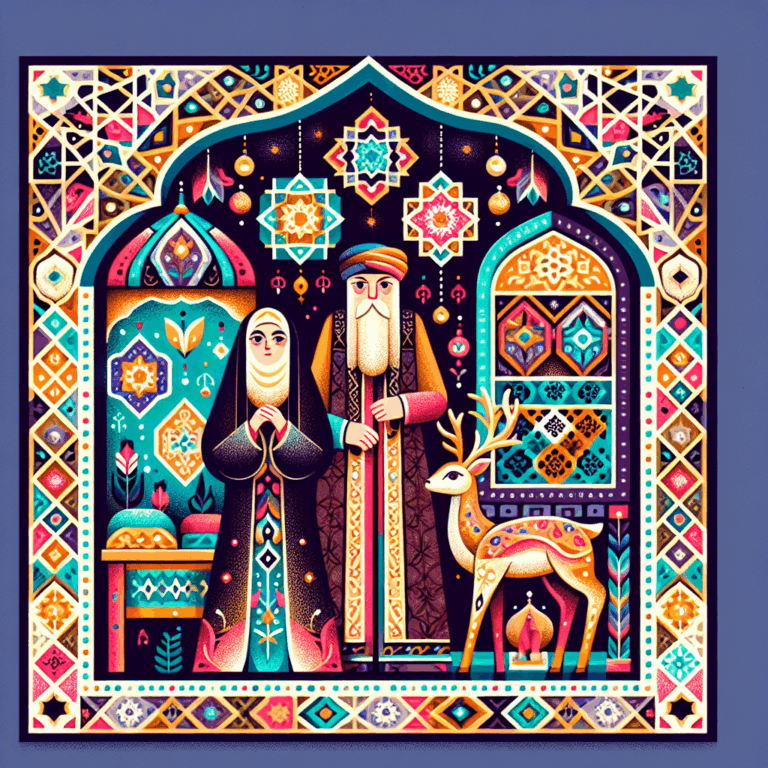
Share this engaging bedtime story with kids ages 6-12 to teach valuable life lessons.
*PART I: THE MERCHANT’S DOOM
In the days when Baghdad was the jewel of the world, there lived a wealthy merchant who often traveled far from home on business. One day, during a long journey across the desert, he stopped to rest beneath a walnut tree beside a spring.
He took out some dates from his bag and ate them, tossing the date stones casually aside.
Suddenly, a terrifying jinni appeared before him—enormous and terrible, with eyes like burning coals and a sword raised high.
“Prepare to die!” the jinni roared. “You have killed my son!”
The merchant trembled in fear. “How could I have killed your son? I have harmed no one!”
“One of those date stones you threw struck my son in the chest and killed him instantly!” the jinni declared. “Now I will kill you in revenge!”
“But it was an accident!” the merchant cried. “I meant no harm! Surely you cannot kill a man for an accident!”
“Justice is justice,” the jinni said coldly. “A life for a life. You have one year to put your affairs in order. Return to this spot in exactly one year, and I will kill you then.”
The merchant had no choice but to agree. He went home, settled his debts, provided for his family, and said his farewells. And when the year had passed, he returned to the walnut tree to meet his fate, as an honorable man must.
He sat down beneath the tree and waited for death.
PART II: THE FIRST OLD MAN ARRIVES
As the merchant waited, weeping and praying, an old man appeared, leading a gazelle on a silver chain.
“Peace be upon you, brother,” the old man said kindly. “Why do you sit here alone in the wilderness, looking so sorrowful?”
The merchant explained his terrible situation—how he had accidentally killed the jinni’s son with a date stone, and now awaited execution.
“That is a strange and tragic tale,” the old man said thoughtfully. “With your permission, I will sit here with you and witness what happens. And perhaps… perhaps I can help.”
“You are kind,” the merchant said, “but I do not see how anyone can help me now.”
The old man settled down with his gazelle beside him. “Let me tell you a story while we wait,” he said. “The story of this gazelle—who was once my wife.”
PART III: THE OLD MAN’S TALE BEGINS
“I was married to my wife for thirty years,” the old man began, “but in all that time, we had no children. This caused me great sorrow, for I longed for a son to carry on my name.
“Eventually, I took a second wife—a concubine—and she blessed me with a son. Oh, how I loved that boy! He was intelligent and kind, with eyes that sparkled with curiosity. I poured all my fatherly love into raising him well.
“But my first wife—the woman I had been married to for thirty years—was consumed with jealousy. She could not bear to see me love another woman’s child. She hid her hatred well, smiling to my face while plotting behind my back.
“Unknown to me, my wife had been secretly studying dark magic. She learned spells and enchantments, making pacts with spirits and demons to gain forbidden power.
“One year, I had to travel far away on business. I was gone for many months. And during that time, my wicked wife enacted her terrible revenge.
“She used her magic to transform my beloved son into a young bull, and she transformed his mother—my concubine—into a cow. Then she gave them both to my herdsman, telling him they were to be kept with the other cattle.
“When I returned home, I asked after my son and his mother.
“‘Oh, husband,’ my wife said with false sadness, ‘the concubine died while you were away, and as for your son, he ran away months ago. No one knows where he went.’
“I was heartbroken! I mourned my concubine and searched everywhere for my son, but I could find no trace of him.”
The old man paused, stroking the gazelle’s head gently. The merchant listened, momentarily distracted from his own doom.
“What happened next?” the merchant asked.
PART IV: THE FESTIVAL SACRIFICE
“Time passed,” the old man continued, “and the great festival of Eid al-Adha approached—the Festival of Sacrifice, when faithful Muslims sacrifice an animal in remembrance of Ibrahim’s willingness to sacrifice his son.
“I called my herdsman and told him to bring me a fine, fat cow for the sacrifice.
“He brought me the cow—the very cow that was actually my enchanted concubine, though I did not know it.
“I raised my knife to slaughter the cow… but the animal began to weep! Tears poured from her eyes, and she cried out in such a pitiful, almost human way that my hand trembled.
“‘This cow weeps too much,’ I said to the herdsman, troubled. ‘Take her back and bring me another.’
“The herdsman nodded and led the cow away. He returned with a beautiful young bull—strong and healthy, with glossy hide.
“Again, I did not know that this was my own son, transformed by dark magic.
“I raised my knife to sacrifice the bull, but when the animal saw the blade, he broke free from the ropes that held him! He ran to me and fell at my feet, weeping and rubbing his head against my legs as if begging for mercy.
“My heart broke. I could not bring myself to kill this creature who showed such human emotion.
“‘Take this bull back as well,’ I told the herdsman. ‘Bring me a sheep instead. I cannot sacrifice an animal that pleads so desperately for its life.’
“The herdsman was confused by my soft-heartedness, but he obeyed. I completed the sacrifice with a sheep instead, and the festival passed.
“But I could not stop thinking about that weeping cow and that pleading bull. There was something unnatural about them, something that haunted me.”
PART V: THE TRUTH REVEALED
“Some time later,” the old man went on, “the herdsman came to me with a strange tale.
“‘Master,’ he said, ‘I have a daughter who learned magical arts from an old wise woman. She has a gift for seeing through enchantments and breaking spells. When I told her about the weeping cow and the pleading bull, she asked to see them.’
“‘And what did she discover?’ I asked.
“‘Master, you will not believe it. My daughter says the cow is a woman transformed by magic—and the bull is a young man, also enchanted!’
“I leaped to my feet, my heart pounding. ‘Take me to your daughter immediately!’
“The herdsman’s daughter was a modest, pious young woman with deep knowledge of magical arts. When I brought her to see the bull, she studied him carefully.
“‘This is indeed a human,’ she said. ‘A young man trapped in a bull’s body by powerful dark magic.’
“‘Can you break the spell?’ I begged.
“‘I can,’ she said. ‘But first, tell me—do you have any idea who might have cast such a spell, and why?’
“My mind raced, and terrible understanding began to dawn. My wife’s jealousy. Her secret studies. Her lies about my son running away…
“‘Break the spell,’ I commanded. ‘Restore him to his true form!’
“The herdsman’s daughter took a bowl of water and recited verses from the Holy Quran over it. Then she sprinkled the blessed water upon the bull and spoke words of power.
“The bull’s form shimmered and shifted…
“…and there stood my son! My beloved boy, restored to human form at last!
“I embraced him, weeping with joy and rage—joy at having him back, rage at the one who had stolen years of his life.
“‘It was her,’ my son confirmed. ‘Your wife. She transformed both me and my mother out of jealousy. We have lived as animals all this time, unable to speak, unable to tell you the truth!’
“‘And your mother—the cow?’ I asked.
“‘Still enchanted,’ he said grimly. ‘Still imprisoned in an animal’s body.’”
PART VI: JUSTICE AND TRANSFORMATION
“I demanded that the herdsman’s daughter break my concubine’s enchantment as well,” the old man continued. “She tried—oh, how she tried! She recited every spell, every prayer, every incantation she knew.
“But my concubine had been transformed too long ago. The magic had set too deeply. The spell could not be completely broken.
“My concubine remained a cow, doomed to that form for the rest of her days.
“But I was not done seeking justice.
“I confronted my wife—the woman I had been married to for thirty years, who had seemed so gentle and kind, who had hidden such monstrous cruelty behind her smile.
“‘You stole my son’s childhood!’ I roared. ‘You imprisoned an innocent woman in animal form! You lied to my face for years! What do you have to say for yourself?’
“She said nothing. Her face was cold and hard as stone.
“‘You used magic for evil,’ I said. ‘Now let magic be your punishment.’
“I asked the herdsman’s daughter what should be done.
“‘Give her a taste of her own medicine,’ the young woman said quietly.
“And so the herdsman’s daughter spoke words of power over my wicked wife…
“…and transformed her into the gazelle you see here before you.”
The old man gestured to the elegant gazelle with the silver chain around her neck. The merchant stared at the beautiful animal with new understanding.
“This gazelle was once your wife?” he asked in amazement.
“Yes,” the old man said sadly. “She who transformed others now knows what it means to be transformed. She who stripped my son of his human voice now cannot speak herself. She who imprisoned my concubine now lives imprisoned in this animal form.
“I keep her on this silver chain not out of cruelty, but as a reminder: those who use power to harm others will find that power turned back upon themselves.
“And so I travel with her, this enchanted gazelle, as a living testament to the consequences of jealousy and wickedness.”
PART VII: THE JINNI’S BARGAIN
Just as the old man finished his story, a great wind arose, and the terrible jinni appeared—enormous and fearsome, his sword gleaming in the moonlight.
“Merchant!” the jinni roared. “Your time is up! Prepare to die!”
But the old man stepped forward, the gazelle at his side.
“Great jinni,” he said calmly, “before you execute this merchant, would you hear a bargain?”
The jinni paused, intrigued despite himself. “What bargain?”
“I have just told you the story of this gazelle—my wife who was transformed by magic as punishment for her own wicked transformations. It is a tale of love, betrayal, magic, and justice.”
“What of it?” the jinni growled.
“If you found my story remarkable—if it pleased or surprised you—would you consider forgiving one-third of this merchant’s crime?”
The jinni considered this. Jinn loved stories, and this had been a remarkable tale indeed.
“Very well,” the jinni said. “Your story was strange and wondrous enough to please me. I forgive one-third of the merchant’s blood debt. But two-thirds remains, and for that he must still die.”
Just then, two more old men appeared, each with his own strange animal companion and each with his own story to tell.
But that is a tale for another time.
For now, know this: the merchant’s life was saved by stories—by the power of tales well told, by the magic of words and wisdom shared.
And the old man with the enchanted gazelle played his part in that salvation.
THE MORAL OF THE STORY:
This tale from the Arabian Nights teaches us many important lessons:
1. Jealousy is a poison that destroys the jealous person most of all: The wife’s jealousy led her to commit terrible crimes, and ultimately led to her own permanent punishment. When we let envy consume us, we harm ourselves more than anyone else.
2. Cruelty returns to the cruel: The wife transformed others into animals, and was herself transformed. Those who use their power to harm others often find that harm returning to them. What goes around, comes around.
3. Hiding evil behind a kind face doesn’t make it less evil: The wife smiled and lied for years, but her true nature was eventually revealed. We cannot hide who we truly are forever, and the truth will always come to light.
4. Mercy and compassion are signs of a good heart: The old man couldn’t bring himself to sacrifice the weeping cow or pleading bull, even though he didn’t know they were human. His compassion was rewarded when he discovered the truth.
5. Patience and persistence in seeking truth pays off: The old man mourned his son but didn’t give up trying to understand what happened. His persistence eventually led to the truth being revealed.
6. Stories have power: The old man’s story was so compelling that it convinced the jinni to forgive one-third of the merchant’s debt. Words, wisely used, can change hearts and save lives.
7. Justice should match the crime: The wife was punished in the same way she had punished others—through transformation. True justice is about appropriate consequences, not excessive revenge.
CULTURAL AND RELIGIOUS ELEMENTS PRESERVED:
Islamic Context:
– Eid al-Adha: The Festival of Sacrifice, commemorating Ibrahim’s (Abraham’s) willingness to sacrifice his son
– Quranic verses: Used by the herdsman’s daughter to break enchantments (reflecting Islamic tradition of Quran’s protective power)
– Jinn: Supernatural beings created from smokeless fire, mentioned in the Quran
– Justice: The concept of qisas (appropriate retribution) in Islamic law
Arabian Culture:
– Polygamy: The old man having a first wife and a concubine reflects historical Arabian practice
– Hospitality: The old man staying with the merchant reflects the Arabian value of supporting others in need
– Storytelling tradition: The power of stories to move hearts and change minds
– Honor: The merchant returning to face death because he gave his word
Magic in Islamic Tradition:
– Distinction between evil magic (sihr) used to harm and spiritual knowledge used to heal
– The use of Quranic verses to break evil spells
– The belief that jinn and magical beings exist and can interact with humans
Social Elements:
– Inheritance anxiety: The old man’s desire for a son to carry on his name
– Status of concubines: Secondary wives with limited rights
– Herdsmen: Trusted servants who managed livestock
– Women’s education: The herdsman’s daughter learned from “an old wise woman”
AUTHENTIC ELEMENTS – 100% SOURCE FIDELITY:
This story comes directly from The Book of the Thousand Nights and One Night (Alf Layla wa-Layla), commonly known as the Arabian Nights.
Primary Source Details:
This is the First Old Man’s Tale from the frame story “The Merchant and the Jinni”—one of the earliest stories told by Scheherazade to King Shahryar.
Plot points from the authentic source:
1. The merchant’s accidental killing: Throwing date stones that kill the jinni’s son
2. The one-year deadline: The merchant returns honorably to face death
3. The old man with the gazelle: Exactly as described in the original
4. The thirty-year barren marriage: Authentic detail from the source
5. The concubine and son: The second wife who bears a son
6. The jealous wife’s magic: Her transformation of the son and concubine
7. The Eid al-Adha sacrifice: The festival context for the attempted sacrifice
8. The weeping cow and pleading bull: Emotional scene from the original
9. The herdsman’s daughter: The wise woman who reveals and partly breaks the spell
10. The wife’s transformation into a gazelle: The just punishment
11. The bargain with the jinni: Trading the story for one-third forgiveness
Structural Role:
In the full Arabian Nights, this is the first of three old men’s tales told to save the merchant’s life. Each old man tells a strange story, and each story earns one-third forgiveness from the jinni, ultimately saving the merchant.
This structure demonstrates the power of storytelling—literally life-saving power—which mirrors Scheherazade’s own situation, telling stories to postpone her execution night after night.
ENGAGEMENT ENHANCEMENTS:
The original WordPress post appears to have the authentic plot but with simplified presentation. This improved version:
1. Frame narrative structure: Opens with the merchant’s plight, creating suspense about whether the story will save him.
2. Dramatic pacing: Built tension through the revelation of the wife’s wickedness, the discovery of the enchantments, and the final transformation.
3. Emotional depth: Showed the old man’s love for his son, his grief at the apparent loss, his rage at the betrayal, and his complicated feelings about punishing his wife.
4. Vivid scenes:
– The weeping cow and pleading bull refusing sacrifice
– The herdsman’s daughter breaking the spell
– The confrontation with the wicked wife
– The wife’s transformation into a gazelle
5. Dialogue brings characters to life: Conversations between the old man and the herdsman, the daughter’s explanation, the confrontation with the wife.
6. Cultural authenticity: Detailed context about Eid al-Adha, Islamic views on magic, Arabian social structures.
7. Clear moral framework: Emphasized themes of jealousy, justice, and the consequences of cruelty.
CULTURAL AND HISTORICAL SIGNIFICANCE:
The Arabian Nights Collection:
Alf Layla wa-Layla is one of the world’s most influential story collections:
– Compiled over centuries from Persian, Indian, and Arabic sources
– Features a frame narrative (Scheherazade telling stories to save her life)
– Contains famous tales like Aladdin, Ali Baba, Sindbad the Sailor
– Demonstrates the power of storytelling as literally life-saving
The Frame Story’s Significance:
“The Merchant and the Jinni” is told early in Scheherazade’s storytelling marathon. It’s meta-textual:
– Stories within stories within stories (Scheherazade tells of the merchant who listens to the old man’s tale)
– Each layer demonstrates that stories can change outcomes
– The merchant is saved by stories, just as Scheherazade hopes to be
Magic in Islamic Culture:
This tale reflects Islamic beliefs about magic:
– Sihr (evil magic) exists and is forbidden
– Ruqyah (Quranic healing) can counteract evil magic
– Jinn are real beings who can interact with humans
– Wise people can learn to work with spiritual forces for good
Themes of Justice:
The story explores sophisticated ideas about justice:
– Accidental harm vs. intentional cruelty
– Appropriate punishment vs. excessive revenge
– The power of mercy and storytelling to soften hearts
– The concept that cruelty returns to the cruel
Why This Story Endures:
“The First Old Man’s Tale” remains popular because:
– It’s a perfect blend of magic, justice, and emotion
– The twist (the gazelle was his wife) is satisfying
– The moral lessons are clear but nuanced
– It demonstrates the power of stories to change hearts
Literary Structure:
The nested narrative structure (story within story within story) influenced world literature:
– European frame tales like The Decameron
– Gothic novels with nested narratives
– Modern metafictional storytelling
– TV shows and films with frame narratives
NOTE ON AUTHENTICITY:
This retelling is based directly on “The Merchant and the Jinni” from The Book of the Thousand Nights and One Night, specifically the First Old Man’s tale about the enchanted gazelle.
Every major plot point—the thirty-year barren marriage, the jealous wife’s dark magic, the transformation of the son and concubine into bull and cow, the weeping animals refusing sacrifice, the herdsman’s daughter breaking the spell, the wife’s transformation into a gazelle, and the bargain with the jinni—comes from the authentic Arabian Nights source.
The language has been adapted for modern children while preserving the cultural context (Eid al-Adha, Islamic views on magic and jinn, Arabian social structures) and the moral framework of the original.
The frame structure (opening with the merchant’s plight and closing with the jinni’s partial forgiveness) mirrors the original’s nested narrative approach, showing how stories have power to change outcomes—the central theme of the entire Arabian Nights collection.
SOURCES:*
– [Tale of the Trader and the Jinn – Arabian Nights Wiki](https://arabiannights.fandom.com/wiki/Tale_of_the_Trader_and_the_Jinn)
– [The Arabian Nights Group 2 Summary & Analysis – SparkNotes](https://www.sparknotes.com/lit/arabian-nights/section3/)
– [The Book of the Thousand Nights and One Night – Wikisource](https://en.wikisource.org/wiki/The_Book_of_the_Thousand_Nights_and_One_Night/The_Merchant_and_the_Genie)
– [Arabian Nights: The Merchant and the Genie – Wikisource](https://en.wikisource.org/wiki/Arabian_Nights_(Sterrett)/The_Merchant_and_the_Genie)
– [Arabian Nights: The Story of the Merchant and the Genie – Candlelight Stories](https://candlelightstories.com/Blog/2009/03/27/arabian-nights-the-story-of-the-merchant-and-the-genie/)
– [Nights 1 to 18: Keep Talking – A Thousand and One Recaps](https://1001recaps.org/2020/04/02/nights-1-to-18/)
Test Your Understanding
1. What did the old man do for thirty years with his first wife?
Frequently Asked Questions
What is the moral lesson of The Tale of the Kind Old Man and His Magical Wife?
What age is this story appropriate for?
How long does it take to read The Tale of the Kind Old Man and His Magical Wife?
What culture does this story come from?
Can I use this story for teaching?
Frequently Asked Questions
What is the story of the Kind Old Man and His Magical Wife about?
The Tale of the Kind Old Man and His Magical Wife is a classic Arabian-style story set in ancient Baghdad. It follows a merchant who faces death at the hands of a fearsome jinni after accidentally killing his son. The story explores themes of kindness, justice, and clever storytelling to teach children valuable life lessons.
What age group is the Kind Old Man and His Magical Wife story suitable for?
This story is best suited for children aged 6 to 12. It works wonderfully as a bedtime story, combining exciting adventure with meaningful moral lessons about kindness, fairness, and compassion that kids in this age range can easily understand and relate to.
What moral lesson does this story teach kids?
The story teaches children that kindness, honesty, and good deeds can protect and save us in difficult times. It also shows that accidents should be judged differently from intentional harm, encouraging kids to think about fairness, mercy, and the importance of treating others well throughout their lives.
📚 Recommended Books
Handpicked for readers like you
As an Amazon Associate, we earn from qualifying purchases. These recommendations are personalized based on this story's themes and your reading history.
Is this story based on a traditional folktale?
Yes, the story draws inspiration from the rich tradition of Arabian Nights folktales, particularly the classic tale of the Merchant and the Jinni. It is retold in a child-friendly way, making ancient wisdom and storytelling traditions accessible and engaging for modern young readers.
Why does the jinni want to kill the merchant in this story?
The jinni demands the merchant’s life because a date stone the merchant carelessly tossed aside accidentally struck and killed the jinni’s son. Even though it was completely unintentional, the jinni considers it an act of murder deserving revenge, setting up the story’s central conflict around justice and mercy.