

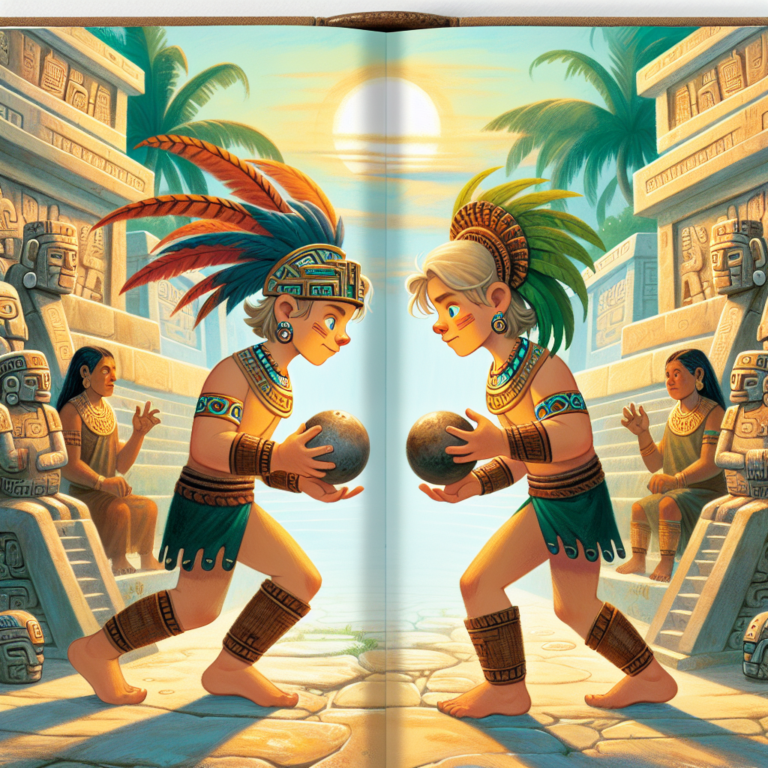
This moral story for children ages 6-12 combines entertainment with important values.
Chapter One: The God of Wind and Wisdom
In the days when the great pyramid temples still shone white and new under the tropical sun, and the cities of the Maya hummed with life and learning, there lived a god named Kukulkan.
Kukulkan was not like other gods. He appeared as a great feathered serpent, his scales gleaming with all the colors of the rainbow, his plumes the brilliant green of the quetzal bird. He was a god of wind and rain, of wisdom and learning, of the sky that touches the earth.
The Maya people loved Kukulkan, for he had given them many gifts: the calendar that told them when to plant and harvest, the writing system that let them record their history, and the art of building great cities from carved stone. Twice each year, at the spring and autumn equinoxes, the shadow of the great pyramid at Chichen Itza formed the image of a serpent descending from heaven to earth, reminding the people that Kukulkan connected the sky above with the world below.
But beneath the earth was another realm: Xibalba, the Place of Fear, where the Lords of Death ruled over a kingdom of shadows. The Lords of Death were jealous of Kukulkan and resentful of the love the Maya people gave him.
“Why should this serpent receive all the praise?” grumbled One Death, the greatest of the Lords. “We are powerful too! Let us challenge him and show the world that death is mightier than life!”
Chapter Two: The Challenge
The Lords of Death sent their messenger to the surface world: a great black jaguar who walked in the spaces between shadows. The jaguar found Kukulkan resting by a sacred cenote, one of the deep blue pools that dotted the jungle like eyes of water gazing at the sky.
“Kukulkan, Feathered Serpent,” the jaguar growled, “the Lords of Death challenge you to a contest in Xibalba. If you refuse, they will send plagues upon your people. If you accept and lose, you must leave the Maya lands forever.”
Kukulkan raised his great plumed head. His eyes, like polished jade, showed no fear. “And if I win?”
“If you win,” the jaguar said, “the Lords will cease their interference in the world above, and your people will prosper.”
Kukulkan thought of the Maya cities, the farmers in their fields, the children playing in the plazas. He knew that to refuse would bring suffering upon them all.
“I accept the challenge,” he said.
Chapter Three: The Descent
The entrance to Xibalba was hidden in a great cave, where an underground river flowed into darkness. Kukulkan descended, his feathers dimming as he left the light of the sun behind.
The path was treacherous. He crossed a river of scorpions, their tails raised to strike, but his scales turned their stings aside. He passed through a canyon of obsidian blades, but his feathers cushioned him from their edges. He walked through a forest of whispering voices that tried to confuse him, but his wisdom kept his path true.
At last, he reached the dark throne room of Xibalba, where the Lords of Death sat on chairs made of bones.
“Welcome, Feathered Serpent,” said One Death, his grinning skull face showing no humor. “We have prepared three tests for you. Fail any one, and you lose the contest.”
“I am ready,” said Kukulkan.
Chapter Four: The First Test – The House of Darkness
The Lords led Kukulkan to a room of absolute darkness, so dark that even his divine eyes could see nothing.
“You must remain here until dawn,” One Death declared. “We will give you a torch and a cigar to keep you warm. But if either the torch or the cigar burns down completely before morning, you fail the test.”
They gave Kukulkan a pine-tar torch and a tobacco cigar, both lit, and sealed the door.
Kukulkan understood the trick. In the darkness, he could not see how quickly the flames consumed the wood and tobacco. If he let them burn through the night, they would be gone by morning. But if he put them out, he would have no light or warmth in the terrifying darkness.
He thought carefully. Then he plucked two of his brightest feathers and placed them on the tips of the torch and the cigar. The feathers glowed with their own inner light, appearing as flames but consuming nothing.
When the Lords opened the door at dawn, they found Kukulkan sitting calmly, the torch and cigar intact, the room filled with the gentle light of his divine feathers.
“The first test is passed,” One Death admitted, his bony jaw tight with frustration.
Chapter Five: The Second Test – The House of Knives
The second test was in a room filled with flying obsidian blades, razor-sharp stone knives that whirled through the air like angry wasps.
“You must retrieve the jade bead from the center of the room,” said Seven Death, the second Lord. “Without the bead, you fail.”
Kukulkan entered the room. Immediately, blades sliced toward him from every direction. But the Feathered Serpent did not try to dodge or fight.
Instead, he began to dance.
He moved with the grace of wind and water, turning and spinning in patterns as old as the stars. His feathers swirled around him like a rainbow shield. The blades, caught in the currents of air his dance created, began to slow, to waver, and finally to fall harmlessly to the floor.
Kukulkan walked calmly to the center of the room, picked up the jade bead, and returned to the door.
“The second test is passed,” the Lords admitted through clenched teeth.
Chapter Six: The Third Test – The Ball Game
The final test was the great ball game that the Maya had played for centuries, a contest of skill and strength in a stone court with high walls and hoops of stone.
“You will play against our champions,” One Death declared. “If the ball touches the ground on your side, you lose.”
The champions of Xibalba were terrifying: spirits of darkness who moved like shadows, barely visible except for their gleaming eyes. The ball they used was made of solid rubber, as heavy as a human head.
The game began. The shadows were fast, hitting the ball with their hips and elbows with devastating force. Again and again, Kukulkan dove to keep the ball aloft, his scales bruised, his feathers torn.
But Kukulkan had one advantage: he was a god of wind, and the wind was everywhere, even in Xibalba.
At a crucial moment, when the ball seemed certain to touch the ground, Kukulkan called upon his power. A gentle breeze, barely noticeable, pushed the ball just enough to keep it aloft. He struck it back, hard and true, through the stone hoop.
The game was won.
Chapter Seven: The Seed of Life
The Lords of Death gathered, their bony faces twisted with rage. But they had given their word, and even in Xibalba, oaths must be honored.
“You have won, Feathered Serpent,” One Death said bitterly. “We will trouble your people no more. But before you leave, we demand to know: how did you defeat us? We are Lords of Death! We have conquered all who came before you!”
Kukulkan rose to his full height, his feathers shimmering with renewed brilliance.
“You made one mistake,” he said. “You thought that darkness was stronger than light, that death was stronger than life. But wherever there is death, life finds a way to bloom again. Wherever there is darkness, even a single flame can shine. You cannot defeat life, only delay it.”
To prove his words, Kukulkan reached into the earth of Xibalba and planted a single seed of maize, the sacred corn that was the gift of the gods to humanity.
The seed sprouted. Even in the darkness of the underworld, fed by nothing but Kukulkan’s will, the maize plant grew tall and strong. Its stalk stretched upward through the layers of rock and soil until it burst into the sunlight above.
“This plant,” Kukulkan declared, “will be a bridge between your world and mine. Its roots will touch Xibalba, but its leaves will taste the sun. Life and death will be connected forever, and from this connection, all living things will draw strength.”
Chapter Eight: The Return
Kukulkan climbed back to the surface world along the stalk of maize. When he emerged from the great cenote, the Maya people were waiting, for they had seen the miraculous plant grow from nothing and knew their god had returned.
“Kukulkan! Kukulkan!” they cheered, their voices echoing across the jungle.
The Feathered Serpent looked upon his people with love. “Remember what I have taught you this day,” he said. “The darkness will always exist, but so will the light. Death comes to all things, but so does new life. When you eat the corn that grows from the earth, remember that its roots touch the land of the dead, and its leaves reach toward the sky. Life is a bridge between worlds.”
From that day forward, the Maya honored maize as the most sacred of plants. They called themselves “people of the corn” and believed that their very flesh was made from it. And they told the story of Kukulkan’s descent to Xibalba to remind themselves that courage, wisdom, and the love of life could overcome any darkness.
Even today, when the equinox shadow serpent descends the pyramid at Chichen Itza, the Maya remember the god who walked into the underworld and returned victorious, bringing with him the promise that life would always find a way.
Moral Lessons
- Light and darkness, life and death, are parts of one great cycle. Courage and wisdom can overcome even the greatest fears, but true victory comes not from destroying our opponents but from finding connection and balance between opposing forces.
Test Your Understanding
1Who is Kukulcan in the story?
Frequently Asked Questions
What is the moral lesson of Kukulcan’s Brave Quest in the Shadowy Underworld?
What age is this story appropriate for?
How long does it take to read Kukulcan’s Brave Quest in the Shadowy Underworld?
What culture does this story come from?
Can I use this story for teaching?
Frequently Asked Questions
What is Kukulcan’s brave quest in the shadowy underworld about?
Kukulcan’s brave quest in the shadowy underworld is a moral story for children ages 6 to 12. It follows Kukulkan, the Mayan feathered serpent god of wind and wisdom, as he ventures into Xibalba, the terrifying underworld of Mayan mythology. The story blends adventure with important values like courage and perseverance.
Who is Kukulkan in Mayan mythology?
Kukulkan is a powerful god in Mayan mythology depicted as a great feathered serpent with rainbow-colored scales and brilliant green plumes. He was the god of wind, rain, wisdom, and learning. He gifted the Maya people with their calendar, writing system, and knowledge of building great stone cities.
What is Xibalba in the Kukulcan underworld story?
Xibalba, meaning the Place of Fear, is the shadowy underworld in Mayan mythology that Kukulkan must bravely enter during his quest. It is a dark and dangerous realm beneath the earth, ruled by powerful and frightening gods, making it the central challenge Kukulkan faces in this children’s story.
📚 Recommended Books
Handpicked for readers like you
As an Amazon Associate, we earn from qualifying purchases. These recommendations are personalized based on this story's themes and your reading history.
What age group is this Kukulcan moral story suitable for?
This story about Kukulkan’s brave quest is designed for children ages 6 to 12. It combines entertaining adventure with meaningful moral lessons, making it ideal for parents, teachers, or caregivers looking for culturally rich stories that also teach important values in an engaging, accessible way.
What moral lessons does the Kukulcan underworld story teach kids?
The story teaches children valuable lessons such as bravery in the face of fear, the importance of wisdom over brute strength, and perseverance through challenges. By following Kukulkan’s journey into the shadowy underworld, young readers learn that courage and knowledge can overcome even the darkest obstacles.
