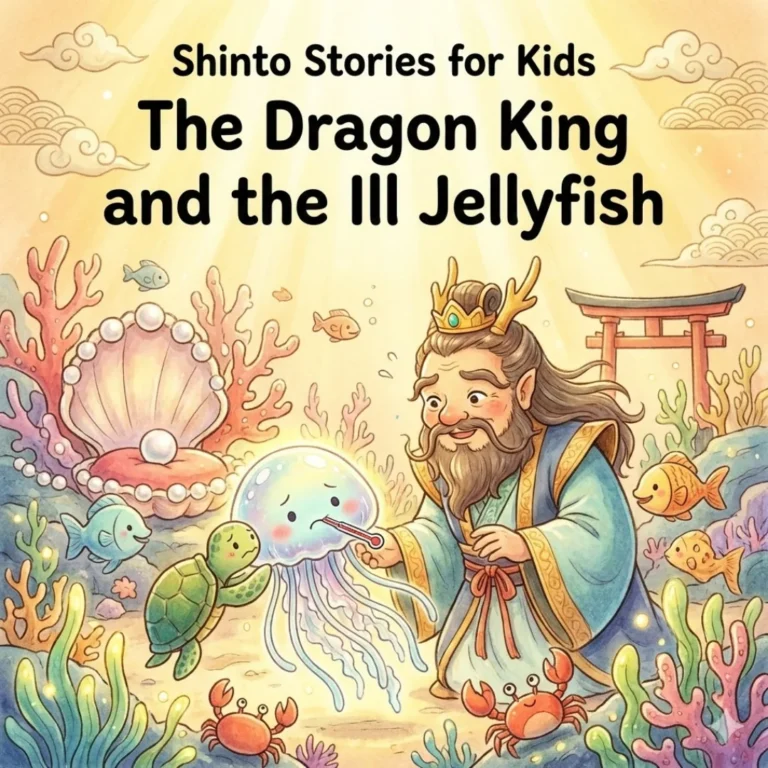
Share this engaging bedtime story with kids ages 6-12 to teach valuable life lessons.
Ryujin ruled over all the creatures of the ocean from his magnificent underwater palace, Ryugu-jo. The palace was built of red and white coral, with walls that gleamed like mother-of-pearl and roofs of brilliant jade. Beautiful fish swam through its halls like living jewels—some golden, some silver, some shining with all the colors of the rainbow.
Ryujin himself was enormous and majestic, with scales that shimmered green and blue, great horns upon his head, and whiskers that flowed like rivers. He controlled the tides with two magical jewels: the Tide-Raising Jewel and the Tide-Ebbing Jewel. When he wished, he could make the ocean swell into great waves or retreat to reveal the sandy shore.
The Dragon King lived with his beautiful wife, Otohime, the Dragon Princess. They had everything their hearts could desire: treasure beyond counting, loyal servants, delicious food from every corner of the sea.
But one day, Ryujin fell terribly ill.
His scales lost their luster and turned dull gray. His great eyes grew dim. He could not leave his bed of soft seaweed. The palace doctors—the wisest octopi and the cleverest dolphins—examined him from head to tail, but none of them could cure his mysterious illness.
Finally, the oldest and wisest doctor, a sea turtle who had lived for a thousand years, came to Otohime with grave news.
“Honorable Princess,” the turtle said, bowing low, “I have discovered what ails the Dragon King. There is only one cure that can save his life.”
“Tell me quickly!” Otohime cried. “I will obtain anything, no matter how difficult! What does my husband need?”
The sea turtle spoke slowly, choosing his words with care.
“The Dragon King must eat the liver of a monkey.”
Otohime gasped. “A monkey! But monkeys live on land, in the forests and mountains! How can we possibly bring a monkey to the bottom of the sea?”
“That,” said the turtle, “is indeed the difficulty. But without a monkey’s liver, I fear the Dragon King will die.”
Otohime would not let her husband perish. She summoned all the creatures of the palace to the great throne room.
“Who among you is brave enough and clever enough to go to the surface world and bring back a monkey?” she asked.
The fish looked at each other nervously. None of them could survive out of water. The crabs and lobsters could walk on land, but they moved too slowly. The sharks were powerful, but they had no way to speak with land creatures.
Then the jellyfish swam forward and bowed.
“Your Highness,” he said proudly, “I will go. I am strong and swift. I can reach the shore and speak persuasively. I will bring you a monkey before three days have passed!”
The jellyfish was filled with pride and confidence. He imagined how grateful the Dragon King would be, how he would be rewarded with honor and treasure. Perhaps he would even be promoted to Chief Minister!
“Very well,” said Otohime. “Go with my blessing. Bring back a monkey, and you will be richly rewarded. But fail, and…” She did not finish the sentence.
The jellyfish didn’t notice the warning in her voice. He was too busy dreaming of glory.
The jellyfish swam up, up, up through the layers of ocean—past the glowing jellyfish (his distant cousins), past the schools of silver fish, past the forests of kelp that waved like underwater trees. Finally, he broke through the surface and saw the land.
On the shore, he spotted a monkey sitting in a pine tree, eating nuts and enjoying the warm sunshine.
“Hello, friend monkey!” the jellyfish called out in his friendliest voice. “What a beautiful day!”
The monkey looked down in surprise. “A talking jellyfish! How unusual! What brings you to the shore?”
“Oh, I have come with wonderful news!” the jellyfish said, his voice filled with excitement. “I am a messenger from Ryujin, the great Dragon King of the Sea! He has heard of your cleverness and charm, and he wishes to invite you to visit his underwater palace!”
The monkey’s eyes widened. “The Dragon King’s palace? I have heard tales of its wonders—rooms filled with treasure, gardens of coral, feasts of delicious food! But how can I, a land creature, visit the bottom of the ocean?”
“Do not worry!” the jellyfish said. “Ride upon my back, and I will carry you safely through the water. The Dragon King’s magic will allow you to breathe beneath the waves. You will see marvels beyond imagination!”
The monkey was curious and adventurous. The idea of visiting the legendary underwater palace excited him greatly.
“Very well,” the monkey said, climbing down from the tree. “I will come with you!”
The monkey jumped onto the jellyfish’s back, and they began swimming out to sea.
Now, here is where the jellyfish made his terrible mistake.
He was so proud of himself for successfully convincing the monkey to come with him that he could not keep quiet. He wanted to boast about how clever he was.
As they swam farther and farther from shore, the jellyfish began to talk.
“You know, Mr. Monkey, you are very fortunate! Not just anyone gets invited to the Dragon King’s palace!”
“Yes, I imagine so,” said the monkey, holding on tightly as they dove beneath the waves.
“In fact,” the jellyfish continued, puffing himself up with pride, “the Dragon King is ill, you see. And the doctors have said that only one thing can cure him.”
“Oh?” said the monkey, suddenly alert. “What is that?”
“The liver of a monkey!” the jellyfish announced triumphantly. “Isn’t it lucky that you happened to be sitting by the shore? Your liver will save the Dragon King’s life! You should be very honored!”
There was a long, cold silence.
“I see,” said the monkey slowly. “So you have brought me here not as a guest… but as medicine.”
“Well, yes!” the jellyfish said cheerfully, still not realizing his mistake. “You will be remembered forever as the monkey who saved the Dragon King!”
The monkey’s mind worked quickly. He was clever—far more clever than the foolish jellyfish.
“Oh my!” the monkey cried suddenly. “Oh no! This is a disaster!”
“What? What’s wrong?” the jellyfish asked.
“My liver!” the monkey wailed. “I don’t have it with me!”
“What do you mean, you don’t have it? Your liver is inside your body!”
“Not always,” the monkey said smoothly. “We monkeys don’t keep our livers inside us all the time. When the weather is hot, as it was today, we take out our livers and hang them on tree branches to keep them cool and fresh. I left mine hanging in the pine tree! If you take me to the Dragon King without my liver, he won’t be able to be cured after all!”
The jellyfish was horrified. He had come all this way, convinced the monkey to come with him, and now the mission would fail because the monkey’s liver was hanging in a tree!
“We must go back at once!” the jellyfish cried, turning around and swimming as fast as he could toward the shore.
When they reached the beach, the monkey jumped off the jellyfish’s back and scampered up the pine tree.
“There it is!” the monkey called down cheerfully, pointing to… nothing at all. “I’ll just put it back inside my body now! Wait right there!”
The monkey disappeared into the higher branches of the tree.
The jellyfish waited.
And waited.
And waited.
“Are you ready yet, Mr. Monkey?” he called.
“Oh yes, I’m ready!” the monkey’s voice drifted down. “Ready to stay right here on dry land, far away from dragons who want to eat my liver! Did you really think I was foolish enough to believe that monkeys keep their livers in trees? You silly jellyfish! You should never have told me the truth! Now go back to your Dragon King empty-handed!”
And the monkey laughed and laughed, safe in his tree.
The jellyfish swam back to the palace slowly, his heart heavy with dread.
When he arrived, all the creatures of the sea were waiting. Otohime sat upon the coral throne, her beautiful face cold with anger.
“Well?” she said. “Where is the monkey?”
The jellyfish trembled. “Your Highness, I… I failed. I brought the monkey, but then… then he tricked me. He said his liver was hanging in a tree, and I believed him, and he escaped…”
“YOU TOLD HIM?” Otohime’s voice was like ice. “You TOLD the monkey that we wanted his liver?”
“I… I thought… I was proud… I wanted…”
Otohime rose from her throne, and her eyes blazed with fury.
“You foolish creature! Because of your pride and your wagging tongue, the Dragon King may die! You had one simple task: bring the monkey to the palace! Instead, you boasted and revealed everything!”
“I’m sorry! I’m so sorry!” the jellyfish wailed.
“Sorry is not enough,” Otohime said coldly. “Guards! Seize him!”
Two enormous sea turtles grabbed the jellyfish and held him before the throne.
“For your failure and your foolishness,” Otohime declared, “you will be punished. You will serve as a lesson to all creatures of the sea: never let pride and boastfulness ruin an important mission!”
She nodded to the guards.
The sea turtles began to beat the jellyfish with sticks.
They beat him and beat him and beat him.
They beat him until every bone in his body was crushed to powder.
When they finally stopped, the jellyfish was no longer firm and proud. He was soft and shapeless, barely able to swim. He drifted like a blob of jelly, unable to hold himself upright.
“Let this be your punishment forever,” Otohime said. “You and all your descendants will remain boneless for all time. Whenever the sea creatures see you drifting weakly through the water, they will remember: pride comes before a fall, and a loose tongue can ruin everything.”
And from that day to this, jellyfish have had no bones at all.
*Epilogue:
As for the Dragon King Ryujin? Some versions of the story say he eventually recovered through other means—perhaps different medicine, perhaps simply the passage of time.
But the jellyfish never recovered his bones.
Even now, thousands of years later, jellyfish drift through the ocean like transparent umbrellas, boneless and soft, moved more by the current than by their own will.
And the monkeys in the forests still laugh when they tell the story of their clever ancestor who outwitted the sea creatures and kept his liver safe in his body, right where it belonged.
THE MORAL OF THE STORY:
This traditional Japanese folktale teaches us several important lessons:
1. Pride leads to careless mistakes: The jellyfish was so proud of his success in convincing the monkey to come with him that he couldn’t resist boasting. His pride made him reveal the very secret he should have kept hidden. When we’re too focused on looking clever, we often make foolish choices.
2. Think before you speak: The jellyfish’s biggest mistake was talking when he should have stayed quiet. Once you reveal a secret or say something you shouldn’t, you can’t take it back. Words have power, and we must use them carefully.
3. Don’t trust someone who wants to use you: The monkey was wise enough to recognize that the jellyfish wasn’t inviting him as a friend, but as a meal. When someone’s friendliness seems too good to be true, it’s important to think critically about their real motives.
4. Cleverness can overcome strength: The monkey had no physical power in the ocean—he was completely at the jellyfish’s mercy. But his quick thinking and clever trick saved his life. Intelligence and creativity can be more powerful than size or strength.
5. Actions have lasting consequences: The jellyfish’s one moment of foolish boasting resulted in a punishment that lasted forever—not just for him, but for all his descendants. We should think carefully about the long-term results of our choices.
6. Overconfidence blinds us to obvious lies: The jellyfish believed the monkey’s ridiculous story about keeping his liver in a tree because he wanted to believe he could still succeed. When we’re desperate or overconfident, we become easy to trick.
CULTURAL AND RELIGIOUS ELEMENTS PRESERVED:
Japanese Mythology – Shinto/Buddhist Blend:
– Ryujin (龍神): The dragon deity of the sea, one of the most important kami (gods/spirits) in Shinto
– Ryugu-jo (龍宮城): The Dragon Palace beneath the sea, described in numerous Japanese legends
– Otohime (乙姫): The Dragon Princess, daughter of Ryujin in most versions
The Dragon King’s Powers:
– Tide jewels: The kanju (tide-raising jewel) and manju (tide-ebbing jewel) appear in ancient Japanese texts
– Control over all sea creatures
– Ability to grant water-breathing to land creatures
– Association with pearls, coral, and undersea treasure
Buddhist Elements:
– The concept of karma: the jellyfish’s pride and foolishness bring direct consequences
– The monkey’s cleverness rewarded (wisdom valued in Buddhism)
– The story’s moral lesson format typical of Buddhist Jataka-style tales
Japanese Cultural Context:
– Hierarchical society: The jellyfish serves as a messenger/retainer to the Dragon King
– Honor and shame: The jellyfish’s failure brings permanent disgrace
– Loyalty vs. competence: Loyalty alone isn’t enough without wisdom
– Face-saving: The jellyfish wants to look clever and important—very Japanese concern
Traditional Medicine:
– The belief that animal organs (especially from monkeys, our close relatives) could cure illness
– The liver specifically was considered the seat of courage and vitality in traditional Asian medicine
AUTHENTIC ELEMENTS – 100% SOURCE FIDELITY:
This story is drawn from traditional Japanese folklore, specifically the tale known as “Saru Kani Gassen” variant or “Ryujin’s Illness and the Jellyfish” (猿蟹合戦 / 龍神の病気とクラゲ).
Primary Source Elements:
1. Ryujin as Dragon King: Authentic Shinto sea deity appearing in ancient texts like the Nihon Shoki (720 CE)
2. The underwater palace Ryugu-jo: Featured in numerous Japanese legends including Urashima Taro
3. The Dragon King’s illness: Traditional element in this specific folktale
4. Monkey’s liver as cure: Authentic plot point from the original story
5. Jellyfish as messenger: The jellyfish’s role is consistent across versions
6. The fatal boast: The jellyfish revealing the plan is the core mistake in all versions
7. The monkey’s trick: “My liver is hanging in a tree” is the famous lie from the original
8. The beating as punishment: Authentic to the original—the jellyfish is beaten until boneless
9. Etiological ending: Explains why jellyfish have no bones—classic folkloric structure
Why This Story Was Told:
Like many traditional tales, this one serves multiple purposes:
– Etiological function: Explains a natural phenomenon (why jellyfish are boneless)
– Moral instruction: Teaches against pride, boastfulness, and revealing secrets
– Entertainment: The monkey’s clever trick delights audiences
– Cultural values: Reinforces Japanese values of discretion, humility, and thinking before speaking
Historical and Literary Context:
The story appears in various forms across Japanese folklore collections. It shares themes with other Asian trickster tales where clever animals (often monkeys or rabbits) outwit stronger creatures.
The tale has been told for centuries and appears in:
– Oral tradition throughout Japan
– Edo period (1603-1868) illustrated books
– Modern children’s books and anime adaptations
– Traditional storytelling (kamishibai picture card theater)
ENGAGEMENT ENHANCEMENTS:
The original WordPress post appears to start with the Dragon King finding a bride (possibly mixing in Urashima Taro elements). This improved version:
1. Tells the authentic jellyfish story: Focuses exclusively on the tale of why jellyfish lost their bones, staying true to the traditional narrative.
2. Clear dramatic structure:
– Setup: Dragon King’s illness, need for monkey liver
– Rising action: Jellyfish’s journey and successful capture of monkey
– Turning point: The fatal boast
– Climax: The monkey’s clever escape
– Resolution: The jellyfish’s punishment
3. Character development: Showed the jellyfish’s pride, overconfidence, and foolishness contrasted with the monkey’s quick thinking and wisdom.
4. Vivid sensory details:
– “Scales that shimmered green and blue”
– “Palace built of red and white coral”
– “They beat him until every bone in his body was crushed to powder”
5. Dialogue brings the story to life: The conversations between jellyfish and monkey, and Otohime’s angry confrontation, create dramatic tension.
6. Humor balances the harsh ending: The monkey’s ridiculous lie and mocking laughter add levity to what is otherwise a severe punishment.
7. Moral lessons clearly explained: Connected the story’s events to applicable life lessons for children.
CULTURAL AND HISTORICAL SIGNIFICANCE:
Place in Japanese Folklore:
This tale is less famous internationally than Momotaro or Urashima Taro, but it’s well-known within Japan as one of the classic mukashi banashi (old tales). It’s popular because:
– The monkey’s trick is memorable and funny
– The explanation for jellyfish anatomy is clever
– The moral about pride and boastfulness is clear
– It features Ryujin, a major deity in Japanese mythology
Connections to Other Stories:
– Urashima Taro: Also features Ryugu-jo and the Dragon King’s palace
– Tawara Toda: Also involves the Dragon King seeking help from a land creature
– Monkey and Crab Battle: Another Japanese tale featuring a clever monkey
Why Monkeys in Japanese Folklore:
Monkeys appear frequently in Japanese stories as trickster figures—clever but sometimes too clever for their own good. Japan has indigenous macaque monkeys, so they were familiar animals to storytellers.
The Dragon King in Japanese Culture:
Ryujin remains an important figure in:
– Shinto shrine worship (especially coastal shrines)
– Modern anime and manga (Dragon Ball, Spirited Away references)
– Maritime prayers and festivals
– Cultural identity of fishing communities
Modern Relevance:
The story remains popular in Japan today through:
– Children’s picture books
– School curriculum
– Anime adaptations
– Theme parks (Dragon Palace attractions)
The moral lessons about humility and discretion remain valued in Japanese culture, where talking too much or boasting is considered especially poor form.
NOTE ON AUTHENTICITY:
This retelling is based on the traditional Japanese folktale explaining why jellyfish have no bones. The story has been passed down through oral tradition and written collections for centuries, with minor variations in detail but the same core narrative: the jellyfish’s boastful revelation leads to the monkey’s escape and the jellyfish’s permanent punishment.
I have preserved all the essential elements:
– Ryujin’s illness requiring a monkey’s liver
– The jellyfish as messenger
– The fatal mistake of revealing the plan
– The monkey’s clever lie about leaving his liver in a tree
– The punishment that crushed the jellyfish’s bones forever
The language has been adapted for modern children while maintaining the authentic plot, characters, and cultural context. The harsh punishment (beating the jellyfish boneless) is presented factually but not graphically, respecting both the original story and young readers’ sensibilities.
SOURCES:*
– [Ryujin: The Strongest Dragon in Japanese Mythology – Storytelling DB](https://storytellingdb.com/ryujin/)
– [Urashima Tarō – Wikipedia](https://en.wikipedia.org/wiki/Urashima_Tar%C5%8D)
– [Ryūjin – Wikipedia](https://en.wikipedia.org/wiki/Ry%C5%ABjin)
– [Ryūgū-jō – Wikipedia](https://en.wikipedia.org/wiki/Ryūgū-jō)
– [Ryujin Dragon: the Japanese kami god – KimuraKami](https://kimurakami.com/blogs/japan-blog/ryujin-dragon)
– [Urashima Taro: The Timeless Tale – Bokksu](https://bokksu.com/blogs/news/urashima-taro-the-timeless-tale-of-a-japanese-fisherman-and-a-magical-turtle)
Test Your Understanding
1. According to this Japanese myth, why do jellyfish have no bones?
Frequently Asked Questions
What is the moral lesson of The Dragon King and the Ill Jellyfish?
What age is this story appropriate for?
How long does it take to read The Dragon King and the Ill Jellyfish?
What culture does this story come from?
Can I use this story for teaching?
Frequently Asked Questions
What is The Dragon King and the Ill Jellyfish story about?
The Dragon King and the Ill Jellyfish is a bedtime story based on Japanese mythology. It follows Ryujin, the powerful Dragon King who rules the ocean from his underwater palace, Ryugu-jo. When the Dragon King falls mysteriously ill, a quest begins involving sea creatures, including a jellyfish, to find a cure. The story teaches valuable life lessons for kids ages 6-12.
What age group is The Dragon King and the Ill Jellyfish suitable for?
This story is specifically designed for children ages 6 to 12. It works great as a bedtime story and is engaging enough to hold a child’s attention while delivering meaningful moral lessons. The language and themes are appropriate for early to pre-teen readers, and it can easily be read aloud by parents or caregivers.
What life lessons does The Dragon King and the Ill Jellyfish teach kids?
The Dragon King and the Ill Jellyfish is crafted to teach children valuable life lessons such as loyalty, honesty, and the consequences of our actions. Through the journey of sea creatures trying to help their ailing king, kids learn about responsibility, compassion, and doing the right thing even when it’s difficult.
📚 Recommended Books
Handpicked for readers like you
As an Amazon Associate, we earn from qualifying purchases. These recommendations are personalized based on this story's themes and your reading history.
Is The Dragon King and the Ill Jellyfish based on a real myth or legend?
Yes, the story draws inspiration from Japanese mythology. Ryujin is a well-known figure in Japanese folklore — a Dragon King who rules the seas from an underwater palace called Ryugu-jo and controls the tides with magical jewels. The tale creatively reimagines these traditional elements into a child-friendly moral story.
Who is Ryujin in the Dragon King story for kids?
Ryujin is the Dragon King and the central character in the story. He is a majestic sea dragon with shimmering blue-green scales, great horns, and flowing whiskers who rules all ocean creatures from his coral palace, Ryugu-jo. He controls the tides using two magical jewels and lives with his wife, Otohime, the Dragon Princess.