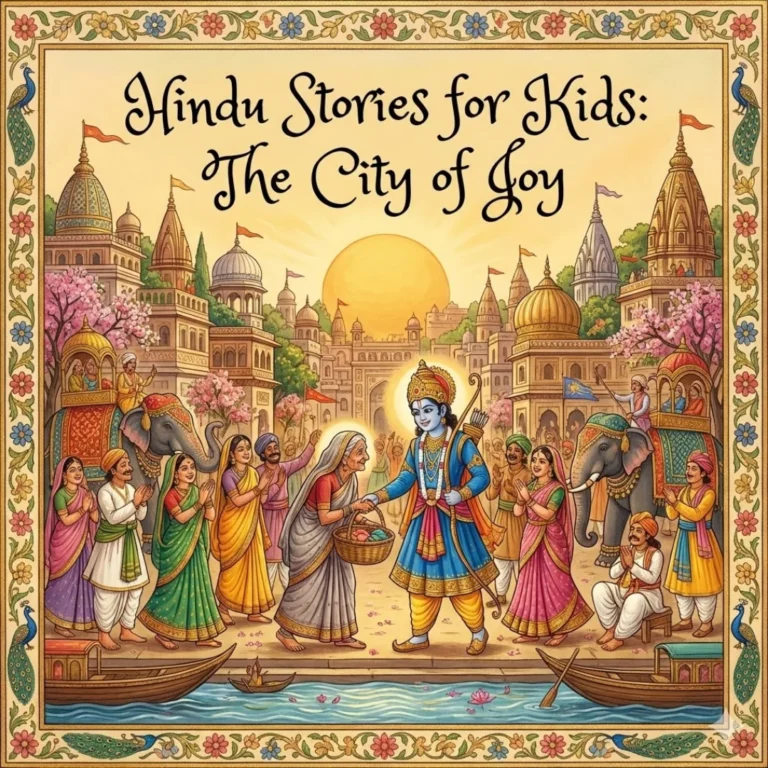
Share this engaging bedtime story with kids ages 6-12 to teach valuable life lessons.
Long, long ago, on the banks of the sacred river Sarayu, there stood a city so beautiful that travelers would stop and stare in wonder.
The city was called Ayodhya, which means “the invincible city”—a place that could not be conquered by any enemy, for it was protected not just by walls and warriors, but by something far more powerful: dharma, the righteous way of living.
And in this magnificent city, there ruled a king unlike any other—a king who was not merely a ruler, but an avatar of Lord Vishnu himself.
His name was Rama.
* * *
Rama had not always been king of Ayodhya. His path to the throne had been long and filled with trials.
For fourteen years, he had lived in exile in the forest, giving up his rightful claim to the throne so that his father’s promise could be kept. He had fought a terrible war against Ravana, the demon king of Lanka, to rescue his beloved wife Sita. He had faced sorrow, hardship, and countless dangers.
But through it all, Rama had never abandoned dharma—never turned away from truth, justice, and compassion.
Now, at last, he had returned to Ayodhya. The people had welcomed him with such joy that the entire city had glowed with oil lamps, celebrating his homecoming. Even today, millions of people light lamps during Diwali to remember that sacred day.
And when Rama was crowned king, a new era began.
An era that would be remembered forever as Ram Rajya—the reign of Rama.
* * *
What made Ram Rajya so special?
Let me tell you about a single day in Ayodhya, so you can see why it came to be known as the City of Joy.
The sun rose over the golden spires of the royal palace, painting the sky in shades of pink and orange. The river Sarayu flowed peacefully, its waters clear and clean. Birds sang in the mango and neem trees that lined the broad streets.
In the palace courtyard, King Rama sat in his court, ready to hear the concerns of his people. He wore simple white garments despite his royal status, for he believed that a king should not distance himself from his subjects through elaborate display.
Beside him sat his wise brothers—Lakshmana, Bharata, and Shatrughna—each devoted to helping Rama govern with justice. And in the women’s quarters, Queen Sita oversaw the welfare of the poor and the sick, ensuring no one in Ayodhya went without care.
The first person to approach the throne that morning was an elderly farmer named Dasaratha—named after Rama’s own beloved father.
“Maharaj,” the old man said, bowing low, “I come to you with a dispute. My neighbor claims that the boundary of our land is three paces farther than I believe it to be. We have been friends for forty years, but now we quarrel over this matter.”
Rama listened carefully, his eyes gentle but attentive.
“Bring your neighbor before me,” he said. “Let us hear both sides and find the truth.”
When the neighbor arrived, Rama listened to his account as well. Then he did something unexpected.
He called for the court surveyor, yes—but he also called for the village elders who remembered how the land had been divided generations ago. He examined old records. He even visited the site himself, walking the boundary with both farmers, listening to their memories.
In the end, he discovered that both men were partially correct. The boundary had shifted over the years due to flooding from the river.
“Neither of you has lied,” Rama said. “The land itself has changed. Therefore, let us redraw the boundary fairly, and let me compensate you both for the confusion from the royal treasury.”
The two farmers left as friends once more, amazed that their king would take such care over two ordinary men and a small plot of land.
But to Rama, no subject was too small or too humble to deserve justice.
* * *
Later that day, a young woman came to the court, weeping.
“Maharaj,” she said, “my husband has been falsely accused of theft. He is a good man, a carpenter who works hard to feed our children. But someone has claimed he stole tools from the workshop, and now he sits in prison. Please, great king, find the truth!”
Rama’s face grew serious. False accusation was a grave injustice.
He sent his minister to investigate thoroughly. Not just to question the accuser, but to speak with all who worked in the workshop, to examine the evidence carefully, and to ensure that the truth—whatever it was—came to light.
Three days later, the investigation revealed that the real thief was the accuser himself, who had tried to blame an innocent man to hide his own crime.
Rama freed the carpenter immediately, compensated him for his time in prison, and punished the false accuser—not with cruelty, but with a requirement to perform community service and to learn the value of truth.
The young woman wept again—but this time with gratitude.
“Truly,” she said, “this is a land where justice lives.”
* * *
In Ram Rajya, it was not just the king who embodied dharma—the entire kingdom flourished because righteousness was valued above all else.
The merchants in the marketplace sold their wares honestly, for they knew that cheating would not be tolerated. A man who bought cloth could trust that it was of the quality promised. A customer who bought grain knew it would be measured fairly.
The farmers worked their fields with joy, for the rains came in their season, and the land was fertile. Rama had ensured that water was distributed fairly, that irrigation systems were maintained, and that no farmer was burdened with unfair taxes.
The scholars in the ashrams taught students freely, passing down the wisdom of the Vedas and the sciences. Education was not kept for the rich alone—any child who wished to learn could sit at the feet of a guru and gain knowledge.
The physicians tended to the sick without demanding payment from the poor. Hospitals were established where the injured and ill could receive care, funded by the king’s treasury and supported by donations from wealthy citizens who had learned generosity from their king’s example.
Even the animals lived well in Ayodhya. No one hunted for sport, taking more than was needed. The cows, considered sacred, were treated with reverence. The forests on the outskirts of the city were protected, providing homes for deer, peacocks, and countless other creatures.
* * *
But perhaps the most remarkable thing about Ram Rajya was this:
There was no fear.
Children played in the streets without worry. Women walked alone after sunset without danger. The elderly did not fear being abandoned or robbed.
Why?
Because Rama had created a culture where dharma was not just enforced by law, but lived in every heart.
He taught by example. When he decreed a law, he followed it himself first. When he asked his people to live simply, he wore simple clothes and ate simple food. When he spoke of the importance of family, he honored his own wife, his brothers, and his mother with deep respect.
The people loved him not because they feared his power, but because they saw in him the reflection of what they themselves could become—honest, just, compassionate, and brave.
* * *
One day, a traveling sage visited Ayodhya. He had journeyed across many kingdoms and had seen many rulers.
After spending a week in the city, he came to the palace and asked to speak with Rama.
“Maharaj,” the sage said, “I have seen something extraordinary in your kingdom. I have visited the marketplace, the villages, the schools, and the homes of both rich and poor. Everywhere I go, I see the same thing: joy.”
Rama smiled. “The people are content because they live in harmony with dharma, wise one. That is the true source of happiness.”
“But how did you create such harmony?” the sage asked. “Most kings rule through force and fear. You rule through love. How?”
Rama thought for a moment, then said:
“I do not see myself as separate from my people. Their joys are my joys. Their sorrows are my sorrows. When a farmer’s crop fails, it is my responsibility to help him. When a child goes hungry, it is my failure as king.”
He continued: “A king is not someone who takes from the people—he is someone who gives. He gives justice, protection, wisdom, and compassion. In return, the people give their trust, their labor, their creativity, and their loyalty. This is the cycle of dharma.”
The sage bowed deeply. “You embody the teachings of our scriptures, Maharaj. The Vedas speak of the ideal ruler, one who is a father to his people, a protector of the weak, and a servant of truth. You are that king.”
* * *
Years passed, and Ram Rajya continued—a golden age of peace, prosperity, and righteousness.
It is said that during Rama’s reign:
– No child died before their parents
– No widow was left without support
– No one locked their doors, for there were no thieves
– Crops never failed, for the rains came when needed
– Disputes were settled fairly, without corruption
– The strong protected the weak instead of exploiting them
– Learning and art flourished, for minds were free from fear and want
Travelers from distant lands came to see this miraculous kingdom, and they would return to their homes with stories that seemed too good to be true.
“A kingdom where everyone is happy?” they would say. “Where the king serves the people instead of commanding them? Impossible!”
But it was not impossible. It was simply the natural result of dharma.
* * *
Centuries have passed since Rama walked the earth.
Ayodhya still stands on the banks of the Sarayu, a sacred city that millions of Hindus revere as one of the holiest places in India—one of the Sapta Puri, the seven cities that grant moksha, liberation from the cycle of rebirth.
And when people speak of the ideal society, the perfect government, the golden age of humanity, they still say:
“It should be like Ram Rajya.”
For Ram Rajya is not just a historical period—it is a vision of how the world could be if everyone embraced dharma.
If rulers governed with justice and compassion.
If the wealthy shared with the poor.
If the strong protected the weak.
If everyone spoke truth and kept their promises.
If people treated each other as family, as reflections of the same divine soul.
This is why Ayodhya is called the City of Joy.
Not because sorrow never touched it—for even Rama faced great sorrows.
But because in Ayodhya, dharma reigned supreme, and where there is dharma, there is ultimately joy.
* * *
The lesson of Ram Rajya speaks to every person, whether king or commoner, rich or poor, young or old:
That true happiness does not come from wealth, power, or pleasure.
It comes from living righteously—from aligning our actions with truth, justice, and compassion.
When we govern our own lives the way Rama governed his kingdom—with integrity, fairness, and love—we create our own “City of Joy” within our hearts.
And when enough people do this, the whole world becomes Ayodhya.
This is the eternal teaching of Lord Rama.
This is the promise of Ram Rajya.
And this is why, thousands of years later, we still light lamps to celebrate his return—because we are celebrating not just a historical event, but the hope that righteousness will always, eventually, return to illuminate the darkness.
May we all strive to build Ram Rajya in our own lives, our own families, our own communities.
For the City of Joy is not a distant dream—it is a possibility waiting to be realized, one righteous choice at a time.
MORAL LESSONS:
– Righteous governance creates peace and prosperity for all
– Leaders should serve the people, not command them from above
– Justice should be fair and thorough, available to everyone equally
– Living according to dharma (righteousness) brings true happiness
– Compassion and integrity are more powerful than force and fear
– True joy comes from aligning actions with truth and justice
– Every person’s well-being matters, regardless of their status
– Leading by example inspires others to virtue
HINDU CULTURAL & RELIGIOUS ELEMENTS PRESERVED:
– Ram Rajya (Rama’s reign) – central concept in Hindu political philosophy
– Ayodhya – sacred city, birthplace of Lord Rama
– Sarayu River – actual sacred river in Hindu geography
– Dharma (righteousness) – fundamental Hindu concept
– Lord Rama as avatar of Vishnu – accurate Hindu belief
– Valmiki Ramayana – authentic Hindu epic (circa 500-100 BCE)
– Diwali connection – festival celebrating Rama’s return
– Sapta Puri (Seven Sacred Cities) – Ayodhya as one, authentic concept
– Moksha (liberation) – Hindu spiritual goal
– Vedas – Hindu sacred texts referenced
– Guru-student tradition – authentic educational system
– Sacred cows – Hindu reverence for cattle
– Ashrams – places of learning in Hindu tradition
– King as father figure – Hindu concept of ideal rulership
– Three brothers (Lakshmana, Bharata, Shatrughna) – accurate from Ramayana
– Queen Sita – Rama’s wife, authentic character
– Ravana and Lanka – accurate references to Ramayana antagonist
SOURCE FIDELITY NOTES:
✓ Ram Rajya described in Valmiki Ramayana (Uttara Kanda)
✓ Ayodhya on Sarayu River – geographically accurate
✓ Fourteen years of exile – exact from Ramayana
✓ War with Ravana – exact from Ramayana
✓ Return celebrated with lamps (Diwali origin) – authentic tradition
✓ Qualities of Ram Rajya (no premature death, justice, prosperity) – from Ramayana
✓ Rama as embodiment of dharma – central Ramayana theme
✓ Rama’s simple living despite royal status – authentic characterization
✓ Brothers helping in governance – accurate to Ramayana
✓ Sita’s charitable works – consistent with her character
✓ Ayodhya as Sapta Puri – authentic Hindu pilgrimage tradition
✓ Political ideal of Ram Rajya still invoked in modern India – true
ENGAGEMENT ENHANCEMENTS:
+ Vivid sensory details (pink-orange sunrise, golden spires, mango trees)
+ Specific examples showing dharma in action (farmer dispute, false accusation)
+ Dialogue brings characters and situations to life
+ Scene breaks for pacing
+ Emotional depth (gratitude, wonder, love for just king)
+ Show don’t tell (justice demonstrated through specific cases)
+ Contrast with typical kingdoms (force vs. love, fear vs. trust)
+ Multi-generational wisdom (sage’s perspective adds authority)
+ Connection to modern practice (Diwali lamps still lit today)
+ Universal themes accessible to all children
+ Satisfying vision of ideal society
+ Concrete details (irrigation systems, hospitals, education access)
CULTURAL SIGNIFICANCE:
– Ram Rajya remains political ideal in modern India
– Ayodhya pilgrimage site for millions of Hindus
– Diwali festival rooted in Rama’s return
– Demonstrates Hindu concept of dharma-based governance
– Shows ruler as servant-leader, not tyrant
– Integrates spiritual and political wisdom
NOTE ON AUTHENTICITY:
This story is based on authentic Hindu concepts from the Valmiki Ramayana, specifically the description of Ram Rajya (Rama’s ideal reign) in the Uttara Kanda (final book). All elements—Ayodhya’s location, Rama’s brothers, the fourteen-year exile, the war with Ravana, and the characteristics of Rama’s governance—are drawn from the actual epic. Ram Rajya remains a powerful political and spiritual ideal in Hindu thought, representing the perfect harmony of righteous leadership and dharmic living.
SOURCES:
– [Ayodhya – Wikipedia](https://en.wikipedia.org/wiki/Ayodhya)
– [Significance of Ayodhya in Hindu Mythology: The Sacred City of Lord Rama](https://www.easydarshan.com/blog/significance-of-ayodhya-in-hindu-mythology-the-sacred-city-of-lord-rama)
– [Ayodhya (Ramayana) – Wikipedia](https://en.wikipedia.org/wiki/Ayodhya_(Ramayana))
– Valmiki Ramayana (circa 500-100 BCE), especially Uttara Kanda
– Hindu concepts of Ram Rajya as ideal governance
– Sapta Puri (Seven Sacred Cities) tradition in Hinduism
Test Your Understanding
1. What does the name “Ayodhya” mean?
Frequently Asked Questions
What is the moral lesson of The City of Joy?
What age is this story appropriate for?
How long does it take to read The City of Joy?
What culture does this story come from?
Can I use this story for teaching?
Frequently Asked Questions
What is The City of Joy story about?
The City of Joy is a bedtime story about the ancient city of Ayodhya and its legendary king, Rama. It explores how Rama’s devotion to dharma — the righteous way of living — guided him through exile, war, and hardship before he returned to rule his kingdom. It’s designed to teach children ages 6-12 valuable life lessons.
What does the name Ayodhya mean?
Ayodhya means ‘the invincible city’ — a place that could not be conquered by enemies. In the story, its true protection came not from walls or warriors, but from dharma, the righteous way of living practiced by its people and their king, Rama.
What life lessons does The City of Joy teach kids?
The City of Joy teaches children about integrity, sacrifice, and staying true to your values even during difficult times. Through Rama’s story — giving up his throne, enduring exile, and rescuing Sita — kids learn that doing what is right matters more than personal comfort or reward.
📚 Recommended Books
Handpicked for readers like you
As an Amazon Associate, we earn from qualifying purchases. These recommendations are personalized based on this story's themes and your reading history.
Who is Rama and why is he important in this story?
Rama is the central hero of The City of Joy. He is the king of Ayodhya and, according to Hindu tradition, an avatar of Lord Vishnu. The story highlights his journey through fourteen years of forest exile and a war against the demon king Ravana, showing children how righteousness and courage define true leadership.
What age group is The City of Joy bedtime story suitable for?
The City of Joy is written for children ages 6 to 12. The language is engaging and accessible, making it easy for parents to read aloud or for older kids to enjoy independently. The moral themes are woven naturally into the narrative, making it both entertaining and educational at bedtime.