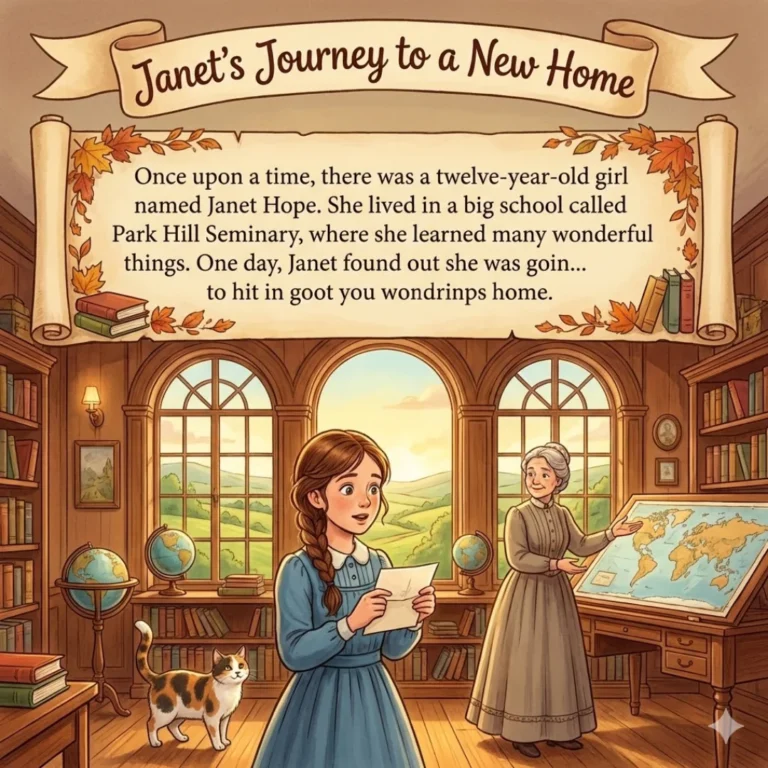
‘Janet’s Journey to a New Home’ is an educational moral story perfect for bedtime reading with children ages 6-12.
CHAPTER ONE: THE MORNING OF DEPARTURE
The grandfather clock in the entrance hall of Park Hill Seminary struck seven, its deep chimes echoing through corridors that had once bustled with the chatter and laughter of dozens of girls.
But this morning, the corridors were empty. The Christmas holidays had begun, and all the students had returned to their families—all except one.
Janet Hope stood at the window of her small room on the third floor, watching the frost glitter on the bare branches of the elm trees outside. At twelve years old, she had grown accustomed to being the one who stayed behind during holidays. She had no family to go to, no cozy parlor waiting with a fire crackling in the hearth.
Until today.
On her narrow bed lay her worn leather suitcase, packed with everything she owned in the world. Pinned to its side was a card that read: “Miss Janet Hope, To the care of Lady Chillington, Deepley Walls, near Eastbury, Midlandshire.”
“Deepley Walls,” Janet whispered to herself for perhaps the hundredth time. The words felt like a spell, opening a door to a future she couldn’t yet imagine.
A knock at her door made her jump.
“Miss Janet?” called Chirper, the house helper, her cheerful voice muffled by the thick oak. “The carriage has arrived, dear!”
* * *
CHAPTER TWO: THE questions THAT WOULDN’T REST
Chirper—whose real name was Mrs. Chapman, but who had earned her nickname through her constant, bird-like chattering—bustled into the room and immediately began fussing.
“Oh, look at your hair, child! We can’t have you meeting Lady Chillington looking like a wild thing, can we?” She produced a brush from her apron pocket and began working on Janet’s auburn curls with determined strokes.
“Chirper,” Janet asked, wincing slightly at a particularly stubborn tangle, “what do you know about Lady Chillington? And about Deepley Walls?”
“Questions again!” Chirper clucked. “You and your questions, Miss Janet. Curiosity has gotten many a young lady into trouble, I always say.”
“But surely you must know something,” Janet pressed. “You’ve been at Park Hill for thirty years. You must have heard stories.”
Chirper paused her brushing and looked at Janet with an expression that was almost tender.
“I know this much, dear heart: Lady Chillington requested you specifically. Out of all the girls who have passed through these halls over the years, she asked for you. That must mean something, mustn’t it?”
“But why?” Janet asked. “I’ve never even heard of her until a week ago. Why would she want me?”
Chirper shook her head. “That’s not for me to say. Some answers have to be found, not told. Now come along—the driver is waiting, and Mrs. Whitehead wants to see you before you go.”
* * *
CHAPTER THREE: THE STERN FAREWELL
Mrs. Whitehead’s office smelled of ink and old books. The senior mistress sat behind her massive desk like a queen upon her throne, her silver spectacles catching the morning light.
“Sit, Miss Hope,” she said, gesturing to the hard wooden chair before the desk.
Janet sat, her hands clasped tightly in her lap.
“I understand you have been asking questions about Lady Chillington,” Mrs. Whitehead said, her tone neither warm nor cold.
“Yes, ma’am. I only wished to know—”
“Young ladies,” Mrs. Whitehead interrupted, “should not ask too many questions. It shows a lack of proper breeding and suggests a dissatisfaction with one’s circumstances that is unbecoming.”
Janet bit her lip but said nothing.
“However,” Mrs. Whitehead continued, and her voice softened almost imperceptibly, “I will tell you this: Lady Chillington is a woman of considerable means and excellent reputation. She has supported this seminary for many years with generous donations. When she learned of your situation—that you have no family, no prospects, no home to return to during holidays—she offered to take you in.”
“Take me in?” Janet echoed. “As a… as a daughter?”
Mrs. Whitehead’s eyebrows rose. “As a companion, I should think. Or perhaps as a ward. The exact nature of the arrangement is between you and Lady Chillington. What matters is that you have been given an opportunity that many girls in your position could only dream of.”
She stood and walked to the window, her back to Janet.
“I was an orphan once too, Miss Hope. Long ago, in another life, it sometimes seems. I know what it is to wonder if anyone in the world cares whether you live or die.”
She turned, and for just a moment, Janet saw something vulnerable in those stern grey eyes.
“Lady Chillington cared. She cared enough to ask for you by name. Remember that, in the days to come.”
* * *
CHAPTER FOUR: THE EMPTY PLAYGROUND

Janet walked out through the back door of the seminary, taking the long way around to where the carriage waited. She wanted one last look at the playground where she had spent so many hours.
The swings hung motionless in the cold December air. The old oak tree, bare of leaves, spread its branches like dark fingers against the pale sky. In the corner, the little garden where Miss Chinfeather had taught the girls to plant vegetables lay dormant under a thin layer of frost.
Miss Chinfeather. Janet felt her eyes prick with tears at the thought of her beloved teacher. Miss Chinfeather had been the closest thing to a mother Janet had known at Park Hill—always ready with a kind word, a gentle correction, a warm embrace when homesickness (or no-home-sickness, as Janet thought of it) grew too heavy to bear.
But Miss Chinfeather was gone now, taken by a fever last winter. And without her, Park Hill had become just a building—brick and mortar and echoing halls, but no longer truly a home.
“Perhaps that’s why I’m not sadder to leave,” Janet murmured to herself. “The part of this place I loved most is already gone.”
She knelt and pressed her hand against the cold earth of Miss Chinfeather’s garden.
“Goodbye, dear teacher,” she whispered. “Wherever I’m going, I’ll try to make you proud.”
* * *
CHAPTER FIVE: THE DECISION TO HOPE
The carriage was a handsome black brougham with brass fittings that gleamed despite the grey winter light. The driver, a friendly-faced man named Mr. Hobbs, touched his cap as Janet approached.

“Miss Hope, is it?” he asked with a warm smile. “That’s a fine name for a young lady starting a new chapter. Shall I stow your bag?”
Janet handed him her suitcase and climbed into the carriage. The seats were upholstered in dark green velvet, worn but comfortable. A wool blanket had been left folded on the seat, and a small basket contained bread, cheese, and a flask that proved to hold hot chocolate.
“Lady Chillington thought you might be hungry on the journey,” Mr. Hobbs explained through the window. “We’ve a long ride ahead—near six hours, if the roads are clear.”
As the carriage pulled away from Park Hill Seminary, Janet watched the familiar buildings grow smaller through the window. The dormitory where she had slept for six years. The classroom where she had learned to read and write. The dining hall where she had shared a thousand meals with girls who had come and gone, always to homes and families of their own.
She waited for sadness to overwhelm her, for tears to fall.
But instead, something else stirred in her chest—something unexpected.
Hope.
“That’s my name,” Janet said softly to herself. “Janet Hope. Perhaps it’s time I started living up to it.”
She poured herself a cup of hot chocolate from the flask and took a sip. It was delicious—sweet and rich and warming.
“I don’t know what waits for me at Deepley Walls,” she thought. “I don’t know who Lady Chillington is or why she wants me. But I can choose how I face the unknown. I can face it with fear, or I can face it with hope.”

She chose hope.
* * *
CHAPTER SIX: THROUGH THE COUNTRYSIDE
The journey was long, but Janet found it fascinating rather than tedious. She had never traveled so far from Park Hill, and every mile brought new sights.
They passed through villages with names like Hawksworth and Middleton, where smoke curled from cottage chimneys and children waved at the passing carriage. They crossed stone bridges over streams that sparkled in the winter sunshine. They climbed hills that offered views of patchwork farmland stretching to the horizon.
Mr. Hobbs proved to be an excellent companion, calling back through the speaking tube to point out interesting landmarks.
“See that church steeple, Miss? That’s where the great battle was fought three hundred years ago.”
“Look there, beyond the trees—that’s the Duke’s estate. Finest roses in all of England, they say.”
“Coming up on Eastbury now, Miss. Deepley Walls is just four miles more.”
Janet’s heart began to beat faster. Four miles. In less than half an hour, she would see her new home for the first time.
What would it be like? She imagined a grand manor house with dozens of rooms, or perhaps a cozy cottage with a garden gate. She imagined Lady Chillington as a stern old woman in black bombazine, or as a warm, grandmotherly figure with flour on her apron.
But no matter how she tried, she couldn’t quite picture it. The future remained stubbornly unknowable.
“That’s all right,” she told herself. “Some stories you can’t imagine until you’re living them.”
* * *
CHAPTER SEVEN: HOME AT LAST
The carriage turned down a lane lined with ancient yew trees, their dark branches creating a tunnel of green even in winter. At the end of the lane, a pair of iron gates stood open, and beyond them…
Janet gasped.
Deepley Walls was beautiful.
It wasn’t a grand manor house or a tiny cottage. It was something in between—a warm, welcoming house of honey-colored stone, with windows that reflected the setting sun like squares of gold. Ivy climbed its walls, winter-bare now but promising green abundance in spring. A garden stretched before it, dotted with statues and bare rose bushes and a fountain that sparkled with frozen ice.
And there, standing at the front door, was a woman.
She was neither old nor young—somewhere in between, with silver-streaked brown hair and kind eyes that crinkled at the corners when she smiled. She wore a simple blue dress with a warm shawl around her shoulders, and she looked at Janet’s approaching carriage with an expression of such genuine joy that Janet felt her fears melt away like frost in sunshine.
The carriage stopped. Mr. Hobbs opened the door. Janet stepped out on trembling legs.
“Janet,” the woman said, coming forward with her hands outstretched. “My dear, dear Janet. I have waited so long to meet you.”
“Lady Chillington?” Janet managed.
“Elizabeth,” the woman corrected gently. “You shall call me Aunt Elizabeth, if that feels comfortable. I was your mother’s dearest friend, many years ago—before you were born, before… before we lost her.”
Janet’s breath caught. “You knew my mother?”
“Knew her and loved her,” Lady Chillington—Aunt Elizabeth—said, her eyes glistening with tears. “She was the sister of my heart. When she passed, I promised myself that one day I would find you and give you the home she would have wanted you to have.”
She cupped Janet’s face in her warm hands.
“Welcome home, my dear girl. Welcome to Deepley Walls.”
And Janet, who had never truly belonged anywhere, who had spent twelve years wondering if anyone in the world thought of her as their own, felt something shift deep in her heart.
She had found what she had never dared to look for.
She had found home.
Moral Lessons
- Embracing change can lead to new adventures and opportunities, and sometimes the family we find is as precious as the family we’re born to.
Test Your Understanding
1. Why was Janet leaving Park Hill Seminary?
2. What important lesson did Janet learn about facing the unknown?
3. Who was Mrs. Whitehead and what did she reveal about herself?
4. What did Lady Chillington reveal when Janet arrived at Deepley Walls?
5. What did Janet’s surname “Hope” symbolize in the story?
6. What is the main moral lesson of this story?
Frequently Asked Questions
What is the moral lesson of Janet’s Journey to a New Home?
What age is this story appropriate for?
How long does it take to read Janet’s Journey to a New Home?
What culture does this story come from?
Can I use this story for teaching?
Frequently Asked Questions
What age is Janet’s Journey to a New Home appropriate for?
This educational moral story is perfect for children ages 6-12. The content is gentle and age-appropriate, making it an ideal bedtime story that parents can read aloud to younger children or that older kids can enjoy independently.
What is Janet’s Journey to a New Home about?
The story follows 12-year-old Janet Hope, an orphan at Park Hill Seminary who has always stayed behind during holidays. When she’s finally sent to live with Lady Chillington at Deepley Walls, her journey toward finding a real home begins.
Is Janet’s Journey a good bedtime story for kids?
Yes! This is specifically designed as a bedtime story for kids ages 6-12. The gentle, heartwarming narrative about finding belonging and home makes it perfect for peaceful evening reading that can help children wind down for sleep.
📚 Recommended Books
Handpicked for readers like you
As an Amazon Associate, we earn from qualifying purchases. These recommendations are personalized based on this story's themes and your reading history.
What moral lessons does this educational story teach children?
This moral story for children explores themes of resilience, hope, and finding belonging. Janet’s journey teaches kids about adapting to new situations, the importance of kindness, and how sometimes the most unexpected places can become home.
How long does it take to read Janet’s Journey to a New Home?
As a full-length children’s story, Janet’s Journey typically takes 15-20 minutes to read aloud, making it the perfect length for bedtime reading. Parents can also break it into chapters for shorter reading sessions across multiple nights.