Share this engaging bedtime story with kids ages 6-12 to teach valuable life lessons.
CHAPTER ONE: THE PEACE TESTIMONY
The year was 1778, and the streets of Scarborough were usually quiet—just the clip-clop of horses, the chatter of the marketplace, and the tolling of the meetinghouse bell on First Day mornings.
Edward Whitmore was seventeen years old, with earnest brown eyes and hands more accustomed to tending his mother’s garden than holding a weapon. He lived with his family in a modest stone house near the edge of town, where honeysuckle grew wild around the door and the smell of his mother’s bread baking always seemed to fill the air.
“Remember, Edward,” his mother Sarah often told him, “we Quakers believe in the Light within every person. Even our enemies carry that same divine spark. To harm another is to harm that Light.”
Edward believed this with all his heart. He had grown up attending Meeting for Worship every First Day, sitting in the simple wooden meetinghouse where Friends gathered in silence, waiting for the Inner Light to guide their words and actions.
But now, as cannon fire echoed in the distance and soldiers marched through the countryside, Edward’s beliefs were about to be tested in ways he had never imagined.
* * *
CHAPTER TWO: THE SOUND OF TROUBLE
It happened on a crisp October morning. Edward was helping his father William repair the fence around their small sheep pasture when they heard it—a sound like distant thunder, but sharper, more violent.
“Cannon fire,” William said gravely, setting down his hammer. “The fighting has reached Scarborough at last.”
Within the hour, the streets were in chaos. People ran in every direction—some fleeing with their belongings bundled in their arms, others rushing toward the harbor where British ships had been spotted.
Edward’s best friend since childhood, Henry Aldridge, came running up the lane, his face flushed with excitement.
“Edward! The militia is gathering! We’re to defend the town! Come on!”
Henry had always been the brave one, the one who climbed the highest trees and swam the farthest into the bay. He wasn’t a Quaker, and to him, fighting for one’s home seemed as natural as breathing.
Edward’s stomach knotted. “Henry, thee knows I cannot take up arms. It goes against everything my family believes.”
Henry’s face fell, then hardened with frustration. “So thee will stand by while others fight and die? What kind of friend is that?”
Before Edward could respond, Henry had run off to join the other young men assembling in the square. Edward watched him go, feeling more torn than he had ever felt in his life.
* * *
CHAPTER THREE: A MOTHER’S LAST WORDS
That evening, as the sounds of distant battle faded with the setting sun, Edward sat at his mother’s bedside. Sarah Whitmore had been ill for many weeks, her once-bright eyes now dim, her gentle voice barely more than a whisper.
“Edward,” she said, reaching for his hand, “I know thee faces a terrible choice.”
“Mother, how can I—”
“Listen, my son.” Her grip tightened with surprising strength. “Courage is not only found on battlefields. It takes great bravery to stand by one’s beliefs when everyone around thee says they are wrong.”
She coughed weakly, and Edward quickly brought water to her lips.
“But,” she continued, “being a peacemaker does not mean being a bystander. There are always ways to help, ways to serve, ways to protect others without causing harm. Promise me thee will find thy own way to be useful, to make a difference.”
“I promise, Mother.”
Sarah smiled, her face peaceful despite her illness. “The Light within thee is strong, Edward. Let it guide thee.”
Those were among her last words. Three days later, with her family gathered around her, Sarah Whitmore passed from this world into the next, leaving Edward with both a broken heart and a sacred promise to keep.
* * *
CHAPTER FOUR: A DIFFERENT KIND OF COURAGE
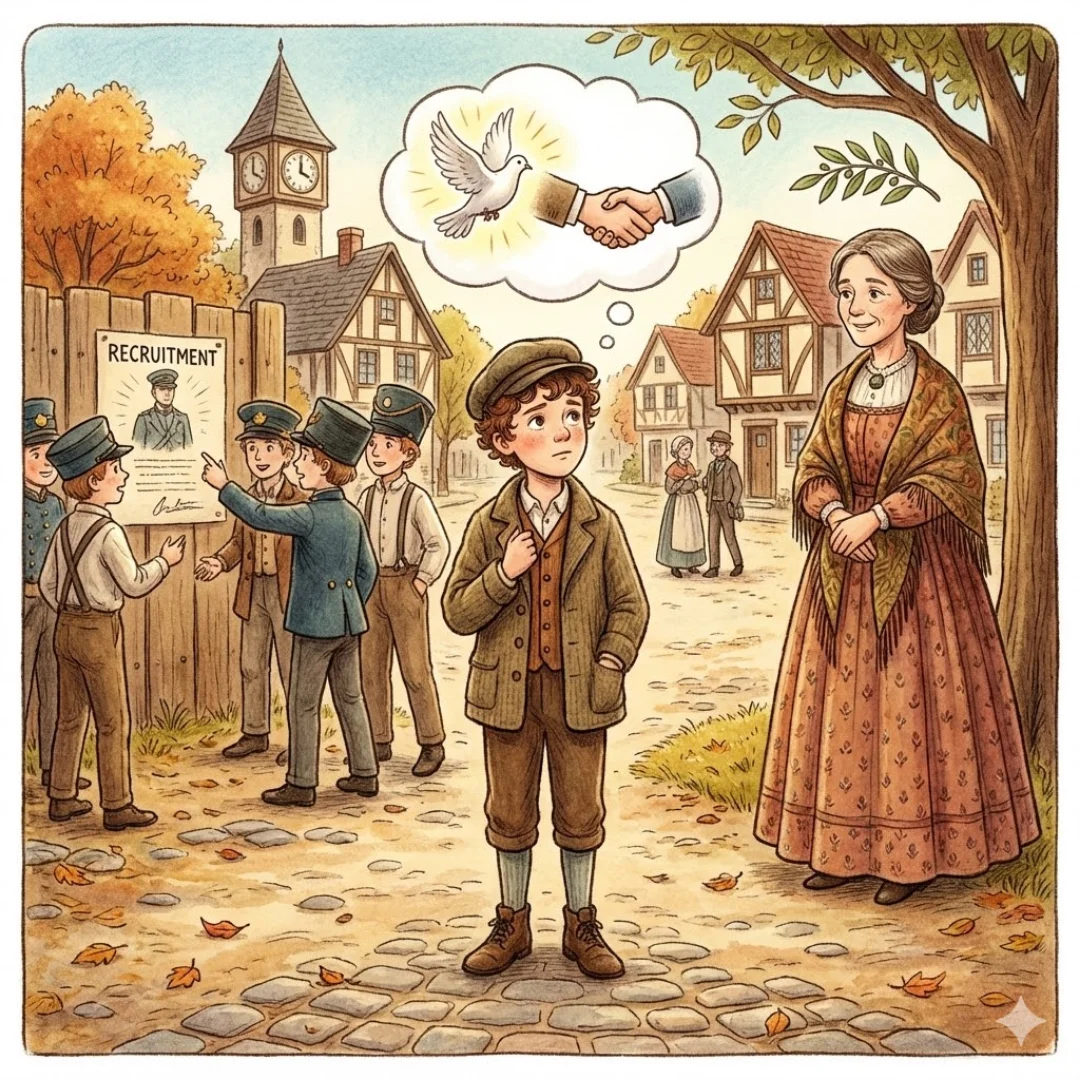
The fighting came closer to Scarborough over the following weeks. Edward watched as his former schoolmates marched off in their makeshift uniforms, carrying muskets and powder horns. Some looked afraid; others looked grimly determined. A few looked at Edward with contempt.
“Coward,” one boy muttered as he passed the Whitmore house.
The word stung like a wasp. Edward wanted to shout back, to explain, to make them understand. But he held his tongue, remembering his mother’s words.
It was his father who showed him the path forward.
“Son,” William said one evening, “Dr. Harrison in town has been overwhelmed with wounded men—soldiers from both sides. He has no assistants left; they have all joined the fighting. He needs help.”
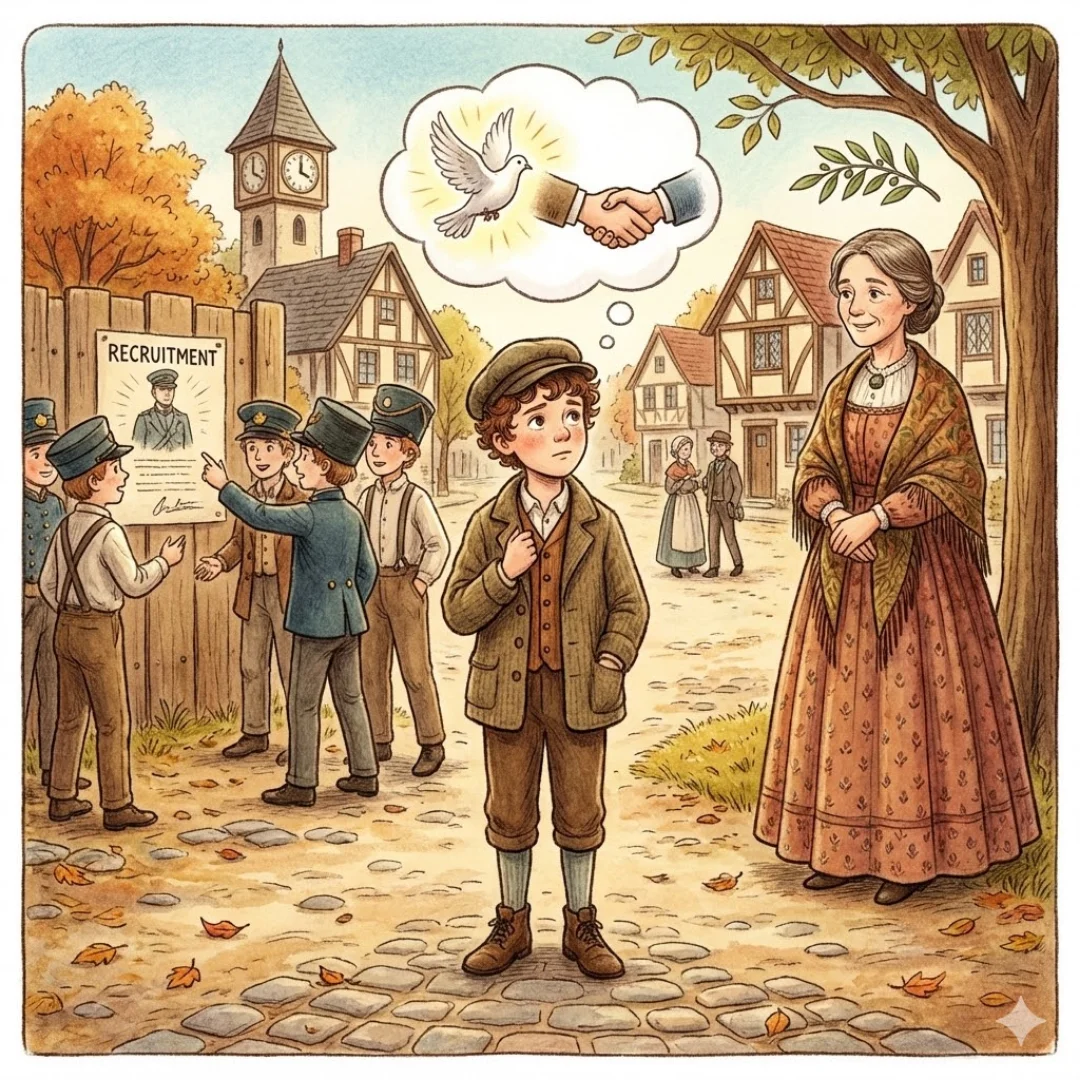
Edward understood immediately. “Thee thinks I should offer my services?”
“Thee has always been good with the healing arts. Thee helped thy mother through her illness better than any physician could. This is a way to serve without compromising thy beliefs.”
The next morning, Edward walked to Dr. Harrison’s clinic, stepping over debris and past shuttered windows, his heart pounding with each step. When he knocked on the door, the elderly doctor looked at him with exhausted, bloodshot eyes.
“I have come to help,” Edward said simply. “I cannot fight, but I can tend to the wounded. I will help anyone who needs it, regardless of which side they are on.”
Dr. Harrison studied him for a long moment. “You’re the Quaker boy, aren’t you? The one everyone calls a coward?”
“I am a Friend, yes,” Edward replied, holding the doctor’s gaze. “But I am no coward.”
Something in Edward’s voice must have convinced him. Dr. Harrison stepped aside and gestured for Edward to enter.
“Then welcome, young man. There is much work to be done.”
* * *
CHAPTER FIVE: IN THE MIDST OF SUFFERING
For the next several months, Edward worked alongside Dr. Harrison, learning to clean and bandage wounds, set broken bones, and comfort dying men. The clinic was always full—red-coated British soldiers lay beside colonial militiamen, their uniforms soaked with blood, their cries of pain mingling in the crowded rooms.
Some men spat at Edward when they learned he was a pacifist. Others cursed him for helping the enemy. But many more looked at him with gratitude, squeezing his hand as he changed their bandages or brought them water.
“Why do you help us?” a young British soldier asked one night. He couldn’t have been more than sixteen, with a shattered leg and fever-bright eyes.
“Because thee are a child of God, same as me,” Edward answered simply. “Thy uniform doesn’t change that.”
The soldier was silent for a moment. “I’ve never met anyone like you before.”
“There are more of us than thee might think. People who believe that kindness is stronger than violence.”
Edward worked through the night, as he had done many nights before. His hands were steady now, confident from practice. He had learned that healing was its own form of bravery—not the loud, dramatic kind that earned medals and parades, but the quiet, persistent kind that saved lives one bandage at a time.
* * *
CHAPTER SIX: THE RESCUE
One grey winter afternoon, Edward was gathering medical supplies from a damaged storehouse when he heard shouting in the distance. Running toward the sound, he found a terrible scene—a collapsed building, and underneath the rubble, a familiar voice crying for help.
“Henry!” Edward gasped.
His childhood friend was trapped beneath fallen beams, his leg pinned at an unnatural angle. A group of soldiers stood nearby, but they were too busy arguing about strategy to help.
Without hesitation, Edward rushed forward. “Help me!” he shouted to the soldiers. “This man needs to be freed!”
Some of them recognized Edward as the pacifist boy and hesitated. But something in his urgency moved them. Together, they lifted the heavy beams, and Edward pulled Henry free.
“Thee came for me,” Henry whispered, his face pale with pain and shock. “But I called thee a coward…”
“Thee are my friend,” Edward said, tears streaming down his face as he examined Henry’s injuries. “That has never changed.”
He carried Henry to the clinic on his back, ignoring the pain in his own muscles, thinking only of getting his friend to safety. Dr. Harrison was able to save Henry’s leg, though he would walk with a limp for the rest of his life.
When Henry was finally well enough to speak properly, he grasped Edward’s hand.
“I understand now,” he said quietly. “What you do—it’s not cowardice. It takes more courage to help than to hate.”
* * *
CHAPTER SEVEN: THE LIGHT REMAINS
The war eventually moved on from Scarborough, leaving the town battered but not broken. Edward continued to work with Dr. Harrison, and in time, he became a doctor himself—one known throughout the region for treating anyone who needed help, regardless of their ability to pay or which side of any conflict they stood on.
His fiancee, a young Quaker woman named Lily, had watched his journey with growing admiration. She had worried at first when he seemed tormented by the expectations of others.
“Why doesn’t thee fight for thy friends?” she had once asked, echoing Henry’s earlier challenge.
“I do fight for them,” Edward had replied gently. “I fight against their suffering. I fight against despair and death. I simply use different weapons—compassion, medicine, and the belief that every life is sacred.”
Now, years later, they sat together in the meetinghouse where Edward had worshipped since childhood. Their own children sat beside them, learning the same lessons of peace and service that Edward had learned from his mother.
The Light within thee is strong, she had told him. Let it guide thee.
And he had. Through the darkest times, when everyone around him insisted that violence was the only answer, Edward had found another way. He had proven that there are many kinds of bravery, and that sometimes the most courageous act is to put down weapons and pick up bandages.
The world, Edward had learned, always needs healers. And while soldiers fight to win wars, it is the peacemakers who help rebuild what war destroys.
That, he knew, was a victory that would last far longer than any battle.
Moral Lessons
- Always stay true to your beliefs, and remember that kindness and compassion can be the greatest form of bravery.
Test Your Understanding
1. What was Edward’s religious background?
2. How did Edward choose to serve during the conflict?
3. What did Edward’s mother Sarah ask him to promise?
4. What happened when Edward rescued his friend Henry?
5. Why did Edward help soldiers from both sides of the conflict?
6. What is the main moral lesson of this story?
Frequently Asked Questions
What is the moral lesson of Edward’s Brave Choice?
What age is this story appropriate for?
How long does it take to read Edward’s Brave Choice?
What culture does this story come from?
Can I use this story for teaching?
Frequently Asked Questions
What is Edward’s Brave Choice bedtime story about?
Edward’s Brave Choice is a historical story about a 17-year-old Quaker boy named Edward Whitmore living in 1778 during wartime. The story explores how Edward must navigate his family’s peaceful Quaker beliefs about the Inner Light in every person while facing external pressures during the Revolutionary War era. It teaches children about courage, faith, and staying true to your values.
What do Quakers believe and why don’t they fight in wars?
Quakers believe in the Inner Light – a divine spark within every person, including enemies. This core belief leads them to practice peace testimony, refusing to harm others because it would mean harming that sacred Light. In the story, Edward’s mother Sarah explains this principle, showing how Quaker families passed down these peaceful values to their children.
What time period does Edward’s story take place in?
The story is set in 1778 in Scarborough, during the American Revolutionary War. This historical setting creates the central conflict – Edward must choose between his Quaker peace beliefs and the wartime pressures surrounding him. The year 1778 was a crucial period when many colonists faced difficult choices about participation in the war.
📚 Recommended Books
Handpicked for readers like you
As an Amazon Associate, we earn from qualifying purchases. These recommendations are personalized based on this story's themes and your reading history.
What age group are these moral stories for children appropriate for?
Edward’s Brave Choice is designed for kids ages 6-12 as an engaging bedtime story that teaches valuable life lessons. The content is carefully crafted to be age-appropriate while addressing serious themes like faith, courage, and moral decision-making in ways that young children can understand and relate to.
What moral lesson does Edward’s story teach kids?
The story teaches children about staying true to their beliefs even when it’s difficult, showing courage in the face of peer pressure, and respecting the inherent worth of all people. Through Edward’s journey, kids learn about the importance of conscience, peaceful conflict resolution, and how personal values guide our choices during challenging times.