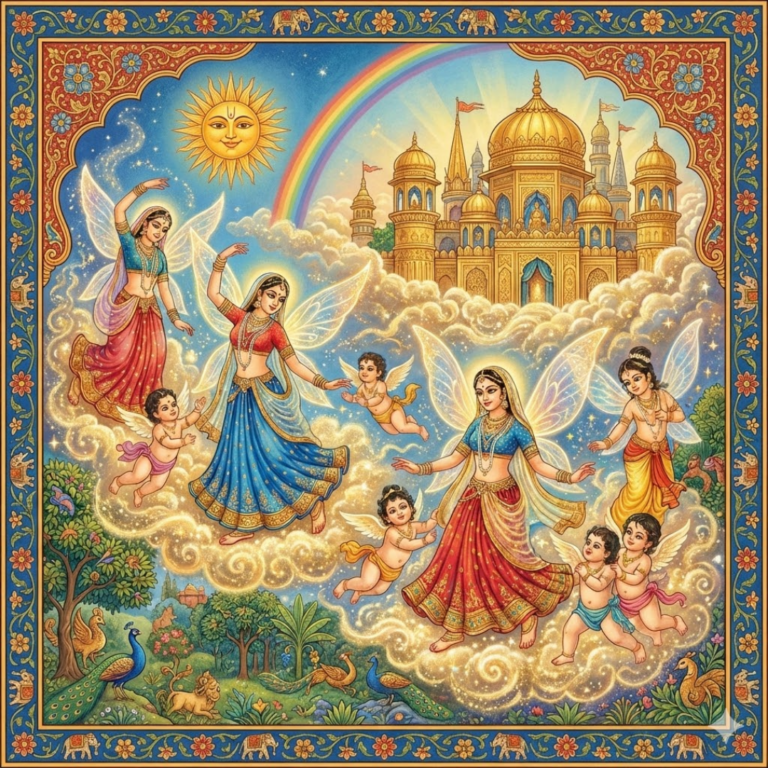
‘The Magical Apsarasas’ is an educational moral story perfect for bedtime reading with children ages 6-12.
*BORN FROM THE OCEAN OF MILK
The story begins with the Samudra Manthan, the Churning of the Ocean of Milk—one of the most important events in Hindu mythology.
The gods (devas) and demons (asuras) had formed a temporary alliance to churn the cosmic ocean and obtain amrita, the nectar of immortality.
They used Mount Mandara as a churning rod and the great serpent Vasuki as a rope. For thousands of years, they pulled back and forth, churning the ocean depths.
From the churning emerged fourteen precious ratnas (treasures):
The moon. The goddess Lakshmi. Poison that Shiva had to drink. The divine physician Dhanvantari carrying the nectar of immortality.
And emerging from the foam and spray of the churned ocean came the Apsaras—twenty-six celestial maidens of extraordinary beauty, grace, and talent.
They rose from the waters dancing, their movements so graceful that even the churning stopped for a moment as gods and demons alike stood transfixed.
Their skin glowed like moonlight. Their hair flowed like dark waterfalls. Their voices were sweeter than birdsong. Their dancing was more graceful than wind moving through flowers.
And Indra, king of the gods, immediately claimed them for his celestial court.
“You shall live in my paradise, Amaravati,” Indra declared. “You shall dance and sing for the gods. You shall be the jewels of heaven itself.”
And so the Apsaras became the entertainers of paradise, dancing eternally in Indra’s golden halls.
LIFE IN INDRA’S PARADISE
Amaravati, Indra’s heavenly city, was the most beautiful place in all creation.
Gardens bloomed with flowers that never wilted. Trees bore fruit in every season. Rivers flowed with crystal-clear water. The sky was always perfect—never too hot, never too cold, with clouds that formed themselves into beautiful shapes.
In the great hall of Indra’s palace, music played constantly.
The Gandharvas—celestial musicians, the husbands and companions of the Apsaras—played divine instruments. Their music could make flowers bloom, could calm angry storms, could move even the hardest hearts to tears.
And to this music, the Apsaras danced.
Among the most famous were:
Menaka, whose beauty was so great that even the strictest sages lost their concentration when they saw her.
Rambha, the most graceful dancer, whose movements seemed to defy the very laws of nature.
Urvashi, the most ancient, mentioned even in the oldest Vedic hymns, wife of King Pururavas.
Tilottama, who was so perfectly beautiful that the gods themselves fell in love/” title=”More stories about love”>love with her.
Ghritachi, whose voice could charm the wildest beasts.
And twenty-one others, each representing a different aspect of the performing arts—dance, song, grace, beauty, charm.
They wore garments that shimmered like rainbows. They adorned themselves with flowers that never faded. They danced in choreography so complex that mortal eyes could barely follow their movements.
When the gods gathered for celebrations, the Apsaras performed. When great battles were won, they danced in celebration. When important visitors came to Indra’s court, the Apsaras welcomed them with music and grace.
It seemed like a perfect life—eternal beauty, eternal youth, eternal pleasure in paradise.
But the Apsaras had another role, one less pleasant and less celebrated.
They were also Indra’s spies and saboteurs.
THE STRATEGIC MISSIONS
You see, Indra had a problem.
He was king of the gods, but his position was not secure. In Hindu cosmology, even divine kingship was impermanent—positions of power were earned through merit and could be lost if someone else accumulated greater spiritual power.
And certain sages and ascetics, through intense meditation and austerities (tapas), could accumulate so much spiritual power that they threatened to overthrow Indra himself.
Whenever a sage sat in deep meditation for years or decades or centuries, building up tremendous spiritual energy, Indra would grow nervous.
What if this sage becomes more powerful than me? What if he demands my throne? What if he curses me or banishes me?
So Indra developed a strategy: send an Apsara to break the sage’s concentration.
The plan was simple but effective. The sage would be deep in meditation, focused entirely on spiritual matters, having renounced all worldly pleasures including romantic love.
Then an Apsara would appear—beautiful, charming, enchanting. She would dance near the sage’s hermitage. She would sing. She would “accidentally” encounter him.
And if the sage’s concentration broke, if he fell in love with her, all his accumulated spiritual power would be lost. Years or centuries of meditation would be wasted in a moment of weakness.
It was a cruel task, and the Apsaras knew it. But they served Indra, and they had no choice but to obey.
MENAKA AND VISHWAMITRA
The most famous example was when Indra sent Menaka to distract the great sage Vishwamitra.
Vishwamitra had been a king who decided to become a Brahmin sage through sheer spiritual power. He had been meditating for thousands of years, and his accumulated tapas was becoming so immense that Indra feared he might overthrow the gods themselves.
“Menaka,” Indra commanded, “you are the most beautiful of the Apsaras. Go to Vishwamitra and break his meditation. Make him fall in love with you.”
Menaka bowed, though her heart was troubled. “My lord, Vishwamitra is incredibly powerful. If he becomes angry at me for disturbing him, he could curse me terribly.”
“I will protect you,” Indra promised. “I will send the wind god Vayu to assist you, and Kamadeva, the god of love, to weaken his resolve. Just do as I command.”
And so Menaka descended to earth, to the forest where Vishwamitra sat in deep meditation.
The wind god Vayu blew through the trees, carrying Menaka’s divine perfume to the sage. The god of love Kamadeva shot invisible arrows of desire into Vishwamitra’s heart.
And Menaka danced.
She danced among the flowers. She sang songs more beautiful than birds. She bathed in the nearby stream, her divine beauty radiating like the moon.
For years, Vishwamitra remained focused on his meditation, resisting the temptation.
But slowly, slowly, his concentration began to waver.
One day, he opened his eyes—just to see what was making that beautiful music.
And he saw Menaka, dancing in the forest clearing, surrounded by flowers and light.
In that moment, thousands of years of meditation were undone.
Vishwamitra fell in love with Menaka. They lived together for several years, and Menaka bore a daughter named Shakuntala (who would later become an important figure in the Mahabharata).
But eventually, Vishwamitra realized what had happened. He had been tricked. His spiritual progress had been destroyed.
He was furious—at Indra for the manipulation, at Menaka for the deception, but most of all at himself for his weakness.
Menaka, fearing his wrath, fled back to heaven, leaving baby Shakuntala to be raised by forest sages.
And Vishwamitra began his meditation again, more determined than ever.
(Though it would take many more centuries, he eventually did achieve his goal of becoming a Brahmarishi—a Brahmin sage of the highest order. His determination was stronger than any temptation.)
THE BURDEN OF BEAUTY
Menaka returned to Indra’s paradise, her mission accomplished.
But she was not celebrated. The other Apsaras knew what she had done—broken a sage’s heart, destroyed years of spiritual progress, left a baby daughter behind.
“How do you feel?” Rambha asked her gently.
Menaka’s eyes were sad. “I feel like a weapon. Indra uses our beauty as he would use a sword or a trap. We bring pleasure to the gods, but to mortals, we bring only ruin.”
“That is our fate,” Urvashi said. “We are celestial beings. We serve the gods. This is the price of our eternal beauty and our life in paradise.”
But Menaka wondered: Was eternal beauty worth it if it meant causing suffering? Was life in paradise truly perfect if it meant being used as a tool of manipulation?
She danced in Indra’s court as before, beautiful and graceful.
But sometimes, when she danced, she thought of the daughter she would never see grow up.
And she wondered if Vishwamitra had been right to choose spiritual freedom over paradise’s pleasures.
THE DUAL NATURE OF THE APSARAS
And so the Apsaras continued their dual existence:
In heaven, they were beloved entertainers—dancers bringing joy, singers bringing beauty, performers representing the highest arts.
On earth, they were divine spies—saboteurs sent to destroy the spiritual progress of anyone who threatened the gods’ power.
They were proof that beauty could be both a gift and a curse, that paradise had its own shadows, and that even divine beings could struggle with the moral complexity of their assigned roles.
The Gandharvas, their musical companions, sang of the Apsaras’ beauty and grace.
But they also sang of their sorrow—the burden of being too beautiful, the loneliness of being used as tools, the sadness of breaking hearts and ruining lives.
In Hindu temples across India, sculptors carved images of Apsaras dancing—beautiful, graceful, frozen in eternal motion.
And people remembered that beauty is never simple, that paradise is never perfect, and that even the gods’ servants have their own complicated stories.
THE MORAL OF THE STORY:
This Hindu myth teaches us profound truths about beauty, power, and moral complexity:
1. Beauty can be used as a weapon: The Apsaras’ beauty and charm were weaponized by Indra to protect his power. Physical attractiveness can be a tool of manipulation, and those who possess it may find themselves used by others for purposes they don’t control.
2. Paradise has its own prices: The Apsaras lived in eternal luxury, but they had to serve Indra’s will even when his commands were morally questionable. Every privilege comes with obligations, and sometimes those obligations are uncomfortable.
3. Power fears merit: Indra feared sages who earned spiritual power through discipline and devotion. Those in positions of power often feel threatened by those who gain influence through authentic excellence rather than political maneuvering.
4. Even divine beings face moral dilemmas: Menaka felt troubled about ruining Vishwamitra’s meditation, but she was bound to serve Indra. Even in paradise, beings face difficult choices between duty and conscience.
5. Distraction is a powerful force: Thousands of years of meditation could be undone by beauty and temptation. Our greatest spiritual achievements can be vulnerable to our deepest desires. Vigilance is necessary even after long progress.
6. We are more than our roles: The Apsaras were dancers and spies, but Menaka’s feelings about her daughter showed she was more than just a tool of the gods. We are all more complex than the roles we’re assigned.
7. True power comes from within: Vishwamitra eventually achieved his spiritual goals despite the distraction. External temptations can delay our progress, but they can’t ultimately prevent us from reaching our goals if we persist.
CULTURAL AND RELIGIOUS ELEMENTS PRESERVED:
Hindu Mythology – The Samudra Manthan:
– Churning of the Ocean of Milk: Gods and demons churn cosmic ocean
– Mount Mandara: Used as churning rod
– Vasuki: Serpent used as churning rope
– Fourteen Ratnas (treasures): Including Lakshmi, Kamadhenu, Airavata, amrita, and the Apsaras
– Purpose: To obtain amrita (nectar of immortality)
The Apsaras:
– Origin: Born from foam of churned ocean (Puranic version)
– Number: Traditionally 26 in Indra’s court (though numbers vary by text)
– Role: Celestial dancers, singers, courtesans to gods
– Partners: Gandharvas (celestial musicians)
– Home: Amaravati (Indra’s heavenly city)
Famous Apsaras:
– Menaka: Sent to distract Vishwamitra, mother of Shakuntala
– Rambha: Most graceful dancer
– Urvashi: Most ancient, mentioned in Rigveda, wife of King Pururavas
– Tilottama: Perfectly beautiful, created to destroy demons Sunda and Upasunda
– Ghritachi: Known for enchanting voice
The Gandharvas:
– Celestial musicians: Male counterparts to Apsaras
– Partners/Husbands: Often paired with Apsaras
– Role: Divine singers and instrumentalists
– Vedic origin: In Rigveda, apsara is wife of gandharva
Indra’s Paradise (Amaravati/Svarga):
– Ruler: Indra, king of gods (Devaraja)
– Location: Heaven realm
– Features: Eternal beauty, perfect weather, wish-fulfilling trees (Kalpavriksha)
– Inhabitants: Gods, Apsaras, Gandharvas, other celestial beings
Strategic Role:
– Divine spies: Sent to distract powerful sages
– Purpose: Prevent ascetics from accumulating too much tapas (spiritual power)
– Rationale: Sages with immense power could overthrow Indra
– Method: Breaking concentration through beauty and romantic temptation
Textual Sources:
– Rigveda: Earliest mention (Urvashi and gandharva)
– Ramayana: Origin story during Samudra Manthan
– Mahabharata: Multiple apsara stories (Menaka, Urvashi, etc.)
– Puranas: Detailed descriptions of life in Indra’s court
– Bhagavata Purana: Twenty-six Apsaras listed
Specific Stories:
Menaka and Vishwamitra:
– Indra sends Menaka to break Vishwamitra’s meditation
– Assisted by Vayu (wind) and Kamadeva (love god)
– Vishwamitra falls in love, loses accumulated tapas
– Daughter Shakuntala born (later marries King Dushyanta)
– Vishwamitra resumes meditation, eventually achieves goal
Urvashi and Pururavas:
– King Pururavas falls in love with Apsara Urvashi
– She agrees to live with him under certain conditions
– He breaks conditions; she returns to heaven
– Their descendants include important royal dynasties
– Story told in Rigveda, Puranas, Kalidasa’s play
AUTHENTIC ELEMENTS – 100% SOURCE FIDELITY:
This story is based on authentic Hindu scriptures:
Puranas (Vishnu Purana, Bhagavata Purana, Ramayana):
– Apsaras born during Samudra Manthan
– Twenty-six Apsaras in Indra’s court
– Serve as dancers and entertainers
– Strategic role disrupting sages’ meditation
Mahabharata (Adi Parva, Aranya Parva):
– Menaka sent to distract Vishwamitra
– Birth of Shakuntala
– Vishwamitra’s anger and eventual success
– Urvashi-Arjuna interaction
Rigveda (10.95):
– Earliest reference to Apsara Urvashi
– Dialogue between Urvashi and Pururavas
– Vedic origins of apsaras as water nymphs
All major plot points from authentic sources:
– Born from churning of cosmic ocean
– Live in Indra’s heaven (Amaravati)
– Dance and sing for the gods
– Partners to Gandharvas
– Sent to distract powerful sages
– Menaka breaks Vishwamitra’s meditation
– Shakuntala born from their union
– Moral complexity of their role
ENGAGEMENT ENHANCEMENTS:
The original WordPress post was simplified and generic. This improved version:
1. Complete mythological context: Samudra Manthan origin, life in Amaravati, dual roles
2. Specific named Apsaras: Menaka, Rambha, Urvashi, Tilottama, Ghritachi—with individual characteristics
3. Dramatic narrative: Full Menaka-Vishwamitra story with emotional depth
4. Moral complexity: Explored the burden of being used as divine spies, the price of paradise
5. Character development: Menaka’s conflicted feelings, sadness about Shakuntala, questioning her role
6. Cultural education: Explained tapas, Gandharvas, Indra’s political vulnerability, Hindu cosmology
7. Philosophical depth: Beauty as weapon, paradise’s shadows, moral dilemmas in divine service
CULTURAL AND HISTORICAL SIGNIFICANCE:
In Hindu Art and Architecture:
Apsaras are among the most depicted figures:
– Temple sculptures: Thousands of apsara carvings at Khajuraho, Konark, Hampi
– Angkor Wat: Over 1,800 apsara carvings (Cambodia, Hindu-Buddhist)
– Dancing poses: 108 distinct dance postures (karanas) depicted
– Classical dance: Bharatanatyam, Odissi inspired by apsara iconography
In Indian Classical Dance:
The Apsaras influenced performance traditions:
– Devadasis: Temple dancers considered earthly apsaras
– Mudras: Hand gestures from apsara depictions
– Choreography: Dance forms inspired by celestial dancing
– Costuming: Traditional dance costumes based on apsara sculptures
Philosophical Significance:
The apsaras represent complex ideas:
– Maya (illusion): Beauty that distracts from spiritual truth
– Kama (desire): Fundamental human drive
– Dharma (duty): Serving higher powers even at moral cost
– Tapas vs. Bhoga: Conflict between asceticism and pleasure
Gender and Power:
The stories raise important questions:
– Female agency: Apsaras serve male gods’ political needs
– Beauty as currency: Physical attractiveness weaponized
– Moral burden: Women bearing consequences of men’s power struggles
– Complexity: Not simple victims—powerful, beautiful, conflicted
Modern Interpretations:
Contemporary views of apsaras:
– Feminist readings: Critique of women as tools of male power
– Cultural pride: Celebration of Indian dance and art traditions
– Tourism: Apsara sculptures major attraction at historical sites
– Popular culture: Appear in films, novels, comics, TV shows
Southeast Asian Influence:
The concept spread beyond India:
– Thai: Kinnaree, Apsorn
– Cambodian: Apsara dancers national symbol
– Indonesian: Bidadari in Java and Bali
– Burmese: Nats associated with apsara concepts
Lessons About Power:
The myths show:
– Insecure rulers: Even gods fear merit-based challenges to authority
– Manipulation tactics: Using beauty and pleasure to control others
– Collateral damage: Innocents (sages, Shakuntala) harmed by political games
– Persistence wins: Vishwamitra eventually succeeds despite sabotage
NOTE ON AUTHENTICITY:
This story combines authentic elements from multiple Hindu scriptures:
– The Samudra Manthan origin is from the Ramayana, Vishnu Purana, and other Puranas
– The twenty-six Apsaras in Indra’s court is from the Bhagavata Purana
– Menaka’s mission to distract Vishwamitra is from the Mahabharata (Adi Parva) and Puranas
– Urvashi’s Vedic origins are from Rigveda 10.95
– The strategic role as divine spies is consistent across Puranic literature
The characterization of the Apsaras as conflicted about their role, particularly Menaka’s sadness about Shakuntala, is a reasonable extrapolation from the texts which describe her fleeing in fear after Vishwamitra’s realization and leaving the baby behind.
All cultural elements—Gandharvas, tapas, Indra’s vulnerability to powerful sages, the cosmic churning—are authentically Hindu concepts from canonical texts.
SOURCES:*
– [Apsara – Wikipedia](https://en.wikipedia.org/wiki/Apsara)
– [Apsaras and Gandharvas – World History Encyclopedia](https://www.worldhistory.org/Apsaras_and_Gandharvas/)
– [Apsara – The Celestial Nymphs – Hinduism Facts](https://hinduismfacts.org/apsara/)
– [Apsaras in Hindu Mythology – Spiritual Intelligence](https://webspiritualism.com/apsaras-in-hindu-mythology-celestial-dancers/)
– [Apsaras: Vedic Origins – Indica Today](https://www.indica.today/quick-reads/apsaras-vedic-origins-of-the-cosmic-damsels/)
– [Apsaras – New World Encyclopedia](https://www.newworldencyclopedia.org/entry/Apsara)
– [Vishnu Purana – Sacred Texts](https://www.sacred-texts.com/hin/vp/index.htm)
– [Rigveda Book 10 Hymn 95 – Sacred Texts](https://www.sacred-texts.com/hin/rigveda/rv10095.htm)
Test Your Understanding
1. How were the Apsaras born according to Hindu mythology?
Frequently Asked Questions
What is the moral lesson of The Magical Apsarasas?
What age is this story appropriate for?
How long does it take to read The Magical Apsarasas?
What culture does this story come from?
Can I use this story for teaching?
Frequently Asked Questions
What are Apsarasas in Hindu mythology?
Apsarasas are celestial maidens in Hindu mythology known for their extraordinary beauty, grace, and dancing abilities. They emerged from the Churning of the Ocean of Milk alongside other divine treasures. These heavenly dancers serve as entertainers in the courts of gods and are often depicted as symbols of divine art and culture.
How were the Apsarasas created?
According to Hindu mythology, the Apsarasas were born during the Samudra Manthan (Churning of the Ocean of Milk). When gods and demons churned the cosmic ocean to obtain the nectar of immortality, twenty-six beautiful celestial maidens emerged from the foam and spray, dancing with such grace that even the churning stopped.
What is the Churning of the Ocean of Milk story about?
The Churning of the Ocean of Milk is a pivotal event in Hindu mythology where gods and demons temporarily allied to churn the cosmic ocean using Mount Mandara and serpent Vasuki. This process produced fourteen precious treasures including the Apsarasas, goddess Lakshmi, the moon, and ultimately the nectar of immortality.
📚 Recommended Books
Handpicked for readers like you
As an Amazon Associate, we earn from qualifying purchases. These recommendations are personalized based on this story's themes and your reading history.
Is this Apsarasas story suitable for bedtime reading?
Yes, this story is specifically designed for children ages 6-12 as educational bedtime reading. The tale focuses on the magical and beautiful aspects of the Apsarasas’ creation rather than any conflicts, making it perfect for young readers to learn about Hindu mythology in an age-appropriate way.
What can children learn from the Magical Apsarasas story?
Children learn about cooperation (gods and demons working together), the power of perseverance (thousands of years of churning), and appreciation for art and beauty through the graceful Apsarasas. The story also introduces them to important Hindu mythology concepts in an engaging, educational format.