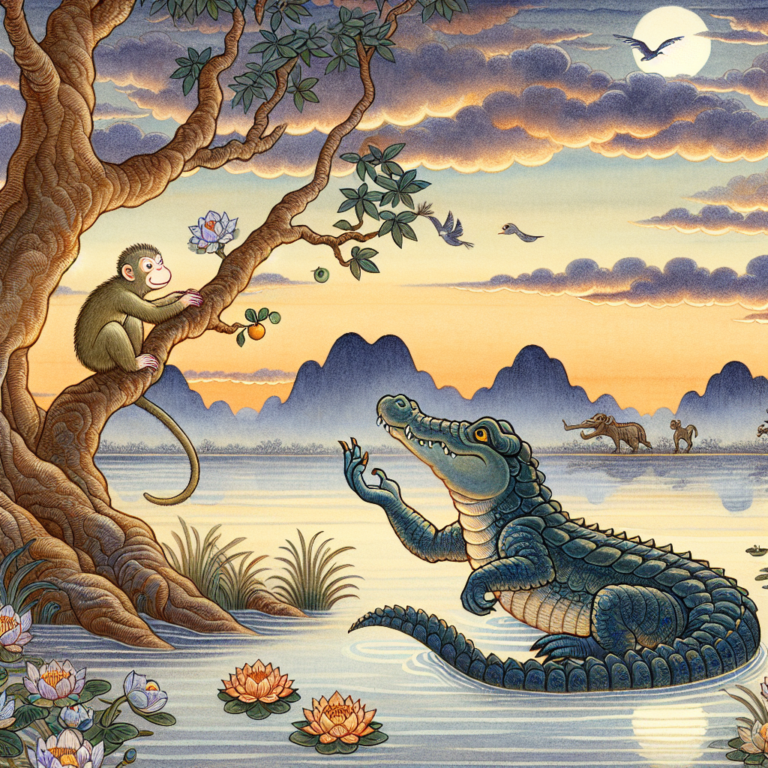
‘The Cheeky Monkey and the Deceptive River Crossing’ is an educational moral story perfect for bedtime reading with children ages 6-12.
Chapter 1: The Monkey in the Mango Tree
Long, long ago, when rivers still remembered the songs of creation and animals spoke their minds freely, there lived a monkey named Kapi in a magnificent mango tree that grew on the banks of a wide river.
Kapi was not the strongest monkey in the forest, nor the most handsome. His fur was rather ordinary brown, and his tail, while functional, would never win any prizes for bushiness. But what Kapi lacked in looks, he made up for in cleverness – and an absolutely extraordinary love of fruit.
“Mangoes in the morning, mangoes at noon, mangoes when the silver moon lights up the lagoon!” he would sing, swinging from branch to branch, filling his belly with the sweet golden fruit.
His tree was perfectly positioned. The branches stretched over the river, and when fruit dropped, it would plop into the water and float downstream. Kapi had everything a monkey could want… except access to the island he could see in the middle of the river.
That island was covered – absolutely covered – with fruit trees of every kind. Jackfruit as big as barrels. Jambu so red they glowed. Papayas like sunshine turned solid. And more mangoes than even Kapi could eat in a lifetime.
But between Kapi and that paradise of fruit lay the river, deep and wide and full of currents that no monkey could swim across.
“One day,” Kapi would sigh, gazing at the island, “one day I’ll find a way.”
He did not know that he was being watched.
Chapter 2: The Crocodiles
Deep beneath the river’s surface, where the water turned dark and cool, lived a family of crocodiles. There was the mother, Makari, as long as three canoes and twice as patient. And there was her son, young Kumbhira, still learning the ways of crocodile cunning.
Makari had lived for a hundred monsoons. She had survived floods and droughts, fishermen’s nets and hunters’ spears. She was wise in the ways of the river – and she was tired of fish.
“Kumbhira,” she said one day, her voice rumbling like stones underwater, “do you see that monkey in the mango tree?”
“Yes, mother. He’s always there, singing silly songs and eating fruit. He never bathes properly – just splashes his face and calls it clean.”
“Filthy habits of monkeys aside,” Makari said, “I have heard that a monkey’s heart is the most delicious thing in all the world. Sweeter than honey, richer than marrow, more satisfying than a thousand fish.”
Kumbhira’s eyes widened. “A monkey’s heart?”
“I have never tasted one,” Makari admitted. “But my grandmother, who lived to be three hundred years old, spoke of it with such longing on her deathbed. ‘If only,’ she said, ‘I had tasted a monkey’s heart just once.’”
She fixed her yellow eyes on her son. “Bring me that monkey’s heart, Kumbhira. Fulfill your great-great-grandmother’s dying wish.”
Chapter 3: The Offer
Kumbhira surfaced near the mango tree, where Kapi sat grooming his fur and contemplating his next snack.
“Greetings, friend monkey!” Kumbhira called out, putting on his friendliest face (which, for a crocodile, looked mostly like a regular crocodile face with slightly less menacing teeth visible).
Kapi peered down suspiciously. In his experience, river creatures rarely started conversations without wanting something.
“Greetings, river dweller. What brings you to my tree?”
“I couldn’t help but notice,” Kumbhira said smoothly, “how often you gaze at the island yonder. Such beautiful fruit trees there, aren’t there?”
Kapi’s ears perked up. “You’ve been to the island?”
“Been to it? I swim past it every day. The mangoes there are twice the size of the ones on your tree, and three times as sweet. The jambu practically leap into your hands.”
Kapi’s mouth watered. “But I can’t swim across. The river is too wide, the current too strong.”
“Ah!” Kumbhira said, as if the solution had just occurred to him. “But I can swim! What if I gave you a ride across? You could feast all day, and I… well, I’ve always wanted a friend who lived above water. It gets lonely, being a crocodile.”
Now, Kapi was clever, but he was also very, very hungry for that island fruit. And surely, he thought, if the crocodile wanted to eat me, he would just say so. Why would he go to all this trouble?
“Very well,” Kapi said, climbing down from his tree. “Let us be friends.”
Chapter 4: The Terrible Truth
Kapi settled onto Kumbhira’s broad, scaly back, gripping the rough hide with his nimble fingers. The crocodile pushed off from the bank and began swimming toward the island.
“This is wonderful!” Kapi exclaimed, enjoying the breeze and the spray. “I’ve never traveled by crocodile before!”
“And I’ve never had a monkey on my back,” Kumbhira replied. “We are both experiencing new things.”
But as they reached the middle of the river, where the water was deepest and the current strongest, something changed. Kumbhira began to sink, just a little at first, then more deliberately.
“Friend?” Kapi said, alarm creeping into his voice. “What are you doing?”
Kumbhira laughed – a horrible, bubbling sound. “I’m sorry, little monkey, but I must be honest with you. I’m not taking you to the island. I’m taking you to my mother.”
“Your mother? Why?”
“Because she wishes to eat your heart.”
Kapi’s blood ran cold. The water was already lapping at his feet, and he could not swim. He was trapped on the back of his own doom.
But in that moment of terror, Kapi’s mind – that quick, clever mind that had always been his greatest asset – began to work.
Chapter 5: The Monkey’s Wit
“My heart?” Kapi said, forcing his voice to remain calm. “Oh dear. Oh dear, oh dear.”
Kumbhira paused. “Why do you say ‘oh dear’ like that?”
“Because, friend crocodile, I would happily give your mother my heart. It’s only a heart, after all, and hearts grow back eventually. But I’m afraid there’s a small problem.”
“What problem?”
Kapi sighed dramatically. “We monkeys don’t keep our hearts inside our bodies.”
Kumbhira was confused. “You don’t?”
“Of course not! Hearts are too important to carry around everywhere. They might get bruised when we jump from tree to tree, or squashed when we swing too fast. No, no – we keep our hearts safely stored in our homes.”
“Where is your home?”
“That magnificent mango tree on the riverbank, of course. My heart is hanging from the highest branch, wrapped in the softest leaves. I was going to the island for fruit, not for… for whatever crocodiles do.”
Kumbhira considered this. It sounded strange, but then again, what did he know about monkey anatomy? He had never actually seen the inside of a monkey.
“So if I take you back to your tree…”
“I’ll give you my heart to bring to your mother! Everyone will be happy. Your mother gets her delicacy, I get to keep living with a new heart that will grow back in a few weeks, and you get to be the good son who fulfilled his mother’s wish.”
Chapter 6: The Escape
Kumbhira turned around and swam back toward the mango tree, faster now, eager to complete his task. The moment they reached the bank, Kapi leaped from the crocodile’s back and scrambled up the tree with speed born of pure relief.
From the highest branch, he called down: “Thank you for the lovely ride, friend crocodile!”
Kumbhira waited. “Well? Where is your heart?”
Kapi burst out laughing – a chattering, rolling monkey laugh that echoed across the river. “You foolish, foolish reptile! Hearts hanging in trees! Hearts that grow back! Did your mother teach you nothing about how bodies work?”
The truth dawned on Kumbhira slowly, like a stone sinking to the riverbed. “You… you tricked me?”
“Of course I tricked you! You were going to let your mother eat my heart! What did you expect me to do – politely agree?”
Kapi plucked a mango and took a triumphant bite. “Let me give you some advice, river-dweller. If you want to catch a clever creature, you must be cleverer still. And between your brains and mine… well, let’s just say it’s not even close.”
Kumbhira roared in frustration and snapped at the tree trunk, but Kapi was safely out of reach.
“Tell your mother,” Kapi added, “that monkey hearts are overrated anyway. I’ve heard fish hearts are the real delicacy. Why not try those instead?”
Chapter 7: The Lesson
Kumbhira swam home in shame, dreading his mother’s reaction. But when he told her what had happened, Makari did not rage or scold.
Instead, she was silent for a long moment. Then she began to laugh – the first time Kumbhira had ever heard her laugh.
“That monkey,” she said, “is wiser than both of us put together.”
“But mother, I failed you!”
“You failed to catch a monkey. But perhaps you learned something more valuable.” She fixed her ancient eyes on her son. “Strength is good. Speed is useful. But cleverness – true cleverness – can escape any trap, defeat any enemy, turn any situation around. That monkey used the only weapon he had, and he used it perfectly.”
“So… I shouldn’t feel ashamed?”
“You should feel taught. Learn from this, my son. The next time you try to trick someone, remember that they might be tricking you right back.”
Meanwhile, up in his mango tree, Kapi gazed at the island with new eyes. Yes, the fruit there looked wonderful. But his tree, his safe and familiar tree, was wonderful too.
“Perhaps,” he said to himself, “what I have is enough. And perhaps the lesson is not just about cleverness, but about being grateful for where I am, rather than always wishing to be somewhere else.”
He settled into his favorite branch and watched the sun set over the river, painting the water gold and orange and pink.
“Besides,” he added with a grin, “I’ve had quite enough adventure for one day.”
And in the river below, a young crocodile swam thoughtfully, learning to respect the power of a quick mind over strong jaws.
Both of them, in their own way, were wiser than they had been that morning.
Moral Lessons
- Wit and quick thinking can overcome greater strength; always keep your wits about you, especially when offered something too good to be true.
Test Your Understanding
1Who lived on the banks of the river?
Frequently Asked Questions
What is the moral lesson of The Cheeky Monkey and the Deceptive River Crossing?
What age is this story appropriate for?
How long does it take to read The Cheeky Monkey and the Deceptive River Crossing?
What culture does this story come from?
Can I use this story for teaching?
Frequently Asked Questions
What is ‘The Cheeky Monkey and the Deceptive River Crossing’ about?
It’s an educational moral story about a clever monkey named Kapi who lives in a mango tree by a wide river and longs to reach a mysterious island. The story blends adventure, wit, and an important life lesson, making it perfect bedtime reading for children ages 6 to 12.
What age group is The Cheeky Monkey and the Deceptive River Crossing suitable for?
This story is best suited for children between the ages of 6 and 12. Its playful language, relatable characters, and clear moral message make it an ideal bedtime read that parents and kids can enjoy together.
What moral lesson does the cheeky monkey story teach children?
While the full lesson unfolds through the story, the tale explores themes of cleverness, greed, and the consequences of deception. Children learn that outsmarting others through trickery often comes with unexpected consequences, encouraging honesty and thoughtful decision-making.
📚 Recommended Books
Handpicked for readers like you
As an Amazon Associate, we earn from qualifying purchases. These recommendations are personalized based on this story's themes and your reading history.
Who is Kapi in the cheeky monkey story?
Kapi is the main character — a clever but ordinary-looking monkey who lives in a mango tree on a riverbank. He’s not the strongest or most handsome, but he’s extraordinarily smart and fruit-obsessed, which drives the adventure when he sets his sights on a nearby island.
Is this monkey story based on any traditional folktale?
The story draws inspiration from classic animal fable traditions, similar to ancient Indian and African folk stories where animals speak and act as moral guides. The character name Kapi and the river setting echo Hindu storytelling traditions, giving the tale a rich cultural depth.