

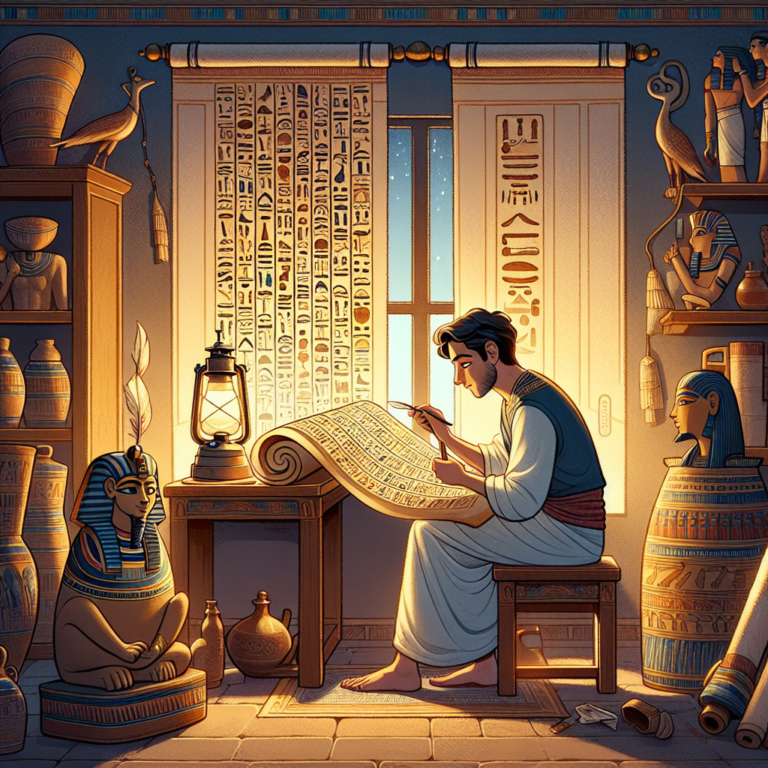
This moral story for children ages 6-12 combines entertainment with important values.
In the golden city of Memphis, where the great pyramids cast their shadows across the desert and the Nile flowed like a ribbon of life through the sand, there lived a boy named Khaemwaset.
Khaemwaset was the son of a scribe, and like his father, he spent his days learning the sacred art of hieroglyphics. But unlike other boys his age who dreamed of becoming soldiers or merchants, Khaemwaset was consumed by a single question that no one seemed able to answer:
“What happens to us when we die?”
His father would shake his head. “Such questions are for the priests, my son. We scribes copy the texts; we do not question them.”
His mother would hold him close. “The gods take care of those who live good lives. That is all you need to know.”
But Khaemwaset needed to know more. Every evening, as the sun god Ra descended into the underworld in his golden barque, the boy would watch the sky turn from blue to orange to purple, and he would wonder: Where does Ra go? What does he see? And could a mortal soul travel that same path?
One morning, Khaemwaset’s father received a special commission from the temple of Ptah. They needed a young scribe to help copy sacred texts that had been damaged by time and moisture.
“You shall assist the high priest,” his father told him. “Mind your manners and do exactly as you are told. This is a great honor.”
When Khaemwaset arrived at the temple, he found himself in a world unlike anything he had seen before. The walls were covered with images of gods and goddesses, with scenes of the afterlife, with spells and prayers in hieroglyphics so ancient that even the priests had to consult older texts to understand them.
The high priest, an old man named Djedptahiufankh, had eyes that seemed to see beyond the physical world.
“So,” the priest said, studying the boy, “you are the one who asks questions about death.”
Khaemwaset was startled. “How did you know?”
“The gods whisper many things to those who know how to listen,” the priest replied with a gentle smile. “Come. I will show you something that may answer your questions.”
Deep within the temple, in a chamber lit only by oil lamps, the priest showed Khaemwaset a collection of papyrus scrolls and stone tablets covered with hieroglyphics.
“These are copies of the Pyramid Texts,” Djedptahiufankh explained. “The oldest sacred writings in all of Egypt, carved on the walls of the pyramids of our ancient kings. They tell the story of what happens to the soul after death.”
Khaemwaset’s heart raced. “Will you teach me to read them?”
“I will do more than that,” the priest said. “I will explain them to you, as they were explained to me by my teacher, and to him by his teacher, in an unbroken chain going back thousands of years.”
And so began Khaemwaset’s true education.
“First,” the priest said, “you must understand that the Egyptians do not believe a person has just one soul. We have many parts, each equally important.”
He drew on a piece of papyrus as he spoke:
“There is the *Ka, your life force, your vital energy. It is created at your birth and remains with your body even after death. This is why we mummify our dead—so the Ka has a body to return to.
“There is the Ba, which is your personality, your unique spirit. After death, the Ba can travel between the world of the living and the realm of the dead. It is often shown as a bird with a human head, flying freely.
“There is the Akh, which is your immortal spirit, the part of you that can become divine after death. When your Ka and Ba unite after death, they become the Akh, a being of light that dwells among the stars.
“There is also your name, your ren, which holds power. As long as your name is spoken and remembered, part of you lives on. This is why we carve names on tombs and monuments.
“And there is your shadow, your sheut, which also holds part of your essence.”
Khaemwaset listened in wonder. “So we are not just one thing, but many things working together?”
“Exactly,” the priest nodded. “And the Pyramid Texts contain the spells and prayers that help all these parts of the soul complete their journey after death.”
Over the following weeks, the priest taught Khaemwaset about the great journey that awaited every righteous soul, but especially the Pharaoh, who was considered a living god.
“When the Pharaoh dies,” Djedptahiufankh explained, “his soul does not simply fade away. It begins the greatest journey of all—a journey to become one with the gods.”
He unrolled a scroll showing the night sky filled with stars.
“The Egyptians believed that the stars were the souls of the dead, shining eternally in the heavens. The circumpolar stars—those that never set below the horizon—were called the ‘Imperishable Ones.’ These were the most honored souls, forever visible, forever remembered.
“The Pyramid Texts were designed to help the Pharaoh’s soul rise up to join these stars.”
Khaemwaset stared at the drawings of the night sky. “But how could a soul travel so far?”
“Ah,” said the priest, “that is where the magic of the texts comes in.”
The Pyramid Texts contained hundreds of “utterances”—spells, prayers, and magical formulas designed to help the dead king overcome every obstacle.
“Listen to this one,” the priest said, reading from an ancient scroll:
“O King, you have not departed dead; you have departed alive!
Sit on the throne of Osiris,
Your scepter in your hand, that you may give orders to the living.”
“This spell,” the priest explained, “declares that the king is not truly dead, but has passed into a new form of life. It gives him authority even in the afterlife.”
He read another:
“A stairway to the sky is set up for you among the Imperishable Stars.
The sky thunders for you, the earth quakes for you,
The stars tremble for you,
When you ascend to the sky as a star.”
“This one,” he continued, “describes how the sky itself opens to receive the king’s soul, and how he rises up like a star to take his place among the gods.”
Khaemwaset imagined the Pharaoh’s soul climbing an invisible stairway, past the sun and moon, up to the eternal stars. “It’s beautiful,” he whispered.
But the journey was not easy, the priest warned. Before a soul could reach the stars, it had to pass through the Hall of Two Truths, where the heart was weighed against the feather of Ma’at, the goddess of truth and justice.
“Your heart,” Djedptahiufankh said, placing his hand over his own chest, “is the seat of your thoughts, your intentions, your moral character. After death, it is placed on a scale opposite the feather of Ma’at.”
He showed Khaemwaset a painting of the scene: the jackal-headed god Anubis operating the scale, the ibis-headed god Thoth recording the results, and a fearsome creature called Ammit—part crocodile, part lion, part hippopotamus—waiting nearby.
“If your heart is heavy with lies and cruelty and selfishness, it will outweigh the feather. Then Ammit will devour your heart, and you will cease to exist. This is the true death, from which there is no return.”
“But if your heart is light?” Khaemwaset asked.
“Then you are declared ‘true of voice’—justified, worthy. You may pass on to the Field of Reeds, a paradise like Egypt but even more beautiful, where the crops always grow tall and the Nile never floods too much or too little. And from there, your soul may rise to join the gods.”
The priest set down his scrolls and looked at Khaemwaset with kindness.
“You came to me asking what happens when we die. Now you know: the Egyptians believed in a journey, a judgment, and the possibility of eternal life among the stars.
“But here is the secret the texts teach us, young one: the journey after death is determined by the life we live before death. Every kind word, every honest deed, every moment of compassion—these make your heart lighter. Every lie, every cruelty, every act of selfishness—these make your heart heavier.
“The Pyramid Texts are full of magical spells, yes. But the greatest magic is to live a life of Ma’at—truth, justice, and harmony. A person who lives this way has nothing to fear from the scales of judgment.”
Khaemwaset thought about this for a long time. “So the afterlife begins now?”
The priest smiled. “In a way, yes. Every day, you are preparing your heart for that final weighing. Every choice you make matters.”
Years later, when Khaemwaset had grown into a wise scribe himself, he would teach these same lessons to young students who came to him with questions.
“The Pyramid Texts are over four thousand years old,” he would tell them. “They are the oldest religious writings we have. And yet their message is timeless: live with truth, act with justice, treat others with kindness, and you need not fear what comes after.”
And when the students asked him if he truly believed in the journey to the stars, Khaemwaset would look up at the night sky, brilliant with thousands of points of light, and say:
“Look at the stars. Each one has been shining for longer than any kingdom has lasted. Perhaps our ancestors were right—perhaps the souls of the righteous do dwell there, watching over us, guiding us, reminding us that our lives, though brief, are part of something eternal.
“Whether or not you believe that literally, believe this: how you live matters. Your choices echo beyond your years. That is the true wisdom of the Pyramid Texts.”
This ancient Egyptian wisdom teaches us several important lessons.
First, how we live determines who we become. The Egyptians believed that every action affects the heart. Living with honesty, kindness, and justice prepares us for whatever comes next—whether that is an afterlife or simply the legacy we leave behind.
Second, death is not necessarily an ending. The Pyramid Texts present death as a transformation, a journey to a new form of existence. This helped the ancient Egyptians face mortality with courage rather than fear.
Third, knowledge preserves memory. The Egyptians believed that as long as your name was spoken, part of you lived on. This reminds us of the power of memory, storytelling, and honoring those who came before us.
Finally, the universe is full of mystery and wonder. Looking at the stars, the Egyptians saw the souls of the dead shining eternally. Whether we share their beliefs or not, we can share their sense of awe at the vastness of existence.
This retelling faithfully preserves authentic ancient Egyptian religious beliefs:
The Pyramid Texts are the oldest known religious writings in the world, dating to approximately 2400-2300 BCE. They were carved on the walls of pyramids at Saqqara, beginning with the pyramid of Pharaoh Unas. They contain about 800 “utterances” (spells and prayers) designed to help the dead king achieve eternal life.
Ancient Egyptians believed in multiple components of the self: the Ka (life force), Ba (personality/spirit), Akh (immortal spirit), Ren (name), and Sheut (shadow). Proper burial rituals were essential to keeping all these parts together.
The judgment scene with Anubis, Thoth, Ma’at’s feather, and Ammit the Devourer is one of the most famous images from ancient Egyptian religion, though it appears more prominently in the later Book of the Dead than in the Pyramid Texts.
Ma’at was both a goddess and a concept representing truth, justice, balance, and cosmic order. Living in accordance with Ma’at was the highest ethical ideal.
– Pyramid Texts: The oldest known religious writings in the world (c. 2400-2300 BCE), carved on the walls of royal pyramids to help the deceased pharaoh reach the afterlife
– Ka: The vital life force that remains with the body after death; why mummification was important
– Ba: The personality or spirit that can travel between worlds; often depicted as a human-headed bird
– Akh: The immortal, glorified spirit formed when Ka and Ba unite after death
– Ma’at: The goddess of truth, justice, and cosmic order; also the concept of living righteously
– Anubis: The jackal-headed god of mummification and the dead, who weighs hearts in the judgment
– Osiris: King of the underworld and god of the dead, resurrection, and fertility
– Field of Reeds: The Egyptian paradise, a perfected version of Egypt where the blessed dead dwell
– Ammit: The “Devourer,” a fearsome creature that consumes the hearts of the unworthy, causing true death
1. The Egyptians believed every action makes your heart heavier or lighter. How might thinking this way change the choices you make? (Explores ethics, consequence, moral awareness)
2. Why do you think the ancient Egyptians imagined so many parts of the soul instead of just one? (Discusses complexity of identity, different aspects of self)
3. The Egyptians believed that speaking someone’s name kept part of them alive. How do we keep the memory of loved ones alive today? (Memory, legacy, honoring ancestors)
4. Looking at the stars, the Egyptians saw the souls of the dead. What do you see when you look at the night sky? (Personal reflection, wonder, different cultural interpretations)
5. Do you think ancient beliefs about the afterlife helped people live better lives? Why or why not? (Philosophy, religion, ethics)
– Faulkner, Raymond O., translator, “The Ancient Egyptian Pyramid Texts” – Standard academic translation
– Allen, James P., “The Ancient Egyptian Pyramid Texts” – Modern scholarly translation
– British Museum resources on Egyptian afterlife beliefs
– Metropolitan Museum of Art educational materials on Egyptian religion
This story introduces the wisdom of the Pyramid Texts, the oldest religious writings known to humanity, helping children understand ancient Egyptian beliefs about death, the soul, and the importance of living a good life.*
Test Your Understanding
1Who translated the Pyramid Texts into English?
Frequently Asked Questions
What is the moral lesson of Samuel’s Quest for the Secrets of the Sacred Pyramids?
What age is this story appropriate for?
How long does it take to read Samuel’s Quest for the Secrets of the Sacred Pyramids?
What culture does this story come from?
Can I use this story for teaching?
Frequently Asked Questions
What are the secrets of the sacred pyramids in Samuel’s Quest?
In this children’s story, the secrets of the sacred pyramids revolve around ancient Egyptian beliefs about death, the afterlife, and the journey of the soul. Young Khaemwaset seeks answers about what happens when we die, uncovering hidden wisdom connected to hieroglyphics, the gods, and the mysteries buried within Egypt’s great pyramids.
What age group is Samuel’s Quest for the Secrets of the Sacred Pyramids written for?
This moral story is written for children ages 6 to 12. It combines exciting adventure set in ancient Egypt with important life values, making it suitable for young readers who enjoy history, mythology, and meaningful storytelling.
What moral lessons does this sacred pyramids story teach children?
The story encourages children to ask questions, pursue knowledge, and think deeply about life and purpose. Through Khaemwaset’s journey, kids learn the value of curiosity, courage, and seeking truth — even when the adults around them say some questions are better left unanswered.
📚 Recommended Books
Handpicked for readers like you
As an Amazon Associate, we earn from qualifying purchases. These recommendations are personalized based on this story's themes and your reading history.
Is this story based on real ancient Egyptian history or mythology?
The story is inspired by real ancient Egyptian culture, including the city of Memphis, hieroglyphics, the god Ra, and beliefs about the afterlife. While the characters and plot are fictional, the historical and mythological details give children an authentic and educational glimpse into ancient Egyptian life.
Who is the main character in Samuel’s Quest for the Secrets of the Sacred Pyramids?
The main character is Khaemwaset, a curious young boy and son of a scribe living in ancient Memphis, Egypt. Obsessed with the question of what happens after death, he embarks on a quest to uncover the mysteries of the sacred pyramids, driven by wonder that sets him apart from other children his age.
