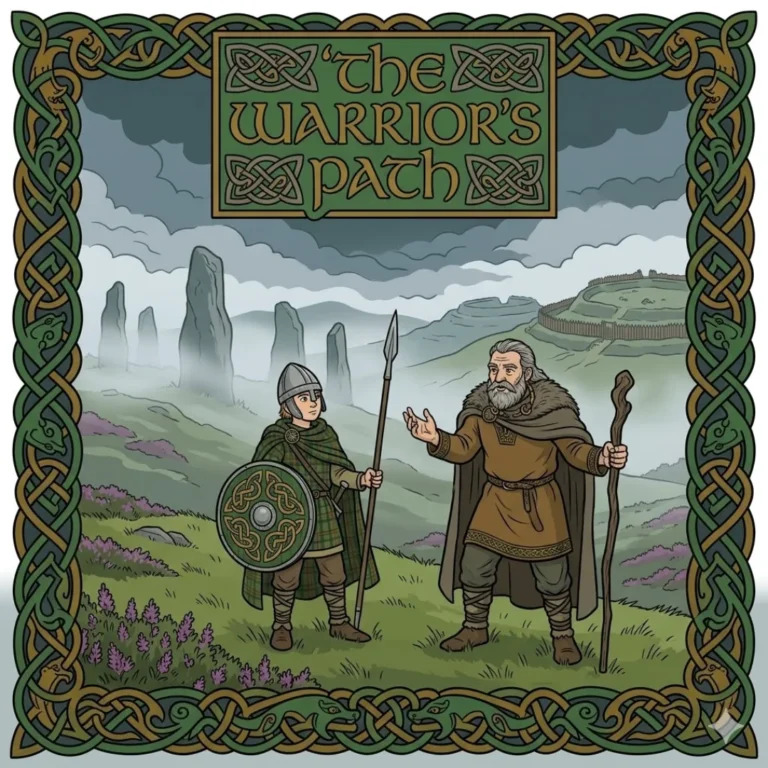
This bedtime story for kids, ‘The courageous Gododdin and the Wisdom of Ancestors’, teaches children ages 6-12 about important moral values.
Chapter One: The Boy Who Loved Words
In the green valleys of Wales, where mountains rose like ancient guardians and mist rolled through the passes like ghostly rivers, there lived a boy named Dai who loved words more than anything in the world.
While other children his age in the village of Llanfair learned to farm and fish, Dai collected stories the way others collected pebbles or bird feathers. He memorized the songs the old women sang while spinning wool. He listened at doorways when the men gathered to talk of ancient times. He repeated the prayers the priest spoke, not because he was especially religious, but because he loved the way the syllables rolled on his tongue.
“That boy has a bard’s soul,” his grandmother would say, watching him recite the village’s lineage without a single error. “One day, he will keep our stories alive.”
But Dai’s father, a practical sheep farmer, worried.
“Stories don’t fill bellies,” he would grumble. “The boy needs to learn useful skills.”
The summer Dai turned twelve, his grandmother fell ill.
Chapter Two: The Hidden Book
Dai sat by her bedside, holding her papery hand, watching her shallow breaths.
“My darling boy,” she whispered one evening, “there is something I must give you before I go to join the ancestors.”
With trembling hands, she pointed to a chest in the corner of her cottage, one Dai had never seen opened.
Inside, wrapped in oilcloth that smelled of ancient things, lay a book.
Not just any book. The pages were made of vellum – the preserved skin of calves – and covered with writing so beautiful it made Dai’s breath catch. The script curled and flowed like the branches of sacred trees, and though the words were in an old form of Welsh, Dai could understand most of them.
“This is a copy,” his grandmother said, “of pages from the Red Book of Hergest. Our family has kept it for three hundred years. Now it passes to you.”
“What is in it?” Dai breathed, barely daring to touch the precious pages.
“The wisdom of our ancestors. The courage of our warriors. The soul of our people.” She squeezed his hand with surprising strength. “Read it. Learn it. Pass it on. Promise me.”
“I promise,” Dai said.
His grandmother smiled, closed her eyes, and did not open them again.
Chapter Three: The Gododdin Warriors
For weeks after her burial, Dai could not bear to open the book. It sat on his small writing desk, wrapped in its oilcloth, waiting.
Then one night, unable to sleep, he lit a candle and finally turned back the cover.
The first pages contained the beginning of an ancient poem: Y Gododdin.
“Men went to Catraeth,” Dai read aloud, his voice barely a whisper. “Shouting war-cry, swift steeds, blue armor and shields, spear shafts held high and spear points sharp, and gleaming armor, and swords…”
The words pulled him in like a strong current. He read of three hundred warriors who rode from Din Eidin (the fortress now called Edinburgh) to face a vast Saxon army at a place called Catraeth. They knew they were outnumbered. They knew they would likely die.
They went anyway.
“For the feast of Mynyddog,” Dai read, “they paid with their lives.”
The poem named them – Gwawrddur, Cynon, Madawg, dozens of others – each one remembered for specific acts of courage. One warrior killed three hundred enemies before falling. Another defended his wounded friend until he too was struck down. A third refused to flee even when offered the chance, saying it would dishonor his oath.
By the time dawn light crept through his window, Dai had read the entire poem three times. And something had changed inside him.
Chapter Four: The Bard’s Fire
“Father,” Dai said at breakfast, his eyes red from his sleepless night, “I want to become a bard.”
His father’s spoon froze halfway to his mouth. “A what?”
“A bard. A keeper of stories. Like our ancestors had. Like the ones who wrote Y Gododdin.”
“We are farmers, boy. Not poets.”
“The Gododdin warriors were farmers too, before they became heroes. And without bards to remember them, their sacrifice would be forgotten. Who would remember us, Father, if we don’t remember them?”
His father stared at him for a long moment. Then, slowly, something shifted in his weathered face.
“Your grandmother spoke to you before she died.”
“She gave me a book.”
“The book.” His father nodded slowly. “She always said she was waiting for the right one to give it to. I thought it would be your older brother.”
“She chose me.”
Another long pause. Then his father pushed back from the table.
“There is an old poet in the village of Beddgelert, two days’ walk from here. They say he still teaches the old ways. If you are serious about this, truly serious, I will take you to him.”
Dai’s heart soared. “I am serious, Father. I promise.”
Chapter Five: The Lessons of the Master
The old poet’s name was Talfryn, and he lived in a stone cottage covered with ivy so thick it seemed the building itself was growing.
He was not impressed by Dai’s enthusiasm.
“You wish to be a bard?” he said, his voice dry as autumn leaves. “Do you know what that means? It means years of study. It means memorizing thousands of lines. It means learning not just words, but the truth behind them.”
“I will do whatever it takes,” Dai said.
“Will you? Let us see. Recite for me the names of the twenty-seven warriors celebrated in Y Gododdin.”
Dai closed his eyes, reached into his memory, and began to speak. Name after name flowed from his lips, and with each name, he added what the poem said about that warrior – their weapon of choice, their finest deed, the manner of their death.
When he finished, the cottage was silent.
“Where did you learn this?” Talfryn asked, and there was a new note in his voice.
“From my grandmother’s book. And from my own heart. These warriors deserve to be remembered. Their courage, their sacrifice – it should not disappear just because centuries have passed.”
Talfryn studied him with eyes that seemed to see beyond the surface.
“The Gododdin warriors rode to certain death because they believed some things are worth dying for – honor, loyalty, the protection of their people. A bard’s task is not just to remember their names, but to understand why they rode. To carry that truth forward so that future generations might find the same courage when they need it.”
He extended his hand.
“I will teach you, Dai of Llanfair. But the learning will be hard, and it will take years. Are you prepared?”
Dai grasped the old man’s hand.
“I am prepared.”
Chapter Six: The Words that Bridge Time
Seven years Dai studied with Talfryn. He learned not only Y Gododdin but countless other poems and stories – the Mabinogion tales of magical transformations, the prophecies of Merlin, the songs of the saints, and the lineages of a hundred noble houses.
He learned that words were not just sounds, but bridges. Bridges between the past and present. Bridges between one heart and another. Bridges between the ordinary world and something greater.
The year he turned nineteen, Talfryn fell ill and knew his time was near.
“You are ready,” the old bard said. “Go now. Share what you have learned. Keep the old stories alive, but tell new ones too. A living tradition must grow, or it dies.”
Dai traveled across Wales, performing in great halls and humble cottages. Everywhere he went, he saw the same thing happen: when he recited Y Gododdin, people sat straighter. Their eyes brightened. Something in them remembered that they came from brave ancestors who had faced impossible odds with courage.
And when they asked him why these old stories mattered, Dai would smile.
“Because the past is not gone,” he would say. “It lives in us. The courage of the Gododdin warriors is our inheritance. When we face our own impossible odds – and we all face them, in our own ways – we can draw on their strength. We are not alone. We never have been.”
Chapter Seven: The Circle Continues
Many years later, an old bard named Dai sat in a stone cottage covered with ivy, teaching a young girl the names of the Gododdin warriors.
“Why do these old stories matter?” the girl asked, echoing a question Dai had heard a thousand times.
And Dai told her about his grandmother, and the book, and the long years of learning. He told her about the three hundred warriors who rode to Catraeth, knowing they would die, because some things were worth dying for.
“And what things are those?” the girl asked.
“Honor,” Dai said. “Loyalty. Love. The protection of what is precious. These things have not changed in a thousand years, and they will not change in the thousand years to come.”
He placed a hand on the worn cover of his grandmother’s book.
“Words have power,” he said. “The power to remember. The power to inspire. The power to connect us to everyone who came before and everyone who will come after. When you learn these stories, you become a link in an unbroken chain stretching back to the beginning of our people.”
“And that chain will stretch forward through me?” the girl asked.
Dai smiled.
“Through you. And through everyone you teach. Forever.”
Moral Lessons
- The stories of our ancestors carry wisdom and courage that can strengthen us across the centuries. When we remember and share the tales of those who faced impossible odds with bravery and honor, we become links in a chain of tradition that connects past, present, and future.
Test Your Understanding
1Who translated all the stories of our ancient Welsh Bardic poetry?
Frequently Asked Questions
What is the moral lesson of The Courageous Gododdin and the Wisdom of Ancestors?
What age is this story appropriate for?
How long does it take to read The Courageous Gododdin and the Wisdom of Ancestors?
What culture does this story come from?
Can I use this story for teaching?
Frequently Asked Questions
What is The Courageous Gododdin and the Wisdom of Ancestors about?
It’s a bedtime story set in the green valleys of Wales, following a boy named Dai who loves words and stories. The tale explores themes of courage, the wisdom of ancestors, and finding your true purpose, making it a meaningful read for children ages 6 to 12.
What age group is The Courageous Gododdin story suitable for?
This story is written for children between 6 and 12 years old. Its rich language, moral values, and adventure make it engaging for early readers and older kids alike, and it works especially well as a bedtime story read aloud together.
What moral values does The Courageous Gododdin teach kids?
The story focuses on courage, respecting ancestral wisdom, and the importance of preserving culture and stories. It also gently explores the tension between practical skills and creative gifts, encouraging children to value what makes them uniquely themselves.
📚 Recommended Books
Handpicked for readers like you
As an Amazon Associate, we earn from qualifying purchases. These recommendations are personalized based on this story's themes and your reading history.
Is The Courageous Gododdin based on real Welsh history or legend?
The story draws inspiration from Welsh culture and the ancient Gododdin tradition, a real body of early Welsh poetry celebrating courage and heroism. While the characters are fictional, the setting and spirit reflect genuine Celtic heritage and storytelling history.
Why is ancestral wisdom important in this bedtime story for kids?
Ancestral wisdom in the story represents the power of memory, cultural identity, and learning from those who came before us. Through Dai’s journey, children discover that the stories and traditions passed down by grandparents and elders carry real strength and lasting value.