

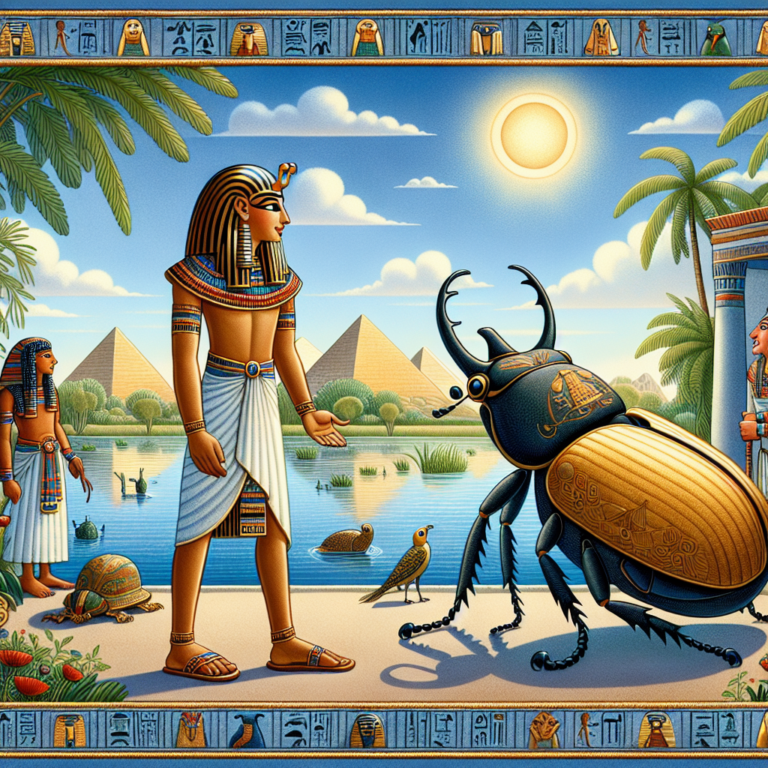
‘Ramses’ Curious Quest to the Land of Gods’ is an educational moral story perfect for bedtime reading with children ages 6-12.
## Chapter One: The Pharaoh Who Wondered
In the ancient land of Egypt, where the great river Nile flowed like a silver serpent through the desert sands, there ruled a young Pharaoh named Ramses.
Ramses was not like the pharaohs who had come before him. Yes, he sat upon the golden throne. Yes, he wore the double crown of Upper and Lower Egypt. Yes, his subjects bowed before him and called him “Son of Ra, Lord of the Two Lands, Mighty Bull.”
But in his heart, Ramses carried questions.
He would stand on the palace balcony at night, gazing up at the stars that scattered across the darkness like grains of spilled wheat, and he would wonder: What lies beyond the stars? What happens when I close my eyes for the last time? Where do my ancestors dwell now, those pharaohs whose tombs lie silent in the Valley of the Kings?
The priests told him stories, of course. They spoke of the Duat – the underworld – and the journey of the soul through its twelve gates. They spoke of the weighing of the heart and the judgment of Osiris. They spoke of the Field of Reeds, where the blessed dead lived in eternal peace.
But stories were not enough for Ramses. He wanted to know. Not believe – know. He wanted to see with his own eyes, hear with his own ears, understand with his own heart.
“Is it possible,” he asked his wisest advisor, “for a living person to visit the realm of the gods? To journey to the Duat and return?”
The advisor shook his head. “No mortal has ever done such a thing, Great One. The realm of the dead is for the dead alone.”
But Ramses was not satisfied. And as he learned, the gods have ways of answering questions that priests cannot.
## Chapter Two: The Messenger of Ra
One morning, as Ramses walked alone along the banks of the Nile, something caught his eye.
A scarab beetle sat on a stone, perfectly still, watching him.
Now, scarab beetles were common in Egypt. They rolled balls of dung across the sand, and the people saw in them a reflection of Khepri, the god who rolled the sun across the sky. Scarabs were sacred, symbols of rebirth and transformation.
But this scarab was different. Its shell was not dark brown or black – it was pure gold, blazing in the morning light like a tiny piece of the sun itself.
And then it spoke.
“Ramses, Son of Ra, Great One of Egypt,” the beetle said, its voice deep and resonant despite its small size, “I come to you as a messenger.”
Ramses should have been frightened – or at least surprised. But somehow, he felt only calm. It was as though he had been waiting his whole life for this moment.
“Who sends you?” he asked.
“The Lord of Light himself – Ra, the Sun God, from whom all pharaohs descend. He has seen your questions burning in your heart. He has heard your longing to understand. And he has decided to grant you a gift that no mortal has ever received.”
“What gift?”
The golden scarab spread its wings, revealing patterns of blue and green and red beneath – the colors of the cosmos.
“I will guide you to the Duat, the realm of the afterlife. There you will meet Osiris and Isis, the rulers of that domain. They will teach you what you wish to know. But remember – this is a journey of the spirit, not the body. Your flesh will remain here, seemingly asleep. Do not stay too long in the realm of the dead, or you may not find your way back.”
Ramses felt his heart racing with excitement and fear. “I accept,” he said. “Show me the way.”
## Chapter Three: Through the Western Gate
The golden scarab took flight, and Ramses followed – not with his feet, but with something deeper. He felt himself rising from his body, light as a feather, thin as a shadow.
He looked back and saw his physical form standing motionless by the river, eyes closed, as still as a statue. But he had no time to worry about it. The scarab was moving fast, flying toward the western horizon where the sun was just beginning to set.
“The Duat lies in the west,” the scarab explained, “beyond the place where the sun dies each evening. That is why we build our tombs on the west bank of the Nile – so the dead can easily find their way to the afterlife.”
They flew over the desert, over the pyramids that gleamed gold in the dying light, over the temples and tombs and obelisks. And then, as the sun touched the horizon, something extraordinary happened.
The sky split open.
Not like a tear or a crack, but like a door – a great golden door that appeared where the sun met the earth. The scarab flew straight toward it, and Ramses followed.
They passed through.
## Chapter Four: The Twelve Hours of Night
The Duat was nothing like Ramses had imagined.
He had expected darkness, gloom, perhaps fire and demons. But instead, he found himself in a realm of strange beauty. The sky above was deep blue-black, filled with stars that seemed closer and brighter than any he had seen before. The landscape was a mix of rivers and fields, deserts and gardens, all bathed in an eerie, soft light that came from no visible source.
“The sun passes through the Duat each night,” the scarab explained. “Ra himself, in his night form, sails through this realm in his great boat, battling the serpent Apophis, bringing light and hope to the dead. What you see is the light of his passage.”
They traveled through the twelve regions of the Duat – one for each hour of the night. In each region, Ramses saw the souls of the dead making their own journeys. Some walked confidently, surrounded by protective spirits. Others struggled against demons and obstacles.
“Why do some have an easier journey than others?” Ramses asked.
“Because of how they lived,” the scarab answered. “Those who lived with truth and kindness in their hearts find the path clear. Those who lived with lies and cruelty find the path difficult. The Duat reflects back what each soul carries within.”
Ramses thought about this. He thought about the decisions he had made as Pharaoh – some wise, some perhaps not so wise. What would his own journey through this realm be like when his time came?
## Chapter Five: The Hall of Two Truths
At last, they reached the heart of the Duat: a vast hall with columns that reached up into infinity, each one carved with hieroglyphs telling the stories of the gods and the history of creation.
This was the Hall of Ma’at – the Hall of Two Truths – where every soul was judged.
At the far end of the hall, on a throne of carved lapis lazuli, sat Osiris.
Ramses had seen images of Osiris all his life – on temple walls, on painted coffins, on papyrus scrolls. But nothing had prepared him for the reality. Osiris was magnificent and terrible, beautiful and awe-inspiring. His skin was green, the color of growing things, for he was the god of resurrection. He wore the white crown of Upper Egypt and held the crook and flail – symbols of kingship and authority.
His eyes, when they turned to look at Ramses, were like two black suns – burning with power that was beyond human comprehension.
“Welcome, Ramses of Egypt,” Osiris spoke, and his voice was like the rumbling of the earth itself. “It is rare for a living soul to stand in my hall. What do you seek?”
Ramses bowed low – the first time he had ever bowed to anyone. “Great Osiris, Lord of the Duat, I seek understanding. I want to know what happens to the soul after death. I want to understand the journey that awaits me and my people.”
## Chapter Six: The Weighing of the Heart
Osiris nodded slowly. “Then you shall see what few living eyes have seen. Bring forward a soul!”
From the shadows emerged a procession: jackal-headed Anubis leading a small, glowing figure – the soul of an Egyptian who had recently died. Behind them came Thoth, the ibis-headed god of wisdom, carrying a scroll and a reed pen.
In the center of the hall stood a great golden scale.
“Every soul that enters my realm must face the Weighing of the Heart,” Osiris explained to Ramses. “Watch and learn.”
Anubis gently took the soul’s heart – not the physical organ, but something that glowed with its own light – and placed it on one side of the scale. On the other side, he placed a single white feather.
“That is the feather of Ma’at,” the golden scarab whispered to Ramses. “Ma’at is truth, justice, cosmic order. The feather represents the ideal of how a life should be lived.”
The scale trembled, rocked, and then… balanced perfectly.
A smile crossed Osiris’s green face. “This heart is pure. It bears no weight of lies, cruelty, or injustice. This soul is worthy of eternal life.”


The soul – a man who had been a simple farmer, Ramses could somehow tell – was led away to a doorway that opened onto golden fields stretching to infinity. The Field of Reeds, where the blessed dead lived in eternal peace and plenty.
“What if the heart is heavy?” Ramses asked. “What if it does not balance?”
As if in answer, another soul was brought forward. This one’s heart, when placed on the scale, sank down immediately. The feather rose high into the air.
“This heart is heavy with falsehood and cruelty,” Osiris pronounced, his voice now terrible. “It cannot pass.”
From the shadows emerged a creature that made Ramses step back in horror. It had the head of a crocodile, the front body of a lion, and the hindquarters of a hippopotamus. Its eyes glowed with hungry fire.
“Ammit,” the scarab said. “The Devourer. She eats the hearts of the unworthy.”
The creature lunged forward and consumed the heavy heart in one bite. The soul attached to it simply… vanished. Disappeared from existence, as though it had never been.
“This is the second death,” Osiris said to Ramses. “The first death is of the body. The second death is of the soul. For those who live in truth, there is eternal life. For those who live in lies, there is eternal nothing.”
## Chapter Seven: The Goddess of Magic
A gentle voice spoke from behind Ramses.
“You are frightened, child. That is natural. But there is more to learn than fear.”
He turned and saw her – Isis, Queen of Heaven, Mistress of Magic, wife of Osiris and mother of Horus. She was the most beautiful being Ramses had ever seen, with eyes like twin moons and a headdress shaped like a throne.
“Come with me,” she said, taking his hand. Her touch was warm and comforting, like sunlight after a cold night. “Let me show you why you should not be afraid.”
She led him away from the Hall of Two Truths, through gardens of lotus flowers that grew in waters of liquid silver, past trees with leaves of gold and fruit of ruby and emerald.
“You saw Ammit and you trembled,” Isis said. “But Ammit only devours those who deserve devouring. The judgment is fair. It is not a punishment invented by cruel gods – it is simply the natural consequence of how a life was lived.
“A heart filled with love becomes light. A heart filled with hate becomes heavy. A heart that spoke truth lifts up. A heart that spoke lies weighs down. The scale does not judge – it simply reveals what is already there.”
## Chapter Eight: The Secret of Eternal Life
Ramses listened carefully, his young mind working to understand these cosmic truths.
“But Great Isis,” he said, “how can I ensure that my heart will be light when my time comes? I am Pharaoh. I must make difficult decisions. Sometimes I must punish. Sometimes I must go to war. How can my heart remain pure?”
Isis smiled, and it was like the sunrise breaking over the river.
“You ask the most important question of all,” she said. “Listen well, for this is the secret that the gods wish all mortals to know:
“Purity of heart does not mean never making mistakes. It does not mean being perfect. It means striving for Ma’at – for truth, justice, and harmony. It means doing your best to be fair, to be kind, to be honest. It means acknowledging when you have been wrong and trying to do better.
“The heart that seeks truth, even when it stumbles, remains light. The heart that embraces lies, even when it succeeds, grows heavy.
“Teach your people this, Ramses. Teach them that the afterlife is not a matter of wealth or status. The richest noble and the poorest farmer face the same scale. The mightiest pharaoh and the humblest servant are judged by the same feather. Only the content of the heart matters.”
She paused, her eyes deep with eternal wisdom.
“And teach them this as well: the journey to the Field of Reeds begins not with death, but with life. Every day you live with truth and kindness, you are already walking the golden path. Every day you live with lies and cruelty, you are already walking into shadows.
“The afterlife is not a separate thing from life. It is a continuation of it. What you plant in life, you harvest in death. Plant well, and your harvest will be sweet.”
## Chapter Nine: The Return
The golden scarab appeared at Ramses’ side. “Great One, the sun is rising in the world above. You must return before the dawn fully breaks, or you will not be able to find your body again.”
Ramses felt a sudden panic. He had so many more questions! But Osiris and Isis were already fading from his sight, the gardens dissolving like mist.
“Remember what you have learned,” Isis’s voice echoed through the dissolving dreamscape. “And share it with your people. That is why we allowed you to come.”
The world spun. Colors blurred. Ramses felt himself falling, rising, flying, tumbling through dimensions he had no names for.
And then he woke.
He was standing by the Nile, exactly where he had been. The sun was just peeking over the eastern horizon, painting the river in shades of pink and gold. His body felt stiff, as though he had stood motionless for hours.
At his feet lay a small scarab beetle – not golden, but ordinary brown. It looked up at him once, seemed almost to bow, and then scurried away into the reeds.
## Chapter Ten: The Teacher
Ramses returned to his palace, but he was not the same man who had left it.
He called together his counselors, his priests, his scribes, and his people. Standing before them in the great hall of the palace, with the morning sun streaming through the windows, he told them what he had seen.
“I have visited the realm of the dead,” he said, and the gasps that rose from the crowd were like the sound of wind through palm trees. “I have stood in the Hall of Two Truths. I have seen the weighing of the heart. And I have learned a great secret that I must share with you.
“The gods do not care how much gold you bury in your tomb. They do not care how tall your pyramid stands. They do not care about your titles or your conquests or your fame.
“What the gods care about is this: Did you live with truth in your heart? Did you treat others with kindness? Did you seek justice and harmony? Did you help those who needed help and protect those who needed protection?
“These things – and only these things – determine whether your heart will be light as a feather or heavy as a stone.
“So I say to you: Live not for the tomb, but for the heart. Gather not gold, but kindness. Build not monuments to yourself, but bridges to others. And when your time comes to stand before Osiris, you will have nothing to fear.”
## Chapter Eleven: The Legacy
Ramses ruled Egypt for many years after his journey to the Duat. He was known as one of the greatest pharaohs – not because of his military victories or his grand buildings, but because of how he treated his people.
He established courts where even the poorest person could bring complaints against the richest noble, and the law applied equally to all. He built schools where children could learn not just to read and write, but to think about truth and justice. He taught the priests to preach not just about rituals and offerings, but about the importance of living a good life.
“Ma’at,” he would say again and again. “Ma’at is the way. Truth, justice, harmony. These are what the gods desire. These are what make the heart light. These are what lead to the Field of Reeds.”
And when at last Ramses’ time came – when he closed his eyes for the final time and felt himself rising from his body as he had once before – he found the golden scarab waiting for him.
“Come,” the scarab said. “The way is prepared.”
They traveled west together, through the golden door where the sun sets. They passed through the twelve hours of night. They came at last to the Hall of Two Truths.
Anubis took Ramses’ heart and placed it on the great golden scale. On the other side lay the feather of Ma’at.
The scale rocked once, twice…
And balanced perfectly.
Osiris smiled. “Welcome home, Ramses, Son of Ra. The Field of Reeds awaits you.”
And as Ramses walked through the doorway into eternity, he knew that everything he had learned, everything he had taught, everything he had lived had been worth it.
For the heart that seeks truth will always find its way home.
Moral Lessons
- Our actions in life determine our fate after death – not our wealth, status, or possessions, but the content of our hearts. Living with truth, kindness, and justice creates a “light heart” that leads to eternal peace, while living with lies and cruelty creates a burden that we carry forever. The way we treat others is the true measure of our lives.
Test Your Understanding
1Who appeared before Ramses by the edge of the Nile?
Frequently Asked Questions
What is the moral lesson of Ramses’ Curious Quest to the Land of Gods?
What age is this story appropriate for?
How long does it take to read Ramses’ Curious Quest to the Land of Gods?
What culture does this story come from?
Can I use this story for teaching?
Frequently Asked Questions
What age group is Ramses’ Curious Quest to the Land of Gods suitable for?
This educational moral story is perfect for children aged 6 to 12. It works especially well as a bedtime read, combining imaginative storytelling with lessons about curiosity, wisdom, and ancient Egyptian mythology in a way that young readers can easily enjoy and understand.
What is Ramses’ Curious Quest to the Land of Gods about?
The story follows Ramses, a young Pharaoh in ancient Egypt who, unlike rulers before him, is filled with deep questions about life, death, and what lies beyond the stars. His quest leads him to explore Egyptian mythology, including the underworld, the judgment of Osiris, and the journey of the soul.
What moral lessons does Ramses’ quest teach children?
The story encourages children to embrace curiosity and ask big questions about life and the world around them. Through Ramses’ journey, young readers learn the value of seeking wisdom, being open-minded, and understanding that great leaders are defined not just by power but by a desire to learn and grow.
📚 Recommended Books
Handpicked for readers like you
As an Amazon Associate, we earn from qualifying purchases. These recommendations are personalized based on this story's themes and your reading history.
What Egyptian mythology is covered in this story?
The story introduces children to several key ancient Egyptian beliefs, including the Duat (the underworld), the twelve gates of the afterlife, the weighing of the heart ceremony, the judgment of Osiris, and the Field of Reeds — the paradise where blessed souls were believed to live after death.
Is Ramses’ Curious Quest a good bedtime story for kids interested in history?
Absolutely! It blends historical Egyptian settings with an engaging adventure story, making it ideal for curious kids who love history or mythology. The rich descriptions of ancient Egypt, from the Nile to the Valley of the Kings, spark imagination while gently introducing real cultural and historical concepts.
