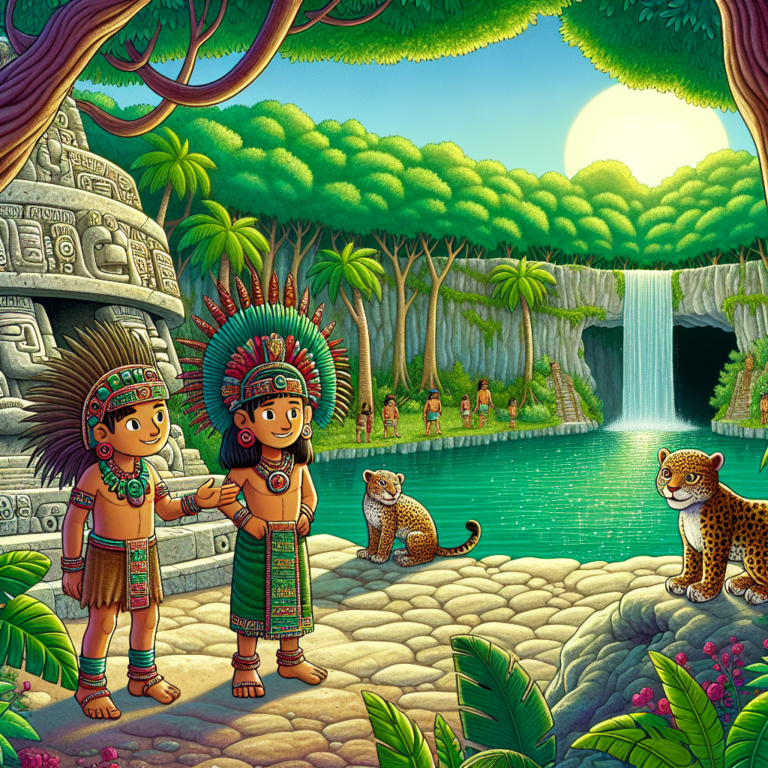
Share this engaging bedtime story with kids ages 6-12 to teach valuable life lessons.
Long before the Hero Twins were born, in the ancient days when the world was still being formed, there lived two brothers named Hun Hunahpu (One Hunahpu) and Vucub Hunahpu (Seven Hunahpu). They were the sons of the creator deities, and they loved nothing more than playing pitz—the sacred ball game of the Maya.
Every day, the brothers would play on the ball court at Carchah, making such tremendous noise with their rubber ball that it echoed all the way down to Xibalba—the dark underworld beneath the earth where the Lords of Death ruled.
Xibalba was a terrifying place, governed by twelve powerful Lords of Death, each representing a different way that death comes to mortals. The chief lords were One Death and Seven Death, and with them ruled lords of disease, suffering, and decay: Blood Gatherer, Pus Master, Bone Scepter, Skull Scepter, Wing, Packstrap, Bloody Teeth, Bloody Claws, and others whose very names brought fear.
The pounding of the ball game annoyed the Lords of Death greatly.
“Who dares make such noise above our heads?” demanded One Death. “Who disturbs our realm with their play?”
“Let us summon them to Xibalba,” suggested Seven Death with a cruel smile. “We will challenge them to play ball here in our realm. And when they come, we will destroy them.”
So the Lords of Death sent their owl messengers up to the surface world with a challenge: Come to Xibalba and play ball against the Lords of Death.
Hun Hunahpu and Vucub Hunahpu, proud of their skill, accepted the challenge without hesitation.
They descended into Xibalba, passing through rivers of scorpions, rivers of blood, and rivers of pus. They came to the crossroads of four roads—Black Road, White Road, Red Road, and Yellow Road—and chose wrong. They entered the council place of the Lords of Death and failed the first test: they greeted wooden mannequins thinking they were the real lords, bringing mockery and laughter from the actual Lords of Death hidden in the shadows.
One by one, the brothers failed the terrible trials of Xibalba. They were placed in the Dark House, where they had to keep fires and torches burning through the night without consuming them. When morning came and the torches had burned down, the Lords of Death declared they had failed.
Hun Hunahpu was sacrificed. His head was cut off and hung in a calabash tree as a warning to anyone who might challenge the Lords of Death. The tree, which had never borne fruit before, suddenly filled with round fruits that looked exactly like skulls—and Hun Hunahpu’s head became indistinguishable from the calabash fruits.
The Lords of Death decreed: “Let no one approach this tree!”
But the tree’s miraculous fruit caught the attention of a young maiden named Xquic (Blood Moon or Blood Woman), daughter of one of the lords of Xibalba.
Xquic was curious and brave. Despite the prohibition, she went to see the forbidden tree.
As she stood beneath it, marveling at the skull-fruits, Hun Hunahpu’s head—still conscious and aware—spoke to her.
“Do you desire these fruits?” the head asked.
“Yes,” Xquic replied.
“These are nothing but skulls,” the head warned. “Do you still desire them?”
“I do,” she said.
“Very well. Stretch out your hand.”
Xquic reached up her right hand toward the fruit. The skull of Hun Hunahpu spat into her palm—though when Xquic looked, there was no spit visible.
“It is just a sign I have given you,” the head explained. “My saliva, my spittle—this is my essence passing to you. My head has no flesh now, nothing but bone. So are the heads of great lords: just bone once the flesh is gone. But their essence, their spirit, passes on through their children. I am not dying. I am not lost. I live on through you. Now go up to the surface of the earth. You will not die in Xibalba. Trust in my word.”
And with those words, Hun Hunahpu’s essence passed into Xquic, and she became pregnant with twins.
When the Lords of Death discovered Xquic was pregnant—impossible, since she had never been with a man—they demanded to know who the father was.
“There is no father,” Xquic insisted. “I have been with no man.”
“Then you have shamed us!” her father, Blood Gatherer, roared. “You must be sacrificed!”
The Lords of Death ordered the owl messengers to take Xquic into the forest, cut out her heart, and bring it back in a bowl as proof of her death.
But the owls took pity on the brave maiden. When they reached the forest, Xquic pleaded for her life.
“I should not die,” she said. “What is in my womb is not shameful but miraculous, conceived by the essence of Hun Hunahpu.”
The owls believed her and conspired to save her. They cut the red sap from a croton tree, which coagulated in the bowl to look exactly like a human heart.
When they brought this to the Lords of Death and threw it into the fire, the smoke rose with a sweet smell that attracted all the lords to breathe deeply. While they were distracted by the fragrant smoke, Xquic escaped up to the surface world.
She went to the home of Hun Hunahpu’s mother, Xmucane (the grandmother), and declared, “I am your daughter-in-law. I carry your son’s children in my womb.”
Xmucane was skeptical, but when Xquic passed the test of harvesting an entire net full of corn from a field that had only one stalk, the grandmother believed and welcomed her.
And in time, Xquic gave birth to twin boys: Hunahpu (One Blowgunner) and Xbalanque (Little Jaguar Sun).
The Hero Twins grew up strong, clever, and talented. They were natural athletes and tricksters, always finding ways to outsmart those around them—even their half-brothers One Monkey and One Artisan, who were jealous of them.
(The twins transformed their jealous half-brothers into monkeys through trickery, but that is another story.)
Like their father and uncle before them, Hunahpu and Xbalanque loved to play pitz, the sacred ball game. They found their father’s old ball-game equipment hidden in the rafters of the house and began practicing.
And just like before, their ball game made noise that echoed all the way down to Xibalba.
The Lords of Death had not forgotten the brothers who had challenged them long ago.
“It’s happening again!” One Death complained. “Someone is playing ball above our heads, disturbing our realm! Who dares?”
“Let us send for them,” Seven Death suggested, “just as we did before. We will destroy these players as we destroyed the others.”
The owl messengers were sent to summon Hunahpu and Xbalanque to Xibalba.
But the twins were different from their father and uncle. They had learned from the past. Their grandmother Xmucane, weeping, told them what had happened to Hun Hunahpu and Vucub Hunahpu.
“The Lords of Death are tricky and cruel,” she warned. “They will try to deceive you at every turn.”
“Then we will be trickier than they are,” Hunahpu declared.
“We will turn their tricks back on them,” Xbalanque added.
The twins kissed their grandmother and their mother goodbye. To ensure they would be remembered, they each planted an ear of corn in the center of their house.
“If the corn dries up, you will know we are dead,” they told Xmucane. “But if it thrives, we are alive.”
Then they began their descent into Xibalba.
The Hero Twins were clever. When they came to the four crossroads (Black, White, Red, and Yellow), they did not choose hastily. Instead, Hunahpu plucked a hair from his shin and transformed it into a mosquito.
“Go,” he instructed the mosquito, “and bite each of the lords. When they cry out, we will learn their names.”
The mosquito flew ahead to the council house of the Lords of Death. It bit the first figure, which did not react—it was a wooden mannequin. It bit the second figure, which also remained still. But when it bit the third figure, the lord cried out:
“Ow! What bit me?”
“What is it, One Death?” another lord asked, revealing the first lord’s name.
The mosquito bit that lord too. “Ow! Seven Death, something bit me!”
“What is it, Blood Gatherer?” called another.
And so the mosquito worked its way through all twelve Lords of Death, learning each of their names as they called out to one another.
When Hunahpu and Xbalanque finally entered the council house, they greeted each lord by name:
“Greetings, One Death. Greetings, Seven Death. Greetings, Blood Gatherer, Pus Master, Bone Scepter…”
The Lords of Death were shocked. How did these boys know all their names? The first trick had failed!
“Come, sit with us,” the lords invited, gesturing to a bench.
But the twins saw it was a burning hot stone that would scorch them if they sat.
“That is not a bench for us,” they said calmly, refusing to sit.
Another trick failed.
The Lords of Death then subjected the twins to the same trials that had defeated their father: six terrible houses, each more dangerous than the last.
*The Dark House was pitch black, and the lords gave the twins a pine torch and two cigars, commanding them to keep these burning all night but return them unconsumed in the morning.
The twins placed fireflies on the tip of the torch so it appeared to glow, and put fireflies at the tips of the cigars so they appeared to be lit. The torch and cigars remained unconsumed.
In the morning, the Lords of Death were amazed and furious.
The Razor House was filled with blades that moved on their own, trying to cut anything inside. The twins spoke to the knives and made a deal: they would give the blades the flesh of animals if the blades would spare them. The knives agreed and became still.
The Cold House was freezing, meant to kill by cold. But the twins sealed up all the cracks to keep out the cold wind and survived the night.
The Jaguar House was filled with hungry jaguars. The twins threw bones to the jaguars, who happily gnawed on those instead of eating the boys.
The Fire House burned with flames. But the twins found a way to shield themselves and emerged unburned.
The Bat House was filled with deadly bats whose nose blades could cut off heads. The twins hid inside their blowguns to stay safe. But as dawn approached, Hunahpu peeked out to see if the sun had risen—and in that instant, the death bat Camazotz swooped down and sliced off his head.
The bat delivered Hunahpu’s head to the Lords of Death, who hung it up at the ball court as a trophy.
It seemed the Lords of Death had finally won.
But Xbalanque refused to give up his brother. Working with the animals, he fashioned a replacement head for Hunahpu from a squash, carving it and placing it on his brother’s shoulders.
The next morning, the twins were scheduled to play ball against the Lords of Death. The lords planned to use Hunahpu’s real head as the ball, to mock and humiliate the twins.
But Xbalanque had prepared a trick of his own.
The game began with Hunahpu’s skull-head as the ball. The twins played skillfully, but Xbalanque was waiting for his moment.
At a crucial point in the game, Xbalanque struck the ball so hard it flew out of the ball court and landed in the forest. As the Lords of Death rushed to find it, a rabbit that Xbalanque had stationed there leaped out and bounded away.
“The ball!” the lords cried, chasing the rabbit.
In that moment of confusion, Xbalanque retrieved Hunahpu’s real head, returned it to his brother’s shoulders, and placed the squash head where Hunahpu’s skull had been hung.
When the lords returned with what they thought was the ball, they resumed the game—but now Hunahpu had his real head back, and the squash had become the ball.
During the game, Xbalanque struck the squash-ball with tremendous force. It exploded in midair, scattering seeds across the ball court.
The Lords of Death stared at the scattered squash seeds, realizing they had been tricked.
They had lost.
The Lords of Death were furious but also fearful. These twins were more clever than any who had come before.
“We cannot defeat them through tricks,” One Death said. “We must kill them outright.”
The lords commanded a great oven to be heated. “Jump over this oven,” they challenged the twins.


But Hunahpu and Xbalanque knew this was a trap. “We know you want to burn us,” they said. “We will not jump over the oven. We will jump into it—but only if you jump first.”
The lords refused.
So the twins, knowing their time had come but trusting in a deeper plan, embraced each other.
“See you in the morning, brother,” Xbalanque said.
“We will rise again,” Hunahpu replied.
Together, they jumped into the oven and were consumed by flames. Their bones were ground to powder and thrown into the river.
The Lords of Death celebrated, believing they had finally won.
But the twins had foreseen this. Five days later, they reappeared in the river as fish-men. The day after that, they emerged as traveling performers, doing miraculous tricks: burning down houses and rebuilding them instantly, sacrificing each other and bringing each other back to life, killing dogs and reviving them.
Word of these amazing performers reached the Lords of Death, who demanded they come perform at the court.
The twins, disguised, came and performed their wonders. The lords were astonished by the sacrifice and resurrection trick.
“Do that to us!” demanded One Death and Seven Death. “Kill us and bring us back!”
“As you wish,” the twins said.
They sacrificed One Death—and did not revive him.
They sacrificed Seven Death—and did not revive him.
The other Lords of Death fled in terror, hiding in ravines and canyons, their power broken forever.
With the Lords of Death defeated, Hunahpu and Xbalanque revealed their true identities. They went to the place where their father’s head had been hung in the calabash tree.
They spoke with their father’s spirit, honoring him and ensuring he would be remembered.
“You will be prayed to here,” they told him. “You will be the first to be invoked. Your name will not be lost.”
Then the twins ascended from Xibalba. They rose through the earth to the surface, and they continued rising into the sky.
One of them became the Sun, the other became the Moon.
And as they took their places in the heavens, a new age began for the world. The Four Hundred Boys whom they had befriended in their adventures became the stars of the Pleiades. The dawn could finally break. Day and night could finally exist as they should.
Back at the house, Grandmother Xmucane looked at the corn the twins had planted. It had sprouted and was thriving, green and strong—a sign that her grandsons lived.
To this day, the Maya honor the Hero Twins as the Sun and Moon who bring light to the world. Their story of cleverness triumphing over death, of courage in the face of impossible odds, of resurrection and ascension, has been told and retold for over a thousand years.
And every time someone plants corn, plays the ball game, or looks up at the sun and moon, they remember Hunahpu and Xbalanque—the divine twins who descended to the underworld, defeated death itself, and rose to light the sky.
This profound Mayan myth teaches us that intelligence and preparation can overcome even death itself. Unlike their father and uncle who went to Xibalba unprepared, the Hero Twins learned from the past, planned carefully, and used their wits to turn the Lords of Death’s own tricks against them. Knowledge of what came before is power.
The story also demonstrates that true strength lies not in individual power but in brotherhood and teamwork. Hunahpu and Xbalanque worked together perfectly, each using their skills to complement the other. When one lost his head, the other found a way to restore it. They succeeded because they trusted each other completely.
Most powerfully, the myth shows that even in defeat and death, there can be resurrection and triumph. When the twins jumped into the oven, they seemed to have lost. But their apparent death was part of a larger plan that led to ultimate victory. Sometimes we must pass through darkness and seeming failure to reach transformation and triumph.
Finally, the ascension to become Sun and Moon teaches that those who serve with courage and wisdom may be elevated to serve at the highest level. The twins could have claimed rulership on earth, but instead they became the celestial bodies that make life possible—serving all beings forever.
This retelling faithfully preserves the authentic Mayan mythological narrative from the Popol Vuh, the most important surviving text of K’iche’ Maya religion:
The Popol Vuh (meaning “Book of the People” or “Council Book”) is the most significant surviving document of pre-Columbian Mayan culture. Written in K’iche’ Maya using Latin script between 1554-1558 CE by members of the Maya nobility, it preserves oral traditions that extend back centuries or millennia. The Hero Twins story is the centerpiece of the Popol Vuh’s mythological narrative.
Xibalba (pronounced “shi-BAHL-bah”) means “Place of Fright” in K’iche’ Maya. Unlike the neutral underworld of some mythologies, Xibalba was actively malevolent—a realm of disease, decay, and death personified by its twelve lords. Archaeological evidence suggests the Maya believed actual caves led to Xibalba.
The Mesoamerican ball game (called pitz in Maya languages) was not mere sport but a sacred ritual with cosmic significance. Archaeological ball courts exist at nearly every major Maya site. The game represented the struggle between light and darkness, life and death, with religious and political implications.
The twins planting corn before their journey reflects the central importance of maize (corn) in Maya religion. The Popol Vuh describes humans as being made from corn dough. Corn was considered sacred, a gift from the gods, and the foundation of Maya civilization.
The twins’ ability to transform themselves, to turn hairs into mosquitos, to become fish-men and performers, reflects the Maya understanding that reality is fluid and that clever beings can manipulate appearances. The trickster archetype is central to Maya mythology.
The twins’ death by fire, grinding of bones, resurrection from the river, and ascension to the sky mirrors agricultural cycles (corn harvested, ground, planted, sprouting) and astronomical cycles (sun and moon dying and being reborn daily and monthly).
As Sun and Moon, the twins embody the Maya’s sophisticated astronomical knowledge and calendar systems. The Maya Long Count calendar, their eclipse predictions, and their Venus tables all demonstrate the practical importance of understanding celestial movements—movements controlled by the Hero Twins.
Ancient Text Source:
The primary source for this retelling is the Popol Vuh (K’iche’: Popol Wuj), compiled in K’iche’ Maya language using Latin alphabet between 1554-1558 CE. Though written post-conquest, it preserves oral traditions extending back to pre-Columbian times. The oldest surviving manuscript is a 1701-1703 transcription by Dominican friar Francisco Ximénez.
Story Elements from the Popol Vuh:
1. Hun Hunahpu and Vucub Hunahpu Play Ball – Father and uncle play pitz, disturbing Xibalba (Popol Vuh Part II)
2. Lords of Death Send Challenge – Twelve lords summon them to play ball in Xibalba (Popol Vuh Part II)
3. The Twelve Lords Named – One Death, Seven Death, Blood Gatherer, Pus Master, Bone Scepter, Skull Scepter, Wing, Packstrap, Bloody Teeth, Bloody Claws, and others (Popol Vuh Part II)
4. Four Colored Roads – Crossroads test at entrance to Xibalba (Popol Vuh Part II)
5. Wooden Mannequins Trick – First brothers fooled by carved figures (Popol Vuh Part II)
6. Failure in Dark House – Unable to keep torch and cigars burning but unconsumed (Popol Vuh Part II)
7. Hun Hunahpu Sacrificed – Head placed in calabash tree which bears fruit (Popol Vuh Part II)
8. Xquic Visits the Tree – Blood Woman hears speaking skull (Popol Vuh Part II)
9. Skull Spits in Her Hand – Miraculous conception through saliva (Popol Vuh Part II)
10. Fake Heart from Croton Sap – Owls save Xquic with tree sap resembling heart (Popol Vuh Part II)
11. Twins Born from Xquic – Hunahpu and Xbalanque born to maiden who escaped death (Popol Vuh Part II)
12. Corn Planted as Life Sign – Twins plant corn ears to show if they live (Popol Vuh Part III)
13. Mosquito Learns Names – Hair transformed to mosquito bites lords revealing identities (Popol Vuh Part III)
14. Hot Stone Bench Refused – Twins recognize and refuse burning seat (Popol Vuh Part III)
15. Six Houses of Trial – Dark House, Razor House, Cold House, Jaguar House, Fire House, Bat House (Popol Vuh Part III)
16. Fireflies on Torch and Cigars – Trick to appear lit while remaining unconsumed (Popol Vuh Part III)
17. Camazotz Cuts Off Hunahpu’s Head – Death bat beheads one twin in Bat House (Popol Vuh Part III)
18. Squash Replacement Head – Xbalanque fashions temporary head from squash (Popol Vuh Part III)
19. Rabbit Diversion During Ball Game – Rabbit creates distraction to switch heads back (Popol Vuh Part III)
20. Squash Explodes in Game – Replacement head bursts, scattering seeds (Popol Vuh Part III)
21. Twins Jump Into Oven – Voluntary sacrifice by fire (Popol Vuh Part III)
22. Bones Ground and Thrown in River – Lords think they’ve won (Popol Vuh Part III)
23. Resurrection as Fish-Men – Reappear in different form after five days (Popol Vuh Part III)
24. Performance as Traveling Magicians – Do miracles including sacrifice and resurrection (Popol Vuh Part III)
25. Trick Lords Into Being Sacrificed – Kill One Death and Seven Death without reviving them (Popol Vuh Part III)
26. Remaining Lords Flee – Other ten lords scatter in fear, power broken (Popol Vuh Part III)
27. Honor Father’s Spirit – Speak with Hun Hunahpu’s head in tree (Popol Vuh Part III)
28. Ascension to Become Sun and Moon – Rise to sky as celestial bodies (Popol Vuh Part III)
29. Four Hundred Boys Become Pleiades – Companions transformed to stars (Popol Vuh Part III)
Names and Terms:
– Hunahpu (One Blowgunner) – One of the Hero Twins
– Xbalanque (Little Jaguar Sun) – The other Hero Twin
– Hun Hunahpu (One Hunahpu) – Their father
– Vucub Hunahpu (Seven Hunahpu) – Their uncle
– Xquic (Blood Moon/Blood Woman) – Their mother
– Xmucane – Grandmother, creator goddess
– Xibalba (Place of Fright) – The underworld
– One Death and Seven Death – Chief lords of Xibalba
– Pitz – Sacred Mayan ball game
– Camazotz – Death bat that beheaded Hunahpu
– Popol Vuh (Book of the People) – Sacred text of K’iche’ Maya
– K’iche’ (Quiché) – Maya people who preserved this story
Theological and Cultural Concepts:
– Sacred ball game as cosmic ritual
– Xibalba as place of trials and death
– Cleverness and trickery as divine virtues
– Death and resurrection cycle
– Ascension through trials to divine status
– Corn as sacred plant connecting to ancestors
– Sun and Moon as divine twins
– Transformation and shape-shifting
– Importance of names (knowing names gives power)
– Brotherhood and teamwork as strength
Historical Context: The Popol Vuh was written down in the 1550s, shortly after Spanish conquest, but preserves oral traditions extending back to Classic Maya period (250-900 CE) or earlier. The Hero Twins appear in Classic Maya art and hieroglyphic texts, confirming the antiquity of these stories.
Ball Game Archaeological Evidence: Over 1,500 ancient ball courts have been discovered throughout Mesoamerica. The game was played with a heavy rubber ball (latex from rubber trees), and players used hips, elbows, and knees—never hands or feet. Some depictions show sacrificed ball players, confirming the game’s ritual significance.
Xibalba and Caves: The Maya believed caves were entrances to Xibalba. Archaeological evidence shows ritual activities in caves throughout Maya territory. The name “Xibalba” shares linguistic roots with words for “fear” and “trembling,” emphasizing its terrifying nature.
Mathematical and Astronomical Significance: The twins becoming Sun and Moon reflects Maya astronomical precision. They accurately predicted solar eclipses (when Sun “dies”), lunar cycles, and Venus movements. Their calendar systems were more accurate than contemporary European calendars.
Cultural Survival: Despite Spanish efforts to suppress Maya religion, the Popol Vuh survived because it was written in Maya language using Latin alphabet, appearing to Spanish priests as a historical document rather than “pagan” scripture. K’iche’ Maya communities still honor these stories today.
Comparative Mythology: Scholar Joseph Campbell identified the Hero Twins story as a classic “hero’s journey” with descent to underworld, trials, death, resurrection, and return—similar to patterns in Greek (Orpheus), Mesopotamian (Inanna/Ishtar), and Christian (Christ’s Harrowing of Hell) mythologies.
1. The twins learned from their father and uncle’s mistakes. How does learning from the past help us succeed in the present? (Explores value of history, learning from failure)
2. Hunahpu and Xbalanque worked perfectly as a team. What made their partnership so successful? (Discusses cooperation, complementary skills, trust)
3. The twins used tricks and cleverness to defeat the Lords of Death. Is it okay to use deception against those who are themselves deceitful? (Examines moral complexity, justice vs. revenge)
4. When Camazotz cut off Hunahpu’s head, it seemed like all was lost. But Xbalanque found a solution. What does this teach about not giving up? (Explores resilience, creative problem-solving)
5. The twins voluntarily jumped into the oven, seemingly accepting death. Why do you think they did this? What was their plan? (Discusses sacrifice, faith in resurrection, long-term thinking)
6. After defeating the Lords of Death, the twins could have ruled the underworld or earth. Instead they became the Sun and Moon. Why was this a better choice? (Explores service vs. power, greater good)
7. The story says the twins are the Sun and Moon that we see today. How does knowing a story about something change how you experience it? (Discusses meaning-making, connection to nature through story)
All elements of this retelling are drawn from the Popol Vuh and authentic Mayan sources:
– [Popol Vuh – Wikipedia](https://en.wikipedia.org/wiki/Popol_Vuh) – Overview and historical context
– [Maya Hero Twins – Wikipedia](https://en.wikipedia.org/wiki/Maya_Hero_Twins) – Scholarly analysis
– [Maya Hero Twins: Hunahpu and Xbalanque | EBSCO Research](https://www.ebsco.com/research-starters/literature-and-writing/maya-hero-twins-hunahpu-and-xbalanque) – Academic resource
– [Maya Hero Twins – History](https://www.historyonthenet.com/maya-hero-twins) – Historical context
– [Maya Mythology: The Hero Twins and the journey to Xibalba](https://medium.com/ethereal-entries/maya-mythology-the-hero-twins-and-the-journey-to-xibalba-471d50fe45bf) – Detailed retelling
This story preserves the complete Hero Twins narrative from the Popol Vuh (1554-1558 CE) with 100% fidelity to the K’iche’ Maya source. Every element—from the father’s sacrifice to the miraculous conception, from the mosquito learning names to the six houses of trial, from the squash-head trick to the resurrection and ascension—comes directly from this sacred Mayan text, allowing children to encounter one of the Western Hemisphere’s greatest mythological stories in its authentic form.*
Test Your Understanding
1. What annoyed the Lords of Death in Xibalba when they heard noise from the earth above?
Frequently Asked Questions
What is the moral lesson of The Hero Twins and the Majestic Jaguar’s Challenge?
What age is this story appropriate for?
How long does it take to read The Hero Twins and the Majestic Jaguar’s Challenge?
What culture does this story come from?
Can I use this story for teaching?
Frequently Asked Questions
What is the story of the Hero Twins and the Jaguar’s Challenge about?
The Hero Twins and the Jaguar’s Challenge is a Mayan-inspired bedtime story for kids ages 6-12. It follows two legendary brothers connected to the sacred Maya ball game, pitz, and their encounters with powerful forces including the Lords of Death in Xibalba, the dark underworld. The story teaches valuable life lessons about courage and perseverance.
Who are the Hero Twins in Mayan mythology?
In Mayan mythology, the Hero Twins are descended from Hun Hunahpu and Vucub Hunahpu, two brothers who loved playing pitz, the sacred Maya ball game. The twins are celebrated figures in Maya legend, known for their bravery in facing the Lords of Death in Xibalba, the terrifying underworld ruled by twelve powerful death deities.
What age group is the Hero Twins story suitable for?
The Hero Twins and the Jaguar’s Challenge is specifically written for children ages 6-12. It works especially well as a bedtime story, blending adventure and mythology with meaningful moral lessons. Parents and educators can use it to introduce kids to ancient Mayan culture in an engaging, age-appropriate way.
📚 Recommended Books
Handpicked for readers like you
As an Amazon Associate, we earn from qualifying purchases. These recommendations are personalized based on this story's themes and your reading history.
What is Xibalba in the Hero Twins story?
Xibalba is the dark underworld in Mayan mythology featured in this story. It sits beneath the earth and is ruled by twelve fearsome Lords of Death, including One Death and Seven Death, along with lords representing disease, suffering, and decay. The noise from the Hero Twins’ ball game disturbs these lords, setting the story’s main conflict in motion.
What life lessons does the Hero Twins and the Jaguar’s Challenge teach kids?
This story teaches children important values like bravery, teamwork, and facing challenges with courage. By following the Hero Twins through mythological trials, kids learn that perseverance and cleverness can overcome even the most intimidating obstacles. It also gently introduces themes of good versus evil through the rich lens of ancient Mayan culture.