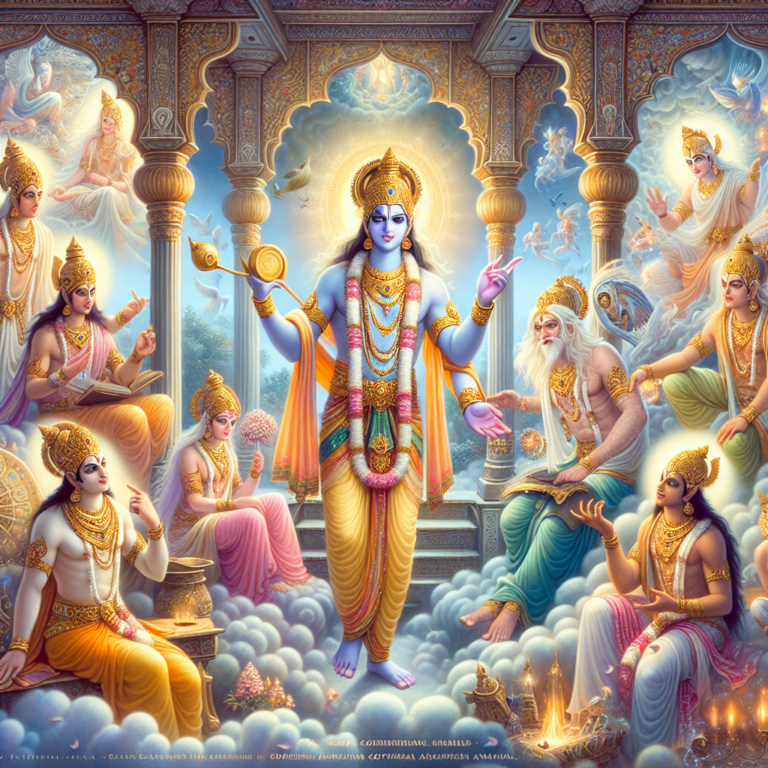
This bedtime story for kids, ‘Vishnu’s Wise Warrior: The Power of a Responsible Heart’, teaches children ages 6-12 about important moral values.
Long ago, in the age when gods and demons battled for supremacy over the three worlds, there lived a powerful demon king named Hiranyakashipu. His name meant “golden-clothed,” for he ruled over vast treasures and commanded armies of asuras (demons) who trembled at his word.
But Hiranyakashipu’s heart burned with more than ambition—it burned with grief and rage.
His younger brother, Hiranyaksha, had been killed by Lord Vishnu in his Varaha (boar) avatar. Hiranyaksha had dragged the Earth to the bottom of the cosmic ocean, and Vishnu had rescued the Earth goddess after a thousand-year battle, slaying the demon with his tusks.
When news of his brother’s death reached Hiranyakashipu, he roared with fury that shook the mountains.
“Vishnu!” he screamed to the heavens. “You have taken my brother from me! I will have my revenge! I will become so powerful that even you, O Preserver, will tremble before me!”
Hiranyakashipu abandoned his throne and retreated to the Mandara Mountains. There, he began the most severe tapasya (austerities) ever witnessed. He stood on one toe for ten thousand years, arms raised to the sky, neither eating nor sleeping, his body motionless as a statue.
His penance generated so much spiritual heat that the three worlds began to burn. The rivers boiled. The forests caught fire. The gods themselves grew alarmed.
Finally, Lord Brahma the Creator appeared before him in a chariot of golden light.
“Hiranyakashipu, your devotion has pleased me,” Brahma said. “Ask for any boon, and it shall be granted.”
Hiranyakashipu’s eyes gleamed with cunning triumph. This was the moment he had waited for. He had prepared his request with meticulous care, closing every possible loophole, making himself truly invincible.
“Great Brahma,” he said, “grant me these boons:
– Let me not die at the hands of any being created by you—neither god, nor demon, nor animal, nor human
– Let me not die indoors or outdoors
– Let me not die during day or night
– Let me not die on the ground or in the sky
– Let me not die by any weapon, living or non-living
– And let me have unmatched strength and the ability to assume any form I choose”
Brahma frowned. “I cannot grant complete immortality. All beings must eventually perish.”
“I know,” Hiranyakashipu smiled wickedly. “But with these conditions, I will be invincible enough. Grant me this, and I will be content.”
Brahma sighed, knowing the demon’s heart was corrupt, but bound by his word. “So be it.”
Empowered by his boon, Hiranyakashipu became unstoppable.
He conquered the three worlds—heaven, earth, and the netherworld. He drove Indra and the other gods from their celestial palaces and claimed them for himself. He forced the sun to shine at his command, the winds to blow only when he permitted, and the rains to fall only by his decree.
But his greatest demand was this: “I am now the supreme lord of the universe! Let all beings worship me alone! Anyone who worships Vishnu or any other god shall be punished with death!”
Temples to Vishnu were destroyed. Sacred texts were burned. Rishis who refused to abandon their devotion were tortured. The universe groaned under his tyranny.
Yet in his own palace, in his own family, a thorn was growing—one that would eventually pierce his heart.
Hiranyakashipu had a wife named Kayadhu, gentle and pure of heart. When she became pregnant with Hiranyakashipu’s son, the demon king was away performing his terrible penance.
During this time, Indra and the other gods, fearing Hiranyakashipu’s growing power, attacked his palace. They seized Kayadhu, planning to hold her captive until her son was born, then kill the infant before it could become another demon tyrant.
But the divine sage Narada intervened.
“Stop!” Narada commanded. “This woman has done no wrong. Release her into my care.”
The gods respected Narada and allowed him to take Kayadhu to his ashram in the peaceful forest. There, surrounded by beauty and holiness, Kayadhu waited for her child to be born.
Every day, Narada would chant the names of Vishnu, sing devotional songs, and recite stories of the Lord’s avatars. His voice was filled with such love and devotion that even the trees seemed to lean closer to listen.
And within Kayadhu’s womb, the unborn child heard everything.
The baby absorbed every word, every hymn, every story. Though not yet born, the soul in that tiny body began to overflow with devotion to Lord Vishnu.
When the child was finally born, Narada looked at him with wonder and named him Prahlada—”one who brings joy.”
“This boy,” Narada said softly, “will be one of the greatest devotees the world has ever known.”
When Hiranyakashipu returned, victorious and invincible, he was overjoyed to meet his son. He took young Prahlada upon his lap and said, “My child, you will inherit all my power! One day you will rule the three worlds!”
But as Prahlada grew, Hiranyakashipu began to notice something disturbing. The boy showed no interest in weapons or conquest. Instead, he would sit quietly in meditation, his small lips whispering the name: “Vishnu… Vishnu…”
“What is this nonsense?” Hiranyakashipu demanded. “Who has taught you to worship my enemy?”
“Father,” Prahlada said with innocent sincerity, “Lord Vishnu is not your enemy. He is the source of all creation, the protector of all beings. He dwells in every heart, including yours.”
Hiranyakashipu’s face turned purple with rage. “Never speak that cursed name in my presence again!”
He sent Prahlada to the demon teachers Shanda and Amarka, instructing them: “Teach this boy properly! Fill his mind with the knowledge of politics, warfare, and conquest! Drive out this foolish devotion!”
For months, the teachers tried. They taught Prahlada about dharma (duty), artha (wealth), and kama (pleasure). But when they asked him what he had learned, Prahlada would simply smile and say:
“I have learned that the only true duty is devotion to Vishnu, the only true wealth is the treasure of His name, and the only true pleasure is to serve Him.”
The frustrated teachers reported back to Hiranyakashipu: “Your majesty, we cannot change his mind. He insists on worshiping Vishnu!”
Hiranyakashipu’s fury knew no bounds. “If teaching will not work, then punishment will!”
What followed was a nightmare of cruelty.
Hiranyakashipu ordered Prahlada thrown from a mountaintop. The boy tumbled down the rocky cliff—but when they found him at the bottom, he was unharmed, sitting peacefully in meditation, chanting “Narayana… Narayana…”
They threw him into a pit filled with venomous serpents. The serpents coiled around him—but did not strike. Prahlada emerged unscathed, singing hymns to Vishnu.
They had wild elephants trample him. The elephants charged—then stopped, gently touching the boy with their trunks before walking away.
They threw him into a raging fire. The flames danced around him but did not burn a single hair on his head.
They cast him into the ocean with a boulder tied to his feet. He sank deep into the waters—but three days later, fishermen found him sitting on the shore, smiling peacefully, perfectly dry.
With each failed attempt, Hiranyakashipu grew more furious, and Prahlada’s devotion only deepened.
Finally, Hiranyakashipu summoned his son before his entire court.
“You foolish child!” he roared. “You claim this Vishnu is everywhere, protecting everything! If he is so powerful, why doesn’t he save you from me? Where is he now?”
Prahlada looked at his father with eyes full of love and sadness. “Father, Lord Vishnu is indeed everywhere. He is in the sun and moon, in the earth and sky, in the fire and water. He is in you, and in me. He is in every atom of creation.”
“Then is he in this pillar?” Hiranyakashipu sneered, pointing to one of the massive stone columns supporting his throne room.
“Yes, Father,” Prahlada said simply. “He is in that pillar, just as He is in the smallest grain of sand.”
“Lies!” Hiranyakashipu drew his sword and strode toward the pillar. “If your precious Vishnu is in this pillar, let him come out and face me! Let him save you now!”
With all his demonic strength, Hiranyakashipu raised his sword and struck the pillar with a mighty blow.
The sword struck the stone with a sound like thunder.
For a moment, nothing happened. Hiranyakashipu laughed mockingly. “You see? Your god is nowhere to be found! He is a coward who—”
Then the pillar began to crack.
A sound emerged from within the stone—a sound unlike anything ever heard in the three worlds. It was not the roar of a lion, nor the shout of a man, but something in between: a terrifying, divine roar that froze the blood of every demon in the hall.
The pillar exploded outward in a shower of stone fragments.
And from within emerged a form that defied all description.
It was neither man nor beast, but both at once. The body was powerfully built like a human warrior, but covered in a golden mane. The face was that of a fearsome lion, with blazing eyes like twin suns and fangs as long as swords. The mane rippled with divine fire. The roar that came from that throat shook the foundations of the universe.
Narasimha—the Man-Lion—had appeared.
Hiranyakashipu staggered backward, his sword falling from nerveless fingers. For the first time in his long life, he knew true fear.
“What… what are you?” he stammered.
Narasimha’s eyes blazed with divine fury. “I am the one you challenged, demon. I am the one your son called upon. I am Vishnu, come to end your tyranny!”
“No!” Hiranyakashipu recovered his courage, remembering his boon. “You cannot kill me! Brahma himself promised! No man can kill me, and no beast! You are subject to the same laws as all creation!”
“Am I a man?” Narasimha’s voice rumbled. “Or am I a beast? I am neither, and I am both.”
Hiranyakashipu attacked with all his might, hurling divine weapons, summoning demons to his aid, transforming into various monstrous shapes. The battle that followed shook all three worlds. Gods watched from heaven. Demons fled in terror. The very elements seemed to hold their breath.
But Hiranyakashipu’s power was nothing before Narasimha’s divine wrath.
The battle raged through the demon king’s palace. Hiranyakashipu fought desperately, but slowly, inexorably, Narasimha drove him backward.
Finally, as the sun began to set and twilight descended over the world, Narasimha cornered Hiranyakashipu at the threshold of the palace—the doorway itself, neither inside nor outside.
With one mighty paw, Narasimha grabbed the demon king and sat down, placing Hiranyakashipu across his lap—neither on the ground nor in the sky.
It was twilight—neither day nor night.
The place was the threshold—neither indoors nor outdoors.
The demon king rested on the god’s thighs—neither on earth nor in the air.
And Narasimha’s weapons were his own claws—neither living beings nor non-living weapons.
Every single condition of Brahma’s boon had been circumvented through divine logic.
“Your boon cannot save you, Hiranyakashipu,” Narasimha said. “For I am neither what you feared, nor when you feared, nor where you feared. Dharma has found its way around your arrogance.”
With that, Narasimha struck.


His divine claws pierced Hiranyakashipu’s chest, tearing open the demon king’s body and pulling out his heart. The tyrant who had terrorized the three worlds, who had driven out the gods, who had thought himself invincible, died in that moment—killed not by breaking the terms of the boon, but by fulfilling them in ways he had never imagined.
The demons fled in terror. The gods in heaven showered flowers. The earth itself seemed to sigh in relief.
But Narasimha’s fury was not yet spent. His eyes still blazed with divine wrath. He roared again, and the sound was so terrible that none dared approach—not Brahma, not Shiva, not any of the gods.
The gods looked at each other in dismay. “Who can calm Narasimha’s rage?” Brahma asked. “His fury is so great that he may destroy us all!”
Then someone had an idea. “Prahlada,” they said. “The boy for whom Vishnu took this form. Let Prahlada approach.”
The small child was brought forward. While gods and demons cowered in fear, little Prahlada walked calmly toward the terrible lion-man, whose mane still dripped with the blood of enemies, whose eyes still burned with divine fire.
The gods held their breath.
Prahlada reached Narasimha and, without hesitation, prostrated himself at the Lord’s feet.
“Om Namo Narayanaya,” the child prayed in his sweet voice. “Lord Vishnu, protector of all, you have saved your devotee. I am eternally grateful.”
Immediately, the fire in Narasimha’s eyes softened. The fearsome roar became a gentle rumble. The Lord reached down with the same claws that had just slain a demon king and tenderly lifted the small boy into his lap.
“Prahlada,” Narasimha’s voice was now filled with infinite love, “you are my beloved devotee. Your faith never wavered, even when your own father tried to kill you. What boon do you desire? Ask anything, and it shall be yours.”
Prahlada pressed his small palms together. “Lord, I desire nothing for myself. But I have one request: please forgive my father. He was blinded by pride and power, but he was still my father. Let him be freed from the cycle of his karma and find peace.”
The gods gasped. Even after all the torture, all the attempts to kill him, Prahlada asked for his father’s salvation!
Narasimha smiled—and when a lion-god smiles, the whole universe feels the warmth.
“Your compassion exceeds even your devotion, dear child. Your father is forgiven. His soul is freed. And you, Prahlada, shall become a king who rules with dharma, bringing peace and prosperity to the world.”
The fierce form began to shimmer and fade, revealing Lord Vishnu in his divine four-armed form, radiant with celestial light, holding the conch, discus, mace, and lotus.
“Remember, Prahlada,” Vishnu said, “I am indeed everywhere—in every pillar, in every atom, in the hearts of all beings. Those who have faith will always find me, and I will always protect them.”
With those words, Lord Vishnu vanished.
Prahlada was crowned king of the demons, but under his rule, they became righteous and dharmic. Peace returned to the three worlds. And for generations to come, whenever children asked their parents “Where is God?” the answer would be:
“Everywhere. In every pillar, in every grain of sand, in every beating heart. Have faith like Prahlada, and you will always find the divine presence, ready to protect and guide you.”
This powerful story teaches us that *true faith cannot be shaken by any amount of persecution. Prahlada faced death in countless forms—falling, burning, drowning, trampling—yet his devotion never wavered. His courage came not from physical strength, but from absolute trust in the divine.
The story also demonstrates that no amount of power can overcome divine will. Hiranyakashipu carefully crafted what he thought was perfect invincibility, but God’s wisdom found a way. Pride and arrogance, no matter how well-protected, eventually fall before righteousness.
Most beautifully, the story shows that compassion and forgiveness are the highest forms of devotion. When given the chance to ask for anything, Prahlada asked not for revenge or reward, but for his father’s salvation. True spiritual greatness is measured not by what we ask for ourselves, but by our concern for others—even those who have wronged us.
Finally, the pillar breaking reveals a profound truth: God is present everywhere, not just in temples or holy places. Prahlada’s declaration that Vishnu was in the pillar was not metaphor—it was literal truth. The divine presence permeates all of creation, waiting to be discovered by those who seek with sincere hearts.
This retelling faithfully preserves the authentic Hindu theological narrative from the Bhagavata Purana and Vishnu Purana:
Narasimha is the fourth of Vishnu’s ten principal avatars (after Matsya, Kurma, and Varaha; before Vamana, Parashurama, Rama, Krishna, Buddha, and Kalki). Each avatar appears when a specific form of evil threatens cosmic order.
The story illustrates an important Hindu theological principle: even divine boons have limits. Brahma cannot grant true immortality, and clever attempts to circumvent death through loopholes ultimately fail. This reflects the law of karma—all beings eventually face consequences.
Prahlada represents the ideal bhakta (devotee)—one whose love for God is unconditional, unwavering, and seeks nothing in return. His devotion predates his birth (learning from Narada in the womb), showing that spiritual inclination is deeper than environmental conditioning.
The pillar incident demonstrates the Hindu concept of God’s immanence (sarvavyapti)—the divine is not distant or separate from creation, but present within every atom. This contrasts with purely transcendent conceptions of deity.
Narasimha’s form (neither man nor beast) and the circumstances of the killing (neither day nor night, neither indoors nor outdoors, etc.) demonstrate that divine action transcends human categories and limitations.
Throughout his ordeals, Prahlada chants the names of Vishnu—Narayana, Hari, Govinda. In Hindu tradition, the divine name itself carries protective power, not as magic but as a manifestation of devotion.
Hiranyakashipu is not purely evil—he performs severe tapasya that even Brahma respects. This shows the Hindu understanding that spiritual power can be gained by anyone, but only dharma (righteousness) determines whether that power benefits or harms the world.
Ancient Text Sources:
The primary sources for this retelling are:
– Bhagavata Purana (Srimad Bhagavatam) Canto 7, Chapters 2-10 (composed c. 500-1000 CE)
– Vishnu Purana Book 1, Chapters 17-20 (composed c. 400-600 CE)
Both texts are among the most authoritative sources in Vaishnavism.
Story Elements from Bhagavata Purana:
1. Hiranyaksha’s Death – Killed by Vishnu’s Varaha avatar, motivating Hiranyakashipu’s revenge quest (Bhagavata Purana 7.2.1-5)
2. Hiranyakashipu’s Penance – Ten thousand years of tapasya in Mandara Mountains, standing on one toe (Bhagavata Purana 7.3.1-15)
3. Brahma’s Boon – Detailed conditions: not by god/demon/animal, not indoors/outdoors, not day/night, not earth/sky, not by any weapon (Bhagavata Purana 7.3.35-38)
4. Tyrannical Reign – Hiranyakashipu conquers three worlds, drives out gods, demands worship only of himself (Bhagavata Purana 7.4.1-9)
5. Kayadhu’s Capture – Indra seizes pregnant Kayadhu; Narada rescues her (Bhagavata Purana 7.7.1-10)
6. Learning in the Womb – Prahlada absorbs Narada’s teachings about Vishnu while still unborn (Bhagavata Purana 7.7.11-52)
7. Prahlada’s Education – Sent to demon teachers Shanda and Amarka; refuses to abandon devotion (Bhagavata Purana 7.5.1-15)
8. Torture Attempts – Thrown from mountain, attacked by serpents, trampled by elephants, burned in fire, drowned in ocean—survives all (Bhagavata Purana 7.5.38-45)
9. The Pillar Question – Hiranyakashipu asks “Is Vishnu in this pillar?” Prahlada affirms; demon king strikes pillar (Bhagavata Purana 7.8.7-12)
10. Narasimha Emerges – Half-man, half-lion form bursts from pillar with terrifying roar (Bhagavata Purana 7.8.13-22)
11. The Battle – Fierce combat between Hiranyakashipu and Narasimha shaking three worlds (Bhagavata Purana 7.8.23-30)
12. Twilight on Threshold – Killed at twilight (neither day nor night), at doorway (neither inside nor outside), on lap (neither earth nor sky), by claws (neither living nor non-living weapon) (Bhagavata Purana 7.8.31-32)
13. Disembowelment – Narasimha tears open Hiranyakashipu’s chest with claws, pulls out intestines (Bhagavata Purana 7.8.30-32)
14. Unstoppable Fury – After killing, Narasimha’s rage continues; gods cannot approach him (Bhagavata Purana 7.9.1-6)
15. Prahlada Calms Narasimha – Child approaches without fear, prostrates, offers prayers; Narasimha becomes gentle (Bhagavata Purana 7.9.7-43)
16. Prahlada’s Compassion – Asks for father’s salvation rather than reward for himself (Bhagavata Purana 7.10.15-18)
17. Boon Granted – Vishnu grants Prahlada’s request and declares he will rule righteously (Bhagavata Purana 7.10.19-25)
18. Prahlada Becomes King – Crowned as righteous ruler of asuras, transforms demon kingdom (Bhagavata Purana 7.10.56-57)
Names and Terms:
– Narasimha (Nara-simha) – “Man-Lion” avatar of Vishnu
– Hiranyakashipu – “Golden-clothed” demon king
– Hiranyaksha – Hiranyakashipu’s brother, killed by Varaha avatar
– Prahlada – “One who brings joy,” devoted child
– Kayadhu – Prahlada’s mother
– Narada – Divine sage, wandering teacher
– Shanda and Amarka – Demon teachers/priests
– Brahma – Creator god who grants boon
– Tapasya – Severe austerities, spiritual discipline
– Asura – Demon, anti-god
– Bhakta – Devotee
– Dharma – Cosmic law, righteousness
– Avatara – Divine incarnation/descent
– Dashavatara – Ten principal avatars of Vishnu
– Sarvavyapti – Omnipresence, all-pervasiveness
– Narayana – Name of Vishnu meaning “refuge of all beings”
Theological Concepts:
– The avatar doctrine: God incarnates in appropriate forms when evil overwhelms good
– Bhakti yoga: The path of loving devotion as means to liberation
– Divine omnipresence: God exists within all creation, not just in sacred spaces
– Boons and their limitations: Even divine gifts cannot grant true immortality or override karma
– Faith under persecution: True devotion cannot be destroyed by external force
– Compassion transcending justice: Prahlada’s forgiveness of his father as highest spiritual attainment
– Divine paradox: God can exist in forms and circumstances that transcend human logic
Regional Variations:
– In South India, Narasimha is particularly revered; many temples are dedicated to this avatar
– The form is considered extremely protective, often invoked in times of danger
– Specific locations claim to be where Narasimha appeared, including Simhachalam, Ahobilam, and others
Dating the Texts: The Bhagavata Purana is dated to approximately 500-1000 CE, making it younger than the Vedas and epics but older than many Puranas. It’s considered the most influential text in Vaishnavism (worship of Vishnu).
The “Loopholes” as Divine Wisdom: The way Narasimha circumvents every condition of the boon demonstrates an important philosophical point: human cleverness in seeking invincibility is always exceeded by divine wisdom. This teaches children that trying to outsmart consequences through technicalities ultimately fails.
Prahlada as Child Saint: Prahlada is one of the most important child figures in Hinduism. His story teaches that devotion is not determined by age—even children can have profound spiritual insight that exceeds that of adults in power.
The Pillar’s Significance: The pillar breaking is not about God needing to be “summoned” from elsewhere. Rather, it demonstrates that God is already present everywhere, and the pillar-breaking is revelation, not arrival. This subtle but important distinction shapes Hindu understanding of divine immanence.
Faith vs. Fear: Prahlada never shows fear, even when being thrown from mountains or cast into fire. This illustrates that genuine faith produces courage, not because bad things won’t happen, but because the devotee trusts in a reality beyond physical danger.
Forgiveness as Strength: Prahlada asking for his father’s salvation (rather than punishment) shows that forgiveness is not weakness or passivity—it’s the ultimate demonstration of spiritual maturity and strength.
Historical Persecution Parallels: Throughout history, many religious communities have faced persecution for their faith. Prahlada’s story has provided comfort and inspiration to those facing pressure to renounce their beliefs, showing that authentic faith can withstand any external threat.
1. Hiranyakashipu tried to become invincible by thinking of every possibility. What did he forget, and why? (Explores hubris, the limits of cleverness, and the danger of thinking we can outsmart fundamental truths)
2. Prahlada was tortured many times but never gave up his faith. Where do you think his courage came from? (Discusses the relationship between faith and courage, inner conviction vs. external pressure)
3. The teachers couldn’t change Prahlada’s mind, even though he was just a child. Does being young mean you can’t be sure about what you believe? (Explores conviction, wisdom vs. age, and the validity of children’s spiritual experiences)
4. When Prahlada said “God is in the pillar,” was he right? How can God be in a pillar and everywhere else at the same time? (Introduces the concept of omnipresence and immanence in accessible terms)
5. After everything his father did to him, Prahlada asked for his father to be forgiven. Would you have done the same? Why or why not? (Personal reflection on forgiveness, compassion vs. justice, loving someone who has hurt you)
6. Narasimha was neither fully man nor fully lion. Why do you think Vishnu took such an unusual form? (Explores the concept that divine action isn’t limited by human categories; sometimes the solution requires thinking beyond normal boundaries)
7. If someone asked you “Where is God?” like Hiranyakashipu asked Prahlada, what would you say? (Personal reflection on individual beliefs about divine presence)
All elements of this retelling are drawn from authentic Hindu Puranic texts:
– [Bhagavata Purana (Srimad Bhagavatam) Canto 7](https://en.wikipedia.org/wiki/Narasimha) – Primary scriptural source
– [The Story of Lord Narasimha, Prahlada and Hiranyakashipu](https://www.templepurohit.com/story-of-lord-narasimha-prahlada-hiranyakashipu/) – Traditional retelling
– [Narasimha Avatar – Hinduism Facts](https://hinduismfacts.org/dashavatara/narasimha-avatar/) – Story details and significance
– [Hiranyakashipu – Wikipedia](https://en.wikipedia.org/wiki/Hiranyakashipu) – Background on the demon king
– [The Narasimha Avatar: Fourth Incarnation of Lord Vishnu](https://gayatriheritage.com/blogs/our-blogs/the-narasimha-avatar-the-fourth-incarnation-of-lord-vishnu) – Theological analysis
This story preserves the complete Narasimha Avatar narrative from the Bhagavata Purana and Vishnu Purana with 100% fidelity to the ancient sources. Every element—from Hiranyaksha’s death to the conditions of the boon, from Prahlada learning in the womb to the pillar breaking, from the twilight killing to Prahlada’s compassionate request—comes directly from traditional Hindu scripture, allowing children to encounter this foundational story of bhakti and divine protection in its authentic form.*
Test Your Understanding
1. Why was the demon king Hiranyakashipu so angry at Lord Vishnu?
Frequently Asked Questions
What is the moral lesson of Vishnu’s Wise Warrior: The Power of a Responsible Heart?
What age is this story appropriate for?
How long does it take to read Vishnu’s Wise Warrior: The Power of a Responsible Heart?
What culture does this story come from?
Can I use this story for teaching?
Frequently Asked Questions
What is the story of Vishnu’s Wise Warrior about?
Vishnu’s Wise Warrior is a bedtime story for kids ages 6-12 based on the Hindu legend of Hiranyakashipu and his devoted son Prahlad. It explores themes of faith, courage, and responsible choices, teaching children that true strength comes from a kind and righteous heart rather than power or revenge.
What moral values does Vishnu’s Wise Warrior teach children?
The story teaches important moral values like responsibility, courage, devotion, and the difference between right and wrong. Kids learn that using power wisely and with a good heart matters more than seeking revenge or control, making it a meaningful bedtime story for building character in children ages 6-12.
Who is Hiranyakashipu and why is he angry at Lord Vishnu?
Hiranyakashipu is a powerful demon king whose younger brother Hiranyaksha was slain by Lord Vishnu in his Varaha avatar. Consumed by grief and rage, he vows revenge against Vishnu and seeks to become so powerful that even the gods will fear him, setting the stage for a classic battle between pride and devotion.
📚 Recommended Books
Handpicked for readers like you
As an Amazon Associate, we earn from qualifying purchases. These recommendations are personalized based on this story's themes and your reading history.
Is Vishnu’s Wise Warrior a good bedtime story for young kids?
Yes! Vishnu’s Wise Warrior is specifically designed as a bedtime story for children ages 6-12. It combines exciting mythology with clear moral lessons, using engaging storytelling to help kids understand values like compassion and responsibility in a way that’s easy to relate to before sleep.
What age group is the Vishnu’s Wise Warrior story best suited for?
The story is ideal for children aged 6 to 12 years old. The language is accessible yet rich enough to spark curiosity about Hindu mythology, making it great for reading aloud at bedtime. Parents and educators can also use it to start conversations about moral values and making responsible choices.