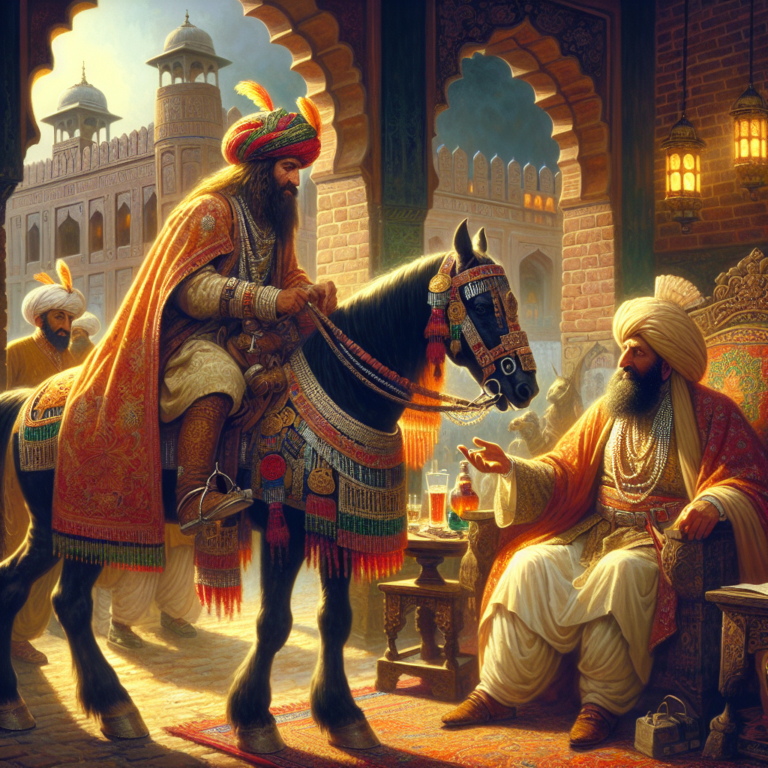
‘The Brave Sikh Warriors and the Secret of Undying Courage’ is an educational moral story perfect for bedtime reading with children ages 6-12.
The sun rose over Anandpur Sahib on Vaisakhi Day in the year 1699, casting golden light across the assembled thousands who had gathered from across the land. They came from Punjab and beyond, drawn by devotion to their beloved Guru Gobind Singh Ji, the tenth master in the line of Guru Nanak.
The Guru, forty-three years old and radiating an aura of both power and compassion, stood before his Sikhs. He wore saffron robes and carried a naked sword that gleamed in the morning light. The crowd fell silent, sensing that something momentous was about to unfold.
“Today,” the Guru’s voice rang out clear and strong across the gathering, “I seek a head. Is there anyone among you who will give their head for their faith?”
A stunned silence fell over the crowd. What was the Guru asking? People looked at each other with confusion and fear. Then, a voice called out from the crowd.
“I am ready, my Guru!” A man named Daya Ram, a Khatri from Lahore, stepped forward without hesitation. The crowd gasped as Guru Gobind Singh Ji took him by the hand and led him into a tent. Moments later, the Guru emerged alone, his sword dripping with what appeared to be blood.
“I need another head!” the Guru called out. The crowd was terrified, but then another voice responded. “I am here, Guru Ji!” Dharam Das, a Jat farmer from Hastinapur, walked forward with steady steps. Again, the Guru led him into the tent. Again, he returned alone with his bloodied sword.
This happened three more times. Mokham Chand, a washerman from Dwarka. Himmat Rai, a water-carrier from Jagannath Puri. Sahib Chand, a barber from Bidar. Five men from different regions, different castes, different backgrounds – all willing to give everything for their Guru.
Then, when the tension had reached its peak and many in the crowd thought they had witnessed five executions, Guru Gobind Singh Ji emerged from the tent with all five men, alive and dressed in saffron robes matching his own. Behind them walked a goat, which had been sacrificed – it was the goat’s blood on the sword, not human blood.
The crowd erupted in relief and joy, but the Guru raised his hand for silence. “These five have shown the courage I sought. Today, I will transform them, and through them, transform the entire Panth.”
What happened next would change Sikh history forever. The Guru prepared amrit – the nectar of immortality – in an iron vessel. He mixed water with sugar crystals, stirring it with a double-edged sword while reciting sacred verses. But then, his wife, Mata Jitoji (also known as Mata Sundari), approached and added sugar patasas (sweeteners) to the mixture, symbolizing that while the Khalsa must be strong as steel, they must also be sweet in temperament.
The Guru gave this amrit to the five men, sprinkling it on their eyes and hair, transforming them completely. Daya Ram became Daya Singh. Dharam Das became Dharam Singh. Mokham Chand became Mokham Singh. Himmat Rai became Himmat Singh. Sahib Chand became Sahib Singh. They were the Panj Piare – the Five Beloved Ones, the first members of the Khalsa.
“From this day forward,” the Guru proclaimed, “you are no longer bound by the chains of caste, creed, or social hierarchy. You are the Khalsa – the pure, the sovereign. You serve no earthly king. You bow to no tyrant. You belong only to Waheguru.”
Then, in a gesture that shocked everyone present, Guru Gobind Singh Ji himself kneeled before the Panj Piare and asked them to give him amrit. The master became the student; the Guru became part of his own Khalsa. This act established forever that the Khalsa was not about hierarchy but about equality and shared commitment to truth.
The Guru then taught them the principles they must live by: Sardari – remember that you are sovereign, that your spirit belongs to no worldly power. Sabar – practice patience and perseverance through all trials. Shukar – remain grateful to Waheguru in all circumstances, whether prosperity or hardship visits you.
“You will face great challenges,” the Guru told them. “There will be times when emperors and kings will try to destroy you. You will be hunted, persecuted, forced into the wilderness. But remember what I tell you today: the Khalsa cannot be destroyed because the Khalsa is not just bodies – it is a spirit, an idea, a commitment to justice that can never die.”
He gave them the Five K’s to wear always: Kesh (uncut hair, symbol of spirituality and acceptance of God’s will), Kara (steel bracelet, symbol of strength and eternity), Kanga (wooden comb, symbol of cleanliness and order), Kachera (cotton undergarment, symbol of self-control), and Kirpan (sword, symbol of dignity and the duty to protect the weak).
“With these,” he said, touching each article, “you will be recognized anywhere as members of the Khalsa. You will never be able to hide your identity, never be able to run from responsibility. And this is good – it is meant to give you courage. When you cannot hide, you must stand firm.”
The Guru also established the practice of langar – the community kitchen where all would be fed equally, where the richest merchant would sit beside the poorest laborer, where no one’s caste or background would matter. “When you prepare langar,” he instructed, “call out to everyone: ‘Degh Tegh Fateh! Guru ka langar tayar hai!’ Let anyone who is hungry come and eat, friend or enemy, it matters not. This is seva – selfless service – and through seva, you touch the divine.”
He taught them to begin each day with Japji Sahib and the morning prayers, to practice simran – constant remembrance of Waheguru’s name – throughout the day, to gather each evening for Rehras Sahib, and to end the day with Kirtan Sohila. “Your mind must be anchored in the Divine Name,” he explained. “This is what will give you courage when facing death, clarity when making difficult choices, and peace when all around you is chaos.”


The Guru also gave them a prophecy and a promise: “Raj Karega Khalsa, aki rahe na koi. The Khalsa shall rule, and no enemy will remain. But understand this correctly – the Khalsa Raj I speak of is not mere political power. It is the reign of justice, compassion, and truth. It is the victory of dharma over adharma, of righteousness over tyranny.”
He continued, “I make one Sikh fight against 125,000 (Sava lakh se ek ladaun). I make sparrows hunt hawks (Chirrion se main baaz ladaun). This is not boasting – this is the power of the spirit I am instilling in you. When you are filled with Waheguru’s name, when you act without ego, when you fight not for personal gain but for justice, you become invincible.”
Years passed. The Guru’s predictions came true. He fought numerous battles against the Mughal Empire and the Hill Rajas who opposed him. He lost all four of his sons – the elder two in battle, the younger two bricked alive by order of Wazir Khan in Sirhind – yet he never wavered. When told of his youngest sons’ martyrdom, he recited: “What if four sons died? The Khalsa is my family of thousands.”
After the Guru’s physical passing in 1708 at Nanded, the Sikhs faced their darkest trials. The Mughal Empire put bounties on Sikh heads. The Afghan invader Ahmad Shah Abdali launched nine invasions between 1747 and 1769, systematically trying to eliminate the Sikhs. During the Vadda Ghallughara (Great Holocaust) of 1762, tens of thousands of Sikhs were massacred in a single day.
Yet the Sikhs survived, living in forests and wilderness, practicing the principles their Guru had taught. It was during this period that Ahmad Shah Abdali, frustrated by the Sikhs’ resilience, had his famous conversation with the Subedar of Lahore.
“Who are these Sikhs who keep attacking my army?” Abdali demanded. “Who leads them?”
“Every Sikh sees himself as a leader,” the Subedar explained. “Their Guru taught them sardari – sovereignty. They bow to no earthly king.”
“But I have killed thousands of them! How do they keep coming back?”
“Their Guru gave them amrit – the nectar of immortality. Not that their bodies cannot die, but that their spirit cannot be destroyed. Kill one Sikh, and ten more will rise up. Their faith makes them fearless.”
“What sustains them in the wilderness?”
“They practice langar – they pool their resources and feed anyone who is hungry, even their enemies. They call it seva. They have sabar – patience in suffering. They maintain shukar – gratitude in all circumstances. These three principles – sardari, sabar, shukar – make them unbreakable.”
Abdali was astounded. “They feed their enemies?”
“Yes. And before they eat, they do simran – remembering Waheguru’s name. They believe that serving others is serving God. They trust in kirpa – divine grace – to provide for them.”
The emperor realized he was fighting not just an army, but an idea, a way of life that grew stronger with each attempt to suppress it.
Decades later, in 1799, Maharaja Ranjit Singh united the Sikh misls and established the Khalsa Raj in Lahore. Guru Gobind Singh Ji’s prophecy had come true. The sparrows had indeed hunted the hawks. The Khalsa, sustained by their principles of sardari, sabar, and shukar, anchored in seva and simran, trusting in Waheguru’s kirpa, had achieved what seemed impossible.
But more important than the political kingdom was the spiritual victory: the Guru had created a community that could not be defeated because it was built on eternal principles. He had given his Sikhs not just amrit in a ceremony, but the amrit of fearlessness, of moral courage, of unshakeable faith.
To this day, Sikhs around the world continue the practices Guru Gobind Singh Ji established. They take amrit and join the Khalsa. They maintain the Five K’s. They serve langar to millions. They begin their days with Japji Sahib, practice simran throughout the day, and trust in Waheguru’s kirpa. They remember the Guru’s teachings about sardari (standing with dignity), sabar (persevering through trials), and shukar (remaining grateful in all circumstances).
The Guru’s gift of amrit was indeed the nectar of immortality – not because it prevented physical death, but because it created a community and a set of values that would live forever, inspiring generations to stand for truth, serve humanity, and never compromise their principles regardless of the cost.
Moral Lessons
- True courage and immortality come not from physical invincibility, but from unshakeable commitment to principles and values. When a community is built on eternal truths – self-sovereignty, patient perseverance, gratitude, selfless service, and constant remembrance of the Divine – it becomes truly indestructible.
Test Your Understanding
1. What happened on Vaisakhi Day 1699 at Anandpur Sahib?
Frequently Asked Questions
What is the moral lesson of The Brave Sikh Warriors and the Secret of Undying Courage?
What age is this story appropriate for?
How long does it take to read The Brave Sikh Warriors and the Secret of Undying Courage?
What culture does this story come from?
Can I use this story for teaching?
Frequently Asked Questions
What is the story of the Brave Sikh Warriors about?
The story follows the historic events of Vaisakhi Day 1699, when Guru Gobind Singh Ji gathered thousands of Sikhs at Anandpur Sahib and called for volunteers willing to sacrifice their lives for their faith. It explores the birth of the Khalsa and the secret of undying courage that defines Sikh warriors.
What age group is this Sikh warriors story suitable for?
This educational moral story is perfect for children ages 6 to 12. It works especially well as a bedtime story, combining exciting historical events with meaningful life lessons about courage, faith, and selfless devotion.
Who were the first Sikh warriors to show undying courage at Anandpur Sahib?
The first was Daya Ram, a Khatri from Lahore, who stepped forward without hesitation when Guru Gobind Singh Ji called for someone willing to give their head for their faith. He became one of the Panj Pyare, or Five Beloved Ones, celebrated as the original brave Sikh warriors of the Khalsa.
📚 Recommended Books
Handpicked for readers like you
As an Amazon Associate, we earn from qualifying purchases. These recommendations are personalized based on this story's themes and your reading history.
What is the significance of Vaisakhi Day 1699 in Sikh history?
Vaisakhi Day 1699 marks the founding of the Khalsa by Guru Gobind Singh Ji, the tenth Sikh Guru. It was a transformative moment when ordinary people demonstrated extraordinary courage, establishing the identity, values, and brotherhood that define Sikhs to this day.
What moral lesson do children learn from this story of Sikh courage?
Children learn that true courage means standing up for what you believe in, even when others hesitate out of fear. The story shows that bravery isn’t the absence of fear but choosing faith and conviction over self-preservation, a timeless lesson relevant to everyday challenges kids face.