This bedtime story for kids, ‘Jengo’s Wisdom: The Secret of the Ubuntu Tree’, teaches children ages 6-12 about important moral values.
## Chapter One: The Village Where Everyone Belonged
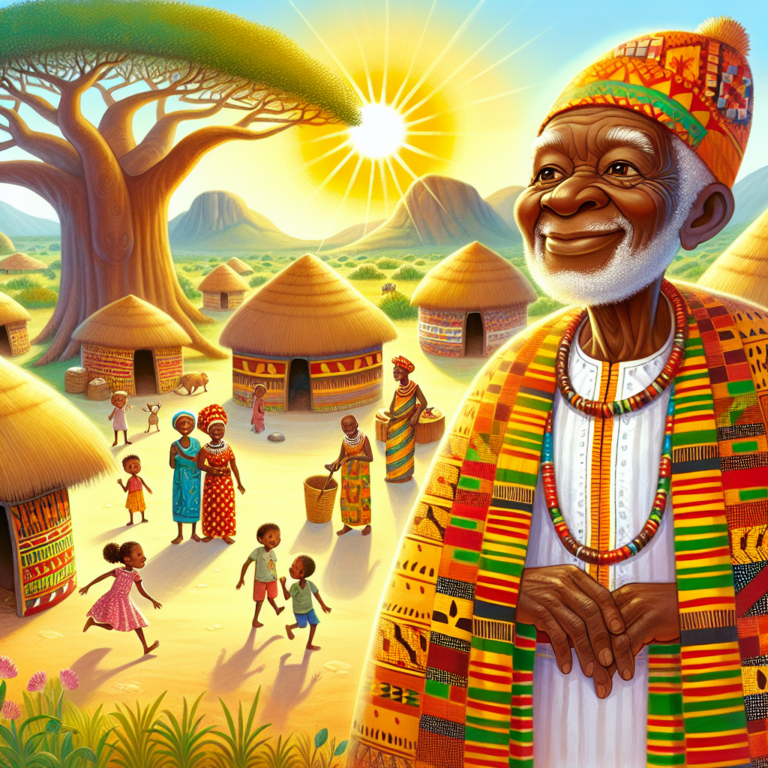
In the heart of Africa, where the savanna stretched golden and endless beneath a sky so blue it seemed to have been painted by the gods themselves, there lay a village unlike any other.
This village had no walls to keep people out. It had no locks on any door. And though the people who lived there came from many different families, with many different stories, they all shared one thing in common: they understood the secret of Ubuntu.
Ubuntu. Say it slowly: Oo-BOON-too.
In the languages of the Zulu, the Xhosa, and many other peoples of Africa, this word carries a meaning too big for any single translation. Some say it means “I am because we are.” Others say it means “A person is a person through other people.” But perhaps the simplest way to understand Ubuntu is this: we are all connected, like threads in a great tapestry, and what happens to one of us happens to all of us.
At the center of this village stood a tree so ancient and so massive that twenty children holding hands could not reach around its trunk. Its bark was smooth and gray, like the skin of an elephant. Its branches stretched up and out in every direction, reaching toward the sky like arms raised in prayer. Its roots were so deep and so strong that even in the driest season, when other plants withered and died, the great tree remained green and full of life.
This was the baobab – the tree of life, the gathering place, the heart of the village. And it was under this tree that an old man named Jengo shared his stories.
## Chapter Two: The Elder Who Remembered Everything
Jengo was so old that no one could remember a time when he hadn’t been old. His hair was white as clouds. His face was creased with wrinkles, each one a map of a story lived. His eyes, though faded with age, still sparkled with a light that seemed to come from somewhere deep within his soul.
But it was not Jengo’s appearance that made him special. It was what he carried inside him.
Jengo remembered everything.
He remembered the stories his grandmother had told him when he was just a small child sitting on her lap. He remembered the stories her grandmother had told her, passed down through the generations like precious gems. He remembered the tales of how the first people came to be, how the animals received their colors, how the stars found their places in the night sky.
And most importantly, he remembered the lessons these stories taught – lessons about kindness, about courage, about the sacred bonds that connect all living things.
Every evening, as the sun began its slow descent toward the horizon, painting the sky in shades of orange and red and purple, the children of the village would gather under the baobab tree. They would sit in a circle around Jengo, their faces eager, their hearts open, ready to receive whatever wisdom the old man would share.
## Chapter Three: The Spirit of Early Spring
On one particular evening, as the first breath of spring warmed the air and new green shoots pushed up through the earth, Jengo gathered the children as usual. But there was something different about him tonight. His eyes seemed brighter. His voice, when he spoke, carried a tremor of emotion.
“Children,” he said, “tonight I will tell you a story that my own grandmother told me, many, many moons ago. It is a story about how the spirit of Ubuntu came to live in our hearts.”
The children leaned forward, drawn in by the promise of something special.
“Long ago,” Jengo began, “when I was young – yes, children, I was young once, though I know it’s hard to believe -” the children giggled at this, “- our ancestors lived much as we do now. They planted crops. They raised cattle. They built homes of mud and thatch. They gathered under this very baobab tree to share their meals and their stories.
“But there was something our ancestors knew that some people today have forgotten. They knew that no person can truly live alone. They knew that we need each other – not just for food and shelter, but for something even more important. Something that feeds the soul.”
Jengo paused, looking at each child in turn.
“Do any of you know what I mean?”
Little Makena, the chief’s daughter, raised her hand. She was perhaps eight years old, with bright curious eyes and hair woven into dozens of tiny braids. “Do you mean love, Elder Jengo?”
Jengo smiled warmly. “Love is part of it, child. But it’s bigger than love. It’s… connection. Understanding. The knowledge that when you suffer, others suffer with you. When you rejoice, others rejoice with you. When you help someone, you help yourself. When you hurt someone, you hurt yourself.”
## Chapter Four: The Ancestor’s Visit
“One night,” Jengo continued, his voice dropping to nearly a whisper so that the children had to lean in closer to hear, “when I was about your age, something extraordinary happened.
“It was the time of early spring, when the rains were just beginning and the world was waking up from its dry season sleep. I had stayed out late playing with my friends, and my mother had sent me to bed without supper as punishment for not coming home when called.
“I lay in my bed, hungry and feeling sorry for myself, when suddenly I felt a presence in the room. Not a scary presence – quite the opposite. It felt like being wrapped in the warmest blanket on the coldest night. It felt like coming home after a long journey.
“I opened my eyes, and there before me stood a figure made of light. Not blinding light – soft light, like starlight gathered into the shape of a person. And though this figure had no face that I could see, I somehow knew it was smiling at me.”
The children gasped.
“Was it a ghost?” asked young Kofi, his eyes wide.
“Not exactly,” Jengo said. “It was something older than ghosts. It was an Ancestor – one of the great spirits who watch over our people. And it spoke to me, not with words that my ears could hear, but with thoughts that appeared directly in my mind.”
“What did it say?” Makena breathed.
## Chapter Five: The Message of the Spirit
Jengo closed his eyes, remembering.
“‘Young one,’ the spirit said to me, ‘you are feeling alone tonight. You think your suffering belongs only to you. But let me show you something.’
“And suddenly, though I had not moved from my bed, I could see the entire village at once. I could see my mother, sitting by the fire, looking at the doorway of my room with worry in her eyes. She had punished me, yes, but she was not happy about it. Her heart ached because mine did.
“I could see my friend Kwame, who had been playing with me that afternoon. He was in his own home, unable to sleep, feeling guilty because he knew I had gotten in trouble partly because of him.
“I could see the village dogs, curled up together for warmth, sharing their body heat because together they were warmer than any one of them could be alone.
“I could see the baobab tree, its roots reaching deep into the earth, connecting with the roots of other trees, sharing water and nutrients through a hidden network beneath the soil.
“And the spirit said to me: ‘This is the truth of existence, young one. Nothing in this world is truly separate from anything else. You are not alone in your suffering, because when you suffer, others feel it too. And you are not alone in your joy, because when you rejoice, others share in it whether they know it or not.


“‘This is Ubuntu. This is the web that connects all living things. When you understand this – truly understand it, in your bones and in your blood – you will never feel alone again. And you will never be able to hurt another without knowing that you hurt yourself as well.’”
## Chapter Six: The Transformation
“When the spirit faded,” Jengo continued, “I lay in my bed for a long time, thinking about what I had been shown. And when I finally got up and went to my mother, I didn’t ask for food or complain about my punishment. I simply hugged her.
“‘I’m sorry I worried you,’ I said.
“My mother looked at me strangely, as if seeing something in my eyes that hadn’t been there before. Then she hugged me back, and we stood there for a long moment, connected in a way that words could not describe.
“From that night on, I saw the world differently. When I passed someone in the village who looked sad, I didn’t walk by – I stopped and asked what was wrong. When my friends succeeded at something, I felt their joy as if it were my own. When I was tempted to be cruel or selfish, I remembered the web of connection and knew that I would only be hurting myself.”
Jengo opened his eyes and looked at the children gathered around him.
“And now, children, I will tell you the most important part of the spirit’s message. Are you ready?”
The children nodded eagerly.
## Chapter Seven: The Wisdom in Every Heart
“The spirit told me this,” Jengo said. “It said: ‘You think I am something outside yourself – a visitor, a messenger from beyond. But the truth is, I am already within you. I am within every person who has ever lived or ever will live. I am the part of you that knows you are connected to all things. I am the voice that whispers “Ubuntu” in your heart when you see someone in need.’
“The spirit showed me that the wisdom of our ancestors is not locked away in some distant place. It is here.” Jengo placed his hand over his heart. “It is in each of us. We carry the wisdom of every grandmother and grandfather who came before us. We carry their courage, their kindness, their understanding of the sacred web that connects us all.
“‘You are not just one small person in a vast world,’ the spirit said. ‘You are a thread in the great tapestry. Without you, the tapestry would have a hole. Without the threads next to you, you would have nothing to hold onto. You need each other. You complete each other. You make each other real.’
“And that, children, is what the spirit said to me on that spring night, so many years ago.”
## Chapter Eight: The Children Understand
The children sat in silence for a long moment, their young minds processing the weight of Jengo’s words.
Finally, little Amara spoke up. She was the youngest of the group, only five years old, but her question showed wisdom beyond her years.
“Elder Jengo,” she said in her small, clear voice, “if we all carry the wisdom of our ancestors inside us… does that mean the spirit could visit any of us? Could it visit me?”
Jengo smiled, and in that smile was all the love he had accumulated over his long, long life.
“The spirit IS visiting you, child. Right now. Every time you feel a pull in your heart to help someone, that is the spirit speaking. Every time you feel sad when your friend is sad, that is the spirit connecting you. Every time you share your food with someone who is hungry, even when you’re hungry yourself, that is the spirit of Ubuntu flowing through you like water through a river.”
He looked around at all the children, his eyes lingering on each face.
“You don’t need to wait for a glowing figure to appear in your room. The ancestors are already with you. They speak to you through your conscience, through your capacity for love, through your understanding that we are all – every one of us – part of the same great family.”
## Chapter Nine: The Lesson Takes Root
That night, as the children walked home to their families, something was different about them. They walked more slowly, looking at the world around them with new eyes.
Young Kofi stopped to help an old woman carry her water jug, even though he was tired and wanted to get home.
Makena, usually quick to argue with her younger brother, instead offered him the first drink from the evening’s milk.
Little Amara gave her dinner to a hungry dog that wandered into the village, and though her stomach rumbled afterward, she felt full in a different way.
And as the days passed and became weeks, and the weeks became months, the spirit of Ubuntu grew stronger in the village. Not because anything magical happened, but because the children carried Jengo’s teaching with them everywhere they went.
When they grew up and had children of their own, they sat those children under the same baobab tree and told them the same story. And those children told their children. And so it continued, the web of connection growing stronger with each generation, the wisdom of the ancestors passing from heart to heart like a flame that never dies.
## Chapter Ten: The Legacy of Ubuntu
Many years have passed since Jengo first told his story under the baobab tree. Jengo himself has joined the ancestors now, becoming one more thread in the eternal tapestry.
But his story lives on. It lives in the village that still gathers under the great tree. It lives in the children who still share their food and their games and their sorrows with one another. It lives in every person who pauses to help a stranger, who weeps at another’s pain, who laughs at another’s joy.
And if you listen very carefully, on quiet nights when the wind whispers through the branches of the baobab, you might hear an echo of Jengo’s voice, still telling his story, still passing down the wisdom of the ancestors to anyone who has ears to hear.
“I am because we are,” the wind seems to say. “We are because of each other. No one is alone. No one is separate. We are all threads in the same tapestry, all notes in the same song, all drops in the same great river of life.”
This is Ubuntu.
This is the truth that the ancestors knew.
This is the secret of the tree of life.
And it is yours now, to carry with you wherever you go, to share with everyone you meet, to pass on to those who come after you.
For the wisdom of Ubuntu does not belong to any one person or any one people. It belongs to all of us – because we are all, in the end, one family.
Moral Lessons
- We are all interconnected like threads in a tapestry – what affects one person affects us all. True wisdom comes not from learning alone but from understanding our deep connection to others. The spirit of Ubuntu teaches us that “I am because we are” – our humanity is fulfilled through our relationships with others, and the wisdom of our ancestors lives within each of us.
Test Your Understanding
1Who was held in the highest regard in the village?
Frequently Asked Questions
What is the moral lesson of Jengo’s Wisdom: The Secret of the Ubuntu Tree?
What age is this story appropriate for?
How long does it take to read Jengo’s Wisdom: The Secret of the Ubuntu Tree?
What culture does this story come from?
Can I use this story for teaching?
Frequently Asked Questions
What is the Ubuntu Tree story about?
Jengo’s Wisdom: The Secret of the Ubuntu Tree is a bedtime story for kids aged 6-12 set in an African village. It teaches children about Ubuntu, an important African philosophy meaning ‘I am because we are,’ exploring how we are all connected and how caring for others enriches everyone in the community.
What does Ubuntu mean for kids?
Ubuntu is an African word from Zulu and Xhosa languages that means we are all connected to each other. The simplest way to explain Ubuntu to kids is: ‘A person is a person through other people.’ It teaches children that what happens to one person affects everyone, and that community and kindness matter.
What age group is Jengo’s Wisdom suitable for?
Jengo’s Wisdom: The Secret of the Ubuntu Tree is written for children aged 6 to 12. Its storytelling style, rich descriptions, and meaningful moral lessons make it an ideal bedtime story that parents can read aloud with younger children or older kids can enjoy independently.
📚 Recommended Books
Handpicked for readers like you
As an Amazon Associate, we earn from qualifying purchases. These recommendations are personalized based on this story's themes and your reading history.
What moral values does the Ubuntu Tree story teach children?
The story teaches children about community, belonging, empathy, and interconnectedness. Through the concept of Ubuntu, kids learn that helping others strengthens everyone, that differences should be embraced, and that true wisdom comes from understanding our shared humanity rather than focusing only on ourselves.
Where does the Ubuntu story take place?
The story is set in a village in the heart of Africa, surrounded by a golden savanna. At the village’s centre stands an enormous ancient tree, so wide that twenty children holding hands cannot reach around it. The setting draws on African traditions, including Zulu and Xhosa culture and philosophy.