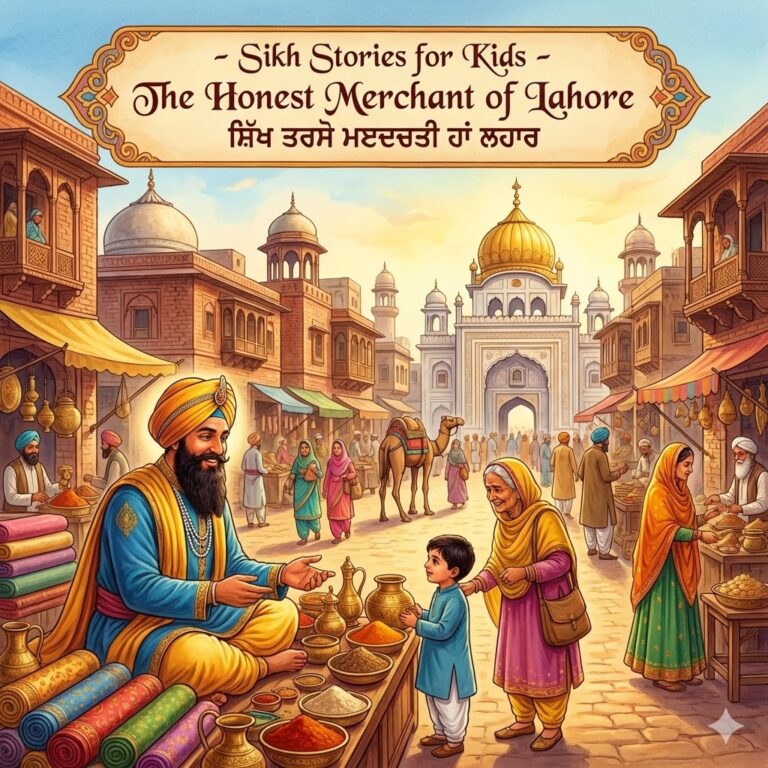
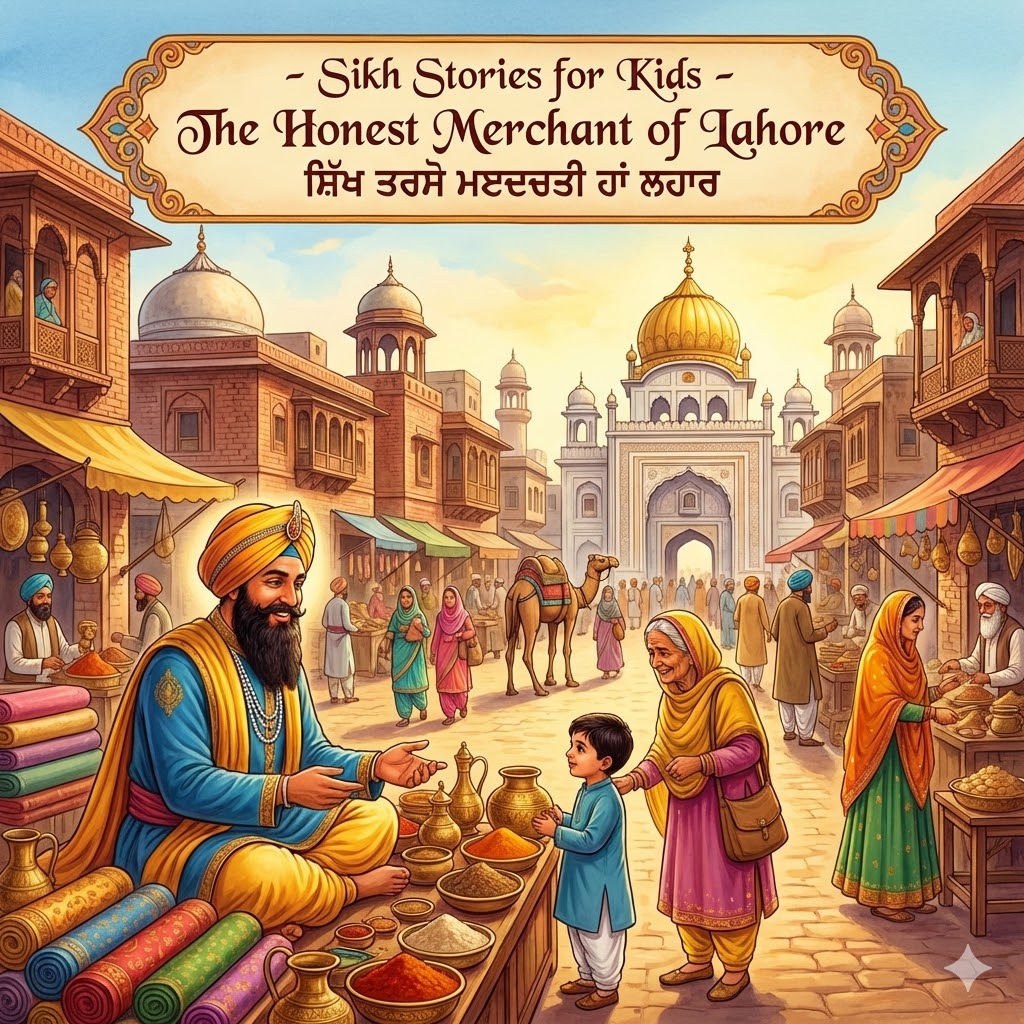
‘The Honest Merchant of Lahore’ is an educational moral story perfect for bedtime reading with children ages 6-12.
In the walled city of Lahore, where the ancient gates opened to bustling bazaars and the minarets of the Badshahi Mosque touched the sky, there lived a cloth merchant named Harbans Singh.
His shop stood in Anarkali Bazaar, wedged between a spice seller whose cumin and cardamom perfumed the air, and a jeweler whose window glittered with gold.
Harbans Singh’s shop was the smallest on the street. His bolts of fabric—silks from Varanasi, cottons from Gujarat, woolens from Kashmir—were neatly arranged on wooden shelves, but they did not spill out onto the street like those of his competitors. His sign was simple, painted in plain letters: “Harbans Singh, Cloth Merchant. Fair Prices. True Words.”
That last phrase made the other merchants smirk.
“True words?” they would say, shaking their heads. “In business, you must know how to embellish! The customer expects it. They want drama, bargaining, the thrill of the deal!”
But Harbans Singh would only smile and stroke his beard—tied neatly in the Sikh tradition—and say, “The Gurus taught us that truth is the foundation of all virtue. I will not build my livelihood on lies.”
* * *
Harbans had learned this lesson from his father, who had learned it from his father, stretching back generations to the time when Guru Nanak himself walked the dusty roads of Punjab, teaching the path of righteousness.
His grandfather had told him the story of Bhai Lalo many times.
“Bhai Lalo was just a simple carpenter,” his grandfather would say, “poor but honest. He earned his bread by the sweat of his brow, harming no one. When Guru Nanak came to his village, the Guru chose to stay with poor Lalo instead of the rich man Malik Bhago.”
“Why?” young Harbans had asked.
“Because Lalo’s food was earned honestly. When Guru ji squeezed Lalo’s simple bread, milk flowed from it—the milk of honest labor. But when he squeezed Malik Bhago’s rich feast, blood dripped out—for that food was earned by exploiting others.”
The lesson had stuck with Harbans all his life: honest work, honest dealings, honest speech. This was Kirat Karni—the Sikh principle of earning one’s living through truthful means.
* * *
But in the competitive world of Lahore’s cloth market, honesty seemed to be a disadvantage.
The other merchants would call out to customers with grand claims:
“The finest silk in all of India! Woven by master craftsmen! Fit for emperors!”
When the silk was merely adequate.
“Pure Kashmiri pashmina! Worth its weight in gold! Yours at half price today only!”
When it was mixed wool, and the price was still inflated.
They would hide flaws in fabric, drape cheap material to look expensive in dim light, and speak numbers that danced and changed with every round of bargaining.
Customers expected it. The marketplace ran on this theater of negotiation.
But not Harbans Singh’s shop.
When a customer asked, “Is this your finest silk?” Harbans would answer truthfully:
“It is good silk, but not my finest. My finest is this one here—it costs twice as much because the weave is tighter and the threads are pure. This one you asked about is excellent for everyday wear. The finer one is for special occasions. Which serves your need?”
When asked, “What is your price?” he would name it clearly, and that price would not change.
“But you must bargain!” customers would protest. “Give me a better price!”
“The price is fair,” Harbans would say gently. “I have already calculated what the fabric cost me, what my family needs to live modestly, and what allows me to continue in business. I do not inflate the price expecting you to bargain it down. I simply tell you the truth from the start.”
Some customers left, frustrated by the lack of drama.
But others—those who were tired of games, tired of wondering if they’d been cheated—became loyal patrons.
“At least with Harbans Singh,” they would tell their friends, “you know exactly what you’re getting.”
* * *
Still, his shop remained small. His competitor across the street, Lakhwinder, had expanded to three shops. He had servants to carry his account books. His turbans were tied with expensive cloth, and his fingers glittered with rings.
Lakhwinder would sometimes stand in his doorway and call across to Harbans:
“Still clinging to your precious honesty, Singh ji? Still making barely enough to feed your family while I prosper?”
Harbans would look up from measuring cloth and reply mildly, “I feed my family well enough, and I sleep soundly at night. Can you say the same, brother?”
Lakhwinder would laugh and return to his shop, but something in his eyes suggested that Harbans’s question had struck home.
* * *
Then came the autumn when the Nawab of Lahore announced his daughter’s wedding.
It would be the grandest celebration the city had seen in a generation. The Nawab was sparing no expense. He needed fabrics for the bride’s trousseau, for the decorations, for the gifts to be given to a hundred noble families.
Every cloth merchant in Lahore hungered for this contract. It could make a year’s profit—or more—in a single sale.
The Nawab’s chief steward, a sharp-eyed man named Ashfaq, came to the bazaar to inspect the merchandise.
He entered Lakhwinder’s shop first. It was the largest, the most prominent.
Lakhwinder rolled out bolt after bolt of fabric.
“The finest silks from China!” he declared. “Brocades from Persia! Velvets from far Europe! Nothing is too good for the Nawab’s daughter!”
Ashfaq examined them critically. He had been the Nawab’s steward for twenty years. He knew fabric. He could tell by touch, by the way light fell, by the scent of the dye, whether he was being told the truth.
He ran his fingers along a bolt of red silk. “This is not Chinese,” he said quietly. “It’s local, dyed to look finer than it is.”
Lakhwinder’s smile didn’t falter. “Perhaps I was mistaken. The supplier assured me—”
“And this price?” Ashfaq interrupted, pointing to the figure written on a scrap of paper.
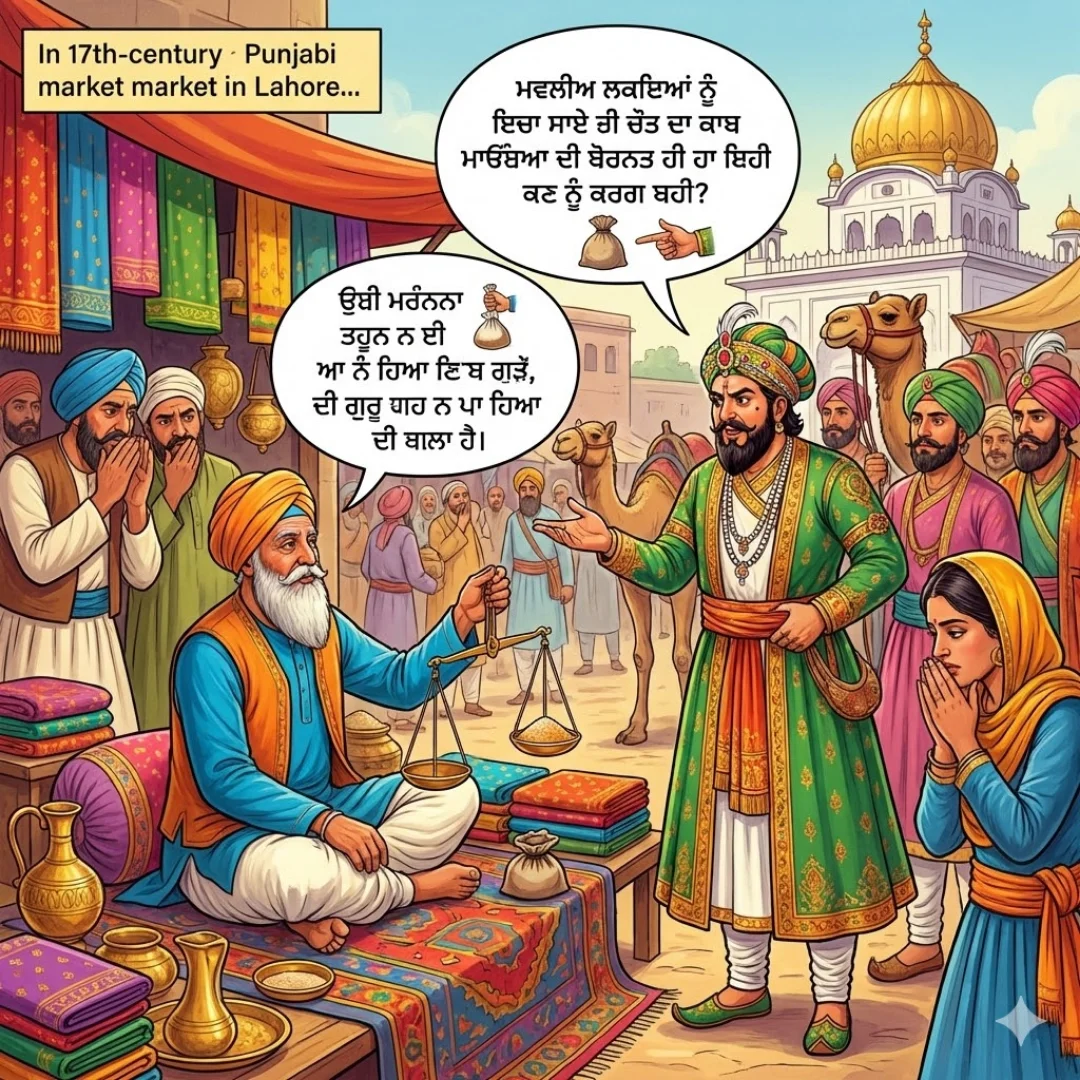
“For the Nawab, naturally, I can offer a special rate—”
“So this is not your real price? You inflated it expecting to bargain?”
Lakhwinder began to sweat. “It is how business is done, sahib. Everyone—”
“I see.” Ashfaq’s voice was cold. He rolled up the fabric. “I will look elsewhere.”
He visited shop after shop. At each one, he found the same pattern: exaggeration, hidden flaws, inflated prices meant to be bargained down.
His frustration grew. The wedding was in six weeks. The Nawab expected the finest materials, honestly sourced, at fair prices. Yet every merchant seemed to think him a fool to be swindled.
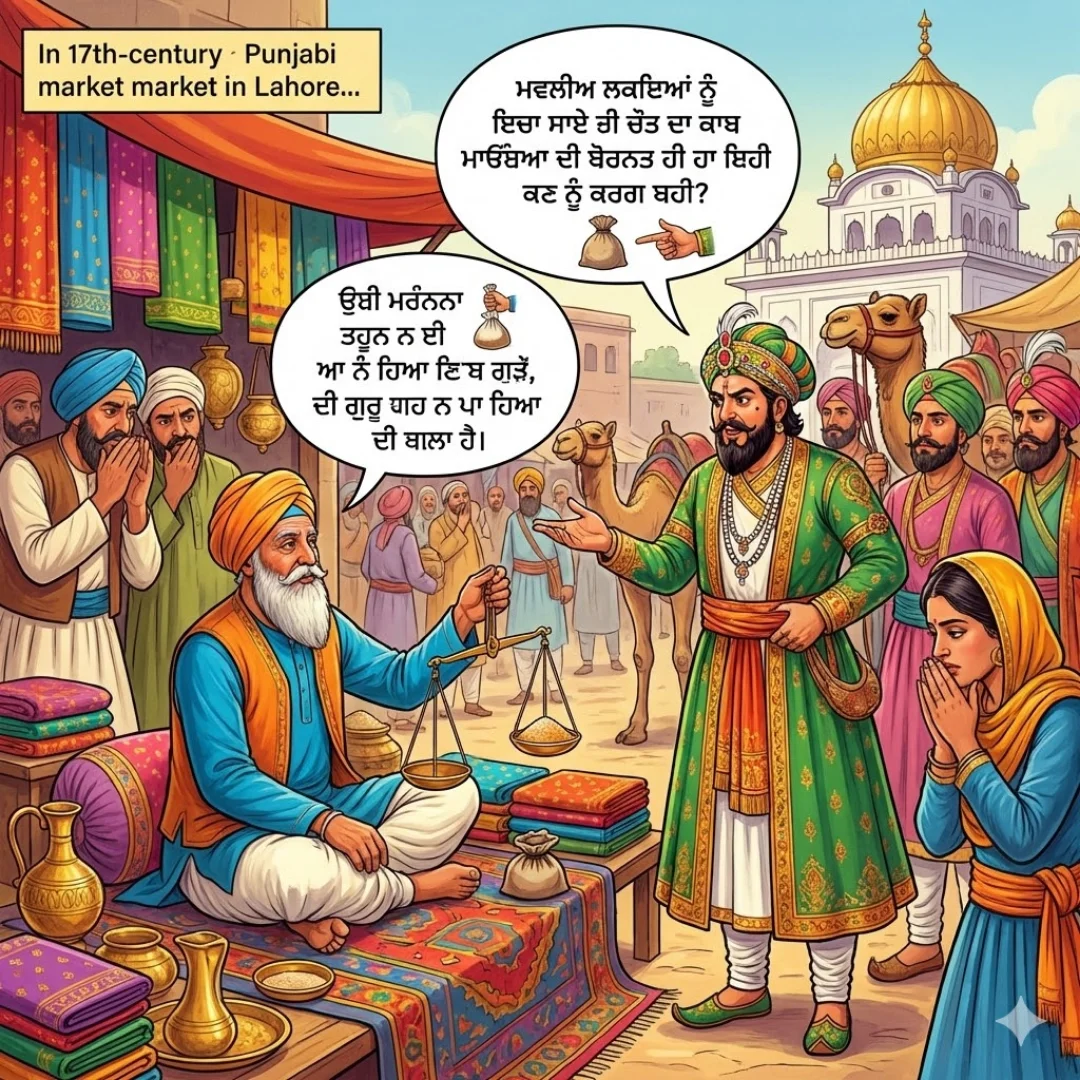
Finally, at the end of the row, Ashfaq noticed a small shop he’d almost overlooked.
The sign read: “Harbans Singh, Cloth Merchant. Fair Prices. True Words.”
Ashfaq had nothing to lose. He entered.
* * *
The shop was quiet, clean, and modest. Harbans Singh rose from his stool and greeted the steward with a respectful bow, his hands pressed together.
“Sat Sri Akaal, ji. Welcome to my humble shop. How may I serve you?”
Ashfaq was tired and wary. “I am searching for fabrics for the Nawab’s daughter’s wedding. I have been to every shop in this bazaar, and I am beginning to think there is not an honest merchant in all of Lahore.”
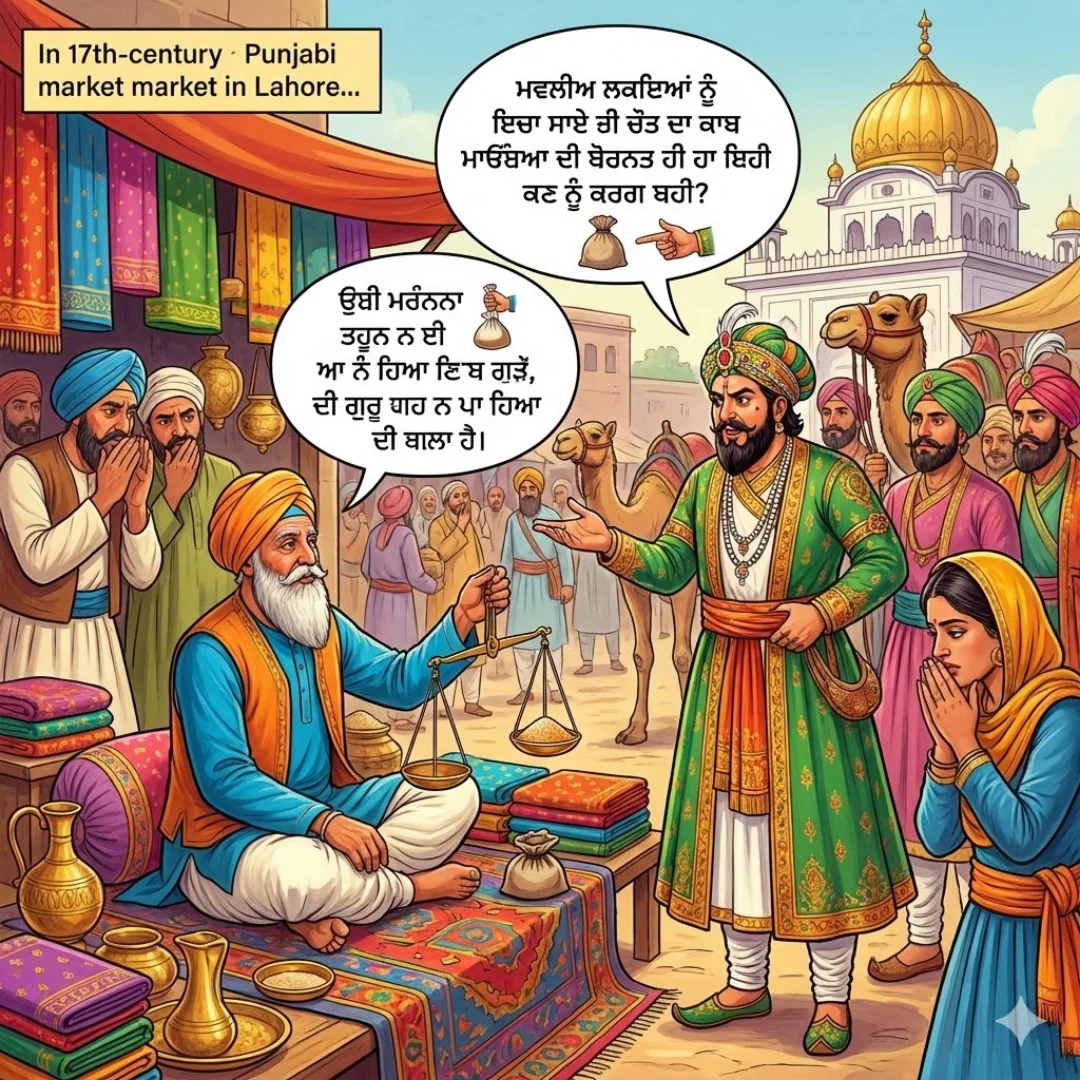
Harbans regarded him steadily. “That must be very frustrating, sir. Please, sit. Let me bring you some tea, and you can tell me what you truly need.”
Surprised by this courtesy, Ashfaq sat. Harbans brought tea scented with cardamom and served it in a simple cup.
“Now,” Harbans said, “tell me about the wedding. What does the Nawab’s daughter love? What colors bring her joy? What is the vision for this celebration?”
Ashfaq found himself talking—not about budgets and quantities, but about the Nawab’s daughter herself. She was kind, he said. She loved gardens. Her favorite colors were the soft blues and greens of springtime.
Harbans listened carefully. Then he began to pull bolts of fabric from his shelves.
“This silk is from Varanasi,” he said, unrolling a fabric the color of a robin’s egg. “It is not the most expensive silk, but the quality is excellent. The weave is tight. The dye is natural—indigo from the south. It will not fade. For a garden wedding, it would be perfect.”
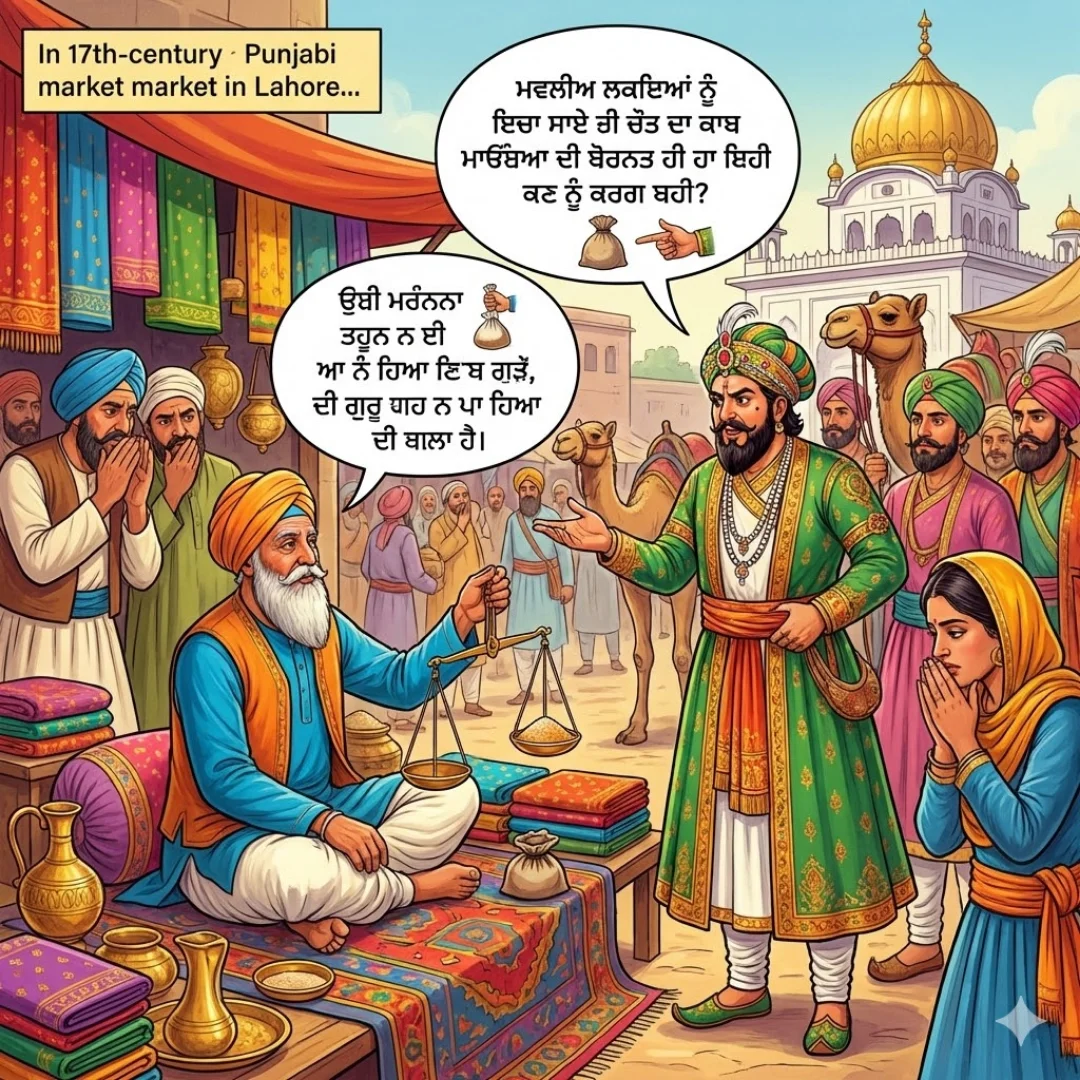
He showed Ashfaq the weave up close, pointing out the tight threads, the evenness of the color.
“And this?” Ashfaq asked, touching a cream-colored brocade.
“This is fine work,” Harbans admitted. “But I must tell you—if you look closely here”—he pointed to a small area—”there is a slight imperfection in the pattern. The weaver’s apprentice made a small error. It’s barely visible, but it is there. I can sell this to you at a reduced price, or I can show you a perfect bolt that costs more. Your choice.”
Ashfaq stared at him. “You… are pointing out the flaws in your own merchandise?”
“Of course,” Harbans said, surprised. “How could I do otherwise? You asked for truth. The Guru teaches that speaking truth is speaking God’s name. To lie would dishonor the Guru, dishonor my family, and dishonor you.”
Ashfaq picked up bolt after bolt. With each one, Harbans described it honestly—its origin, its quality, its price, its merits and limitations.
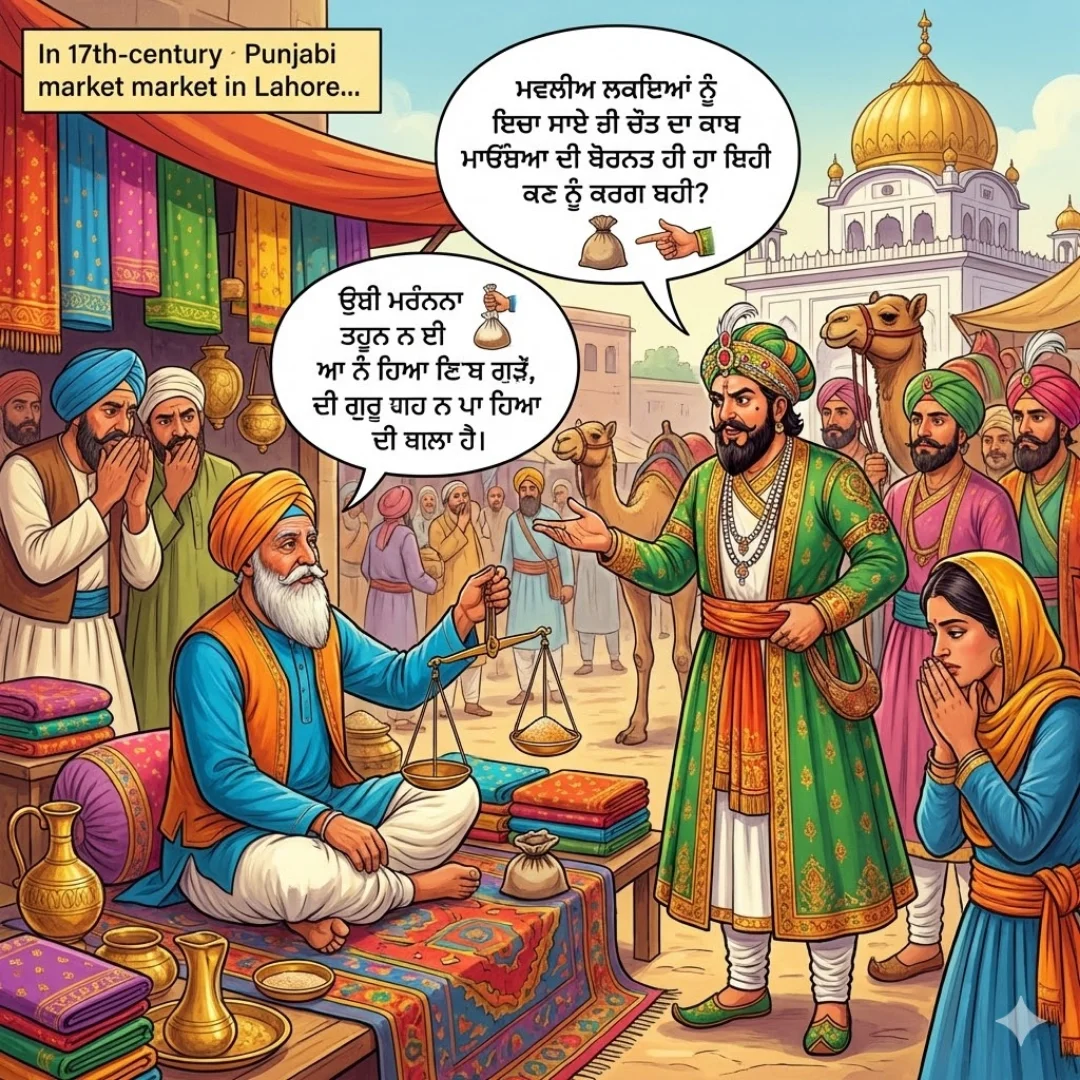
“This cotton is strong and will last a lifetime, but it is plain. This silk is beautiful but delicate and will require careful handling. This wool is warm but will be too heavy for an autumn wedding.”
No exaggeration. No hidden flaws. No inflated prices.
Ashfaq felt a weight lifting from his shoulders. He could trust this man.
“Tell me your price for these fabrics,” he said, gesturing to a selection of bolts.
Harbans calculated carefully, using an abacus, showing his work. “This is what they cost me from my suppliers. This is my modest profit, which feeds my family and keeps my shop open. The total is this amount.”
He named a figure.
Ashfaq had been prepared to pay three times that much—and he’d expected to bargain down from five times that much at other shops.
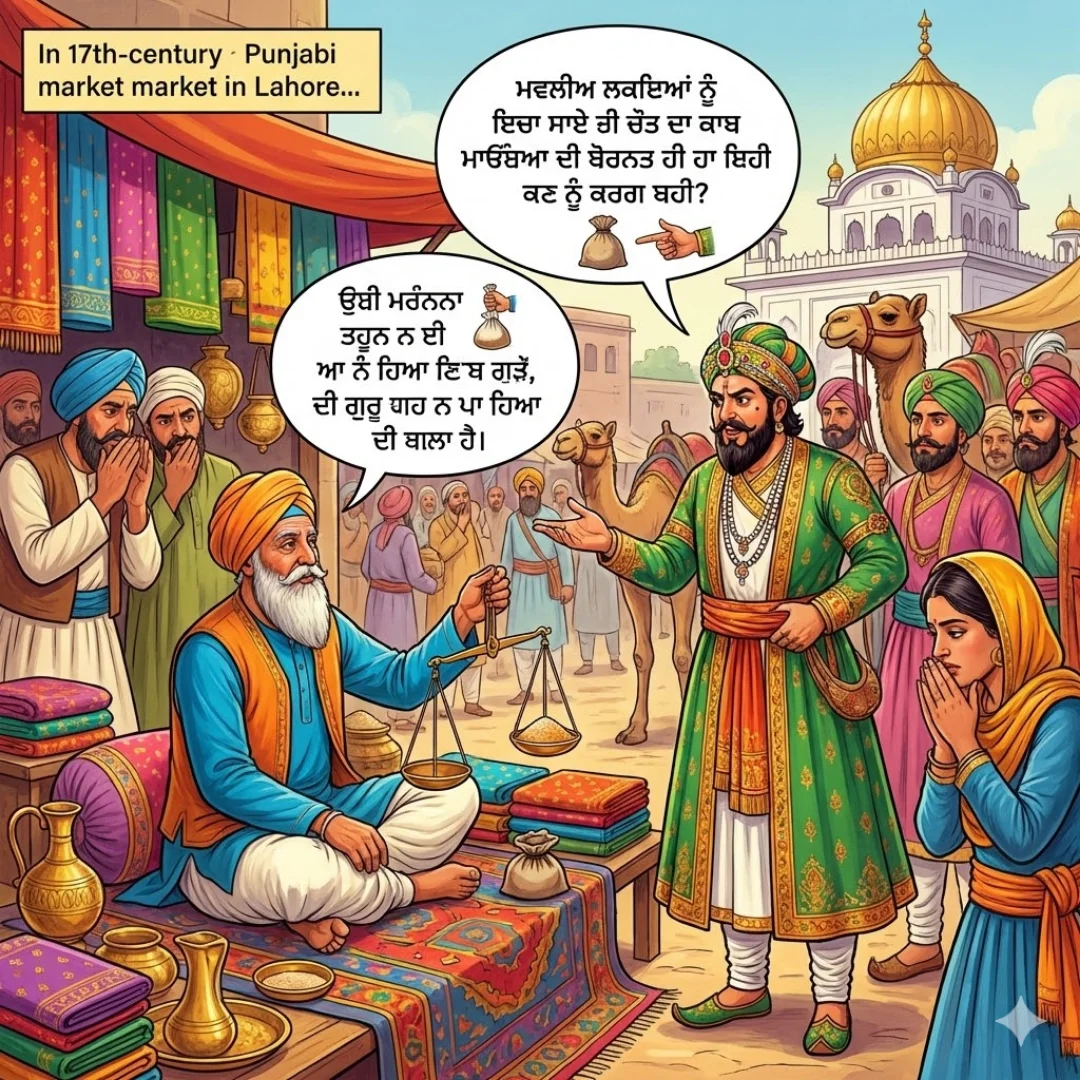
“This is truly your price?” he asked.
“It is a fair price,” Harbans said. “Fair to you, fair to me. I do not lie about numbers any more than I lie about fabric.”
* * *
Ashfaq sat in silence for a moment.
Then he spoke: “I came to this bazaar expecting to be cheated. I have been disappointed by a dozen merchants today. And then I find you, sitting in this small shop, selling truth as if it were the most natural thing in the world.”
He stood and extended his hand. “I will purchase everything you have shown me. But more than that—I will tell the Nawab about you. A man of such integrity should be rewarded.”
Harbans shook his hand. “I seek no reward except to live according to the Guru’s teachings. But I am grateful for your trust.”
* * *
The next day, Harbans delivered the fabrics to the Nawab’s palace. He carried them himself on a wooden cart, refusing to hire servants.
The Nawab himself came to inspect the delivery. He unrolled the bolts, examined the weave, tested the colors in sunlight and shade.
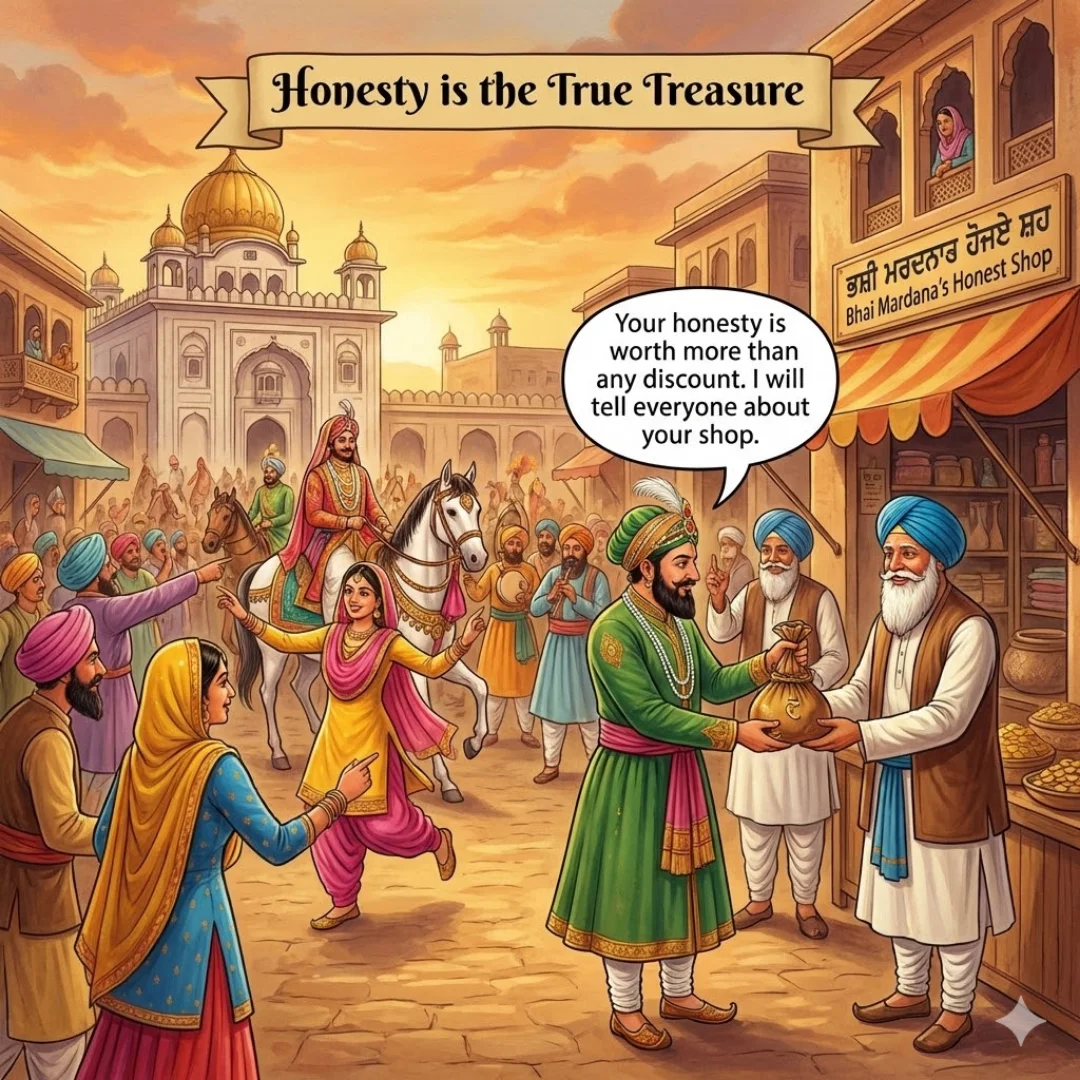
“My steward tells me you are the only honest merchant in Lahore,” the Nawab said.
Harbans bowed. “I cannot speak for others, Your Excellency. I know only that my Guru taught me to speak truth and to earn my bread by honest work. I have tried to live by that teaching.”
The Nawab smiled. “My daughter will be married in these fabrics. And I will sleep well knowing that no one was exploited in their making or their selling.”
He paid Harbans the agreed-upon price—and then added a generous bonus.
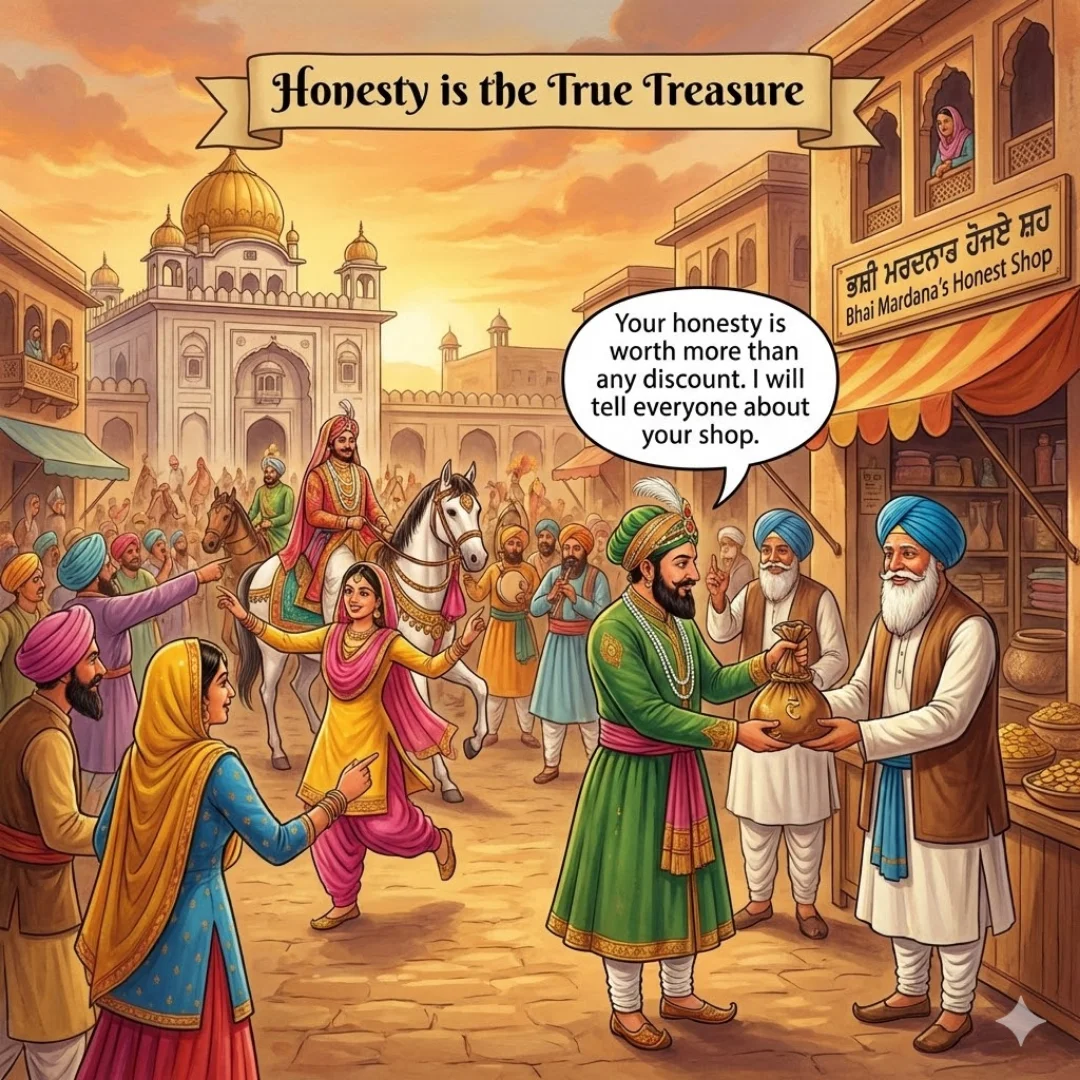
“For your integrity,” he said.
* * *
Word spread through Lahore like fire through dry grass.
The Nawab had found an honest merchant. The Nawab had purchased from Harbans Singh.
Nobles and wealthy families began to visit the small shop in Anarkali Bazaar. They came not for bargaining or theater, but for truth.
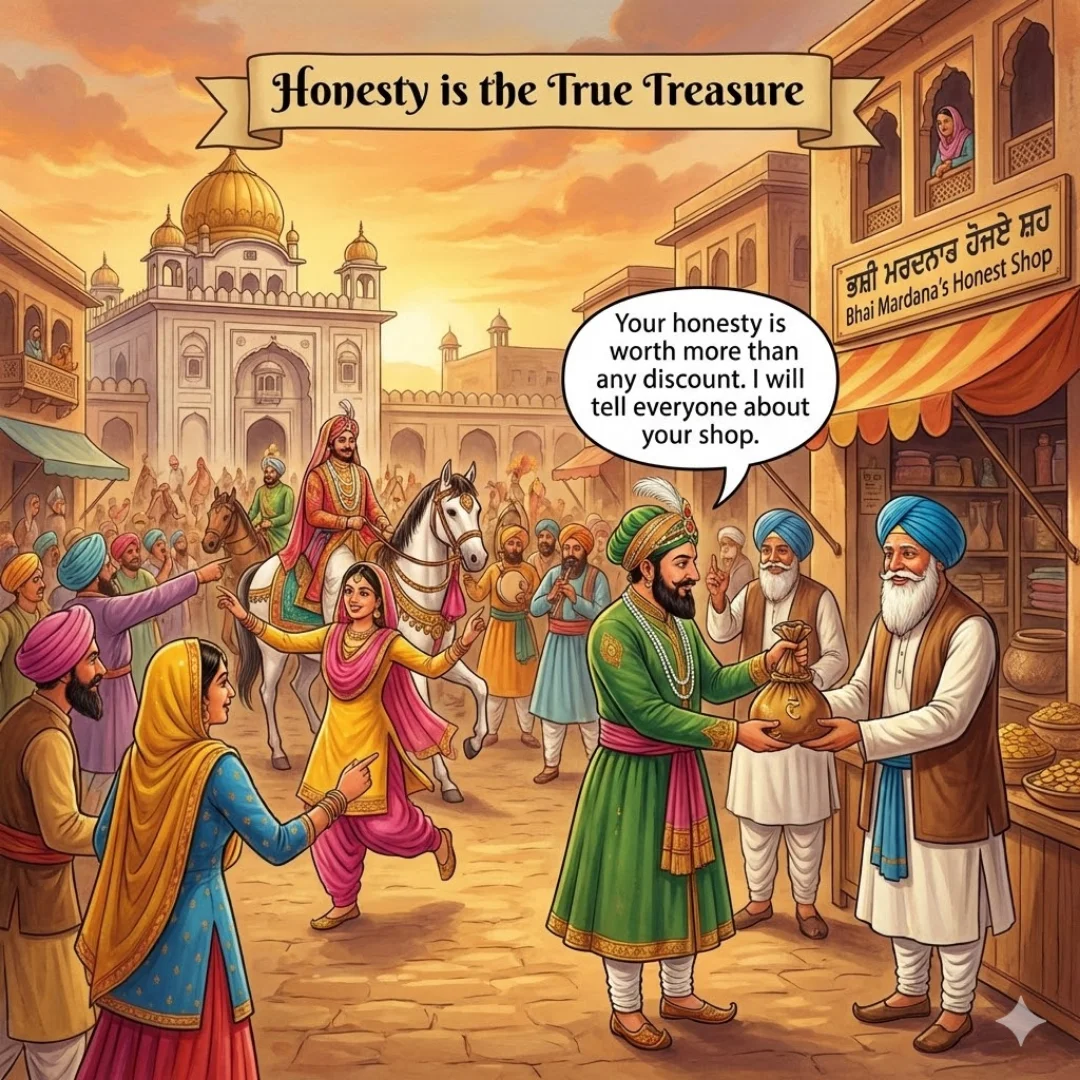
Within a year, Harbans had to expand his shop. Within two years, he had opened a second location. Within five years, he was the most successful cloth merchant in Lahore—not the flashiest, not the loudest, but the most trusted.
And across the street, Lakhwinder’s three shops began to fail. Customers drifted away, tired of wondering if they’d been cheated. One by one, the shops closed.
Lakhwinder himself came to Harbans one evening, after the bazaar had quieted.
“You were right,” he said simply. “I have been chasing wealth by clever words and hidden tricks. I have three shops and no peace. You have truth, and look what it has brought you.”
Harbans invited him in, offered him tea.
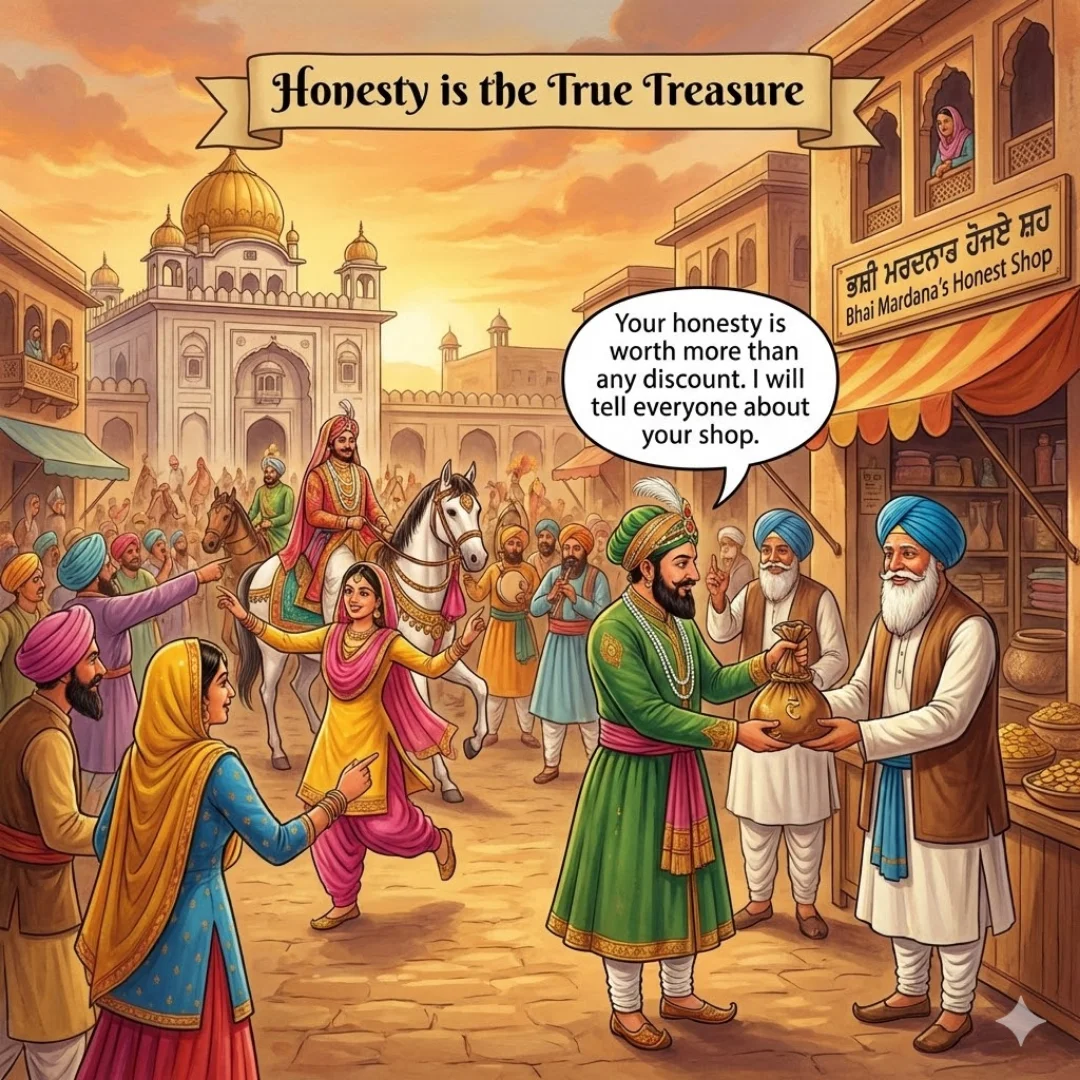
“It is not too late, brother,” Harbans said gently. “The path of truth is always open. Guru Nanak taught that we can always return to the righteous way. Start again. Choose honesty. Your customers will return.”
Lakhwinder’s eyes filled with tears. “Will you teach me?”
“Of course,” Harbans said. “The Gurus teach us to share what we have learned. That too is part of Kirat Karni—honest work includes honest teaching.”
* * *
Years later, when Harbans Singh was an old man with a silver beard, his grandchildren would sit at his feet in the shop and ask:
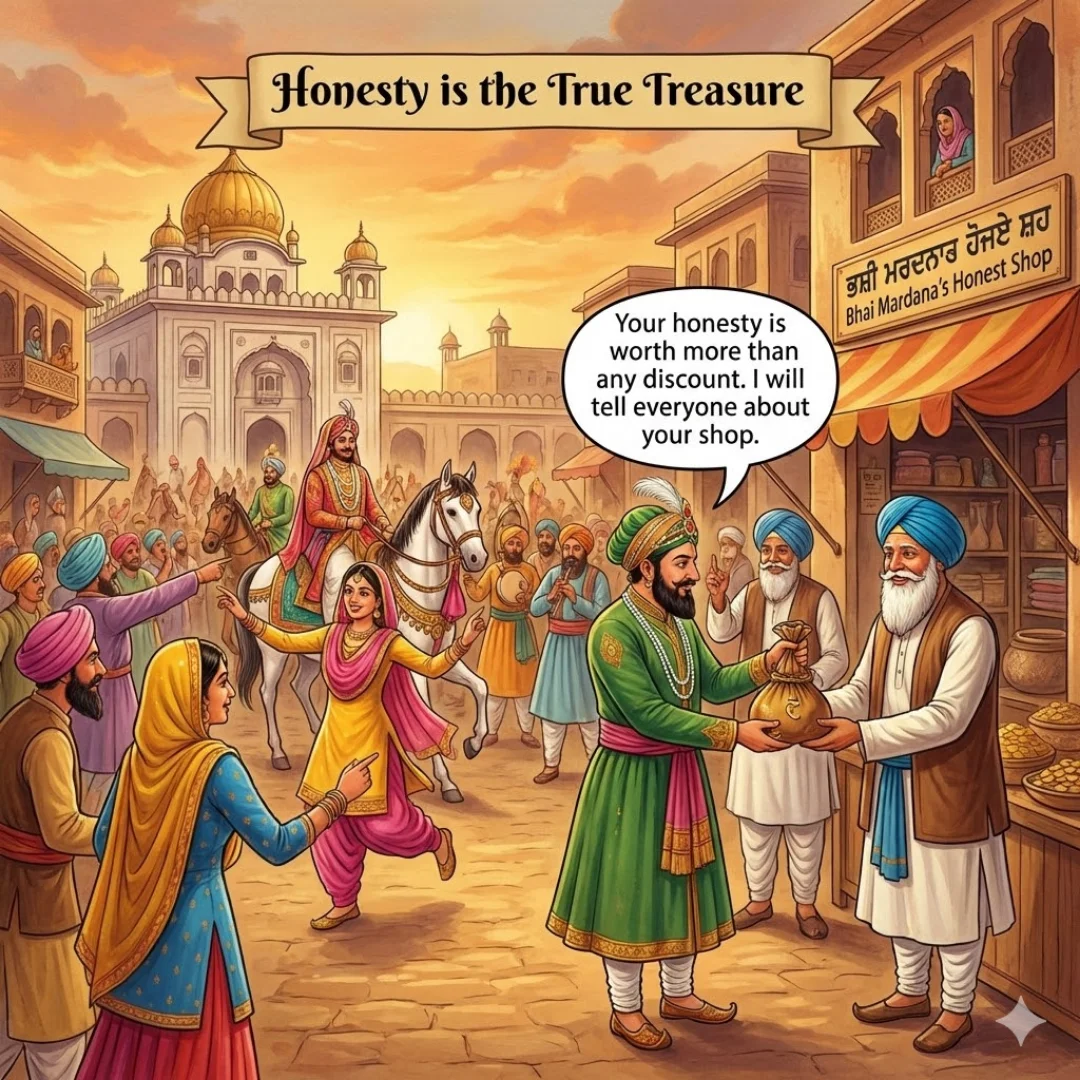
“Grandfather, how did you become so successful?”
And he would smile and tell them the same story his grandfather had told him—the story of Bhai Lalo and the Guru, of bread that flowed with milk because it was earned honestly.
“The Gurus taught us three things,” he would say, holding up three fingers. “Naam Japna—remember God’s name. Kirat Karni—earn your living honestly. Vand Chakna—share with others.”
He would point to the bolts of fabric surrounding them.
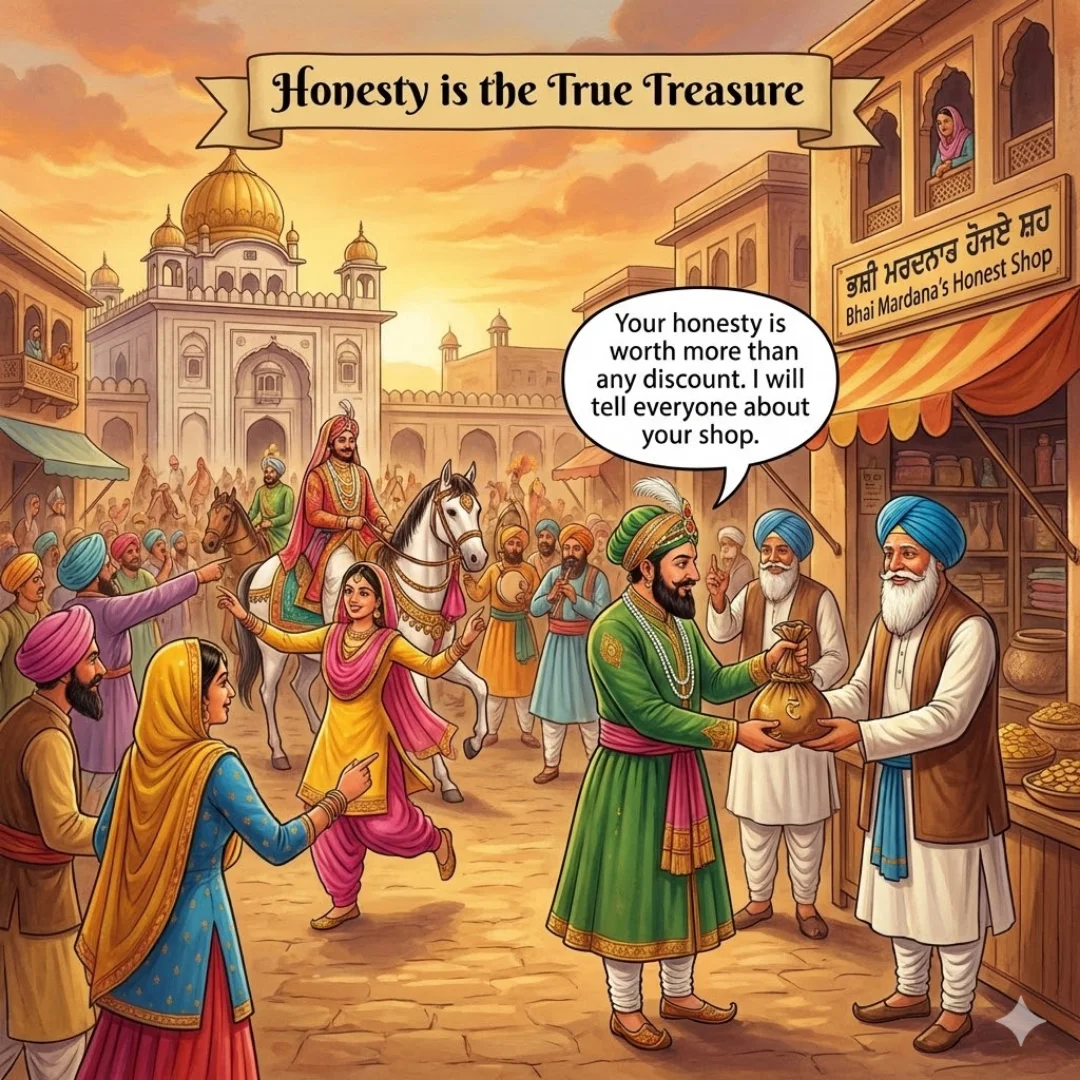
“This shop stands on those three principles. Every thread in every bolt was purchased fairly. Every customer was told the truth. Every profit was shared with those in need. This is not just business, my children. This is dharma—righteous living.”
“But grandfather,” one grandchild asked, “what if you had chosen to be like the other merchants? What if you had lied and cheated? Wouldn’t you have become rich faster?”
The old man laughed, his eyes crinkling.
“Perhaps I would have made more money,” he said. “But would I have made more peace? More trust? More sleep at night? More honor?”
He shook his head.
“Guru Nanak Dev Ji said: ‘Truth is high, but higher still is truthful living.’ I chose to live truthfully. And I have been rewarded not just with wealth, but with something far more valuable—the knowledge that I have walked the path the Gurus showed us.”
He looked at each grandchild in turn.
“That is the lesson I want you to carry forward. Not how to make money, but how to live with integrity. Because in the end, it is not what you have that matters, but who you are.”
* * *
And so the lesson passed down, generation to generation, just as the teachings of the Gurus passed down through the ages.
That truth is not just the highest virtue—it is the foundation on which all lasting success must be built.
That honest work, honestly done, brings blessings that no amount of clever deception can match.
That a small shop built on integrity will outlast a great empire built on lies.
This is the wisdom of the Sikh Gurus.
This is the path shown by Guru Nanak.
And this is the story of Harbans Singh, the merchant who chose truth—and found that truth chose him in return.
MORAL LESSONS:
– Truth is the foundation of all lasting success
– Honest work (Kirat Karni) brings more peace than dishonest wealth
– Integrity builds trust, which is more valuable than gold
– Speaking truth honors God and ourselves
– Fair dealing creates loyal relationships
– Short-term gains from deception lead to long-term loss
– Living by principles, even when difficult, ultimately rewards us
SIKH PRINCIPLES PRESERVED:
– Sat (Truth) – central Sikh value, truth as highest virtue
– Kirat Karni (Honest labor) – earning living through rightful means
– Naam Japna (Remembering God) – devotional practice
– Vand Chakna (Sharing with others) – generosity and community
– Guru Nanak’s teachings – direct references to Guru’s wisdom
– Bhai Lalo sakhi – authentic Sikh story woven into narrative
– Malik Bhago story – contrasting honest vs. dishonest wealth
– Sat Sri Akaal – traditional Sikh greeting
– Dharma (Righteous living) – living according to moral principles
– Guru Granth Sahib teachings – “Truth is high, higher still is truthful living”
CULTURAL ELEMENTS:
– Lahore setting – historical Sikh presence in Punjab
– Anarkali Bazaar – real historic market in Lahore
– Badshahi Mosque – authentic Lahore landmark
– Nawab – Mughal nobility structure
– Traditional cloth trade – accurate to Punjab commerce
– Sikh merchant class – historically accurate
– Turban tying – Sikh cultural practice
– Tea with cardamom – Punjabi hospitality
– Family business tradition – cultural transmission
ENGAGEMENT ENHANCEMENTS:
+ Vivid sensory details (spice scents, fabric textures, cardamom tea)
+ Dialogue reveals character and teaches principles naturally
+ Internal conflict shown through Lakhwinder’s journey
+ Scene breaks for better pacing
+ Emotional depth (steward’s frustration, merchant’s peace, competitor’s regret)
+ Show don’t tell throughout (honesty demonstrated through actions)
+ Contrast between honest and dishonest approaches
+ Satisfying arc: small shop → success through integrity
+ Multi-generational teaching (grandfather → father → Harbans → grandchildren)
+ Specific business details (abacus, calculations, fabric origins)
NOTE ON AUTHENTICITY:
This is a modern story embodying authentic Sikh principles rather than a direct retelling of a historical sakhi. The story of Bhai Lalo and Malik Bhago is referenced and is an authentic teaching from Guru Nanak’s life. The principles of Sat, Kirat Karni, Naam Japna, and Vand Chakna are core Sikh values. The Guru Granth Sahib quote “Truth is high, higher still is truthful living” is authentic.
SOURCES:
– [Bhai Lalo’s honesty – SikhiWiki](https://www.sikhiwiki.org/index.php/Bhai_Lalo’s_honesty)
– [Guru Nanak (for Children) – Honest Living](https://www.sikhmissionarysociety.org/sms/smspublications/gurunanakforchildren/chapter5/)
– [Guru Nanak Sakhis (Stories) | Discover Sikhism](https://www.discoversikhism.com/sikh_gurus/guru_nanak_sakhis.html)
– Sikh teachings on Kirat Karni (honest labor), Sat (truth), and righteous living
– Historical Lahore bazaar culture and Sikh merchant traditions
Test Your Understanding
1. What made Harbans Singh’s cloth shop different from other merchants in the bazaar?
Frequently Asked Questions
What is the moral lesson of The Honest Merchant of Lahore?
What age is this story appropriate for?
How long does it take to read The Honest Merchant of Lahore?
What culture does this story come from?
Can I use this story for teaching?
Frequently Asked Questions
What is The Honest Merchant of Lahore story about?
This educational story for kids follows Harbans Singh, a cloth merchant in Lahore who believes in honest business practices. While other merchants use drama and embellishment to make sales, Harbans Singh sticks to ‘fair prices and true words,’ teaching children the value of integrity and honesty in all dealings.
Is this a good bedtime story for young children?
Yes, this moral story is perfect for bedtime reading with children ages 6-12. It features gentle themes about honesty and good character, set in the beautiful city of Lahore. The story teaches valuable life lessons without scary or inappropriate content, making it ideal for peaceful bedtime routines.
What Sikh values does this story teach?
The story showcases important Sikh principles through Harbans Singh’s character, including truthfulness (sat), honest living, and treating all customers fairly. Children learn about Sikh traditions like the tied beard and the emphasis on conducting business with integrity, reflecting the Guru’s teachings about righteous living.
📚 Recommended Books
Handpicked for readers like you
As an Amazon Associate, we earn from qualifying purchases. These recommendations are personalized based on this story's themes and your reading history.
Where does The Honest Merchant story take place?
The story is set in the historic walled city of Lahore, specifically in the famous Anarkali Bazaar. Children will learn about this vibrant Pakistani city with its bustling markets, the beautiful Badshahi Mosque, and ancient gates, providing cultural context alongside the moral lesson about honesty.
Why is teaching honesty in business important for children?
This moral story helps children understand that success built on honesty lasts longer than success built on deception. By showing how Harbans Singh’s truthful approach differs from other merchants’ embellishments, kids learn that integrity in all dealings—whether business or personal—builds trust and self-respect.