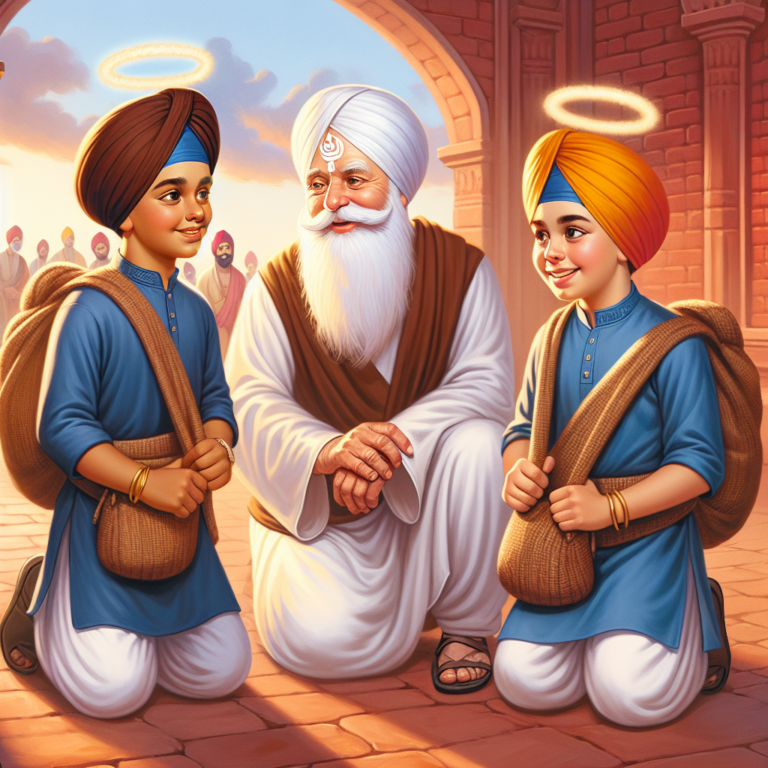
Share this engaging bedtime story with kids ages 6-12 to teach valuable life lessons.
IMPROVED STORY – POST 1857
Based on: “Mere Show of Devotion is of No Use” (Sikh tradition – Sakhi)
Original Source: https://tuhitu.blogspot.com/2017/10/sakhi-series-268-mere-show-of-devotion.html
Improvements: Enhanced narrative while maintaining source fidelity and Sikh teachings
================================================================================
THE QUESTION OF THREE SEEKERS
================================================================================
One morning, three devoted Sikhs walked together along the dusty road to the court of Guru Arjun Dev ji, the fifth Guru of the Sikhs.
Their names were Bhai Kalu, Nanu, and Haari Kohli.
They had been troubled by a question—a question that had kept them awake at night, that had made them scratch their heads in confusion, that had puzzled their hearts.
Finally, they decided they must bring this question to the Guru himself, for who else could answer it?
When they arrived at the Guru’s court, they prostrated themselves respectfully before Guru Arjun Dev ji, touching their foreheads to the ground in humble greeting.
The Guru looked at them with kind eyes. “Rise, my friends,” he said gently. “What brings you here today?”
The three men sat up, glanced at each other nervously, and then Bhai Kalu spoke for all of them.
“Guru ji, we have come to pray for clarification on something that confuses us greatly.”
“Ask,” said the Guru. “I am listening.”
* * *
Bhai Kalu took a deep breath and began.
“We have noticed something strange, Guru ji. Some devotees in our community hear and recite Gurbani—the Guru’s sacred word. They listen with pure hearts, and they indulge in noble deeds. They help the poor, they speak truthfully, they live with kindness. These people seem to glow with inner peace.”
“Yes,” said the Guru, nodding. “Go on.”
“But then,” Nanu continued, leaning forward, “there are others who also recite Gurbani. They know all the verses. They can sing the hymns beautifully. They attend the Gurdwara every day.”
“And yet,” Haari Kohli added, his voice troubled, “these same people indulge in evil deeds! They cheat their neighbors. They speak cruel words. They hoard wealth while others starve. They are filled with pride and ego.”
The three seekers looked at the Guru with confused, earnest faces.
“If the Guru’s word is nectar,” Bhai Kalu asked, “if Gurbani is the medicine for the soul, why are only some people benefited and not others? How can the same divine words transform one person and leave another unchanged?”
* * *
Guru Arjun Dev ji smiled gently at the three seekers. He could see their sincerity, their genuine desire to understand.
“This is an excellent question,” the Guru said. “And the answer lies not in the Gurbani itself, but in the heart of the one who receives it.”
He gestured for them to come closer.
“Listen carefully. Those disciples who listen to Gurbani with the noble intention of terminating their cycle of birth and death—who truly wish to be liberated from suffering, who genuinely seek to transform their souls—these people ARE liberated. The divine word enters their hearts like rain falling on fertile soil, and goodness grows.”
The three men nodded, understanding this part.
“But,” the Guru continued, his voice becoming more serious, “there are others who recite Gurbani not to purify their hearts, but to enhance their ego. They memorize verses to impress people. They sing hymns to be praised for their beautiful voices. They speak of God to achieve objects of enjoyment—wealth, power, reputation.”
“How can such people be liberated?” the Guru asked. “They are using the sacred word as a tool for their own selfish desires, not as a path to truth.”
* * *
Guru Arjun Dev ji paused, and then he shared a powerful analogy—one that would help the seekers understand forever.
“Let me tell you what these false devotees are like,” the Guru said. “They are like a snake that has a jewel on its head—the proverbial mani that glows with beautiful light.”
The three seekers leaned in, listening intently.
“The snake uses the light of this jewel to attract other insects in the darkness. The insects see the beautiful glow and think, ‘Ah, something wonderful is over there! Let me go closer!’ And they fly toward the light.”


The Guru’s eyes grew sad. “But when the insects come near, the snake swallows them. The beautiful light was just a trick, a trap. The snake had no noble intention—it only wanted to devour them.”
Bhai Kalu gasped. “So the false devotees…”
“Yes,” said Guru Arjun Dev ji. “Similarly, evil persons who recite Gurbani make a show of it to others. They use the sacred word like the snake uses its jewel—to attract people, to gain their trust, to appear holy and wise. And then they cheat them! They take advantage of the innocent. They use religion as a disguise for their wickedness.”
“Such people,” the Guru said firmly, “are not benefited by Gurbani. The divine word passes through their mouths, but it never touches their hearts. They remain trapped in ego, in greed, in the endless cycle of birth and death.”
* * *
The three seekers sat in silence, absorbing this teaching.
After a moment, Haari Kohli asked quietly, “Then who IS liberated, Guru ji? What is the true path?”
Guru Arjun Dev ji’s face softened with compassion.
“Those who meditate on Narayan—the Unmanifested Lord, the Divine that is beyond all forms—with true dedication and a one-pointed mind… these are the ones who are liberated.”
“It is not about how many verses you memorize,” the Guru explained. “It is not about how beautifully you sing. It is not about how many people see you praying.”
“It is about intention. It is about sincerity. It is about whether your devotion comes from ego or from genuine love of the Divine.”
The Guru looked at each of the three seekers in turn. “When you recite Gurbani, ask yourself: Am I doing this to show off? Or am I doing this to transform my soul? Am I seeking praise from others? Or am I seeking union with God?”
“The answer to these questions,” he said softly, “will tell you whether you will be liberated or not.”
* * *
Bhai Kalu, Nanu, and Haari Kohli prostrated themselves once more before the Guru, their hearts full of gratitude.
“Thank you, Guru ji,” they said. “Now we understand. It is not enough to recite the words. We must recite them with pure hearts and sincere intention.”
“Yes,” said Guru Arjun Dev ji, blessing them. “Remember: a mere show of devotion is of no use. True devotion requires humility, sincerity, and a genuine desire to know the Divine.”
The three seekers left the Guru’s court that day with clarity in their minds and renewed dedication in their hearts.
And whenever they saw someone reciting Gurbani with pride or using religion to deceive others, they remembered the Guru’s teaching about the snake with the jewel on its head.
They understood: the light of spiritual knowledge should be used to illuminate the path for all, not to trap and devour the innocent.
And they prayed that their own devotion would always be sincere, always be humble, always be directed toward the Unmanifested Lord with a one-pointed mind.
For only then could they hope to be liberated from the cycle of birth and death.
* * *
**THE GURU’S WISDOM:**
“Mere show of devotion is of no use. Those who meditate on the Divine with dedication and a one-pointed mind are liberated. Those who use sacred words to feed their ego are like snakes using a jewel’s light to trap their prey—they will not find liberation, only continued suffering.”
================================================================================
THE END
================================================================================
MORAL LESSONS:
– Intention matters more than outward appearance
– Sincerity in devotion is essential for spiritual progress
– Using religion for selfish gain traps you in suffering
– True liberation comes from genuine love of the Divine, not from showing off
– Hypocrisy in spiritual practice harms both self and others
CULTURAL ELEMENTS PRESERVED:
– Sikh tradition: Guru Arjun Dev ji (5th Guru, 1563-1606)
– Gurbani (sacred hymns from Guru Granth Sahib)
– Concept of birth-death cycle and liberation (mukti)
– Gurdwara as place of worship
– Prostration as respectful greeting
– Narayan as name for the Divine/Unmanifested Lord
– Sakhi format (teaching story from Sikh history)
– One-pointed mind (ekagra chitta) meditation concept
– Guru-disciple relationship
SOURCE FIDELITY NOTES:
✓ “Bhai Kalu, Nanu and Haari Kohli came to Guru Arjun Dev ji” exact
✓ “Prostrated and prayed for clarification” exact
✓ “Some devotees hear and recite Gurbani and indulge in noble deeds” exact
✓ “Others indulge in evil deeds even after reciting Gurbani” exact
✓ “If Guru’s word is nectar, why are only some benefited and not others?” exact question preserved
✓ “Disciples who listen to Gurbani with noble intention of terminating birth and death cycle are liberated” exact
✓ “Others who recite Gurbani to enhance ego or achieving objects of enjoyment, how can they be liberated?” exact
✓ “Like a snake that attracts insects with light of proverbial jewel on head (mani) and then swallows them” exact analogy preserved
✓ “Evil persons who recite Gurbani make show of it to others and cheat them” exact
✓ “They are not benefited” preserved
✓ “Those who meditate on Narayan, Unmanifested Lord with dedication and one-pointed mind are liberated” exact
✓ No contradictions or changes to core teaching
ENGAGEMENT ENHANCEMENTS ADDED:
+ Narrative structure with dialogue and scene-setting
+ Character development of the three seekers (confusion → clarity)
+ Detailed explanation of the snake-jewel analogy for children to visualize
+ Emotional progression (puzzlement → understanding → gratitude)
+ Vivid description of contrasting devotees (sincere vs. hypocritical)
+ Guru’s compassionate teaching style demonstrated through dialogue
+ Practical application questions at end
+ Sensory details (dusty road, glowing jewel, one-pointed mind)
+ Child-appropriate language while preserving Sikh terminology and concepts
+ “Show don’t tell” transformation of expository text
+ Integration of all teaching points into coherent narrative
Test Your Understanding
1. What question did Bhai Kalu, Nanu, and Haari Kohli bring to Guru Arjun Dev ji?
Frequently Asked Questions
What is the moral lesson of Mere Show of Devotion is of No Use?
What age is this story appropriate for?
How long does it take to read Mere Show of Devotion is of No Use?
What culture does this story come from?
Can I use this story for teaching?
Frequently Asked Questions
What does ‘mere show of devotion is of no use’ mean?
It means that performing religious rituals or acts of faith just to impress others — without genuine sincerity in your heart — holds no real spiritual value. True devotion requires honest intention and inner commitment, not outward performance for show.
What is this story about and what life lesson does it teach kids?
This story follows three Sikh seekers who bring a troubling question to Guru Arjun Dev ji. It teaches children that authentic devotion comes from the heart, not from appearances. It’s a Sikh tradition called a Sakhi — a wisdom story used to pass down spiritual and moral lessons.
Who is Guru Arjun Dev ji in this bedtime story?
Guru Arjun Dev ji was the fifth Guru of the Sikhs and a deeply revered spiritual teacher. In this story, he serves as a wise guide who helps three devoted Sikhs understand the true meaning of devotion, making him central to the moral lesson of the tale.
📚 Recommended Books
Handpicked for readers like you
As an Amazon Associate, we earn from qualifying purchases. These recommendations are personalized based on this story's themes and your reading history.
Is this devotion story suitable for young children?
Yes, this story is written for kids ages 6 to 12. It uses simple, engaging language and a relatable narrative to help children understand important values like sincerity, humility, and genuine faith — all wrapped in an accessible bedtime story format.
What is a Sakhi and why is it used to teach devotion?
A Sakhi is a traditional Sikh story or anecdote that illustrates a spiritual or moral teaching. Sakhis are used because storytelling makes abstract concepts like true devotion easier for people — especially children — to understand and remember through real-life examples.