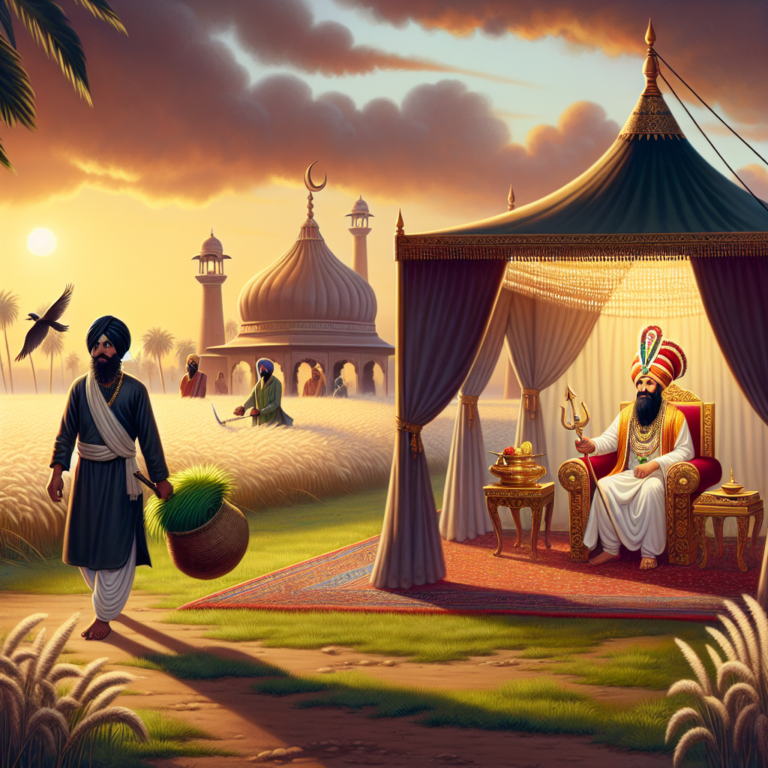
This bedtime story for kids, ‘The humble grass-cutter’s Quest for the True King’, teaches children ages 6-12 about important moral values.
Chapter One: The City of the Emperor
Long ago, in the time of emperors and kings, when India was a land of magnificent palaces and humble villages side by side, there stood the great city of Agra. Its white marble buildings gleamed in the sunlight, and at its heart rose the majestic Red Fort, where Emperor Jehangir ruled over a vast empire.
Agra was a city of contrasts. Within the fort’s walls, nobles dressed in silk and velvet, their fingers heavy with jeweled rings. Servants carried platters of fruit and sweetmeats through perfumed gardens. Musicians played gentle ragas as peacocks strutted across lawns as smooth as carpets.
But outside the fort, in the narrow lanes and crowded bazaars, ordinary people worked hard to make their living. Among them was a humble grass-cutter named Bhai Almast – a simple man who spent his days harvesting grass from the meadows to sell as feed for horses and cattle.
Bhai Almast was not wealthy. His clothes were patched, his hands were calloused from work, and he lived in a small hut on the edge of the city. But his heart was pure, and his faith was strong. Every day, before he began his work, he would say his prayers and remember the name of Waheguru, the Wonderful Lord.
And every night, he would count his small earnings and set aside two copper pice – the tiniest coins – as an offering for the True King.
Chapter Two: The Search for the True King
“The True King?” his neighbor once asked him. “Who is this True King you speak of?”
Bhai Almast’s eyes shone with devotion. “Guru Hargobind Sahib Ji,” he replied. “He is the sixth Guru of the Sikhs, and he is the True King of my heart. The emperors of this world rule over land and armies, but the Guru rules over souls. One day, I will travel to see him and offer these coins as a token of my love.”
Year after year, Bhai Almast saved his two pice each day. The coins grew into a small leather pouch, heavy with copper. He could have used this money for better food, for warmer clothes, for a hundred small comforts. But he never touched it.
“This belongs to my True King,” he would say. “Every coin is a prayer.”
Finally, after years of saving, Bhai Almast heard wonderful news: Guru Hargobind Sahib Ji was coming to Agra! The Guru had been summoned by the Emperor himself. Two grand tents were to be pitched in the meadows outside the city – one for the Emperor, and one for the Guru.
Bhai Almast could hardly believe his good fortune. “At last!” he cried, clutching his pouch of coins. “At last I will meet my True King!”
Chapter Three: A Case of Mistaken Identity
On the appointed day, Bhai Almast dressed in his cleanest clothes (which were still quite humble) and walked to the meadows where the two tents had been erected. What a sight they were! Both tents were enormous, made of the finest cloth, decorated with banners and surrounded by guards.
But which tent belonged to the Guru?
Bhai Almast approached the first tent he saw. Guards in gleaming armor stood at the entrance, and rich carpets covered the ground inside. Surely, he thought, this must be where the great True King sits.
He walked in hesitantly, his grass-stained sandals padding softly on the expensive rugs. At the far end of the tent, on a golden throne covered with cushions, sat a man in magnificent robes. His turban was adorned with jewels, and rings sparkled on every finger.
Bhai Almast fell to his knees and pressed his forehead to the ground.
“O True King!” he cried out. “I am but a poor grass-cutter, unworthy to be in your presence. I have spent many years saving these coins to offer at your feet. Please, guide me from the darkness of this world into the light of true wisdom!”
Chapter Four: The Emperor’s Surprise
The man on the throne was Emperor Jehangir himself. He looked down at the ragged grass-cutter with surprise and curiosity.
“Who are you, and why do you call me ‘True King’?” the Emperor asked.
Bhai Almast looked up, his face full of innocent devotion. “You are the True King, are you not? I have come to offer my humble savings and to receive your blessings.”
The Emperor’s courtiers began to snicker. What an ignorant peasant, they thought, not even knowing who sits before him!
But Jehangir did not laugh. Something in the grass-cutter’s simple faith touched his heart.
“Tell me,” the Emperor said gently, “what do you seek from this True King?”
“I seek only to be guided from darkness to light,” Bhai Almast replied earnestly. “I seek the knowledge that will free me from the cycle of suffering and bring peace to my soul. I seek the King who rules not over lands and armies, but over hearts and spirits.”
Chapter Five: The Emperor’s Gift
Jehangir was moved. Here was a man with nothing in the world except his faith, and that faith was more precious to him than all the Emperor’s gold.
“Good man,” Jehangir said kindly, “I am Jehangir, the Emperor of Hindustan. I rule over many lands and many peoples, but I am not the True King you seek. That title belongs to another.”
Bhai Almast’s face fell. “Then I have come to the wrong place?”
“No, not wrong – just mistaken. The one you seek is in the tent beside mine. Guru Hargobind Sahib Ji is there. Go to him, grass-cutter. Your True King awaits.”
With trembling hands, Bhai Almast gathered up his offering of copper coins, which he had spread before the Emperor’s throne. He bowed deeply to Jehangir.
“Thank you, great Emperor, for showing me the way.”
Jehangir nodded thoughtfully, watching the humble grass-cutter hurry from his tent. He had met many people – nobles and scholars, warriors and artists – but something about this simple man’s devotion lingered in his mind.


Chapter Six: The True King
Bhai Almast stepped into the second tent, and immediately he felt a difference. The tent was just as fine as the Emperor’s, but the atmosphere was different – calmer, more peaceful, filled with a gentle power that seemed to radiate from the figure seated on a simple wooden platform.
Guru Hargobind Sahib Ji was a striking sight. He was young and strong, with a warrior’s bearing, yet his face shone with spiritual light. He wore two swords at his belt – Miri and Piri, representing worldly and spiritual authority – but his eyes held only compassion.
Around him sat Sikhs from all walks of life: merchants and farmers, soldiers and scholars. And in a corner, to Bhai Almast’s surprise, sat Nur Jehan, the Emperor’s own wife, who had come seeking the Guru’s wisdom.
Bhai Almast approached and fell at the Guru’s feet.
“O True King,” he whispered, tears flowing freely, “I have waited so many years for this moment. I am nothing – a poor grass-cutter with nothing to offer but these copper coins. But they represent every day of my faith, every morning prayer, every evening remembrance of your name.”
Chapter Seven: The Guru’s Response
Guru Hargobind Sahib Ji reached down and raised Bhai Almast to his feet.
“Stand, beloved one,” the Guru said, his voice warm and gentle. “You are not nothing. In the eyes of Waheguru, you are as precious as any king or emperor. Your copper coins, earned through honest labor and offered with pure devotion, are worth more than all the gold in Jehangir’s treasury.”
The Guru took the leather pouch of coins and held it up for all to see.
“Look, my Sikhs,” he announced. “This is the true offering – not the size of the gift, but the size of the heart that gives it. This grass-cutter has given everything he could spare, and he has given it with love. This is what Waheguru desires from us all.”
He blessed Bhai Almast and seated him among the gathered Sikhs, treating him with the same respect he showed to the wealthiest nobles.
“True kingship,” the Guru taught, “is not about crowns and thrones. It is about serving others, standing for justice, and leading souls toward the light. An emperor who oppresses his people is no king at all. A grass-cutter who lives honestly and loves purely is royalty in the court of heaven.”
Chapter Eight: The Liberator of Prisoners
What Bhai Almast did not know was that the Guru’s time in Agra would lead to one of the most remarkable events in Sikh history.
Due to the scheming of jealous advisors, Guru Hargobind Sahib Ji was imprisoned in the Fort of Gwalior. There, he found 52 princes and nobles who had been locked away by the Emperor – some for years – simply because Jehangir feared their influence.
Even in prison, the Guru brought hope. He taught the prisoners, comforted them, and helped them find peace in their suffering.
When Jehangir recovered from an illness and, moved by the prayers of Nur Jehan, ordered the Guru’s release, something extraordinary happened.
“I will not leave,” Guru Hargobind Sahib Ji declared, “unless all 52 of these innocent prisoners are freed with me.”
The Emperor, grudgingly impressed by such selflessness, agreed – but with a condition. “Only those who can hold onto your cloak as you walk through the prison gate may be released.”
The Guru smiled. He ordered a special cloak to be made – a cloak with 52 tassels, one for each prisoner to hold. And so, on the day of Diwali, Guru Hargobind Sahib Ji walked out of the Fort of Gwalior, and 52 prisoners walked to freedom with him, each holding a tassel of his magnificent cloak.
From that day forward, the Guru was known as Bandi Chhor – the Great Liberator.
Chapter Nine: The Legacy
Years later, when Bhai Almast had grown old and was surrounded by grandchildren, he would tell them the story of his journey to Agra.
“I went seeking the True King,” he would say, his eyes still bright with the memory, “and I found him. But do you know what else I learned?”
“What, Grandfather?” the children would ask.
“I learned that the True King is not just one person. The True King is anyone who lives with honesty, loves with all their heart, and serves others without seeking reward. The emperor Jehangir had all the power in the world, but he was kind enough to guide me to my Guru. The Guru had all the spiritual authority of heaven, but he cared enough about 52 strangers to refuse his own freedom until they could be free too.”
He would look at his grandchildren with love.
“You can be True Kings too, my little ones. Not with crowns or swords, but with kindness and honesty. Every good deed you do, every true word you speak, every time you help someone in need – you are being a True King in that moment.”
Chapter Ten: A Shrine of Remembrance
To this day, in the ancient Fort of Gwalior, a shrine stands in memory of Bandi Chhor Diwas – the Day of Liberation. A lamp burns there continuously, never allowed to go out, remembering the light that Guru Hargobind Sahib Ji brought to those dark prison cells.
And every year, Sikhs around the world celebrate this day, remembering not only the Guru’s courage but the lesson he taught: that true leadership means caring for others, that true power means using your strength to help the weak, and that true kingship is found not in thrones and palaces, but in hearts that serve.
The humble grass-cutter’s quest was not just for himself. Through his simple faith and honest devotion, he became part of a story that would inspire millions for centuries to come.
For in the end, we are all grass-cutters in our own way – humble souls seeking the True King within ourselves, hoping to bring a little more light into a world that sometimes seems so dark.
Moral Lessons
- True kingship lies not in wealth or power, but in wisdom, humility, and service to others. What matters is not how much we give, but the love and devotion with which we give it. And true leaders care for those in need, even at great cost to themselves.
Test Your Understanding
1Who was the grass-cutter looking for in the tents?
Frequently Asked Questions
What is the moral lesson of The Humble Grass-Cutter’s Quest for the True King?
What age is this story appropriate for?
How long does it take to read The Humble Grass-Cutter’s Quest for the True King?
What culture does this story come from?
Can I use this story for teaching?
Frequently Asked Questions
What is ‘The Humble Grass-Cutter’s Quest for the True King’ about?
It’s a bedtime story for kids set in ancient Agra, India, during the time of Emperor Jehangir. It follows Bhai Almast, a humble grass-cutter with a pure heart and strong faith, on a quest to find the true king. The story teaches children ages 6-12 important moral values like humility, faith, and integrity.
What moral values does the humble grass-cutter story teach children?
The story teaches children key moral values including humility, faith, perseverance, and the idea that true greatness isn’t measured by wealth or status. Through Bhai Almast’s journey, kids learn that a pure heart and strong character matter more than riches or fine clothes.
What age group is this bedtime story suitable for?
This story is recommended for children ages 6 to 12. The language and themes are age-appropriate, making it ideal for bedtime reading. Parents can read it aloud to younger children, while older kids in the 9-12 range can enjoy it independently.
📚 Recommended Books
Handpicked for readers like you
As an Amazon Associate, we earn from qualifying purchases. These recommendations are personalized based on this story's themes and your reading history.
Where is the humble grass-cutter’s story set?
The story is set in the historic city of Agra, India, during the reign of Emperor Jehangir. It vividly contrasts life inside the grand Red Fort, with its silk-clad nobles and perfumed gardens, against the humble lanes and bazaars where ordinary people like Bhai Almast lived and worked.
Who is Bhai Almast in the humble grass-cutter’s quest story?
Bhai Almast is the story’s main character — a simple, hardworking grass-cutter who harvests grass to sell as animal feed. Despite his patched clothes, calloused hands, and modest hut, he possesses a pure heart and deep faith, which drive his quest to find the true king.