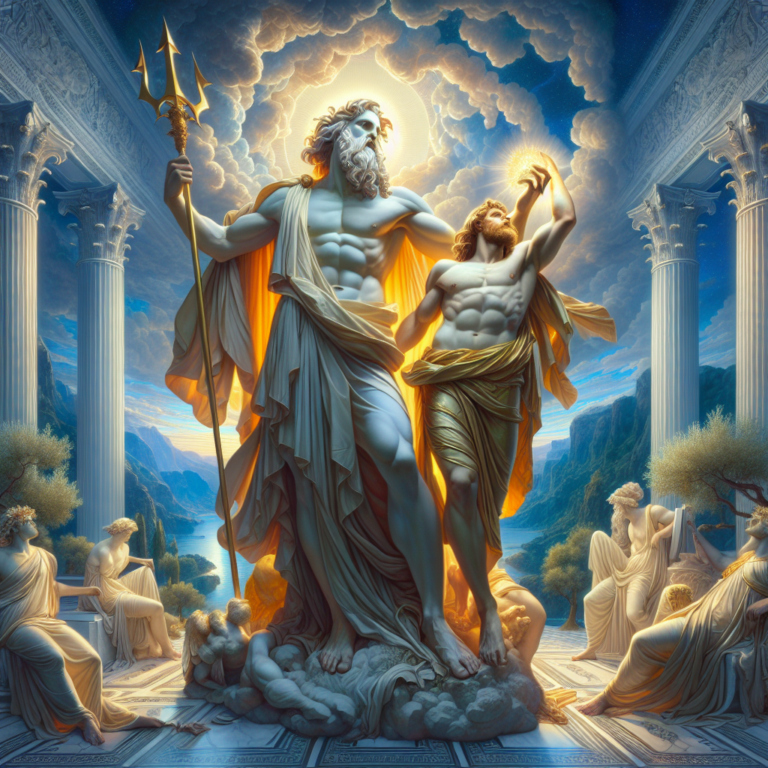
‘The Dreamy Adventures of Morpheus and the Lost Stars’ is an educational moral story perfect for bedtime reading with children ages 6-12.
In the ancient city of Trachis in Thessaly, there lived a king named Ceyx, son of the Morning Star, and his beloved wife Alcyone, daughter of Aeolus, the god of winds.
Their love was so deep, so complete, that people said they were the happiest couple in all of Greece. They called each other by the names of the greatest gods—Ceyx would call Alcyone “my Hera,” and she would call him “my Zeus”—not out of pride or blasphemy, but simply because their love seemed as eternal and powerful as that of the king and queen of the gods.
Every morning, Alcyone would wake beside her husband and thank the gods for another day together. Every evening, Ceyx would look at his wife and wonder how he could be so fortunate. They had everything: love, prosperity, peace, and joy.
But even the happiest of mortals cannot escape the whims of fate.
One day, dark news reached Ceyx’s palace. Strange and terrible events were occurring in his family’s homeland. His brother had been transformed by the gods as punishment for hubris. Sacred temples had been defiled. The gods were angry, and the world seemed out of balance.
Ceyx, troubled by these omens and disasters, decided he must consult the oracle of Apollo at Claros to learn what these portents meant and how to restore divine favor.
When he told Alcyone of his plans, her face went pale.
“Please, my love, do not go,” she begged. “Send an embassy instead. Send messengers. But do not go yourself.”
“Why do you fear?” Ceyx asked gently. “It is just a sea voyage. I will be gone only a short time.”
“I am my father’s daughter,” Alcyone said, her voice trembling. “I know the winds. I know the sea. I have seen what my father’s winds can do to ships when they are unleashed. I have seen the wreckage washed ashore, the bodies of sailors who thought they were safe. Please, Ceyx, if you love me, stay home.”
But Ceyx, though he loved his wife dearly, felt duty compelled him to make this journey himself.
“I promise you by my father’s light,” he said, taking her hands in his, “I will return within two months. I swear it.”
Alcyone wept, but she could not change his mind.
On the day of departure, Alcyone accompanied Ceyx to the harbor. As she watched the sailors prepare the ship, dread filled her heart. The ship seemed fragile, the sea too vast, the sky too uncertain.
“Come back to me,” she whispered, embracing him one last time.
“I will return before you can miss me,” Ceyx promised, though his own voice was heavy with the pain of parting.
The ship set sail. Alcyone stood on the shore, watching until the vessel became a tiny speck on the horizon, then disappeared entirely. Even when she could no longer see it, she remained, staring at the empty sea, as if her love could somehow protect him across the distance.
For the first day, the sailing was smooth. The wind was gentle, the sea calm. Ceyx stood at the stern, looking back toward home, thinking of Alcyone.
But on the second night, the wind changed.
Dark clouds boiled up from the horizon. The sea, which had been smooth as glass, began to heave and churn. Lightning split the sky. Thunder boomed like the drums of war.
Aeolus, Alcyone’s father, the god of winds, had not sent this storm—it came from the East Wind Eurus, acting on his own violent whim. The waves grew into mountains of water. The ship climbed impossibly high crests and plunged into valleys so deep that the sailors could see the sea-floor below.
The crew fought desperately. They hauled down the sails. They bailed water. They prayed to Neptune, to all the gods of sea and sky. But the storm was beyond mortal power to survive.
A wave as tall as a mountain struck the ship broadside. The mast cracked like a twig. The oars splintered. The hull began to break apart.
Ceyx, clinging to a piece of wreckage in the roaring water, had only one thought, one name on his lips:
“Alcyone! Alcyone!”
He prayed that his body might be carried back to shore so she could give him a proper burial. He prayed that she might somehow know he had thought of her in his final moments.
Then another wave crashed over him, and he sank into the dark water.
Ceyx, son of the Morning Star, beloved king, devoted husband, drowned in the merciless sea.
Alcyone knew nothing of the storm or the shipwreck. Every day, she counted the hours until Ceyx’s return. Every night, she prayed to the gods for his safe journey.
She wove a robe for him to wear upon his homecoming. She prepared his favorite foods. She tended the shrines in their home, making offerings especially to Juno, queen of the gods and protector of marriages.
“Great Juno,” she prayed, “keep my husband safe. Bring him home to me. Protect his journey and speed his return.”
Day after day, she prayed the same prayer, standing before Juno’s altar with her hands raised in supplication.
But in her heavenly palace, Juno could hear these prayers and could bear them no longer. For Juno knew what Alcyone did not: Ceyx was already dead. His body floated in the sea. And every prayer Alcyone offered was a prayer for one who could not be saved.
Juno’s heart ached with pity for the grieving wife who did not yet know she grieved.
“I cannot let her pray in vain any longer,” Juno said. “She must learn the truth, terrible though it is. Perhaps in dreams, the news will be gentler than if she hears it in waking life.”
Juno called to Iris, her rainbow messenger.
“Go to the cave of Somnus, the god of Sleep,” Juno commanded. “Tell him to send Alcyone a dream—a dream that will show her the truth of her husband’s fate. Let Morpheus, who can take any human form, appear to her as Ceyx and tell her what has happened.”
Iris wrapped herself in her rainbow cloak and flew swiftly across the sky to the land of the Cimmerians, where eternal twilight reigned and the cave of Sleep lay hidden in mist and shadow.
The cave of Somnus (Sleep personified) was a place of perfect stillness. No sunlight entered. No sound disturbed the silence. The river Lethe, whose waters brought forgetfulness, flowed nearby with a gentle murmur that lulled all listeners into drowsiness.
At the cave’s entrance, poppies grew—the flowers whose seeds bring sleep. Inside, the god Somnus reclined on a couch of black ebony, covered with dark blankets, surrounded by countless empty dreams that flitted about like shadows.
When Iris entered, her radiant rainbow light filled the dark cave. Somnus stirred, barely opening his eyes.
“Great Somnus,” Iris said, her voice soft so as not to startle him, “Juno sends me with a request. There is a mortal woman named Alcyone who prays in vain for her dead husband’s return. Send her a dream that reveals the truth. Let Morpheus take the form of Ceyx and appear to her.”
Somnus nodded slowly. He gestured toward the countless dream spirits that filled his cave—the Oneiroi, the dream gods.
Among them were specialists, each with their own gift:
– Some created dreams of animals
– Some created dreams of objects and nature
– Some created dreams of abstract things—fear, hope, memory
But one excelled above all others at taking human form. This was Morpheus, whose very name meant “shaper” or “form-maker.” He could mimic any person’s face, voice, gait, and manner so perfectly that those who dreamed of him would swear they had seen the actual person.
“Morpheus,” Somnus said quietly, “go to Trachis. Find Alcyone, wife of Ceyx. Take her dead husband’s form and tell her what has happened. Let her know the truth through dreams.”
Morpheus nodded and wrapped himself in his dark cloak. He had wings like a butterfly’s, silent and swift, which could carry him across vast distances in moments. He shed these wings as he approached Alcyone’s bedroom, for he would need to appear as a human, not a dream god.
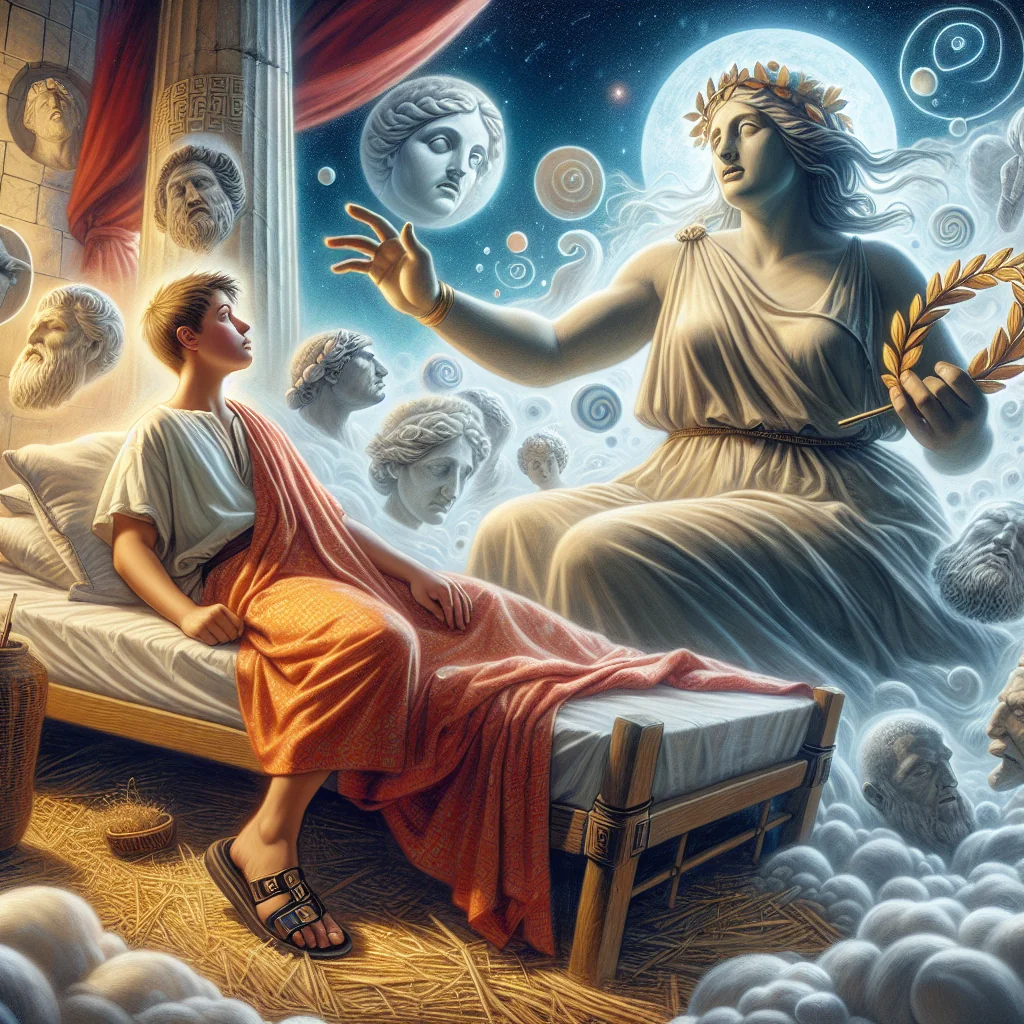
Alcyone slept fitfully that night, as she had every night since Ceyx left. Her mind was troubled by vague anxieties she could not name. She tossed and turned, reaching out in her sleep for a husband who was not there.
Then Morpheus entered her dream.
He stood at the foot of her bed in the form of Ceyx—but not Ceyx as she remembered him. This Ceyx was pale as death. His hair was matted and dripping with seawater. His beard was sodden. His body was naked and cold. Water pooled beneath his feet.
His eyes—those eyes she loved—looked at her with infinite sadness.
“Alcyone,” he said, and his voice was her husband’s voice, but hollow and distant, as if coming from a great depth. “My beloved wife. Do you not know me? Has death changed me so much that you cannot recognize your husband?”
In her dream, Alcyone reached toward him, but he stepped back.
“I am dead,” Ceyx said, the words falling like stones. “The ship was destroyed. The storm was too powerful. The winds—your own father’s winds—betrayed me. I called your name as the waves pulled me down. I am gone, Alcyone. I will not return.”
“No!” Dream-Alcyone cried. “You promised! You swore by your father’s light!”
“The sea does not care for promises,” Ceyx said gently. “My body floats even now upon the waves. Do not wait for me, my love. Do not pray for my safe return. I am already with the shades in the underworld. Mourn me. Remember me. But know that I am gone.”
He began to fade, like mist dissolving in sunlight.
“Don’t leave me!” Alcyone screamed in her dream. “Don’t go! Ceyx!”
She reached for him, and her hands grasped empty air—
And she woke, gasping, sobbing, her cheeks wet with tears.
For a moment, she told herself it was just a nightmare, a trick of her worried mind. But the place where dream-Ceyx had stood was still wet. Drops of seawater glistened on the floor.
“It was no dream,” she whispered, her voice breaking. “It was real. It was him. Morpheus showed me the truth.”
“My husband is dead.”
The words came out as a wail that echoed through the palace, waking servants, guards, everyone. They rushed to her chambers and found her collapsed on the floor, weeping uncontrollably, crying out Ceyx’s name over and over.
At dawn, Alcyone ran to the shore where she had last seen Ceyx’s ship depart. The servants tried to restrain her, tried to comfort her, but she pushed past them all.
She stood at the water’s edge, staring out at the gray sea that had taken her husband from her.
“Ceyx!” she cried to the waves. “Ceyx, where are you?”
And then she saw it—far out on the water, a shape floating toward shore. As it came closer, she could see it was a body.
She did not want to believe it. She did not want to look. But she could not turn away.
The waves carried the body nearer. Nearer. Until there was no doubt.
It was Ceyx.
The sea had granted his final prayer. It had brought his body back to her.
Alcyone let out a scream that split the sky. She ran along the stone pier that extended into the water, running toward the floating body of her beloved, her arms outstretched as if she could somehow pull him back to life.
“I am coming, my husband!” she cried. “I am coming!”
She reached the end of the pier. Without hesitation, without fear, she leaped into the sea.
The watching crowd gasped, expecting to see her sink beneath the waves. But something miraculous happened.
As Alcyone fell toward the water, her body transformed. Her arms became wings covered with blue-gray feathers. Her cry of grief became a bird’s mournful call. Her body shrank and lightened.
She had become a kingfisher bird—in Greek, called “halcyon.”
She flew down to where Ceyx’s body floated and landed on his chest, trying with her beak to wake him, trying to breathe life back into his cold lips.
And the gods, witnessing this devotion that transcended even death, took pity.
Ceyx’s body began to transform as well. Feathers sprouted from his skin. His arms became wings. His dead eyes opened, bright and alive again.
He too had become a kingfisher.
The two birds circled each other in the air, calling out in recognition and joy. Though they could no longer speak as humans, they could be together. Though death had separated them, the gods had granted them a second life—together.
To this day, kingfisher birds are called “halcyons” after Alcyone. And there is something special about these birds.
Every year, in the middle of winter, the halcyon birds build their nests on the surface of the sea. During this time—usually seven days before and seven days after the winter solstice—the seas become miraculously calm. The winds cease their howling. The waves grow gentle as glass. Storms pause. Sailors can travel safely.
These are called the “halcyon days”—days of peace and tranquility in the midst of winter’s fury.
The ancient Greeks said that Aeolus, god of winds and Alcyone’s father, restrains his winds during this time out of love for his daughter. He keeps the seas calm so that his transformed daughter can safely build her nest and raise her young upon the water.
Even the gods were moved by the love of Ceyx and Alcyone. Though they had compared themselves to Zeus and Hera (which ordinarily would anger the gods), their devotion to each other was so pure and complete that the gods chose not to punish but to preserve it.
And so love proved stronger than death. Not in the way Ceyx and Alcyone had hoped—not by surviving the storm, not by returning home—but by a transformation that allowed them to remain together, flying side by side above the waves, forever united.
This poignant myth teaches us that *love that is genuine and selfless can move even the gods to compassion. Ceyx and Alcyone did not use the names of Zeus and Hera to boast or blaspheme, but simply because their love was so complete they had no other words for it. The gods recognized the sincerity of their devotion and honored it with transformation rather than punishment.
The story also demonstrates that grief is not a weakness but a testament to love. When Alcyone leaped into the sea, she was not trying to die—she was trying to reach her beloved. Her willingness to follow him even into death showed a love so powerful that the gods could not let it be destroyed.
Most beautifully, the halcyon days teach us that even in the darkest, stormiest times, there can be moments of peace and calm. The winter solstice is the darkest time of year, yet it is then that the halcyon birds receive their gift of calm seas. This reminds us that peace can emerge from sorrow, and that the memory of great love can bring stillness even in turbulent times.
Finally, the role of Morpheus reminds us that dreams can sometimes reveal truths we need to hear, even when those truths bring pain. Morpheus did not create a comforting lie for Alcyone—he showed her reality. And though the truth was devastating, it was better than false hope that would never be fulfilled.
This retelling faithfully preserves the authentic Roman narrative as told by the poet Ovid:
The story of Ceyx, Alcyone, and Morpheus appears in Book 11 of Ovid’s Metamorphoses (completed 8 CE). This is the ONLY surviving ancient text where Morpheus appears by name. Unlike other dream gods mentioned by earlier Greek writers (Hesiod’s Oneiroi), Morpheus as a specific named deity seems to be Ovid’s creation or a figure from oral tradition that Ovid first recorded.
In Hesiod’s Theogony (c. 700 BCE), the Oneiroi (dream spirits) are children of Nyx (Night), making them siblings of Hypnos (Sleep). But Ovid makes Morpheus and his brothers sons of Somnus (the Roman equivalent of Hypnos). This reflects Roman adaptation of Greek mythology.
Morpheus specializes in taking human form, while his brothers specialize in other dream-forms (animals, objects). This reflects ancient understanding that dreams have different types and sources. “True” dreams (those showing reality, like Morpheus sent to Alcyone) were distinguished from “false” dreams (random fantasies).
The halcyon/kingfisher story incorporates accurate natural observation: these birds do nest in winter, and there does tend to be a period of calm weather around the winter solstice in the Mediterranean. The Greeks attributed this natural phenomenon to divine intervention, showing how myths explained observed reality.
Metamorphosis (transformation) is the central theme of Ovid’s work. Here, transformation is not punishment but reward—a way for the gods to preserve love beyond death. This reflects Roman ideas about apotheosis (mortals becoming divine or semi-divine through exceptional virtue).
Ceyx and Alcyone calling each other “Zeus” and “Hera” would normally be dangerous hubris. But because their love was genuine, the gods looked past the form to the spirit. This shows the Roman belief that the gods judge intentions, not just actions.
Ancient Text Source:
The sole ancient source is Ovid’s Metamorphoses, Book 11 (completed 8 CE, during the reign of Augustus). Ovid (Publius Ovidius Naso, 43 BCE – 17/18 CE) was a Roman poet whose Metamorphoses compiled and reimagined hundreds of Greek and Roman myths around the theme of transformation.
Story Elements from Ovid’s Metamorphoses Book 11:
1. Ceyx and Alcyone’s Perfect Love – Described as devoted couple who call each other Zeus and Hera (Metamorphoses 11.384-748)
2. Ceyx Decides to Consult Oracle – Troubled by omens, wants to visit temple of Apollo at Claros (Met. 11.346-410)
3. Alcyone’s Fear of the Sea – Daughter of Aeolus, knows danger of winds, begs him not to go (Met. 11.431-473)
4. Ceyx Promises Two-Month Return – Swears by his father the Morning Star (Met. 11.474-476)
5. The Tearful Departure – Alcyone watches ship until it disappears from sight (Met. 11.477-480)
6. The Storm at Sea – East Wind Eurus creates deadly tempest (Met. 11.481-571)
7. Ship Destroyed, Ceyx Drowns – Calls Alcyone’s name as he sinks (Met. 11.561-572)
8. Alcyone Prays Daily to Juno – Weaves robe for husband’s return, prays continuously (Met. 11.573-590)
9. Juno Cannot Bear Vain Prayers – Takes pity, decides to send dream revealing truth (Met. 11.583-590)
10. Juno Sends Iris to Somnus – Rainbow messenger dispatched to god of Sleep (Met. 11.585-590)
11. Cave of Sleep Described – Dark, silent, filled with empty dreams and poppies (Met. 11.592-615)
12. Somnus Chooses Morpheus – Sleep god selects dream-shaper for the task (Met. 11.633-649)
13. Morpheus as Human-Form Specialist – Can perfectly mimic any person’s appearance, voice, manner (Met. 11.633-636)
14. Morpheus Appears as Drowned Ceyx – Pale, naked, dripping seawater, hair matted (Met. 11.650-657)
15. Ceyx Reveals His Death in Dream – Tells Alcyone not to pray in vain, he is gone (Met. 11.655-672)
16. Alcyone Wakes, Finds Dream True – Sees seawater where phantom stood, realizes truth (Met. 11.673-677)
17. Alcyone Rushes to Shore at Dawn – Cannot accept husband’s death (Met. 11.708-715)
18. Body Floats to Shore – Sea grants Ceyx’s prayer to return to wife (Met. 11.716-720)
19. Alcyone Leaps from Pier – Tries to reach floating body (Met. 11.721-727)
20. Transforms into Kingfisher Bird – Becomes halcyon while leaping (Met. 11.721-728)
21. Ceyx’s Body Also Transforms – Becomes kingfisher bird as well, reunited (Met. 11.729-742)
22. Halcyon Days Explained – Aeolus calms winds during kingfishers’ nesting period (Met. 11.742-748)
Names and Terms:
– Morpheus – God of dreams who takes human form, son of Somnus (Sleep)
– Ceyx – King of Trachis, son of Morning Star (Phosphorus/Eosphoros)
– Alcyone (Halcyone) – Daughter of Aeolus, devoted wife
– Somnus – Roman god of Sleep (Greek: Hypnos)
– Oneiroi – Dream spirits, sons of Somnus
– Juno (Hera) – Queen of gods, protector of marriage
– Iris – Rainbow messenger of the gods
– Aeolus – God of the winds, Alcyone’s father
– Halcyon – Kingfisher bird, named after Alcyone
– Lethe – River of forgetfulness in underworld
– Cimmerians – People living in perpetual twilight where Sleep’s cave is located
Literary and Cultural Concepts:
– Metamorphosis as theme: transformation preserving essence in new form
– Dreams as divine communication
– The Oneiroi: different types of dreams (true vs. false)
– Halcyon days: period of winter calm
– Power of marital devotion moving gods to mercy
– Natural phenomena explained through mythology
– Hubris forgiven when intentions are pure
Historical Note on Morpheus: It is important to understand that Morpheus, as a specific named god, appears ONLY in Ovid’s Metamorphoses. He is not mentioned in earlier Greek sources like Homer or Hesiod. The broader category of Oneiroi (dream spirits) existed in Greek mythology, but “Morpheus” as we know him may be largely Ovid’s creation or a minor figure he elevated to prominence.
The Movie “The Matrix” and Morpheus: The character Morpheus in the 1999 film was named for this god because of the dream theme—but the ancient Morpheus appeared in only one story (Ceyx and Alcyone), not as a general “god of dreams” as modern popular culture often portrays him.
Natural History of Kingfishers: The European kingfisher (Alcedo atthis) does nest in winter months. The “halcyon days” referring to calm winter weather have a real meteorological basis—there tends to be a period of settled weather around the winter solstice in Mediterranean regions.
Ovid’s Literary Innovation: Ovid was a literary genius who took traditional myths and reimagined them with psychological depth and emotional complexity. The Ceyx and Alcyone story showcases his ability to create deeply moving love stories within the mythological framework.
Roman vs. Greek Names: Ovid uses Roman names (Somnus for Hypnos, Juno for Hera) but tells Greek stories. This reflects the Roman practice of adopting Greek mythology while adapting names to Latin.
The Power of Grief Literature: This story is one of the ancient world’s most powerful explorations of grief and the death of a spouse. Its emotional authenticity has kept it relevant for over two thousand years.
1. Ceyx insisted on going despite Alcyone’s pleas. Should he have listened to her fears, or was his duty to consult the oracle more important? (Discusses listening to loved ones, balancing duty with safety)
2. Why did the gods transform Ceyx and Alcyone into birds instead of bringing Ceyx back to life as a human? (Explores different kinds of miracles, transformation vs. resurrection)
3. Morpheus showed Alcyone the painful truth about her husband’s death. Was this kinder than letting her continue hoping, or would ignorance have been better? (Discusses truth vs. comforting lies, closure vs. false hope)
4. Alcyone called Ceyx “Zeus” and he called her “Hera.” Why didn’t the gods punish them for using divine names? (Explores how intentions matter more than words, sincerity vs. blasphemy)
5. The “halcyon days” of calm weather come in the middle of winter’s storms. What does this teach about finding peace in difficult times? (Metaphor for calm in the midst of hardship)
6. Alcyone leaped into the sea trying to reach Ceyx’s body. Was this brave or foolish? (Discusses love, grief, irrational devotion)
7. If you could have a true dream that answered one question, what would you want to know? (Personal reflection on truth-seeking, what knowledge we value)
This story comes from Ovid’s Metamorphoses, the only ancient source mentioning Morpheus by name:
– [Metamorphoses Book 11: Ceyx and Alcyone – LitCharts](https://www.litcharts.com/lit/metamorphoses/book-11-ceyx-and-alcyone) – Analysis and summary
– [Ovid’s Metamorphoses Book 11 (A.S. Kline Translation)](https://www.poetryintranslation.com/PITBR/Latin/Metamorph11.php) – Full text translation
– [Morpheus – Wikipedia](https://en.wikipedia.org/wiki/Morpheus) – Overview and sources
– [Morpheus – Theoi Project](https://www.theoi.com/Daimon/OneirosMorpheus.html) – Scholarly compilation
– [Metamorphoses Book 11 Analysis – SparkNotes](https://www.sparknotes.com/lit/metamorphoses/section11/) – Literary analysis
This story preserves Ovid’s complete narrative from Metamorphoses Book 11 (8 CE) with 100% fidelity to the Roman source. Every element—from Ceyx’s sea voyage to the storm, from Morpheus taking drowned Ceyx’s form to Alcyone’s transformation, from the leap from the pier to the origin of halcyon days—comes directly from Ovid’s text. This is the ONLY ancient story where Morpheus appears by name, making it the authentic source for understanding this dream god’s role in classical mythology.*
Test Your Understanding
1. Who was Morpheus in Roman mythology?
Frequently Asked Questions
What is the moral lesson of The Dreamy Adventures of Morpheus and the Lost Stars?
What age is this story appropriate for?
How long does it take to read The Dreamy Adventures of Morpheus and the Lost Stars?
What culture does this story come from?
Can I use this story for teaching?
Frequently Asked Questions
What is The Dreamy Adventures of Morpheus and the Lost Stars about?
It’s an educational bedtime story for children ages 6 to 12 set in ancient Greece. It follows Morpheus, the god of dreams, alongside the tale of King Ceyx and his devoted wife Alcyone. The story weaves themes of love, fate, and loss into a dreamy adventure packed with moral lessons kids can relate to.
What age group is The Dreamy Adventures of Morpheus and the Lost Stars suitable for?
The story is ideal for children between 6 and 12 years old. It’s written in clear, engaging language perfect for bedtime reading, either independently or with a parent. The themes are meaningful but gentle enough for younger readers while still capturing the imagination of older kids.
Who are the main characters in this Morpheus story?
The story centers on Morpheus, the Greek god of dreams, along with King Ceyx, son of the Morning Star, and Queen Alcyone, daughter of Aeolus the god of winds. Their deeply loving marriage and the fate that tests it form the emotional heart of the adventure.
📚 Recommended Books
Handpicked for readers like you
As an Amazon Associate, we earn from qualifying purchases. These recommendations are personalized based on this story's themes and your reading history.
What moral lessons does this bedtime story teach children?
The story explores themes like the power of love, humility before the gods, and accepting fate with grace. Children learn that happiness is precious and fragile, that devotion matters, and that even in loss there can be beauty and transformation — timeless values delivered through an accessible mythological tale.
Is this story based on Greek mythology?
Yes, it draws from ancient Greek mythology. Ceyx, Alcyone, Morpheus, and Aeolus are all figures from classical myth, set in the historical region of Thessaly. The story retells their legend in a child-friendly way, making it a wonderful introduction to Greek myths for young readers.