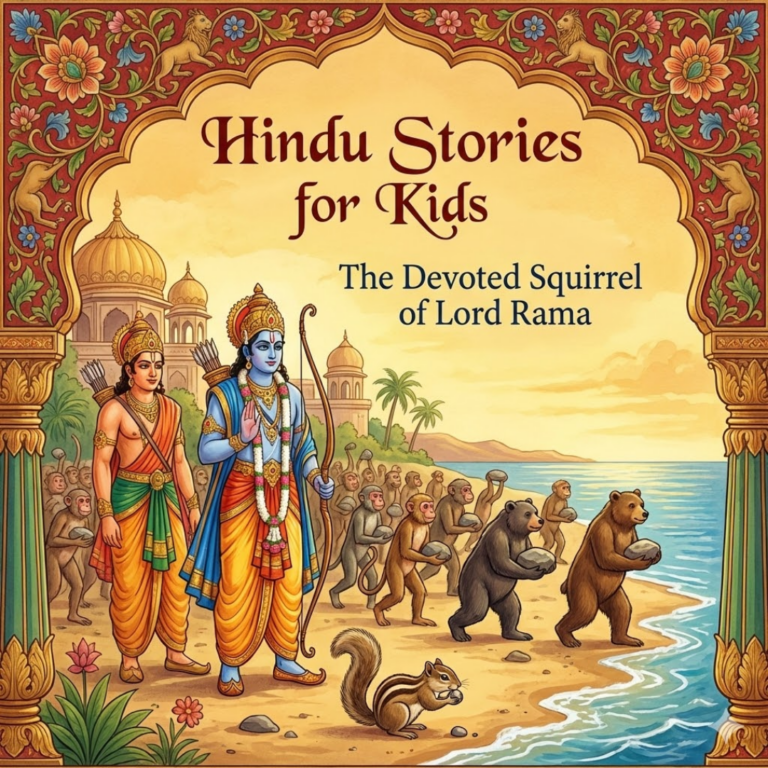
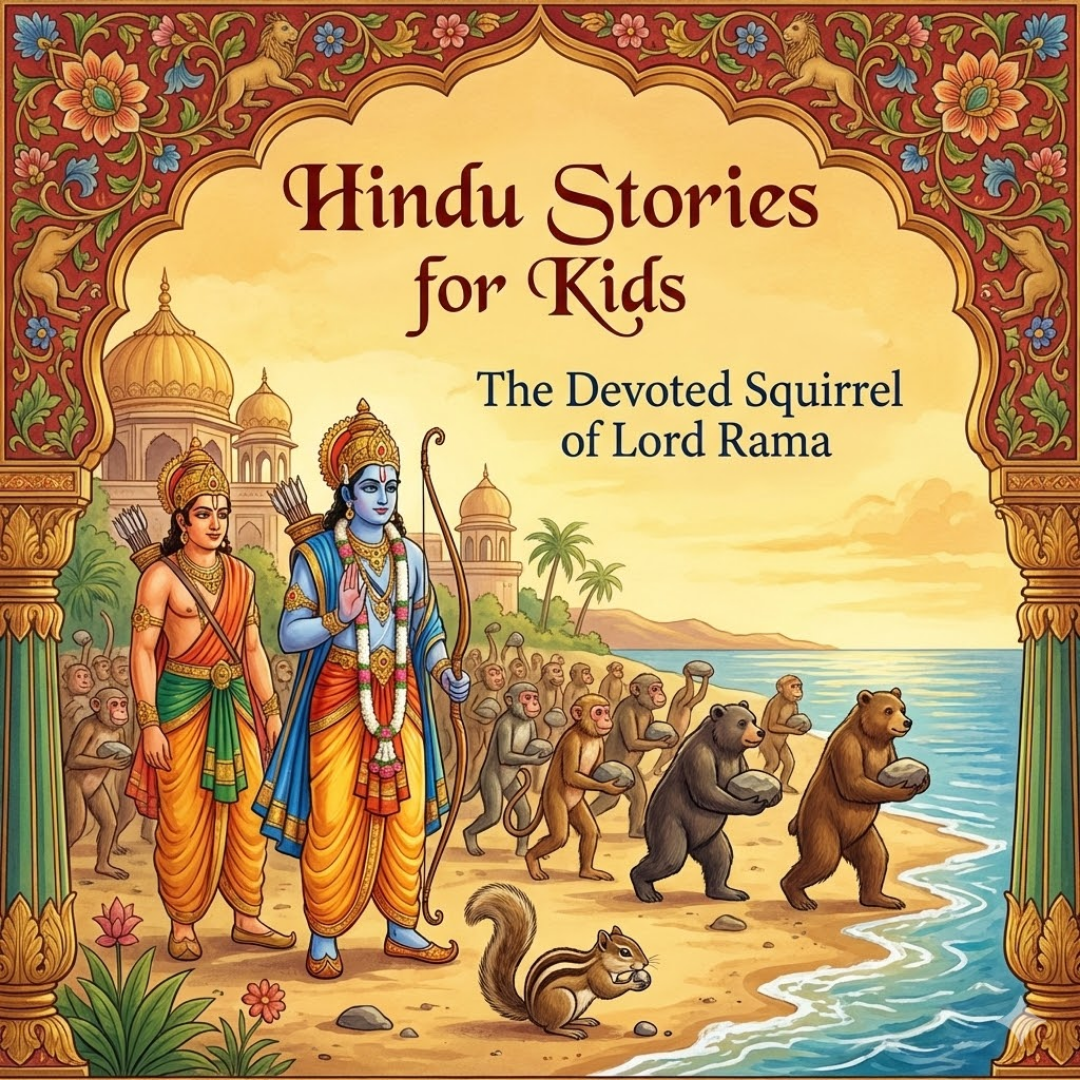
This moral story for children ages 6-12 combines entertainment with important values.
Long, long ago, when the gods still walked the earth and demons ruled over darkness, there lived a great prince named Rama.
He was no ordinary prince. He was an avatar of Lord Vishnu himself, born into the world to defeat evil and restore dharma—the righteous way of living.
But even gods in human form must face trials.
Rama’s beloved wife, Sita, had been stolen away by Ravana, the demon king of Lanka. Ravana was a creature of terrible power—he had ten heads and twenty arms, and his kingdom was a fortress island surrounded by the endless ocean.
To reach Lanka and rescue Sita, Rama needed to do something that had never been done before.
He needed to build a bridge across the sea.
* * *
Rama stood on the shore where the land ended and the vast ocean began. The water stretched to the horizon, endless and dark and deep.
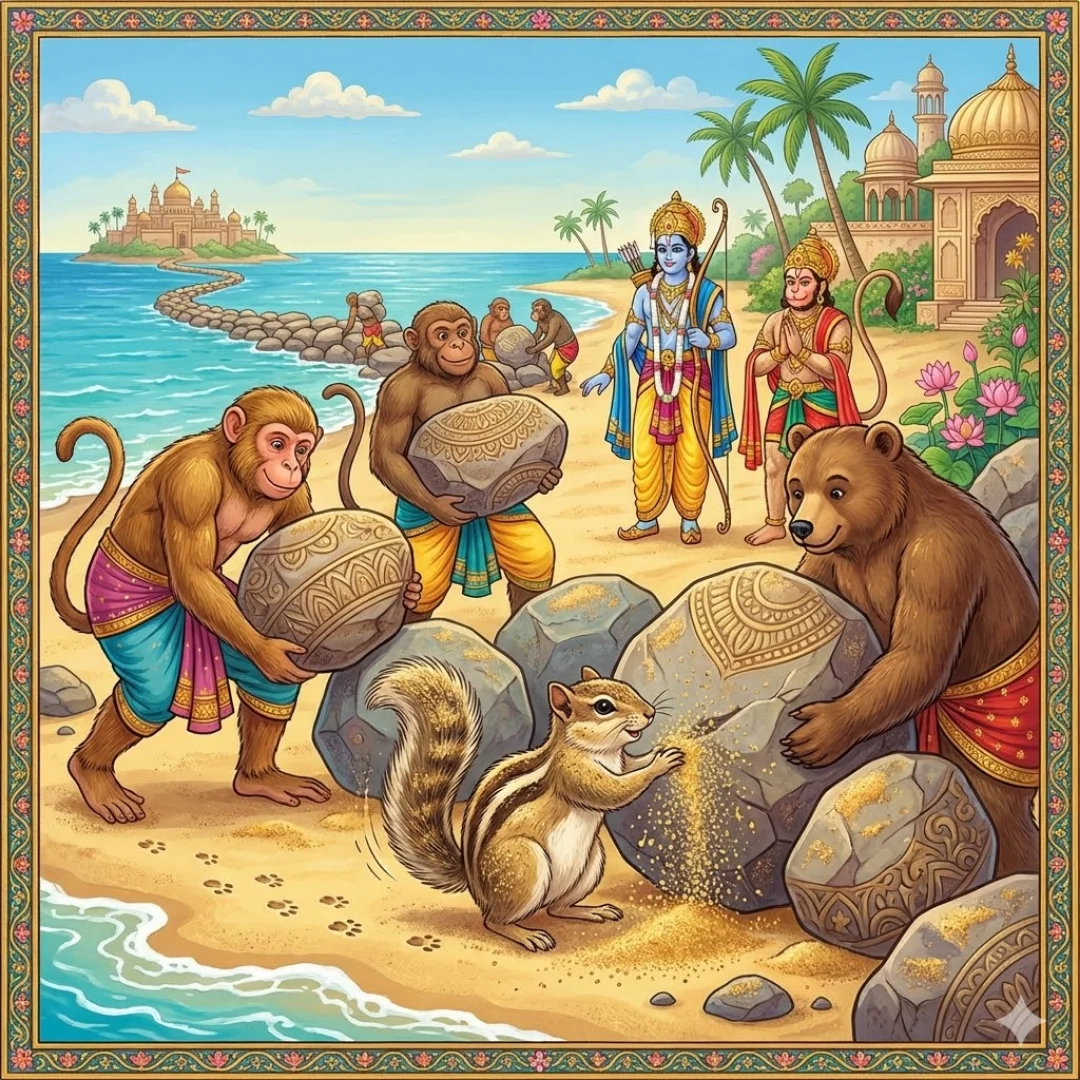
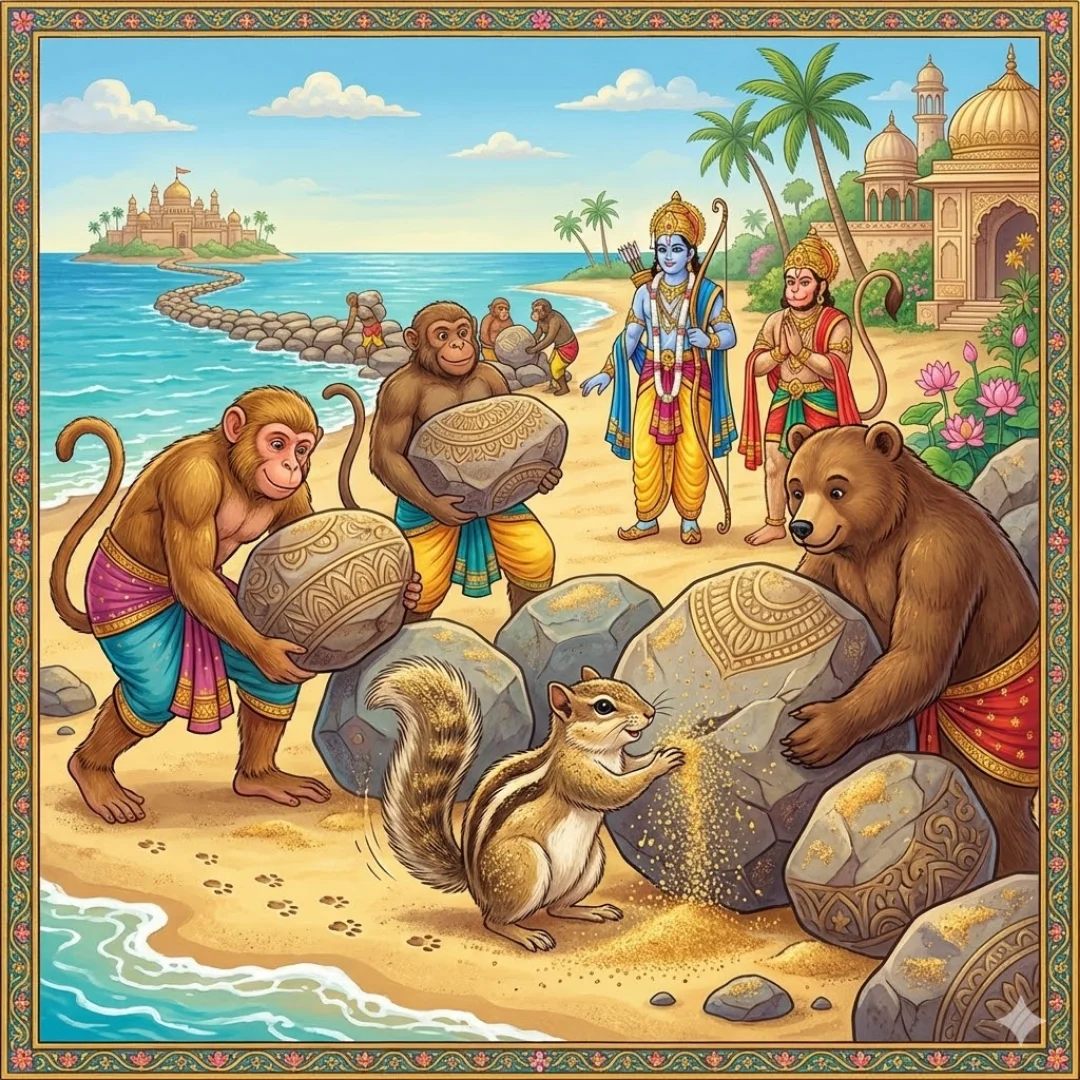
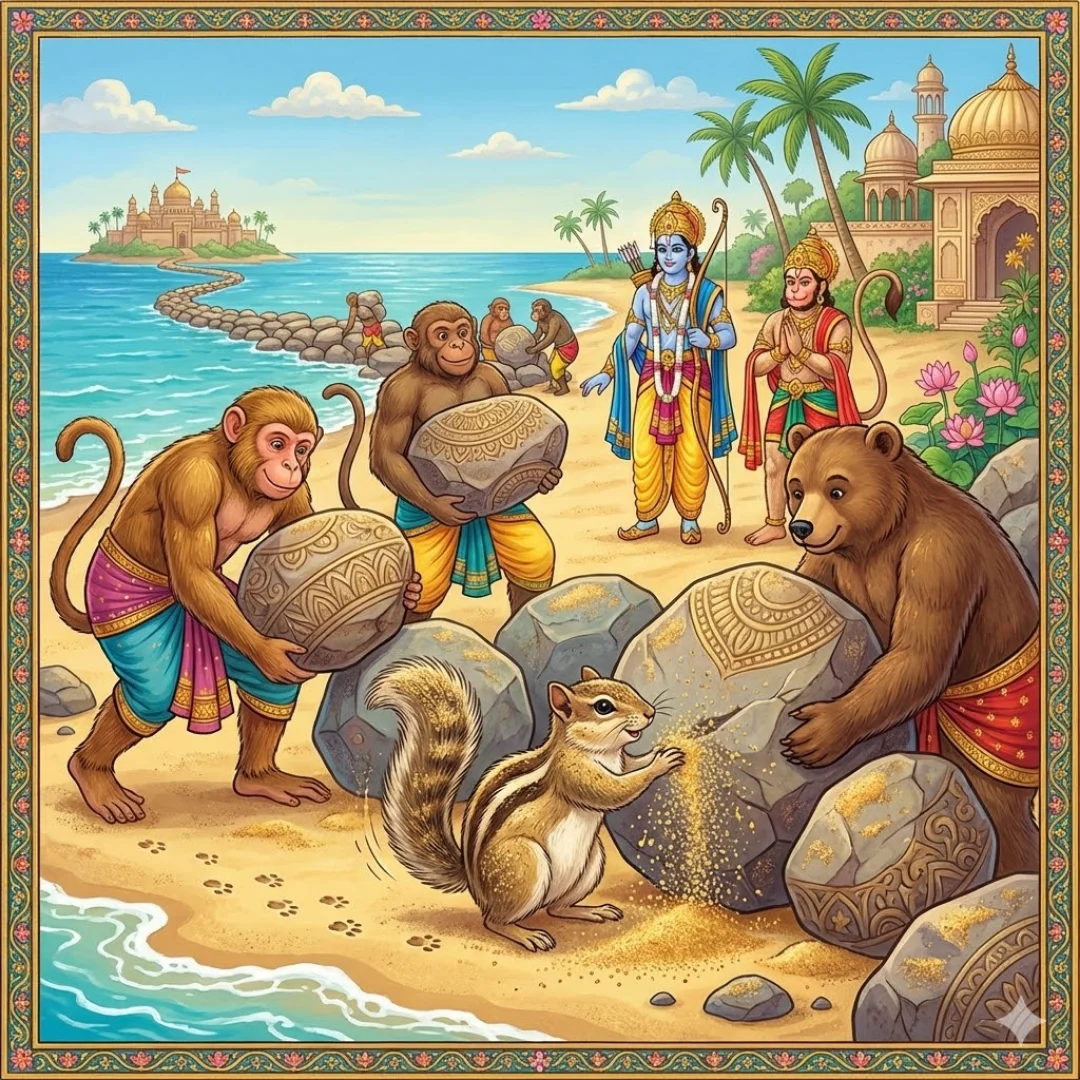
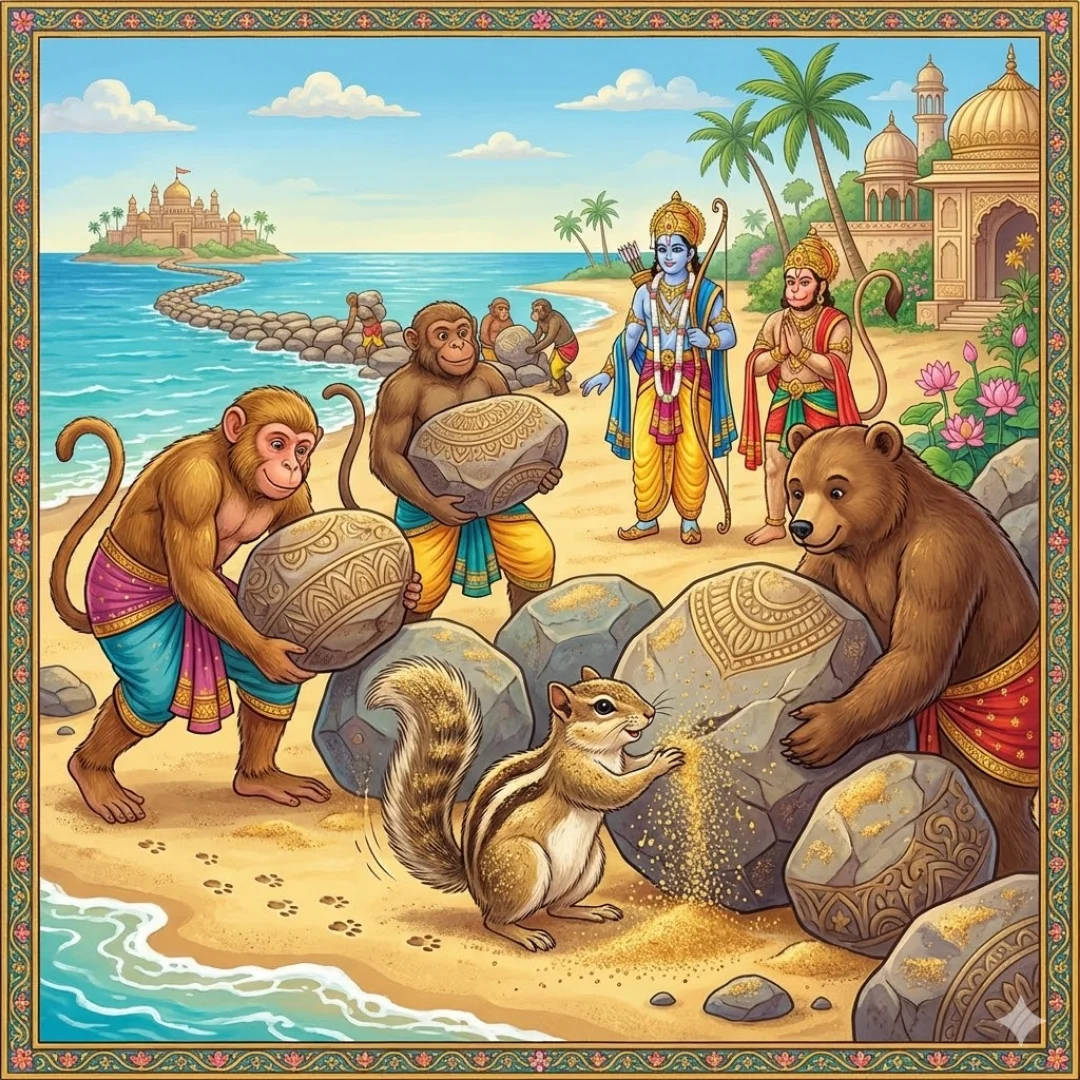
With him stood his brother Lakshmana, and a great army of devoted allies—an army of vanaras, the monkey people who had pledged their lives to help rescue Sita.
The greatest among them was Hanuman, who had already proven his devotion by leaping across the ocean to find Sita and bring word that she still lived. His fur was white as clouds, and his strength could move mountains.
“How will we cross this ocean, Lord Rama?” asked Angada, another powerful vanara warrior. “It is too wide to swim, too deep to wade.”
Rama looked at the faithful faces around him. “We will build a bridge,” he said simply. “A bridge of stone that will carry us to Lanka.”
The vanaras looked at each other in wonder. A bridge across the ocean? Was such a thing possible?
But for Rama, they would try.
* * *
The work began at dawn.
The mighty vanaras raced to the mountains and tore enormous boulders from the cliffs. The sound of cracking stone echoed like thunder.
Hanuman carried rocks the size of houses on his broad shoulders. His feet pounded the earth with each step, shaking the ground.
Angada uprooted whole trees and dragged them to the shore, their roots trailing dirt and stones.
Thousands of vanaras worked together, grunting and straining, their muscles rippling beneath their fur as they lifted and carried and placed stone upon stone.
The ocean spray soaked them. The sun beat down mercilessly. But they did not stop.
For this was not just a bridge.
This was the path to justice. The path to bring Sita home. The path to defeat evil.
* * *
Watching from a distance, her little heart bursting with devotion, was a tiny squirrel named Shravani.
She was small enough to fit in a child’s hand. Her fur was soft and brown, the color of tree bark. Her eyes were bright as black pearls.
All morning, she had watched the vanaras’ incredible work. Her whiskers trembled with excitement.
“I want to help Lord Rama too,” she whispered to herself. “But look at me. I am so small. So weak. What could I possibly do?”
She looked down at her tiny paws. Then she looked at the massive boulders the vanaras were carrying.
It seemed hopeless.
But then she remembered something her mother had taught her: “Every creature, no matter how small, has something to give.”
Shravani’s eyes brightened. She had an idea.
* * *
The little squirrel scampered down to the beach where the fine sand lay thick and wet.
She rolled in it—rolled and rolled—until every bit of her brown fur was coated with tiny grains of sand. She looked like a little moving lump of earth.
Then she raced as fast as her tiny legs could carry her to where the vanaras were building the bridge.
She squeezed between two massive stones and shook herself vigorously, sending a shower of sand flying from her fur. The sand fell into the tiny cracks and crevices between the boulders.
Then she ran back to the beach, rolled in the sand again, and returned to shake herself in the next gap between stones.
Back and forth. Back and forth.
Sand grain by sand grain.
Her tiny legs ached. Her fur became matted and dirty. The salt water stung her eyes.
But she did not stop.
* * *
One of the vanaras—a great ape named Sugriva—nearly stepped on the little squirrel as she darted between his feet.
“Hey! Watch out, little pest!” he shouted, jumping aside. He looked down and saw what she was doing.
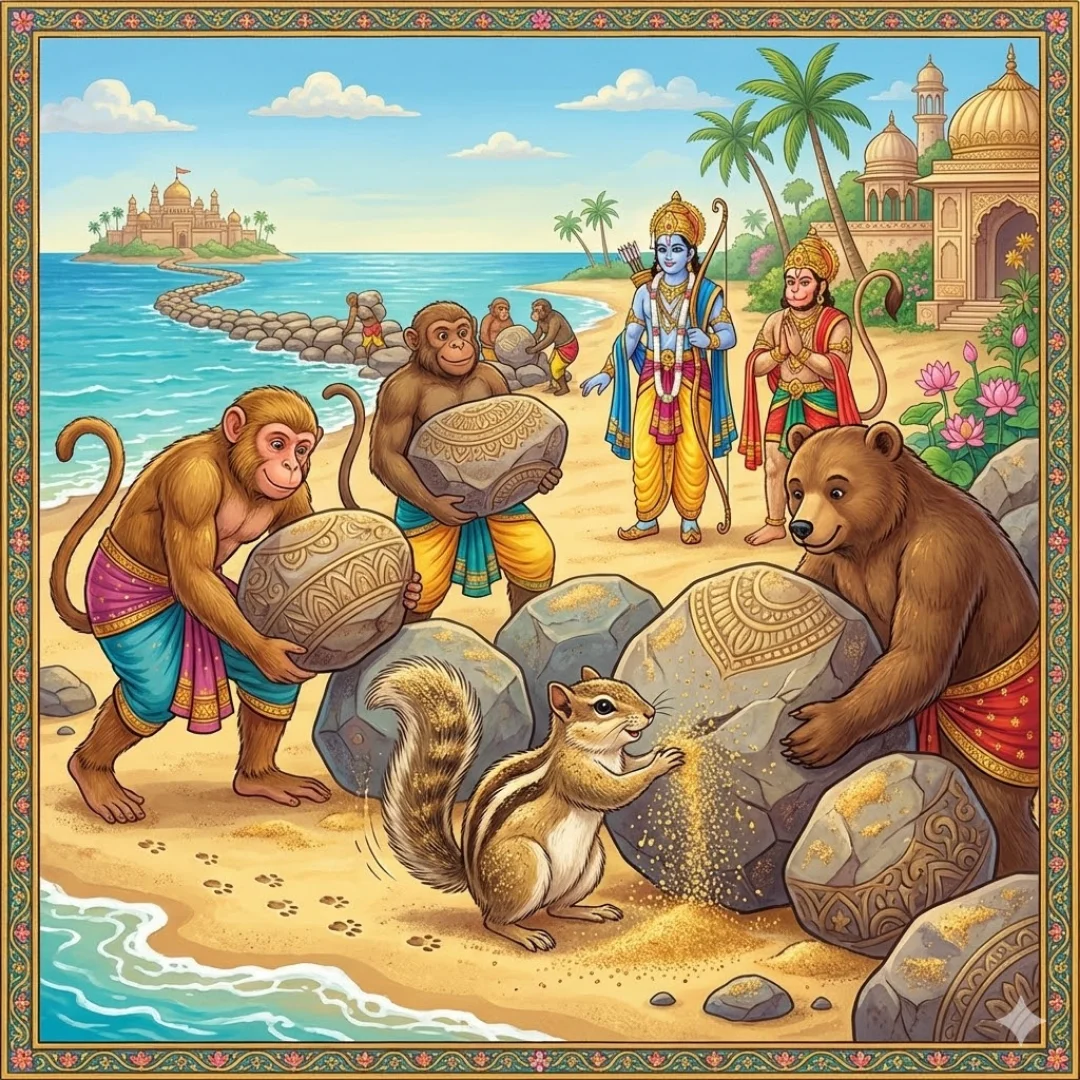
And he laughed.
“Look, brothers!” he called to the other vanaras. “This foolish squirrel thinks she’s helping us build the bridge! Look at her—carrying sand while we carry mountains!”
Other vanaras stopped their work to look. Some smiled. Some laughed outright.
“Silly creature,” said one. “Can’t you see this is work for the strong?”
“Go away,” said another, not unkindly. “You’ll only get hurt here. These stones are dangerous.”
A younger vanara, less gentle than the others, picked Shravani up by her tail.
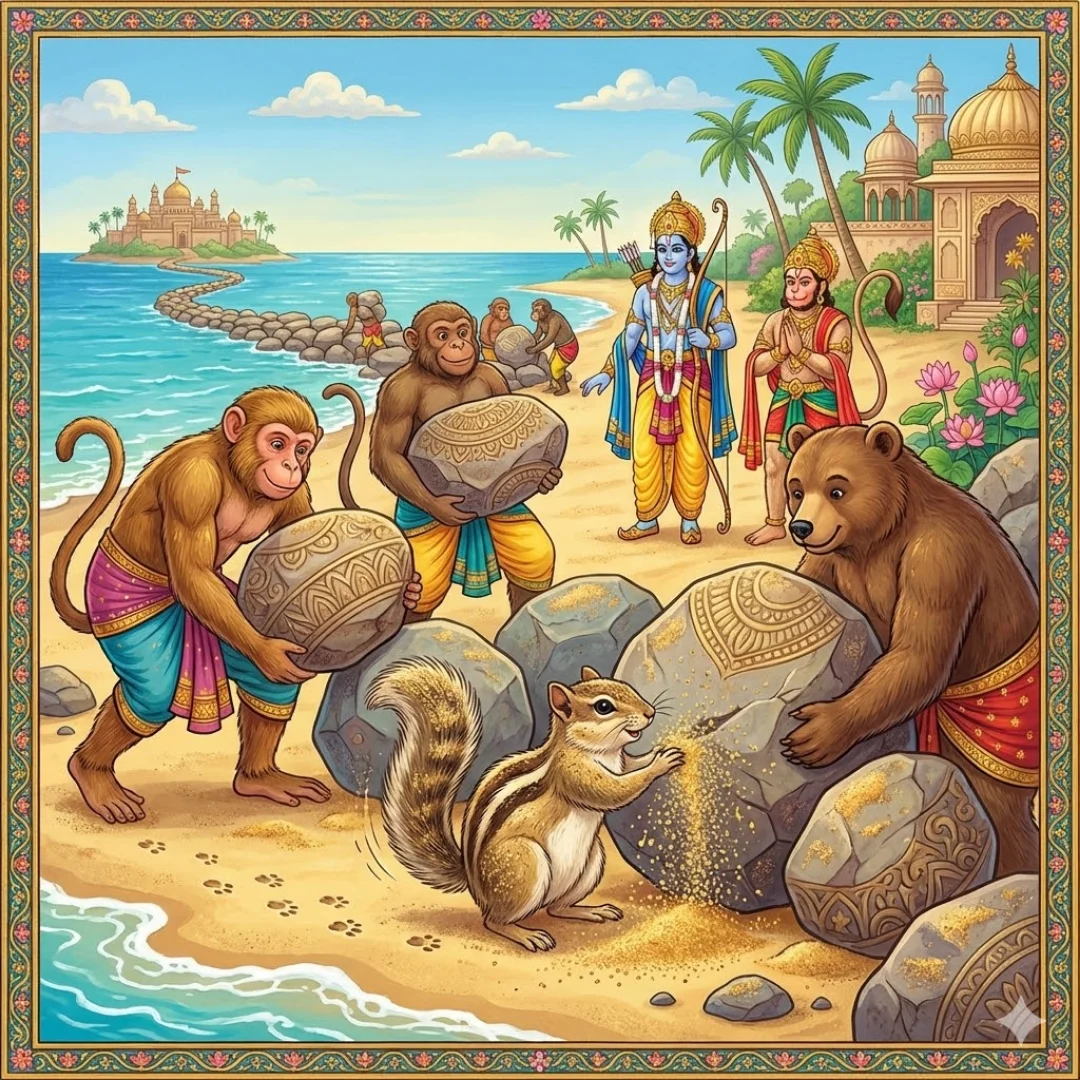
“Let me remove this little nuisance,” he said. And he threw her—not hard enough to hurt seriously, but hard enough to send her flying through the air.
Shravani tumbled head over tail, crying out in fear.
“RAMA!” she squeaked. “Lord Rama, help me!”
* * *
And Rama—who sees all things, who hears all prayers—was there.
His hands, swift and gentle as a warm breeze, caught the tiny squirrel in mid-air.
The vanaras fell silent, ashamed. They had not realized Rama was watching.
Rama lifted the little squirrel close to his face. His eyes, deep and kind and ancient, looked at her with infinite gentleness.
“Are you hurt, little one?” he asked.
Shravani trembled in the warmth of his palms. She could feel the divine power radiating from him like heat from the sun. But his voice was soft, concerned only for her small comfort.
“N-no, my Lord,” she managed to squeak. “I am well.”
“Why do you work so hard?” Rama asked. “Why do you carry sand when these great vanaras carry stones as large as houses?”
The little squirrel’s voice grew stronger, filled with the truth of her heart.
“My Lord,” she said, “I cannot lift boulders like mighty Hanuman. I cannot uproot trees like strong Angada. I do not have the power of the vanara army.”
She paused, and her small voice trembled with emotion.
“But I have these four paws. And this tiny body. And this heart that loves you. If even one grain of my sand helps you cross the ocean—if even one crack is filled by my effort—then I have served my purpose. Then I have given all I have to give.”
Tears welled in Rama’s eyes.
He turned to face the assembled vanaras. His voice, when he spoke, was gentle but carried the weight of divine truth.
“My friends,” he said, “look upon this tiny creature and learn a lesson that even the mighty must remember.”
The vanaras bowed their heads, listening.
“This squirrel cannot match your strength,” Rama continued. “She cannot carry what you carry or move what you move. But look at her devotion. Look at the purity of her offering.”
He held the squirrel higher so all could see.
“She does not measure her worth by comparison to others. She does not refuse to serve because her service seems small. She gives what she has—all of it—with a full heart. And that, my friends, is more precious than the greatest strength.”
Rama’s voice grew even softer, filled with infinite love.
“Every act of devotion, no matter how small, is seen. Every grain of sand offered with love is cherished. Every effort made with a pure heart is blessed.”
* * *
Then Rama did something that would be remembered forever.
He lifted his right hand and gently—so gently—stroked the little squirrel’s back with three fingers.
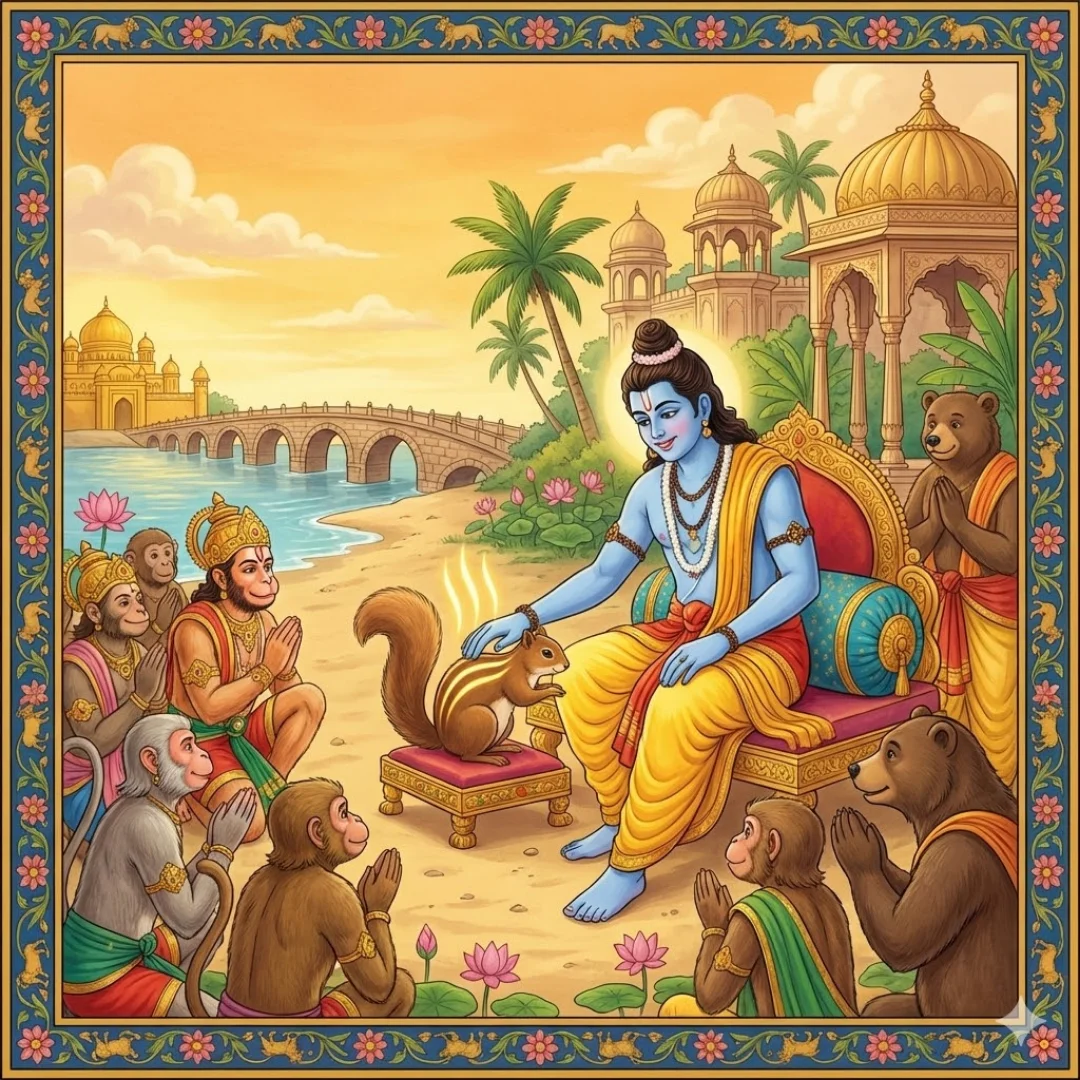
Where his divine fingers touched, three lines appeared on her fur—three stripes of lighter color that glowed for a moment with golden light.
“From this day forward,” Rama declared, “you and all your descendants will carry these three marks. Let everyone who sees them remember: No act of love is too small. No service is insignificant. Every soul who offers what they have with devotion is blessed beyond measure.”
He set Shravani down gently on the ground.
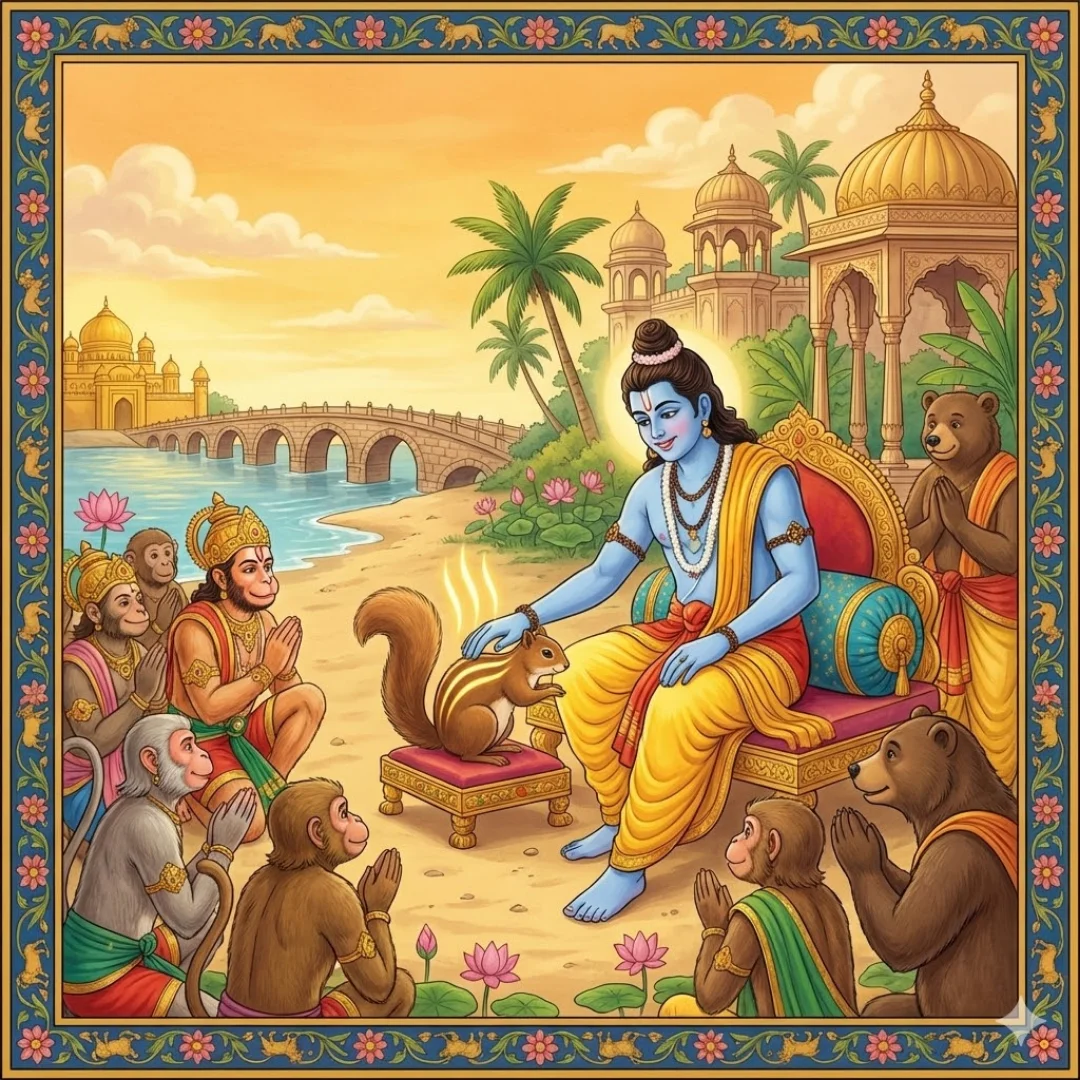
The little squirrel looked at her back and saw the three beautiful stripes. She bowed low, her whiskers touching the earth.
“Thank you, my Lord,” she whispered.
Then she hurried back to work, carrying more sand, her heart singing with joy.
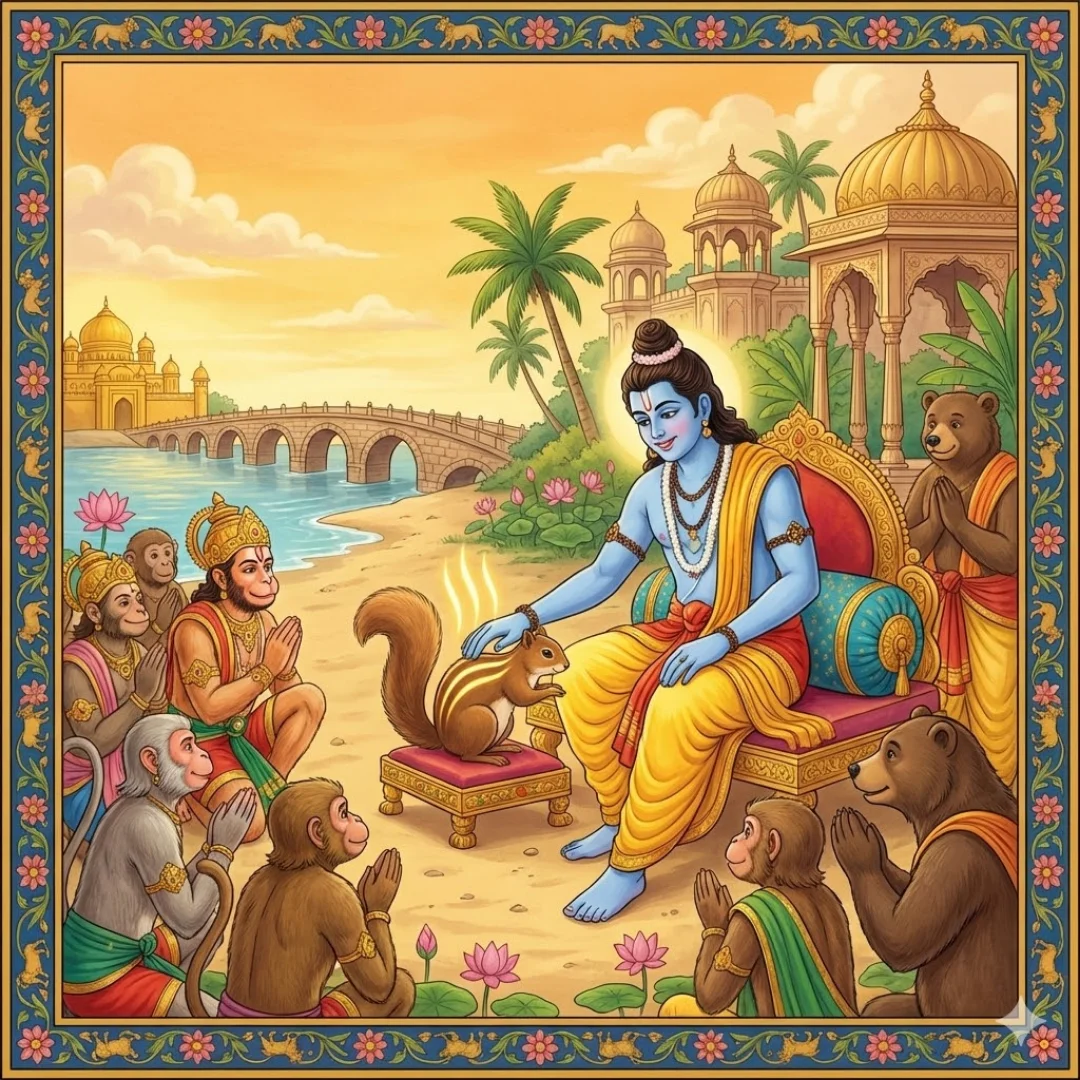
And the vanaras, humbled and inspired, returned to their labors with renewed devotion.
* * *
The bridge was completed—a magnificent causeway of stone and wood stretching across the endless ocean, connecting the land to Lanka.
Rama’s army crossed. Lanka was conquered. Ravana was defeated. Sita was rescued and brought home safely.
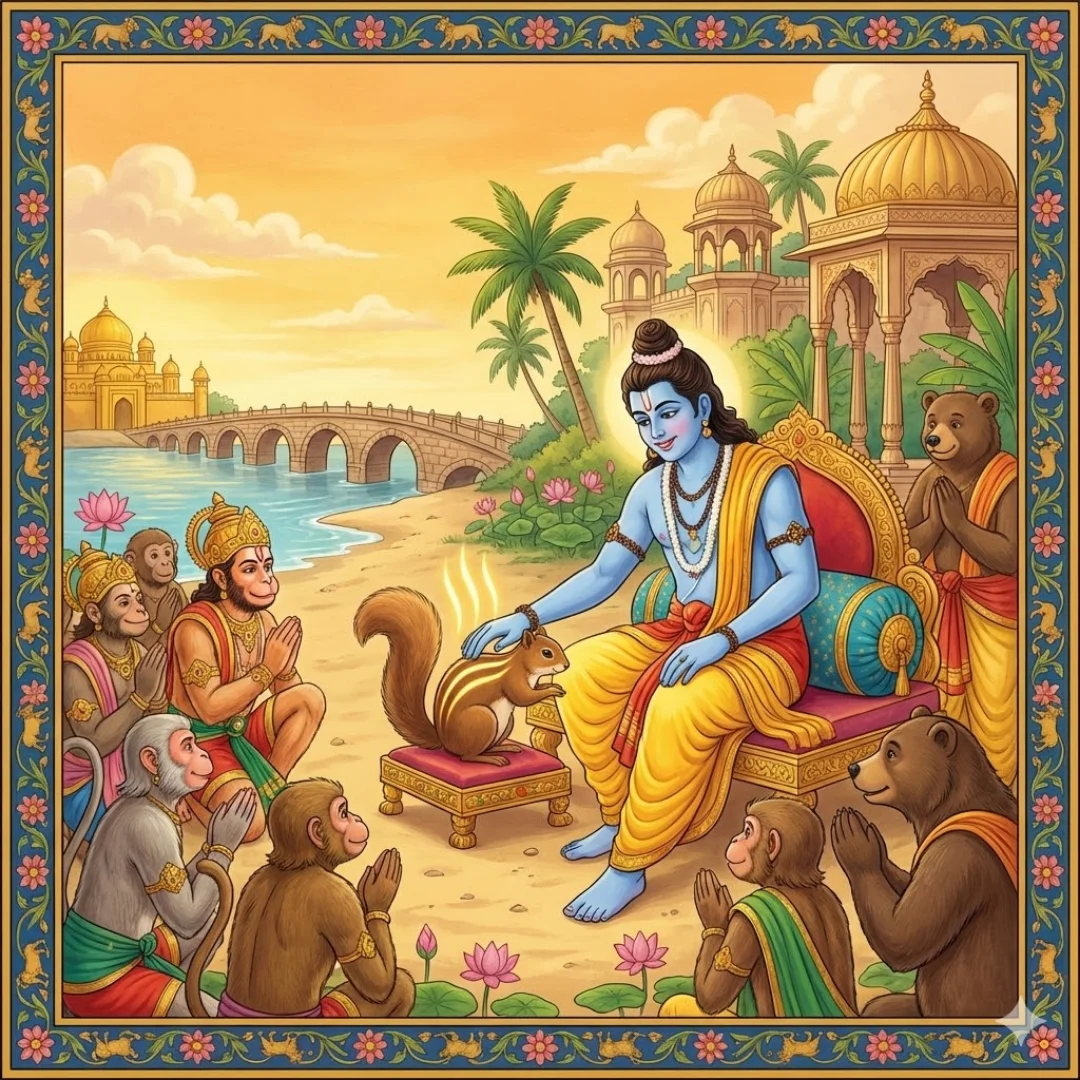
The great heroes returned in triumph, and their names were sung in songs and stories.
But the story of the devoted squirrel was told just as often.
For while Hanuman’s strength was mighty and Angada’s courage was great, the little squirrel had taught the world something just as important:
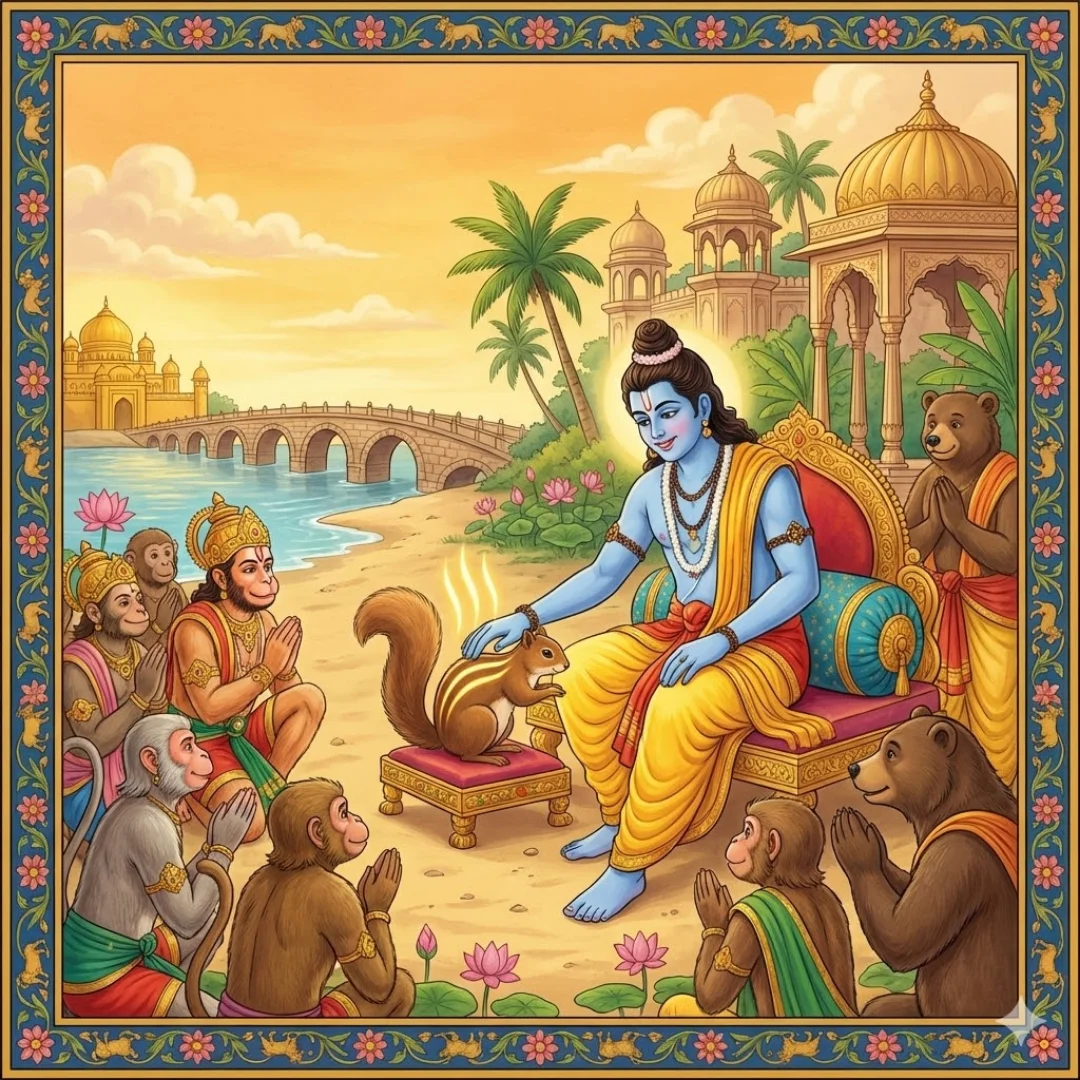
True devotion is not measured by the size of the offering, but by the fullness of the heart that gives it.
* * *
To this very day, if you look at an Indian palm squirrel—those quick little creatures that scurry up trees and across walls—you will see three stripes running down its back.
They are not just markings.
They are Lord Rama’s blessing, preserved through countless generations.
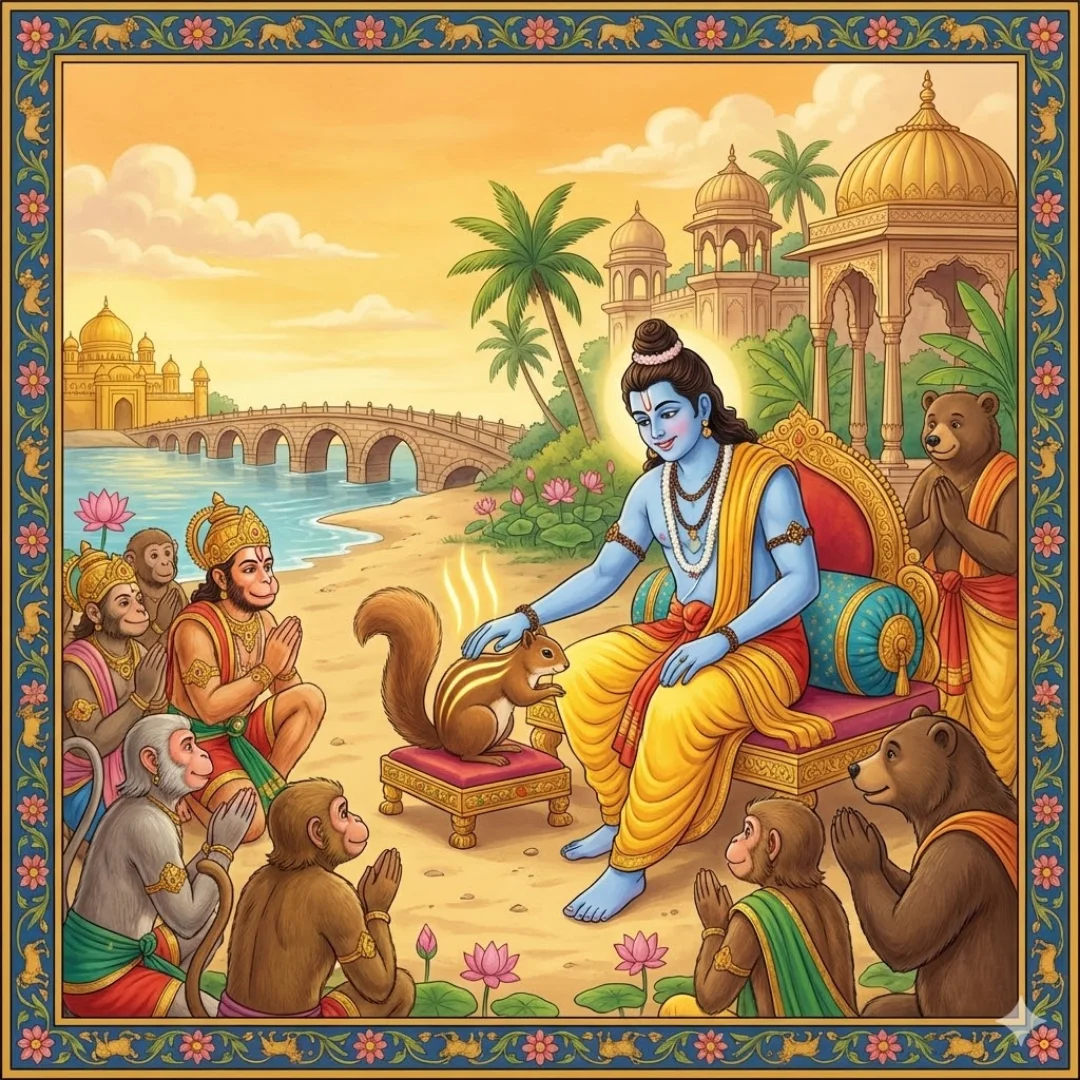
They are a reminder that every creature has value.
That every effort made with love matters.
That the smallest among us can serve the greatest purposes.
Every time a child sees a squirrel and notices those three stripes, they are seeing a lesson written in fur and flesh:
In the eyes of the divine, there is no such thing as too small, too weak, or too unimportant.
There is only love—offered, received, and blessed.
And that is the truth that Shravani, the devoted squirrel, carried with her across the ages.
A truth as eternal as the stars.
A truth as simple as three stripes on a tiny back.
A truth as profound as the love of God.
MORAL LESSONS:
– True devotion is not measured by the size of the offering but by the purity of the heart
– Every act of service, no matter how small, has value when offered with love
– Do not compare yourself to others—give what you have with a full heart
– The divine sees and blesses every sincere effort, however humble
– Even the smallest among us can serve the greatest purposes
– Devotion and love matter more than strength or ability
CULTURAL & RELIGIOUS ELEMENTS PRESERVED:
– Ramayana epic (Hindu scripture)
– Lord Rama as avatar of Vishnu
– Sita’s kidnapping by Ravana (demon with ten heads)
– Lanka as island fortress
– Hanuman and the vanara (monkey) army
– Dharma (righteous way of living)
– Building the bridge to Lanka (Rama Setu)
– Indian palm squirrel’s three stripes (scientific name: Funambulus palmarum)
– Hindu concept of bhakti (devotion)
– Divine blessings manifest in physical form
SOURCE FIDELITY NOTES:
✓ Story from Ranganatha Ramayanam (13th century Telugu epic)
✓ All characters accurate: Rama, Sita, Ravana, Hanuman, Angada, Lakshmana
✓ Bridge building to Lanka preserved
✓ Squirrel carries sand, vanaras carry boulders – exact
✓ Vanaras mock/dismiss squirrel – exact
✓ Squirrel thrown by vanara, caught by Rama – exact
✓ Rama strokes squirrel with three fingers – exact
✓ Three stripes appear as blessing – exact
✓ Explanation of real Indian palm squirrel stripes – exact
✓ Moral about devotion regardless of size – exact
✓ No contradictions or additions to plot
ENGAGEMENT ENHANCEMENTS ADDED:
+ Vivid sensory details (ocean spray, pounding feet, salt water stinging)
+ Emotional depth (squirrel’s self-doubt, Rama’s tears, vanaras’ shame)
+ Dialogue brings characters to life
+ Scene breaks for better pacing
+ Internal thoughts reveal motivations
+ Specific actions showing emotion (whiskers trembling, bowing low)
+ Dramatic tension (will squirrel be hurt? will Rama notice?)
+ Universal themes accessible to children
+ “Show don’t tell” throughout
+ Connection to real-world squirrels children can observe
SOURCES:
– [For young readers: A tale from the ‘Ramayana’ about how the squirrel got its three stripes](https://scroll.in/article/1045287/for-young-readers-a-tale-from-the-ramayana-about-how-the-squirrel-got-its-three-stripes)
– [How a Squirrel Helped Lord Rama Build the Bridge to Lanka](https://www.talesofsanatan.com/how-a-squirrel-helped-lord-rama-build-the-bridge-to-lanka/)
– [The Squirrel and Hanuman: Lessons from the Ramayana](https://www.bhagavatam-katha.com/ramayana-story-little-squirrel-who-helped-lord-rama/)
– [Tale of the Devoted Squirrel in the Ramayana](https://mythologicalstories.net/tale-of-the-devoted-squirrel-in-the-ramayana/)
Test Your Understanding
1. Why was Rama trying to build a bridge to Lanka?
Frequently Asked Questions
What is the moral lesson of The Devoted Squirrel of Lord Rama?
What age is this story appropriate for?
How long does it take to read The Devoted Squirrel of Lord Rama?
What culture does this story come from?
Can I use this story for teaching?
Frequently Asked Questions
What is the devoted squirrel of Lord Rama story about?
This Hindu moral story tells how a tiny squirrel helped Lord Rama and his monkey army build a bridge to Lanka to rescue Sita from the demon king Ravana. Despite being small, the squirrel’s devotion and determination made a meaningful contribution to the great mission, teaching children about how everyone can help regardless of size.
Is this a good bedtime story for children?
Yes, this is an excellent bedtime story for children ages 6-12. It combines adventure and mythology with important moral lessons about devotion, helping others, and believing in yourself. The story is engaging but not too scary, making it perfect for bedtime reading while teaching valuable life lessons.
What age is this Lord Rama story appropriate for?
This Lord Rama story is perfect for children ages 6-12. The content is age-appropriate with exciting adventure elements like building a bridge and rescuing a princess, while teaching important values. Younger children will enjoy the animal characters, while older kids can appreciate the deeper moral lessons about devotion and service.
📚 Recommended Books
Handpicked for readers like you
As an Amazon Associate, we earn from qualifying purchases. These recommendations are personalized based on this story's themes and your reading history.
What moral lesson does this story teach kids?
The story teaches children that no act of service is too small when done with love and devotion. It shows how the tiny squirrel’s contribution was just as valuable as the monkeys’ larger efforts, helping kids understand that everyone can make a difference regardless of their size or abilities.
Is this based on real Hindu mythology or is it made up?
This story is based on authentic Hindu mythology from the ancient epic Ramayana. While the specific tale of the devoted squirrel is a beloved traditional story passed down through generations, it’s rooted in the real mythological account of Rama’s quest to rescue Sita and defeat the demon king Ravana.