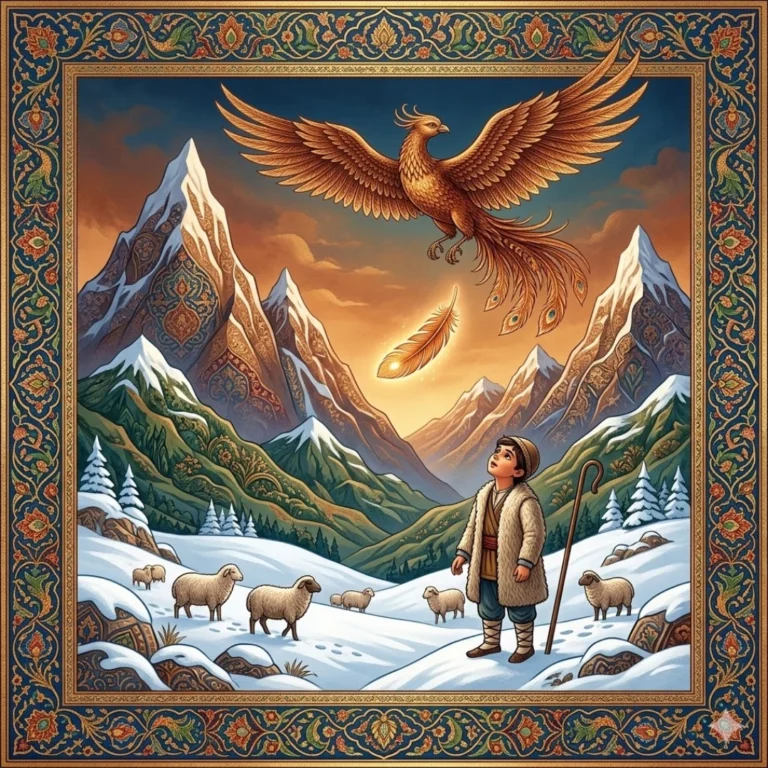
A legendary bird that dies and is reborn from ash teaches a boy that every ending holds the seed of a new beginning.
In the mountains of Khorasan, in ancient Persia, there was a legend told around every campfire: that a great bird called the Simurgh had lived since the world was young, and that it never truly died.
A shepherd boy named Sina had heard the story all his life. But Sina was going through a hard winter. His father had died that autumn. The flock was thin. The nights were bitterly cold.
One grey morning, a great feather fell from the sky—enormous, shimmering copper and gold—and landed in the snow beside Sina’s foot.
He carried it home. His mother examined it. “Simurgh,” she whispered.
That night, Sina dreamed of the great bird. It spoke to him—not in words exactly, but in images: flames, then ash, then a small, perfect egg glowing orange in a nest of charcoal. Then a new bird cracking the shell.
“I do not understand,” Sina said in the dream.
“You are in the ash time,” the Simurgh said. “Your flame has gone out. But ash is not the end. It is what holds the ember.”
Sina woke before dawn. He laid the feather beside his sleeping mother, quietly milked the goats, then took the flock out to the high meadow where—he had noticed but not acted on—the southern-facing slope had thin, sweet grass still growing under the snow.
He began the work of feeding his family. One day, then the next.
By spring, the flock had recovered. His mother had started weaving again. A neighbour helped mend their roof.
The hard winter did not disappear from Sina’s memory. But he understood now: the ash time had not been the end. Under the cold surface of his hardest season, something had been quietly growing.
Moral of the Story
Hope is not pretending things are fine—it is believing that within every ending, a new beginning is already taking shape.
Learn These Words
- Simurgh
- a legendary bird in Persian mythology, said to be immortal and wise
- ember
- a small piece of burning wood or coal in a dying fire
- bitterly
- extremely and unpleasantly (usually used with cold or disappointed)
- shimmering
- shining with a soft, trembling light
- legend
- an old story handed down through generations that may be partly true
Test Your Understanding
1What was the Simurgh?
2What did the Simurgh’s dream tell Sina?
3What did Sina do after the dream?
4What happened by spring?
5What lesson does this story teach?
Frequently Asked Questions
What is The Phoenix of Khorasan story about?
The Phoenix of Khorasan is a children’s story inspired by Persian mythology. It follows a shepherd boy named Sina who, after losing his father, discovers a shimmering feather from the legendary Simurgh bird. Through dreams and a symbolic journey, the Simurgh teaches Sina that endings are not final—every loss holds the seed of renewal and a new beginning.
What is the Simurgh in Persian mythology?
The Simurgh is a mythical bird from ancient Persian legend, often described as enormous and magnificently plumed. It is said to have lived since the world was young and possesses great wisdom. Similar to the phoenix, the Simurgh is associated with cycles of death and rebirth, and it appears prominently in classic Persian literature, including Ferdowsi’s Shahnameh.
What moral lesson does The Phoenix of Khorasan teach children?
The story teaches children that every ending holds the seed of a new beginning. Through the Simurgh’s metaphor of flame, ash, and ember, kids learn that grief and hardship are not permanent states. Difficult times—what the Simurgh calls ‘the ash time’—still contain warmth and potential, encouraging resilience and hope during life’s toughest moments.
📚 Recommended Books
Handpicked for readers like you
As an Amazon Associate, we earn from qualifying purchases. These recommendations are personalized based on this story's themes and your reading history.
Is The Phoenix of Khorasan suitable for kids dealing with loss or grief?
Yes, this story is a gentle and age-appropriate way to help children process loss. Sina’s experience of losing his father mirrors real childhood grief, and the Simurgh’s wisdom offers comforting imagery rather than abstract explanations. The narrative validates sadness while showing that healing and new chapters are possible, making it a thoughtful read-aloud for grieving families.
What age group is this Simurgh story best suited for?
This Simurgh story works well for children ages 5 to 10. Younger listeners will enjoy the vivid imagery of the magical feather and the great bird, while older children can grasp the deeper themes of resilience, grief, and renewal. Its campfire-legend tone also makes it an excellent bedtime or classroom read-aloud story.