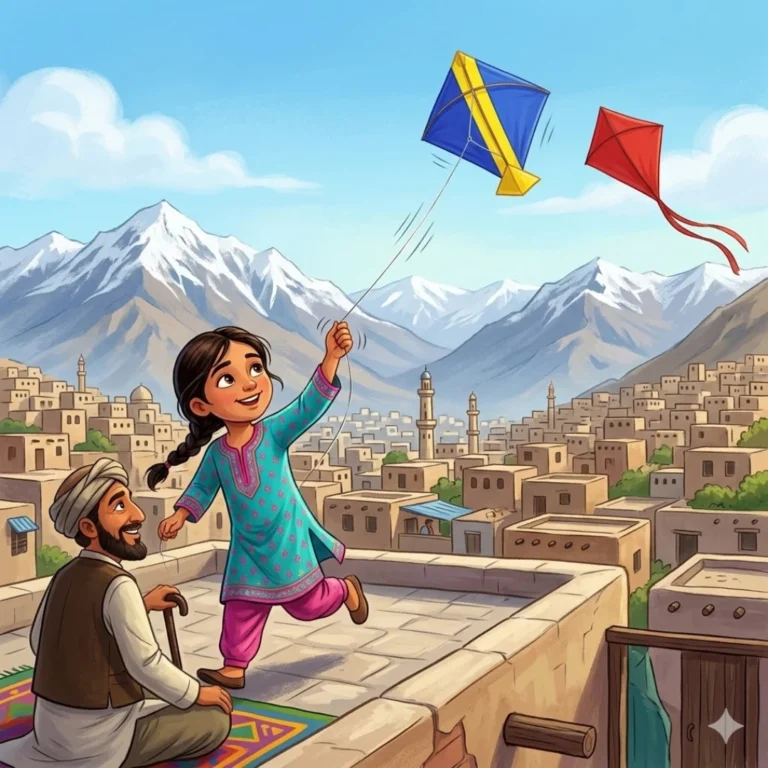
The kite season in Kabul comes in spring, when the mountains have lost their heaviest snow and the wind comes across the Hindu Kush with just enough strength to lift a properly weighted kite into the cold clear air above the city’s rooftops.
This is the season of champions. Kite runners know the city by its air the way sailors know the sea by its currents – each neighborhood has its updrafts and its dead spots, its treacherous crosswinds near the river and its reliable thermals above the old quarter. To run kites in Kabul is to know the sky above a particular city, and to know that sky is to be of that place in a way that moves past what any map can show.
Soraya was eleven years old and she was learning this knowledge from her father, who had been the best kite runner in the Karte Seh district and who now taught her on Sunday mornings when his joints permitted.
Her father’s joints did not always permit. There had been a hard year three years ago, and in that year his knees had been injured in a way that healed imperfectly, and now he walked with a cane on the cold days and without it on the warm ones, and on Sunday kite-running mornings he sent Soraya ahead and followed more slowly, calling instructions as he came.
Soraya ran the kite. He directed from below, which he said was in some ways better because you could see the whole sky without being in it.
On a Sunday in March, the kite they had built together over the previous weeks went up for the first time. It was a special kite – lapis blue with a yellow crescent, made from the plastic of three bags and tissue paper and a wooden frame her father had shaped very carefully over two evenings. The string was coated with ground glass in the traditional way: sharp enough to cut another kite’s line in competition, which was the whole point of the kite-fighting that happened on the best flying days.
Soraya let the line out as the kite climbed. She could feel the pull of it in her hands – the particular alive-ness of a kite that is well-made and in good wind, the way it knows what it wants to do and needs only to be guided.
“More,” her father called from fifty meters behind. “The thermal is higher today. Let it climb.”
She let it climb.
This is what she had learned from watching her father: you do not fight the wind. The kite is always in negotiation with the air around it. If you pull too hard against the current, the kite turns and fights itself. If you release too much, it goes where the wind wants, which is not always where you want. The skill is the conversation between what the kite wants to do and what you need it to do.
The kite went up until it was a blue and yellow diamond against the bright sky, moving in the slow circles of something perfectly balanced.
A year ago, Soraya thought, she had believed that a good kite day would fix the bad year. That running kites in the spring meant the winter was over in every sense. She had been wrong about this, and she had had to learn it slowly.
The hard year had been hard in ways that spring could not fix. Her family had left their home for a time, gone to her grandmother’s house in Mazar-i-Sharif, come back to find that things were changed and the changing was permanent in some ways and not in others. Her father’s knees were permanent. Their house was the same house. Her school had changed teachers twice. The neighbor who had taught her to bake bolani had moved away.
She had been angry for a long time. Not at any single thing – at the general situation, which is harder to be angry at because it has no face.
Her father had said, one evening when she’d been furious at something small that stood in for everything: “The kite.”
“What?”
“What happens when you pull too hard against the wind?”
“It turns and fights itself.”
“And when you let go entirely?”
“It goes where the wind wants.”
“And what do you do?”
“I have a conversation,” she had said, slowly.
“Yes. This is also what we are doing.” He had looked at his cane, which he had stopped being angry about some time ago by what mechanism she still did not entirely understand. “The storm is the storm. We are the kite. We do not pretend the wind is not real. We learn its direction, we feel its pressure, we work with what it is and what we are, and we stay in the air.”
Stay in the air. This was not nothing. This was sometimes everything.
On the rooftop this March morning, the lapis blue kite rode the thermal in its slow circles and Soraya stood with the string humming in her hands and felt the aliveness of it – the conversation between what she held and what the sky wanted to do.
Another kite appeared from the direction of the river quarter. Red and white, fighting kite, the string already angled toward hers.
Soraya watched its approach. She could feel it in the tension on her line – the change in the wind as another line entered the same air.
“Let him come close,” her father called. “Don’t try to avoid him.”
She didn’t try to avoid him. She held her line steady and let the red-and-white approach, and at the exact moment the lines crossed she did the thing her father had taught her: a slight flick of the wrist, not a pull, that changed the angle of her line against his.
The red and white kite’s line frayed. A moment later it was free, going where the wind wanted, and the kite swooped and climbed and fell in the pattern of unmoored things.
Soraya’s blue kite rose higher.
“Good,” her father called. “You felt the moment.”
She had felt the moment. She was still feeling it – the rightness of having waited and then moved precisely when moving was correct.
The spring was here. The mountains had their snow still but the wind was changing. The sky above Kabul was bright and cold and full of possibilities moving in it.
Soraya held the string and stayed in the air.
This was, for now, exactly enough.
The Moral of This Story
What the storm bends does not break – it grows stronger at the bend
About This Story’s Culture
Kite flying and kite fighting (known as gudiparan bazi in Dari) is one of Afghanistan’s most beloved traditional sports, with deep cultural roots in Kabul and other Afghan cities. The Afghan kite fighting tradition involves coating the flying line with ground glass to cut competitors’ strings. Karte Seh is a real residential district in western Kabul. The city of Mazar-i-Sharif in northern Afghanistan is a real city known for its famous Blue Mosque. The Afghan tradition of kite season (spring through summer) has survived through remarkable periods of difficulty. The story handles the ‘hard year’ with appropriate obliqueness, focusing on the family’s resilience and their cultural practice without specifics that would date or politicize the story. Bolani is an authentic Afghan flatbread stuffed with vegetables, commonly made and shared in Afghan communities. The name Soraya is a traditional Persian/Afghan female name.
Key Story Elements
- Soraya – an eleven-year-old Afghan girl learning kite running from her injured father above Kabul’s rooftops
- The father – former best kite runner of Karte Seh, directing from below since the hard year hurt his knees
- The lapis blue kite with yellow crescent – built together over two evenings, a shared creation
- Lagerlöf’s journey structure: a spiritual pilgrimage through grief toward earned equilibrium
- The kite as resilience metaphor: don’t fight the wind, don’t let go – have a conversation
- The hard year and its permanent changes: the father’s knees, the neighbor gone, the anger at the general situation
- The kite fight won not by avoidance but by presence and precise timing
Frequently Asked Questions
What is The Kite Runner’s Daughter story about?
The Kite Runner’s Daughter is a short story for kids aged 6-12 set in Kabul, Afghanistan. It follows eleven-year-old Soraya as she learns the ancient art of kite running from her father, exploring themes of resilience, tradition, and the special bond between a parent and child.
What age group is The Kite Runner’s Daughter suitable for?
This story is written for children aged 6 to 12 years old. It takes around 8 to 10 minutes to read, making it a great bedtime story or classroom read. The themes of perseverance and family connection resonate well with children in that age range.
What is kite running in Afghan tradition?
Kite running is a beloved tradition in Afghanistan where participants chase and catch kites that have been cut loose during competitions. Skilled kite runners learn the wind patterns of their city intimately, making it both a sport and a deep cultural practice passed down through generations.
📚 Recommended Books
Handpicked for readers like you
As an Amazon Associate, we earn from qualifying purchases. These recommendations are personalized based on this story's themes and your reading history.
What lesson or moral does The Kite Runner’s Daughter teach kids?
The story’s core theme is resilience — showing children how to carry on with passion and purpose even when facing hardship. Through Soraya’s father teaching her despite his injured knees, it highlights how traditions survive through love, determination, and the courage to keep going.
Is The Kite Runner’s Daughter based on Afghan culture?
Yes, the story is rooted in Afghan tradition. It is set in Kabul and authentically depicts the cultural significance of kite season, the geography of the Hindu Kush, and neighbourhood life. It offers young readers a meaningful and respectful window into Afghan heritage and community identity.