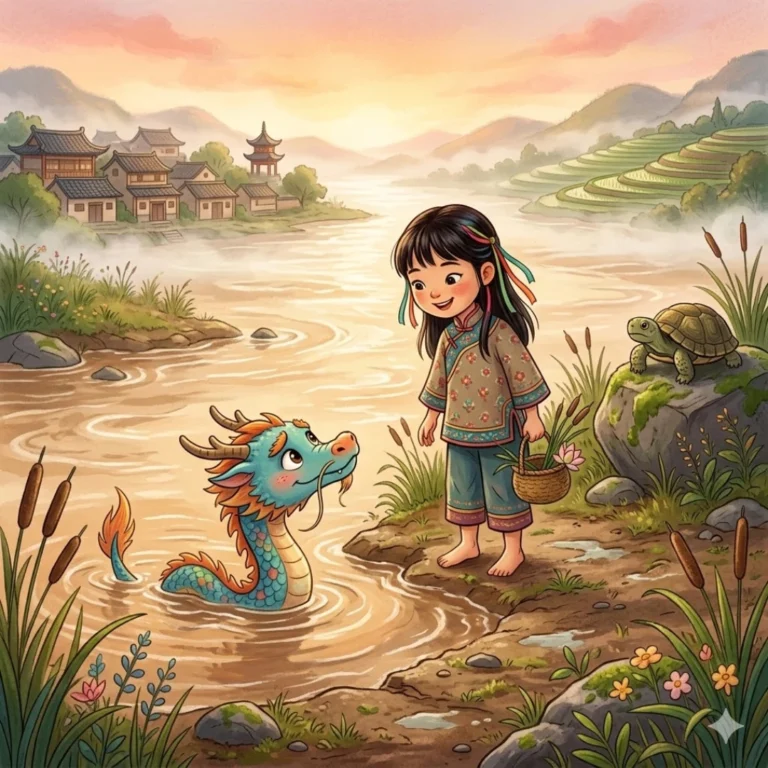
There was once a dragon who could not wait.
This was, as dragons go, a significant problem. Dragons are creatures of vast time – they sleep for centuries and think in decades and move through the world at the speed of mountains. A dragon who cannot wait is rather like a river that will not flow downhill: technically possible, entirely inconvenient, and liable to cause flooding.
This particular dragon’s name was Long Zha, and he lived in the Yellow River, and the reason he could not wait was this: he had been told, by a very reliable tortoise, that somewhere on earth there was a place where the sky touched the water, and that if he reached that place, he would become a proper dragon with all the attributes of proper dragons – which is to say, the ability to make rain and command clouds and be appropriately majestic.
Long Zha was not yet majestic. He was, to be honest, rather small for a dragon and somewhat impetuous, and his attempts at rain-making produced mostly drizzle.
He had been told that the journey from the Yellow River to where the sky touches the water would require patience beyond any patience he currently had, which was not very much.
He set out immediately.
Now, a girl called Mei Lin lived by the Yellow River, and she was nine years old, and she was waiting for something herself.
What she was waiting for was her father, who was a sailor and had been gone two years on a trading voyage to the southern seas. Her mother said he would come back when he came back, and there was nothing to be done about it but keep the house clean and the lantern lit and trust the sea to return what the sea had taken.
Mei Lin was not good at this. She checked the harbor every morning. She asked every boat. She had written a list of questions she intended to ask her father when he returned, which was currently forty-seven items long.
She was sitting by the river one morning, listing a forty-eighth question, when a small dragon surfaced beside her and said: “Excuse me. Is this the Yellow River?”
“Yes,” said Mei Lin, because it clearly was.
“Good. I am going to where the sky touches the water. Which way?”
Mei Lin considered this. “That depends on what kind of sky and what kind of water.”
Long Zha found this intensely frustrating. He wanted a direction. East or west, up or down – something he could act on immediately.
“The sky,” he said, with the patience of something that has very little patience, “and the water. Where they touch. The tortoise was very clear.”
“The sky touches the water everywhere on the horizon,” said Mei Lin, “and also in the river when it reflects the sky, and also in the ocean at every edge. You need more information.”
Long Zha looked at her.
She looked back.
“What are you waiting for?” he asked, because she had the unmistakable look of someone waiting for something.
“My father,” she said. “He is a sailor and he has been gone two years.”
Long Zha thought about two years. For a dragon, two years was not very long. He tried to think about it from the perspective of a nine-year-old, which was harder.
“Does the waiting help him come back faster?”
“No,” said Mei Lin. “It does not. But I can’t stop.” She paused. “Can you?”
Long Zha thought about his journey and how immediately he had needed to start it and how much he hated the not-knowing-how-long.
“No,” he said, in a voice that was considerably smaller than a dragon’s voice generally is.
They sat together for a while. The river moved past them both.
“The tortoise told you patience,” said Mei Lin. “What does the tortoise know that you don’t?”
Long Zha thought. Tortoises, he knew, were famous for one thing above all others: surviving. They survived not by speed or force or urgency but by being exactly where they needed to be and doing exactly what the moment required, for as long as it required it.
“The tortoise knows that arriving too early is the same as not arriving,” he said slowly. “If I reach the place where sky touches water before I have learned what I need to learn on the journey, it will not give me what it is meant to give.”
“Yes,” said Mei Lin. She had been thinking something similar about her father.
“And your father,” said Long Zha, “will come back when the journey is done and not before. And when he comes back, he will come back having done what needed doing.”
“And I am supposed to stay ready,” said Mei Lin. “Forty-eight questions ready.”
“Yes,” said the dragon, who found that saying this to her was considerably easier than saying it to himself.
Long Zha stayed by the Yellow River for three months. This was the beginning of his patience. He watched the river in all its moods – fast and muddy in flood season, clear and low in drought, moving always but never the same. He watched a heron wait on a rock for forty minutes for a fish. He watched the reeds grow.
Mei Lin visited. She brought him tangerines on special occasions, which he didn’t need but appreciated as the gesture it was.
In the spring, he set out again. Not urgently this time. In the direction that felt right, when it felt right to go.
Seven years later, he arrived where the sky touched the water. The tortoise had been correct: it was worth it, and the worth of it required all seven years of what he had learned along the way.
Mei Lin’s father came home in the autumn after Long Zha left, brown from the southern sun and full of stories and profoundly glad to see the lantern still lit in the window.
She asked him thirty-nine of her forty-eight questions that first evening. The other nine, she saved. They could wait.
The Moral of This Story
Patience is not waiting – it is trusting that the right moment will come if you stay ready
About This Story’s Culture
Chinese dragons (long) are fundamentally different from Western dragons – they are benevolent, aquatic, and associated with water, rain, and imperial power. The Yellow River (Huang He) is central to Chinese civilization and mythology, considered the cradle of Chinese culture. The transformation of carp into dragons by swimming up the Dragon Gate waterfall is a well-known Chinese myth representing perseverance and transformation. The tortoise in Chinese mythology represents wisdom, longevity, and the cosmos (the tortoise’s shell was used for divination in ancient China). The tradition of the lantern kept burning for a returned traveler is authentic to Chinese domestic tradition. The name Long Zha (dragon born) and Mei Lin (beautiful forest) are authentic Chinese names.
Key Story Elements
- Long Zha – a small impatient dragon in the Yellow River on a quest he cannot rush
- Mei Lin – a nine-year-old girl waiting for her sailor father with forty-eight prepared questions
- The tortoise’s prophecy: both the destination and the patience to reach it
- Collodi’s fable-clear moral mechanics: the dragon who can’t wait mirrors the girl who can’t stop
- The heron watching forty minutes for a fish – patience as a learned art
- Long Zha’s three months at the river learning patience before he can continue
- The ending: father returns, thirty-nine questions asked, nine saved – patience becomes a choice
Frequently Asked Questions
What is The Dragon Who Counted Years about?
The Dragon Who Counted Years is a Chinese-tradition story about Long Zha, a young dragon who struggles with impatience. He sets out on a quest to find where the sky touches the water, a journey that will grant him the power to make rain and become truly majestic. The story explores patience as he learns that great things take time.
What age group is The Dragon Who Counted Years suitable for?
This story is recommended for children aged 6 to 12. It takes around 8 to 10 minutes to read aloud, making it a great bedtime story or classroom read. The themes of patience and perseverance are presented in a way that is accessible and engaging for early and middle primary school children.
What lesson does the dragon story teach kids about patience?
The story teaches children that patience is a skill you can grow, not something you either have or don’t. Long Zha starts out impetuous and rushed, but his long journey forces him to slow down and think in bigger stretches of time. It gently shows kids that worthwhile goals often require waiting and persisting through difficulty.
📚 Recommended Books
Handpicked for readers like you
As an Amazon Associate, we earn from qualifying purchases. These recommendations are personalized based on this story's themes and your reading history.
Is The Dragon Who Counted Years based on Chinese folklore?
The story draws on Chinese tradition, featuring Long Zha, a river dragon from the Yellow River. In Chinese folklore, dragons are powerful beings associated with rain, rivers, and clouds. The story uses these cultural roots to frame a universal theme about patience, making it a lovely introduction to Chinese mythological ideas for young readers.
Why can’t the dragon in the story make proper rain?
Long Zha hasn’t yet become a fully formed dragon, so his rain-making only produces drizzle. According to the story, he needs to reach the place where the sky touches the water to gain his true powers. This detail makes him relatable and endearing — he’s a work in progress, just like the children reading about him.