

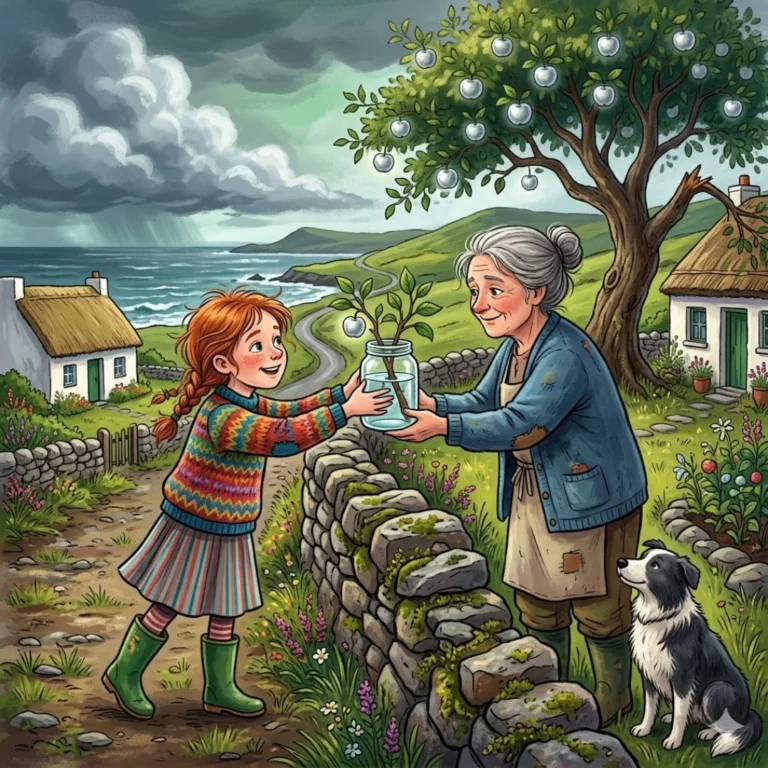
In the west of Ireland, where the Atlantic comes in hard against the limestone and the sky is a different color every quarter hour, there grew a silver apple tree at the edge of Siobhán’s family’s land.
It was not entirely an ordinary tree. Its bark was white as birch but harder, its leaves the grey-green of old coins, and in autumn it bore small silver apples that were sour on the tongue but clear in the chest, like breathing cold clean air. The old people said it was a descendant of a branch from Tír na nÓg, the land of eternal youth, brought back by a wandering hero long before any living memory.
Siobhán was nine years old and she loved that tree the way you love the things that were there before you were born and will be there after, the things that belong to the place and not to any person.
She loved it until the day her neighbor Caitlin broke it.
Not by malice – this was the hardest part. Caitlin had been chasing a lamb that had gotten through the wall, and she had grabbed the lowest branch to pull herself over, and the branch had come away in her hands. Half the tree’s crown was gone. The wound in the white bark seeped something clear and slow that looked too much like sorrow.
Siobhán arrived to find the branch lying in the grass and Caitlin standing beside it with the expression of someone who knows they have done a terrible thing.
“I’m sorry,” said Caitlin immediately. “I’m so sorry, Siobhán. I didn’t mean -“
“Go away,” said Siobhán.
Caitlin went away.
Siobhán picked up the branch. It was still alive – leaves not yet wilted, three silver apples still clinging to the smaller twigs. She carried it inside and put it in a jar of water and went to her room and did not speak to anyone for the rest of the day.
The anger was the first feeling. Clean and certain, it told her exactly where she stood: Caitlin had broken the branch. the branch was broken. These were facts.
Under the anger was the sadness, which was less certain and harder to hold onto. The tree had been there a long time. The branch was part of the shape she knew from childhood, part of the angle of light through the window in the morning. It was gone. This was also true.
A week passed. Caitlin left a note at the door: I am still sorry. A card at the end of the week: If there is anything I can do. After two weeks, silence, because there is a limit to apologizing to a door.
The branch in the jar had not died. It had, in fact, put out three new small leaves from a node below the break. This happened, sometimes, with silver apple branches – they could be rooted. Her grandmother had told her.
Siobhán’s grandmother, who was called Máire and lived up the hill and smelled of turf smoke and old lavender, came to visit on a rainy Tuesday and found the branch in its jar on the kitchen windowsill.
“That’s a good-sized piece,” she said. “You could root it.”
“I know.”
Her grandmother looked at her. The particular look that grandmothers have when they know something and are waiting to see if you’ll arrive at it yourself.
“The tree will grow back,” Máire said. “It’s happened before. Your great-uncle Donal fell out of that tree when he was twelve and broke three branches. The tree outlasted the embarrassment.”
“Caitlin broke it.”
“She did,” said her grandmother evenly.
“She should have been more careful.”
“She should have.”
A long silence, rain against the window, the kind of rain that means the west of Ireland and no other place.
“But?” said Siobhán, because there was clearly a ‘but’ waiting.
“No but,” said her grandmother. “I’m agreeing with you. She was careless and the tree is damaged and your feeling about it is fair and true.”
Siobhán waited.
“There are two questions,” Máire said at last. “The first is: was it wrong? It was. The second is: what does carrying this feeling past the point of usefulness do to you? Those are different questions and they need different answers.”
“I don’t want to let it go,” said Siobhán. “It feels like if I forgive her it means what she did was fine.”
“It means,” said her grandmother carefully, “that you have decided to put it down. You can put something down without deciding it was light.”
Siobhán looked at the branch. The new leaves were the pale hopeful green of early spring things.
“What happened to Donal? After he broke the branches?”
“His mother made him repair the wall and plant three new apple seedlings by way of apology to the tree,” said Máire. “He did. Two of them are still standing. He and the tree came to an arrangement.”
Siobhán took the branch to Caitlin the next morning.
“You should plant this,” she said. “In the corner of your family’s field, near the wall. My grandmother says silver apple cuttings can root if you’re patient.”
Caitlin held the branch and looked at it. “This is -“
“It doesn’t make it fine,” said Siobhán. “It was wrong. But the tree will keep growing either way. This is better than a jar on a windowsill.”
Caitlin planted the cutting carefully, in a sheltered corner, in good earth, staked against the Atlantic wind.
The cutting took. It was three years before it bloomed, and by then both girls were twelve and had argued about several other things and made up about all of them, the way people do when they have decided the relationship is worth more than any single grievance.
But on the first autumn it bore silver apples, Caitlin brought Siobhán three of them, and Siobhán bit into one, and it was sour on the tongue and clear in the chest, and she thought about how strange it is that the most painful things can, with time and intention, become something you carry toward the light instead of against it.
The tree grew on, as trees do, outlasting everything.
The Moral of This Story
Forgiveness does not excuse the wrong – it frees you from carrying it forever
About This Story’s Culture
This story draws on Irish mythology, particularly the tradition of the silver branch (craobh airgid) from Tír na nÓg (the Land of Eternal Youth), which appears in multiple Irish myths including the tale of Bran’s voyage. In Irish mythology, a silver branch from Tír na nÓg was a magical object that could heal, induce magical sleep, or mark someone as a visitor from the otherworld. The West of Ireland setting with its limestone landscape (the Burren region) and Atlantic exposure is authentic to County Clare/Galway. The name Siobhán is a traditional Irish female name (pronounced Shiv-AWN). The practice of rooting apple cuttings is authentic to Irish kitchen garden tradition. The story also reflects the Irish cultural value of meitheal (community mutual help) and the importance of repairing relationships in small rural communities.
Key Story Elements
- Siobhán – a nine-year-old Irish girl whose beloved silver apple tree is accidentally damaged
- The silver apple tree – a descendant of a branch from Tír na nÓg, beautiful and irreplaceable
- Caitlin’s accident – not malice but carelessness, making forgiveness harder and more important
- Grandmother Máire’s teaching: putting something down is different from deciding it was light
- Andersen’s poetic melancholy: the sorrow that seeps clear from the wound in the bark
- The cutting taken to Caitlin – an act of forgiveness that becomes something growing and alive
- The sour-then-clear sensation of the silver apple as a physical metaphor for forgiveness
Frequently Asked Questions
What is The Silver Branch and the Bitter Heart about?
The Silver Branch and the Bitter Heart is an Irish-tradition children’s story about a nine-year-old girl named Siobhán whose magical silver apple tree is accidentally damaged by her neighbor Caitlin. The story explores how Siobhán wrestles with anger and hurt, and ultimately learns about the power of forgiveness — even when the harm was never meant.
What age group is The Silver Branch and the Bitter Heart suitable for?
This story is written for children aged 6 to 12. It takes around 8 to 10 minutes to read aloud, making it a great bedtime or classroom story. The themes of forgiveness and handling hurt feelings are presented gently enough for younger children while still resonating with older kids.
What does the silver apple tree represent in the story?
The silver apple tree is described as a descendant of a magical branch from Tír na nÓg, the Irish land of eternal youth. It represents things that belong to a place rather than a person — deep roots, continuity, and something precious that can’t simply be replaced, which is why its damage feels so devastating to Siobhán.
📚 Recommended Books
Handpicked for readers like you
As an Amazon Associate, we earn from qualifying purchases. These recommendations are personalized based on this story's themes and your reading history.
What lesson does this Irish forgiveness story teach children?
The central lesson is about forgiveness — specifically the hardest kind, forgiving someone who hurt you without meaning to. The story gently shows children that holding onto bitterness can be as damaging as the original hurt, and that letting go is something you choose, not something that just happens.
Is The Silver Branch and the Bitter Heart based on Irish mythology?
The story draws on Irish mythological imagery, particularly Tír na nÓg and the idea of magical silver branches from Celtic lore. While it’s an original children’s tale rather than a retelling, it is rooted in the Irish storytelling tradition and feels authentically connected to that cultural heritage.
