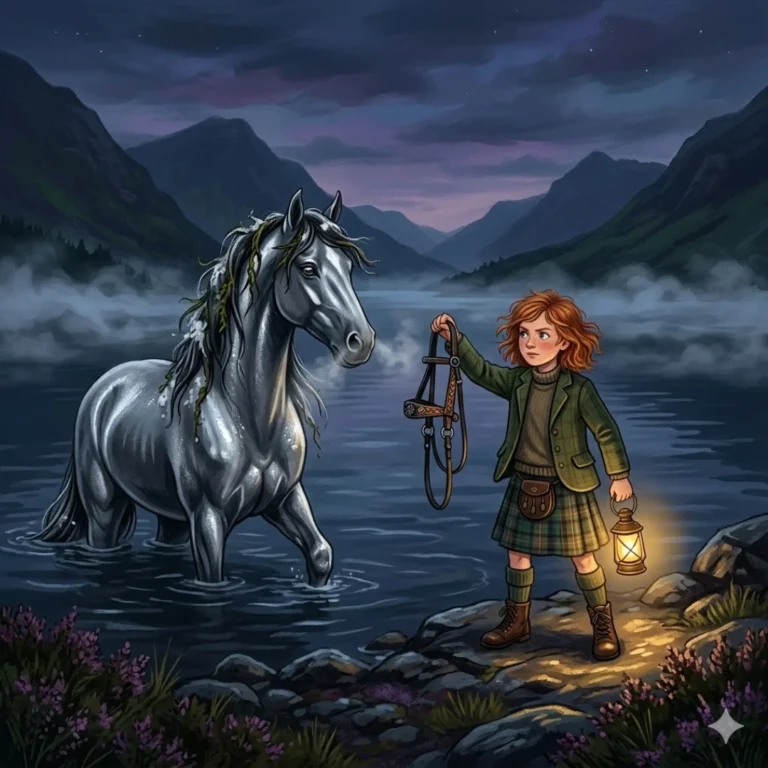
The loch at the foot of Glen Carrow was the kind of water you didn’t look at too long. Not because it was ugly – it was beautiful, in the way that very cold, very deep things are beautiful – but because it seemed to look back.
Morag MacPhail was eleven years old, with red hair the color of autumn bracken, and she had lived all her life beside that loch. She knew every stone of its shore, every reed bed, every place where the trout dimpled the surface at dawn. She knew also – because her grandmother had told her and her grandmother’s grandmother had told her before that – about the kelpie.
The kelpie was a water horse. Not a real horse, though it looked like one when it chose to – a grey horse, the color of deep water, with a mane like foam and eyes the amber-green of the loch in summer. A kelpie’s magic worked like this: it would appear on the shore looking like the most beautiful horse you had ever seen, and if you were foolish enough to climb onto its back, it would gallop straight into the loch and drown you. This was simply what kelpies did. It wasn’t personal.
“You’ll know it,” her grandmother had said, “because the mane is always wet. Touch it and your hand will stick fast and you’ll never pull free. The only thing that can make a kelpie do your bidding is a bridle, and the only way to put a bridle on it is to be braver than afraid.”
Morag had thought about this many times. She was not a girl who particularly wanted to be braver than afraid. She wanted very much to be entirely unafraid, and she couldn’t quite work out how.
The trouble started on a Tuesday in October, when her younger brother Ewan went missing.
Ewan was seven years old and interested in everything, which was useful for learning but dangerous near lochs. He had gone out after breakfast to look for interesting stones – he had a very thorough collection – and had not come back for lunch, or tea, or supper. By the time the sky went dark, their mother’s face had gone tight with the particular fear that parents carry.
Morag searched the woods above the house. She searched the burn. She found Ewan’s stone-collecting bag lying on the shore of the loch, just at the waterline, which was exactly the wrong place to find it.
She stood on the grey pebbles in the dark, her lantern making a small warm circle in the enormous night, and she looked at the bag, and she thought.
A yard from the bag, in the soft mud, was a hoofprint. Perfectly shaped. Already filling with water.
Morag held her lantern up and looked out at the loch. The water was very black and very still. Somewhere in the middle of it, something surfaced briefly – a long, pale shape – and then was gone.
Her heart was going like a hammer. She could feel it in her ears.
She was afraid. Let’s be clear about that. She was so afraid that her hands were shaking, which was inconvenient when you were carrying a lantern.
She was also Morag MacPhail, who had lived all her life beside this loch, and her brother was in it.
“Right,” she said to herself, in the voice you use when there is no one else to talk to and you need to say something sensible. “Right then.”
She set the lantern down carefully on a flat stone. She took off her boots and stockings – the pebbles were shockingly cold – and she walked to the water’s edge.
“Kelpie,” she said. Her voice came out steadier than she expected, which was a pleasant surprise. “I know you have my brother. Come out and speak with me.”
Nothing, for a long moment. Just the lap of water and the wind in the heather on the hill above.
Then the shape surfaced again, closer this time, moving smoothly toward shore. The grey horse waded from the shallows and stood before her on the pebbles. It was larger than any real horse she had ever seen. Its coat gleamed silver-black in the lantern light. Its mane dripped loch water onto the stones.
Its eyes were amber-green and very old.
“You are the first,” said the kelpie, in a voice like stones rolling underwater, “to call for me without running. Most run.”
“I expect most people aren’t looking for their brother,” said Morag.
The kelpie regarded her. “He is safe. For now. He touched my mane without meaning to – he thought I was a real horse. He is in my hall under the loch, sleeping, as they all sleep when I bring them down.”
Morag felt the cold go deeper than her feet. “Give him back.”
“There is a price,” said the kelpie. It took a step closer. “Always a price. You know what I am. You know my nature. Are you going to try the bridle?”
She had brought it. Her grandmother’s old bridle, iron and rowan-wood, hung from her belt where she’d tucked it before she came down. Her grandmother had said: be braver than afraid. Not unafraid. Braver than.
“Yes,” said Morag.
“Then come close enough to put it on,” said the kelpie, “and if your hand so much as brushes my mane, you will not be able to let go, and I will take you down as well, and then there will be two MacPhails sleeping in my hall, which is more than I need.”
Morag looked at the kelpie. She looked at the wet mane, which dripped and shifted in the wind. She looked at the iron-and-rowan bridle in her hand.
Her hands were still shaking. This was, she decided, simply what hands did in this situation, and was not necessarily relevant.
She moved.
She had practised bridling horses since she was four. She knew the motion – the quick loop of the headband, the slide of the bit, the buckle on the offside cheek. She knew how to do it without looking, and she knew how to do it without touching mane. She focused entirely on the kelpie’s nose, on the path of the bridle, on her hands doing exactly what they knew how to do.
The kelpie stood very still. Watching her.
The bridle went on.
Morag buckled the last buckle and stepped back, breathing hard, both hands entirely her own.
The kelpie made a sound that might have been surprise, if supernatural creatures of immense age and power were capable of being surprised. Its amber-green eyes blinked, slow as an owl.
“Well,” it said.
“My brother,” said Morag. Her voice was shaking now. The hands had been correct all along; the shaking just needed to wait for the right moment.
The kelpie was quiet. Under the bridle – iron and rowan, the old strong things – it was bound by old rules that even kelpies had to follow.
“You are braver than afraid,” it said. It didn’t sound angry. It sounded something more like… respectful. “Your grandmother’s grandmother put this bridle on me once, long ago. I wondered when another MacPhail would come.”
It walked back into the water until it was standing chest-deep in the loch. Then it shook, once, hard, like a dog – and Ewan came sputtering up from somewhere about the kelpie’s side, soaking wet and completely bewildered, holding a very interesting stone.
“Morag!” he shouted. “There was a horse and I touched its nose and then I was UNDER and it was BRILLIANT and – why are you crying?”
“I am not crying,” said Morag, who was absolutely crying. “Get out of the water. Right now. We’re going home.”
The kelpie removed the bridle itself – it could, once the bargain was fulfilled – and Morag took it back without argument. The kelpie looked at her for a long moment with its old amber-green eyes.
“The bridle gives you no power over me now,” it said. “We are even. I do not owe you a favour and you do not owe me one. This is the end of the bargain.”
“Aye,” said Morag. “Good night, then.”
“Good night, MacPhail,” said the kelpie, and walked backward into the dark water until it was gone.
Morag put her boots back on, tucked the bridle away, took her brother firmly by the hand, and walked them both home.
All the way up the hill, Ewan talked about the stone he’d found and what the inside of the loch looked like when you were sleeping in it, and Morag let him talk, because his voice was warm and ordinary and real, which was exactly what she needed to hear.
Her grandmother met them at the door. She looked at Morag’s face, and then at the bridle on Morag’s belt, and she nodded once – the nod of someone who understands.
“Was it terrible?” she asked quietly, while Ewan was taken inside by their mother.
“I was terrified the whole time,” said Morag honestly.
“Aye,” said her grandmother. “That’s the way of it.”
They stood together in the doorway for a moment, looking down at the loch, which lay dark and quiet in the valley, minding its own business.
“Grandmother,” said Morag, “is courage always that frightening?”
Her grandmother considered this seriously, as she considered all serious questions.
“Usually,” she said. “That’s rather the point of it. Now come inside. You’ll have cold feet.”
The Moral of This Story
True courage is acting despite your fear, not the absence of it
About This Story’s Culture
The kelpie (each-uisge, or water horse) is one of the most iconic creatures in Scottish and broader Celtic mythology. Found throughout Highland folklore, kelpies appear as beautiful horses at lochsides and riverbanks, luring unwary travelers onto their backs before dragging them underwater. The traditional countermeasure of an iron bridle (often incorporating rowan wood, both sacred in Celtic tradition) appears in multiple authentic Scottish folk accounts. The story is set in the Scottish Highlands with authentic details including Highland glen landscape, heather moorland, and the strong oral tradition of family knowledge passed grandmother to granddaughter. The name MacPhail is a genuine Gaelic surname meaning ‘son of Paul.’
Key Story Elements
- Morag MacPhail – red-haired, practical Scottish girl living beside a mysterious Highland loch
- The kelpie – authentic Scottish water horse spirit that lures riders into the depths
- The grandmother’s iron-and-rowan bridle as the only power over a kelpie
- Ewan lost in the kelpie’s underwater hall, holding his interesting stone
- Morag’s hands shaking throughout – courage as action despite fear, not absence of it
- Stevenson adventure style: danger is real, stakes are high, courage is earned
- The ancient bargain: kelpie and MacPhail clan in generational relationship
Frequently Asked Questions
What is a kelpie in Scottish folklore?
A kelpie is a shape-shifting water horse from Scottish folklore that lurks near lochs and rivers. It disguises itself as a beautiful horse to lure people onto its back, then drags them into the water. Kelpies are one of the most well-known supernatural creatures in Scottish tradition.
What is the story Morag and the Kelpie’s Bargain about?
Morag and the Kelpie’s Bargain is a Scottish folklore-inspired story about an eleven-year-old girl named Morag who lives beside a mysterious loch and encounters a kelpie. The story explores themes of courage and bravery as Morag faces this dangerous magical creature from her family’s legends.
What age group is Morag and the Kelpie’s Bargain suitable for?
This story is recommended for children aged 6 to 12. It takes around 8 to 10 minutes to read aloud, making it a great bedtime or classroom story. The themes of bravery and Scottish tradition give it wide appeal for both younger listeners and older independent readers.
📚 Recommended Books
Handpicked for readers like you
As an Amazon Associate, we earn from qualifying purchases. These recommendations are personalized based on this story's themes and your reading history.
How do you recognise a kelpie according to Scottish legend?
According to Scottish folklore, a kelpie appears as a strikingly beautiful grey horse with a foam-like mane and amber-green eyes, usually spotted near a loch or river shore. The key warning sign is that its mane may feel wet, and it seems almost too perfect. Once you climb on, it won’t let go.
What themes does this Scottish kelpie story teach children?
The story focuses on courage and bravery, showing how a young girl confronts a powerful and dangerous supernatural creature. It also touches on the importance of family wisdom passed down through generations. These themes make it a meaningful read for children learning about facing fear and trusting the knowledge of those before them.