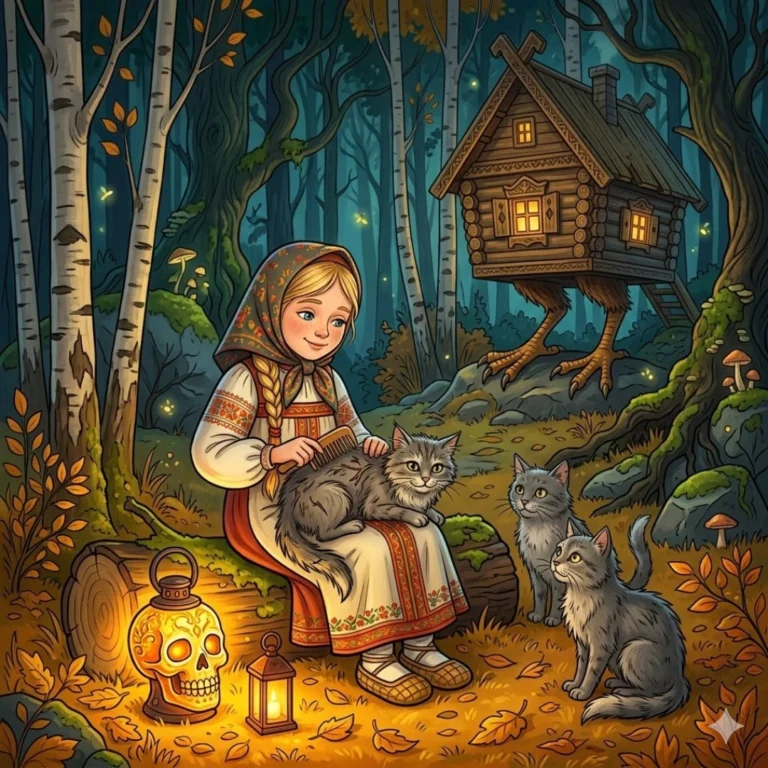
Now, settle in close, because this is the sort of story that wants to be told by firelight, with the wind outside doing its best to be dramatic and the tea going cold in your cup before you notice. It is a story about a girl named Vasilisa, and a very old woman who lived in the forest, and the small, quiet magic that lives inside a kind heart.
Vasilisa was nine years old, and she lived at the edge of a great dark forest – the kind of forest where the birch trees stand so close together that the sunlight arrives in thin silver slices, like letters from somewhere far away. She had bright eyes, quick hands, and a doll no bigger than her thumb that she kept tucked in her apron pocket at all times.
The doll had been her mother’s gift. “When you are frightened or hungry or lost,” her mother had whispered, long ago, “feed the little doll a crumb and a drop, and she will tell you what to do. She carries all the love I have for you, and love, my darling, never runs out.”
Vasilisa’s stepmother was not cruel in the loud, dramatic way of story-book stepmothers. She was simply cold – the way a stone left in shadow is cold – and she had two daughters who were very like her. One autumn afternoon, when the sky had gone the colour of pewter and the first cold had crept under the door, the stepmother looked at Vasilisa with narrow eyes and said, “We need fire. Ours has gone out. You will go into the forest and fetch a coal from Baba Yaga’s hearth.”
“From Baba Yaga?” breathed one of the stepsisters.
“From Baba Yaga,” said the stepmother, and smiled in the way that meant the conversation was finished.
Now, every child in the village knew about Baba Yaga. She was ancient as tree-roots, powerful as winter, and she lived deep in the forest in an izba – a little wooden house – that stood on two enormous chicken legs and could spin around when it pleased. Children who wandered to her door without good manners were said to become the filling for her supper pies. Children who were clever and kind – well. Nobody was quite sure what happened to those children, because the stories got complicated at that part.
Vasilisa stood at the edge of the forest until the dark came down like a dropped blanket. Then she put her hand in her apron pocket, felt the smooth wood of the little doll, and walked in.
The forest at night in late autumn is not a cheerful place. The leshy – the forest spirits – moved in the branches overhead, and their laughter sounded very much like wind. Vasilisa’s boots crunched through frost-stiffened leaves. She was frightened, if we are being honest, which we should always be in a good story. She was quite frightened indeed.
She stopped, took the doll from her pocket, and gave her a crumb of bread from her coat and a drop of dew from a leaf.
“Which way do I go?” she whispered.
The doll’s carved eyes seemed to catch the moonlight. “Straight on,” she said, in a voice like a warm thought. “And when you see the fire – do not run. Walk slowly. Remember your manners.”
Vasilisa tucked her back in her pocket and walked straight on.
She smelled the izba before she saw it – woodsmoke and pine resin and something earthy and old. Then she saw the fire glowing through the trees, and there it was: a little wooden house perched on two enormous scaly legs, rotating slowly, as if looking for something it had misplaced.
“Izba, izba,” said Vasilisa politely, because this was the proper thing to say, “turn your back to the forest and your door to me.”
The house stopped rotating. The door swung open. And there, filling the doorway the way a storm fills the sky, was Baba Yaga.
She was extraordinarily old. Her nose was long enough to be its own separate concern. Her teeth were iron. But her eyes – her eyes were bright and sharp and curious as a crow’s, and they looked at Vasilisa with an expression that was not entirely unkind.
“Fie, fie,” said Baba Yaga, sniffing the air. “I smell a Russian soul. Are you here by your own will, little girl, or by another’s sending?”
“By both, grandmother,” said Vasilisa carefully, because politeness costs nothing and is frequently very useful. “My stepmother sent me to ask for a coal from your hearth, for our fire has gone out.”
Baba Yaga looked at her for a long moment. “I give nothing for nothing,” she said at last. “You may have your coal. But first you will work for me. Complete my three tasks by morning and you shall have what you need. Fail, and you shall be my supper.”
“Yes, grandmother,” said Vasilisa, because what else was there to say?
Baba Yaga served her a bowl of shchi – cabbage soup, thick and hot – and set the tasks. In the morning, she said, Vasilisa must: first, sweep the yard and the izba from top to bottom; second, wash and comb Baba Yaga’s three shaggy cats; and third, sort a whole sackful of millet, removing every tiny black seed from the white ones.
Baba Yaga settled into her enormous bed and was asleep in moments, snoring like distant thunder.
Vasilisa looked at the tasks. The yard was enormous. The cats – three of them, grey and wild-eyed and tangled as old rope – hissed from a corner. The sack of millet was the size of a small child.
She took out the doll. A crumb. A drop.
“What do I do first?” she asked.
“Rest,” said the doll firmly. “Sleep. I will begin the sorting. You will need your strength.”
Vasilisa could not quite imagine sleeping, but she lay down on the bench by the warm stove and was asleep in moments.
In the morning she woke to find the millet sorted into two perfect piles. The doll sat between them, looking pleased with herself in the way that small wooden dolls sometimes do.
Vasilisa swept the yard briskly, and then went to find the cats.
The cats were huddled under the woodpile, hissing and miserable. Up close, she saw why: they were matted with burrs, their fur tangled from weeks of forest-wandering, and the largest one had a long thorn caught in her paw.
“Oh, you poor things,” said Vasilisa, and she did not try to grab them. She sat down in the cold yard, very still and very quiet, and waited.
After a while, the smallest cat crept forward and sniffed her boot.
“Good morning,” said Vasilisa, very softly. “I am not going to hurt you. I would very much like to help, if you will let me.”
The smallest cat sat down and began to wash her face, which in cat-language means I am thinking about trusting you.
Vasilisa found a bit of dried fish in her coat pocket – she had packed sensibly – and held it out flat on her palm. Within ten minutes, all three cats were in her lap. She combed their fur with her fingers, gentle and patient, easing the burrs free one by one. She drew the thorn from the large cat’s paw, slow and careful, and the cat made a sound that was almost a thank-you.
“You have done us a very great kindness,” said the large cat, in a low, rumbling voice. “We are Baba Yaga’s cats, and we have been watching you. Here.”
She pressed something into Vasilisa’s hand: a small silver comb.
“When you need to, throw this behind you,” said the cat. “You will understand when the time comes. Now go and show the old one your work.”
Baba Yaga emerged at sunrise, stumping through the yard on her iron teeth (this is another way of saying she was very grumpy in the mornings, which many of us understand). She inspected the swept yard. She looked at the sorted millet. She examined her three cats, who sat in a row looking clean and remarkably dignified.
Baba Yaga narrowed her crow-bright eyes at Vasilisa. “How did you manage all this, girl?”
“By kindness, grandmother,” said Vasilisa honestly. “And a good doll.”
Baba Yaga was quiet for a long moment. She looked at the cats. She looked at the millet. She looked at Vasilisa.
“You did not ask me questions,” she said finally. “Most children who come here cannot stop asking questions. How old am I. What do I eat. Where do I keep my magic. Questions, questions. You asked for nothing but what you needed.”
“My mother told me,” said Vasilisa, “that too many questions are bad for the soul.”
Baba Yaga threw her head back and laughed – a sound like a whole forest of trees falling at once, loud and raucous and oddly warm. “Ha! Your mother was sensible. And she left you something else, I think. A doll with a warm heart in it.” She peered at Vasilisa’s pocket. “Yes. I thought so. A mother’s love, that is. You cannot buy it and you cannot steal it, and it is the only magic stronger than mine.”
She stumped inside and returned with a skull – an old skull mounted on a stick, its eye sockets blazing with orange-gold fire, like two tiny suns.
“There is your coal,” said Baba Yaga. “Or rather, there is your light. Carry it home. It will do what it must do.”
Vasilisa accepted the skull with both hands and a proper thank-you, and turned to go.
“Girl,” said Baba Yaga.
Vasilisa turned back.
Baba Yaga looked at her for a long moment, and something in those sharp crow-eyes softened, just slightly, like frost in February sunshine. “You have a good heart,” she said. “Do not let anyone make you hard.”
“Yes, grandmother,” said Vasilisa.
She walked home through the forest, which was much less frightening in the thin morning light. She carried the glowing skull before her, and the silver comb was warm in her pocket beside the doll.
When she arrived home, the blazing light from the skull’s eyes fell on her stepmother and stepsisters, and such is the nature of Baba Yaga’s fire that it reveals what truly lives in a person’s heart. The cold things in the stepmother shriveled in that honest light, and by the time the skull had done its work, she and her daughters had become quite considerably kinder, in the way that happens sometimes when something true and bright illuminates a dark room.
Vasilisa set the skull on the windowsill, where it glowed all winter like a small fierce lamp.
As for the doll – she tucked her back in her pocket, as always, and kept her close. She is there still, most likely, in the warm dark of an apron pocket somewhere, carrying a mother’s love through the world, which is, when you think about it, one of the most important things that can be carried.
And that, my dears, is what small acts of kindness can do. They can comb the tangles out of a wild thing’s fur. They can sort what is muddled into something clear. They can even, on the right winter morning, make an ancient and terrible and rather wonderful old woman laugh like a falling forest.
Now then. Your tea has gone cold. Shall I warm it up?
The Moral of This Story
Small acts of kindness can change everything
About This Story’s Culture
This story draws faithfully on the Russian fairy tale ‘Vasilisa the Beautiful’ (Vasilisa Prekrasnaya), one of the most beloved tales in Slavic folklore, featuring Baba Yaga – a complex forest-crone figure who tests heroes with impossible tasks. Authentic cultural details include the izba on chicken legs, the leshy (forest spirit), the traditional spoken formula used to summon Baba Yaga’s house, shchi (cabbage soup), and the famous skull-lantern motif from the original tale. The magical doll represents a mother’s enduring protective love, reflecting the Slavic folk belief that handmade objects can carry spiritual power and guidance across generations.
Key Story Elements
- Vasilisa and the magical doll (symbol of mother’s love and guidance)
- Baba Yaga as a test-giver in her izba on chicken legs
- Three tasks completed through kindness – sorting millet, sweeping the yard, and combing the wild cats
- Kindness to the three suffering cats earns a magical silver comb
- Authentic Slavic forest atmosphere with leshy spirits and birch trees
- Baba Yaga’s glowing skull lantern as the reward for virtue
- The moral revealed: small kindnesses (combing burrs, removing a thorn) change everything
Frequently Asked Questions
What is the story of Vasilisa and the Baba Yaga about?
Vasilisa and the Baba Yaga is a Slavic fairy tale about a brave nine-year-old girl named Vasilisa who must face the fearsome witch Baba Yaga in the forest. The story explores how kindness, compassion, and inner courage help Vasilisa pass a series of tests and find her way home safely.
What age group is the Vasilisa and Baba Yaga story suitable for?
This retelling of Vasilisa and the Baba Yaga is written for children aged 6 to 12, with a reading time of around 8 to 10 minutes. It works beautifully as a bedtime story or a read-aloud, and parents often enjoy it just as much as the kids do.
What moral lesson does the Baba Yaga story teach children?
The Baba Yaga story teaches children that kindness and compassion are a form of quiet magic. Vasilisa succeeds not through force or trickery, but by treating others — even strange or frightening ones — with warmth and care. It encourages kids to trust their good hearts even when they feel scared.
📚 Recommended Books
Handpicked for readers like you
As an Amazon Associate, we earn from qualifying purchases. These recommendations are personalized based on this story's themes and your reading history.
Who is Baba Yaga in Slavic folklore?
Baba Yaga is one of the most famous figures in Slavic folklore — a wild, mysterious old witch who lives deep in the forest. She can be terrifying or surprisingly helpful, depending on how a visitor behaves. In many stories, she tests young heroes and heroines before deciding whether to hinder or assist them.
What is the significance of Vasilisa’s doll in the story?
Vasilisa’s tiny doll is a gift from her mother and acts as a source of comfort and guidance throughout the story. It represents a mother’s love and the inner wisdom we carry with us. When Vasilisa feels frightened or lost, the doll reminds her to stay kind and trust herself.