In the highlands of Ethiopia, where the Blue Nile is born from the dark waters of Lake Tana and the mountains wear clouds like silver shawls, there lived a young woman named Desta.
Desta’s name meant joy, and once—oh, once—she had lived up to it entirely. She had laughed easily, moved through her days with the light step of someone who knows she is loved. But that was before she married Bekele, a quiet farmer with kind eyes and two fields of teff that turned gold in the dry season. And that was before she came to understand that Bekele carried inside him a silence as vast and dark as the rift valley itself.
He had a son. The boy’s name was Yonas. He was eight years old, thin-wristed and serious, with eyes that reminded Desta of the mountain pools her grandmother had called “heaven’s mirrors”—clear, still, impossibly deep. His mother had died when he was three. Since then, Yonas had built around himself a wall as patient and thick as the stone terraces the farmers cut into the hillsides, layer by layer, year by year.
Desta tried everything she knew. She made him his injera the way Bekele said he used to love it—sour and spongy, perfect for scooping up the golden lentil stew, misir wat. She saved him the crispiest edge pieces, the ones children always fight over. She woke before dawn to grind the teff herself, so the bread would be fresh when he stirred.
But Yonas would only eat in silence and then disappear into the field.
She sat with him during the long afternoons, when the eucalyptus trees swayed and the air smelled of smoke from neighboring cookfires, and told him the stories her own grandmother had told her: the tale of the lion who learned kindness, the tortoise who outwitted the sky. But Yonas only stared at the middle distance, as if looking for someone who was not there.
“What am I doing wrong?” she whispered to Bekele one evening, as the stars crowded over the highland plateau like a congregation at Sunday service. The Ethiopian Orthodox church at the valley’s edge still glowed faintly with candlelight, and somewhere a priest was chanting the Psalms of David in ancient Ge’ez, that language old as the first rain.
Bekele took her hand. “You are doing nothing wrong,” he said quietly. “He loved his mother very much. He fears to love again.”
But Desta could not rest with an answer like that. She was a woman who believed that love was not something that simply arrived—it was something you built, as the stonemasons of Axum had once built their great obelisks, stone upon patient stone, until something that pierced heaven stood in the earth.
So she went to see the hermit.
Everyone in the highlands knew of him. They called him Abba Girma—Father Girma—though his true name had been swallowed by decades of prayer and solitude. He lived in a cave behind a waterfall that tumbled down the basalt cliffs of the escarpment, half a day’s walk from Desta’s village. The path went through forests of juniper and wild olive, past shepherd boys who nodded to her in that ancient Ethiopian way, touching their hearts without a word.
She found him sitting outside his cave, grinding grain in a small stone mill, as if he were simply an old man with nothing more complicated on his mind than flour.
“Abba Girma,” she said, kneeling before him. “I need your wisdom/” title=”More stories about wisdom”>wisdom. I have a stepson who will not let me love him. He is a good boy. I do not blame him. But it is breaking something inside me.”
The old hermit set down his grinding stone. He had a face like a dried fig—wrinkled and sweet-looking, brown and very wise. His white shamma cloth was wrapped twice around his thin shoulders. He was quiet for a long time.
“There is a cure,” he said at last. “But it is not easy.”
“Tell me,” Desta said. “I will do anything.”
“Bring me a single whisker,” said Abba Girma, “from the lion that sleeps in the ravine below the waterfall pool. One whisker, freely given—or at least, not taken by force. Bring it to me and I will prepare you a medicine that will open your stepson’s heart.”
Desta stared at him. “A lion’s whisker,” she said.
“A lion’s whisker,” he confirmed, and picked up his grinding stone again.
She walked home through the juniper forest with a weight in her chest and a wild plan beginning to unfold in her mind like the wings of a stork rising from the marshes of Lake Tana.
The next morning, before the first cock crowed, before Yonas stirred in his room and Bekele rose to tend the teff, Desta cut a generous portion of raw goat meat—the kind the butcher at the market kept for special orders—wrapped it in banana leaf, and walked to the ravine.
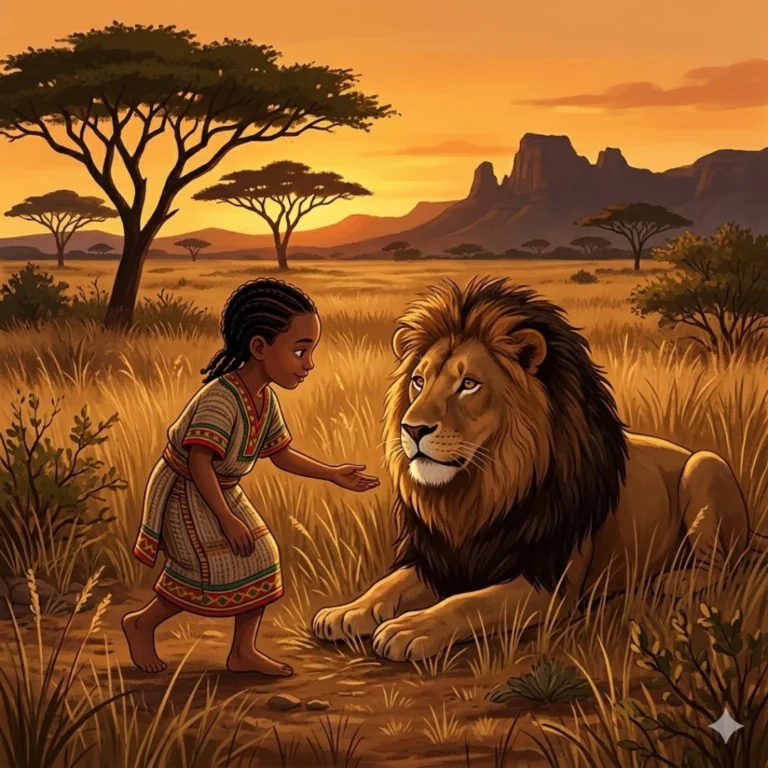
The lion was there. He was immense. His mane was the color of a storm cloud just before the rains. He lay beside the pool where the waterfall threw silver light in every direction, and he was watching her with eyes like amber set in shadow. He did not move. He simply watched, the way mountains watch.
Desta set the meat down on a flat rock fifty paces away. Her hands trembled. Her feet wanted to run. But she breathed slowly, the way her grandmother had taught her to breathe when fear came—in through the nose like you are breathing in courage, out through the mouth like you are breathing out everything you do not need.
She set the meat down. She stepped back. She walked home.
The following morning, she came again. The meat was gone. She placed a fresh offering, this time forty paces from the pool. The lion was there again. He lifted his great head and looked at her. She looked back at him, calm as she could make herself, and then she sat down on a stone and simply waited.
After a while, the lion looked away. He lapped at the pool. He lay back down.
Desta went home.
This is how the weeks passed. Each morning before the village stirred, Desta rose in the blue-grey dark. She ground the coffee beans—the bunna—that Bekele loved, left it ready for him on the clay pot stand. She kissed her sleeping stepson’s doorframe—she did not go in, she did not wake him, only kissed the wood—and then she walked to the ravine.
Every day she moved the offering stone a little closer. Every day she sat a little longer. Every day the lion grew a little less tense, a little more accustomed to the scent of her, the sound of her breathing, the particular quality of her stillness.
On the thirty-first day, she placed the meat twelve paces from the pool. The lion stood and walked toward it while she was still there, still seated on her stone, and he ate.
Her heart hammered so loudly she was certain he could hear it. But she did not move.
On the forty-second day, the lion approached the stone not for the meat, but to sniff her outstretched hand. His breath was hot as a cookfire. His eyes were old and gold and very serious. She understood, in that moment, that he was not a monster. He was simply a creature who had learned, as all wild things learn, to trust nothing that came too close too quickly.
On the fifty-fourth day, he lay down beside her in the early morning light, that great tawny weight of him settled into the earth like a boulder that had always been there. And Desta reached out her hand, very slowly, and stroked the thick ruff of his mane, and found one long silver whisker, and—with a breath that was half a prayer—she took it.
The lion lifted his head. He looked at her with those amber eyes. Then he set his head back down.
Desta rose, slowly, and walked backward for twenty paces, then turned and walked uphill through the juniper trees with a lion’s whisker in her closed fist and tears running down her face for reasons she could not entirely explain.
She ran the last part of the path to Abba Girma’s waterfall. She was breathless when she arrived, her white dress dusty at the hem, her braid coming loose from its wrap.
“I have it!” she cried, holding out the whisker. “Fifty-four mornings. I have it!”
Abba Girma took the whisker from her palm. He turned it in the light—long and silver-white, strong as a thread of mountain spring. He examined it carefully, tilting his head this way and that, making small sounds of consideration. And then, without a word, he held it over his clay oil lamp.
The whisker caught flame and was gone in one bright, instant second.
“No!” Desta gasped. She stared at the old hermit. “Why—what have you done? I needed that—you said—”
“I said I would prepare you a medicine to open your stepson’s heart,” Abba Girma said. His voice was the gentlest thing she had ever heard. “And I have.”
Desta felt anger rise in her like the Blue Nile in flood season, and then—slowly, strangely—felt it recede.
“Tell me,” she said.
“The lion,” said Abba Girma, “was wild. Wounded by years of living alone. Accustomed to fear and to pain. How did you approach him?”
Desta was quiet.
“You came every day,” the old man said. “Not some days. Every day. You brought him gifts without demanding that he accept them. You sat with him in his silence without filling it with your noise. You moved closer only when he was ready, not when you were ready. You waited. You were patient not because patience came easily—I saw your face, child, I know it did not—but because you loved him enough to wait.”
“He was a lion,” Desta said, and her voice broke on the last word.
“Yes. And Yonas is a boy who lost his mother when he was three years old.” Abba Girma folded his old hands together. “Go home. Do what you did in the ravine. No more. No less.”
Desta walked home through the afternoon light, through the smell of eucalyptus and cooksmoke and the sound of the church bell calling the village to evening prayer. She walked past the teff fields, past the stone walls her husband had built with his own hands, and into the compound where Yonas was sitting alone on the low wall, watching the mountains turn purple in the distance.
She sat beside him. She did not speak. She did not offer injera or stories or carefully prepared questions. She simply sat with him and watched the mountains the way he was watching them, and breathed.
After a long while, Yonas said, very quietly, “My mother used to sit here too.”
Desta did not move too close, too fast. She only said, “She must have loved these mountains very much.”
“She did,” said Yonas.
They sat together until the stars came out. Then he went inside to eat, and Desta followed, and that was all. But something had shifted in the air between them, small and significant as the first green shoot after the long dry season.
Days became weeks. Weeks, as they always do, became something more. Slowly—oh, so slowly, like the teff rising toward the highland sun—Yonas began to turn toward her. One morning she found him in the kitchen before she arrived, grinding the coffee beans because he had seen how she did it and wanted to try. She said nothing except thank you. Another day he left a small bunch of yellow meskel flowers—those wild daisies that bloom across Ethiopia in the feast season—on the stone beside her grinding mat.
She did not make too much of it. She only put them in water and smiled.
And one evening—a cool evening in the time when the rains were beginning again and the whole highland world smelled of wet earth and new grass—Yonas came and stood beside her at the cookfire, watching the stew bubble in the clay pot, and he said, without looking at her: “Desta. Do you think she would have liked you?”
Desta stirred the stew. She took her time answering, because she had learned that good answers, like good things, cannot be rushed.
“I don’t know,” she said at last, honestly. “I hope so. I would have liked to have known her. Anyone who loved you so well must have been worth knowing.”
Yonas was quiet for a moment. Then he leaned against her arm—just slightly, just briefly, as a boy who is learning trust leans—and said nothing more.
But Desta felt it. That small, warm weight. That first act of choosing closeness.
It was worth every morning in the ravine. Every trembling step across the wet grass. Every silent hour beside a lion who had needed time to believe the world could still be safe.
She thought of Abba Girma burning the whisker without ceremony, and she understood now what he had known all along: there was never any medicine. There was never any trick. There was only this—the kind of love that does not demand to be received before it is given, that moves closer only when the other is ready, that brings its gifts quietly and does not turn away when they are not yet accepted.
Good things come to those who wait. Not to those who sit idle, but to those who wait with wisdom—who keep showing up, keep bringing their offerings, keep sitting in the silence until the wild and frightened heart beside them learns, slowly, beautifully, that it is safe to be loved again.
And somewhere below the waterfall, in the blue morning mist, a lion turned in his sleep and breathed deep the smell of juniper, and was at peace.
The Moral of This Story
Good things come to those who wait and act with wisdom
About This Story’s Culture
This story authentically incorporates Ethiopian cultural elements including injera (sourdough flatbread made from teff grain) and misir wat (lentil stew), the traditional bunna (coffee) ceremony, the white shamma cloth worn by elders, the Ethiopian Orthodox Christian tradition with its Ge’ez liturgical language and ancient church chants, and the meskel yellow daisies celebrated during the Feast of the True Cross. The setting references Lake Tana (source of the Blue Nile), the ancient Axum obelisks, and the Semien highland escarpment. The respected figure of the abba (holy hermit) and the concept of deep, considerate respect in relationships underpins the patience lesson at the story’s heart.
Key Story Elements
- Ethiopian highland setting with Lake Tana, Blue Nile, and mountain plateau
- Desta, a compassionate young stepmother learning patience
- Withdrawn stepson Yonas grieving his late mother
- Wise hermit Abba Girma and the lion’s whisker quest
- Fifty-four days of daily offerings and patient trust-building with a wild lion
- The whisker burned to reveal the true medicine was patience all along
- Parallel emotional journey: lion trust mirrors stepchild relationship
Frequently Asked Questions
What is The Lion’s Whisker story about?
The Lion’s Whisker is an Ethiopian folktale about a young woman named Desta who struggles to connect with her stepson Yonas after marrying a widower. The story explores themes of patience, timing, and building trust, showing how love sometimes requires courage and quiet persistence rather than rushing results.
Where does The Lion’s Whisker folktale come from?
The Lion’s Whisker is a traditional Ethiopian folktale rooted in the highland regions of Ethiopia. The story draws on the landscape and culture around Lake Tana and the Blue Nile, giving it a rich, vivid setting that reflects the storytelling traditions of East Africa.
What age group is The Lion’s Whisker story suitable for?
This story is recommended for children aged 6 to 12, with a reading time of around 8 to 10 minutes. Its themes of patience and family bonding make it a meaningful read for kids and parents together, and it works well as a bedtime story or classroom read-aloud.
📚 Recommended Books
Handpicked for readers like you
As an Amazon Associate, we earn from qualifying purchases. These recommendations are personalized based on this story's themes and your reading history.
What lesson does The Lion’s Whisker teach children?
The Lion’s Whisker teaches children that patience and careful timing are essential when building relationships. It shows that trust cannot be forced — it grows slowly, like the layers of stone terraces on an Ethiopian hillside. The story gently demonstrates how persistence and empathy can open even the most guarded heart.
Is The Lion’s Whisker a good story for teaching patience to kids?
Yes, The Lion’s Whisker is widely regarded as one of the most powerful folktales for teaching patience to kids. Through Desta’s journey to connect with her stepson, children learn that worthwhile things take time. Its gentle pace and emotional depth make it especially effective for sparking conversations about feelings and family.