

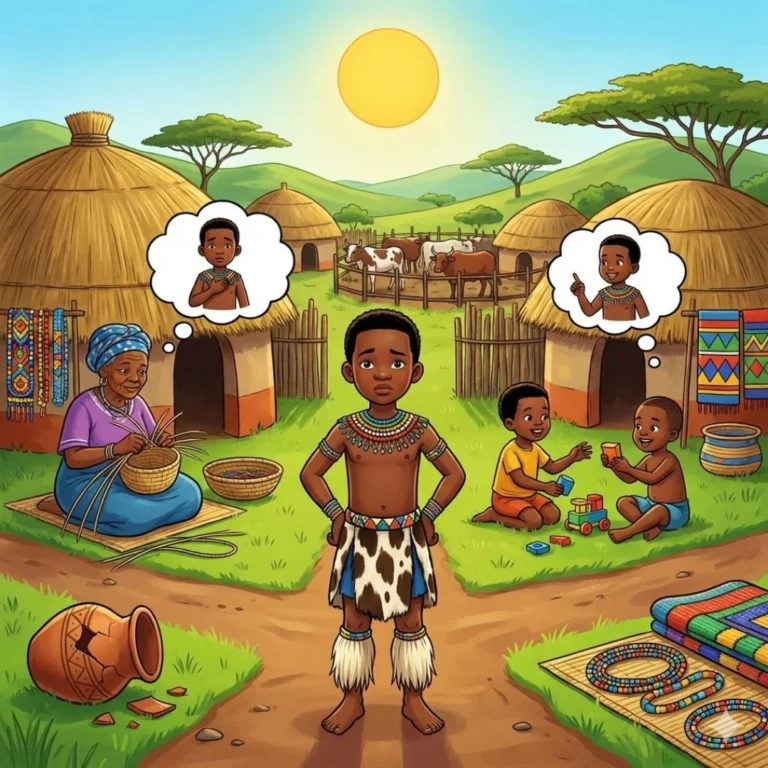
Now, let me tell you a story about a girl named Nandi, who lived in a Zulu village where the hills rolled green and endless under the wide African sky, where the cattle grazed peacefully and their bells made gentle music, and where the mist rose from the valleys each morning like the breath of the ancestors. This is a story my grandmother told me, and her grandmother told her, and perhaps you will tell it to someone special too. It’s a story about truth, about courage, and about the value of trust.
Nandi was ten years old, with bright eyes that sparkled with curiosity and quick feet that could outrun most of the children in the village. She had a smile that could light up a room and a laugh that sounded like bells. She loved helping her mother, Mama Zinhle, make beautiful clay pots that were famous throughout the region and beyond, traded as far as the coastal settlements. These weren’t just any pots, you see. They were special pots, made with clay dug from a secret place near the river, decorated with patterns that told stories—stories of brave warriors like Shaka, wise ancestors who watched over the living, and the great adventures of the Zulu people through the generations. Each line, each curve, each symbol had meaning passed down through countless mothers to countless daughters.
One day—and this is where our story truly begins—the King himself sent a message to the village. He needed a very special pot for a very important ceremony. The pot would hold sacred water for the blessing of the new harvest, and it had to be perfect. Perfect in every way.
Mama Zinhle was chosen to make this pot, and she was very honored. “Nandi,” she said, “this is the most important work I have ever done. Will you help me?”
“Oh yes, Mama!” said Nandi, bouncing on her toes with excitement. “I will help you make the most beautiful pot the King has ever seen!”
For three days, they worked together from sunrise to sunset, shaping the clay with skilled hands, coiling it carefully into the traditional form, smoothing it with river-polished stones until the surface was perfect, decorating it with careful patterns using tools made from bones and reeds. Nandi learned to mix the special ochre paints—red from iron-rich soil, black from charcoal, white from kaolin clay. The pot grew tall and elegant under their patient hands, its graceful curves perfect for holding water, its surface telling the story of how the Zulu people learned to grow maize from the ancient spirits who first showed them which seeds to plant and when the rains would come.
On the fourth day, Mama Zinhle said, “Now the pot must dry in the sun for one whole day. Tomorrow we will fire it in the kiln, and then it will be ready for the King. Nandi, you must watch it carefully while I go to gather special herbs for the final glaze. Make sure nothing happens to it. Do you understand?”
“Yes, Mama,” said Nandi seriously. “I will guard it with my life!”
So Mama Zinhle went off to the hills, and Nandi sat beside the drying pot, watching it proudly. It really was the most beautiful pot she had ever seen.
But here’s the thing about children—and perhaps you know this yourself—sometimes even when we mean to be careful, accidents happen.
Nandi’s friend Themba came by, calling, “Nandi! Come and play! We’re having races down by the river!”
“I can’t,” Nandi called back. “I have to watch the pot.”
“Oh, come on! Just for a little while! The pot isn’t going anywhere!”
Well. Nandi looked at the pot. It was just sitting there, drying nicely. The sun was shining. What could possibly go wrong in just a few minutes?
“All right,” she said. “But only for a very short time!”
Off she ran to play with her friends, and oh, what fun they had! Racing and laughing and splashing in the cool water. Time passed so quickly, the way it does when you’re having fun.
When Nandi finally ran back home, the sun was much lower in the sky than she’d thought. And as she rounded the corner of her family’s homestead, her heart nearly stopped.
The King’s pot lay in pieces on the ground.
Nandi’s little brother, Sipho, who was only three years old, stood nearby, looking frightened. He had been playing with his ball, and the ball had knocked right into the pot, sending it tumbling down.
“Nandi!” Sipho cried. “The pot broke! I’m sorry! I’m sorry!”
Nandi’s mind raced. Mama would be home soon. The King was expecting his pot. What could she do?
And then—and this is the important part of the story—a terrible thought crept into Nandi’s mind. A thought that seemed helpful at first, but was really quite dangerous.
She thought: “I could say I was watching the whole time. I could say it was an accident that happened while I was sitting right here. I could say it wasn’t my fault at all.”
She could even, she thought, blame it all on Sipho.
Sipho was very little. He wouldn’t be punished harshly. And then no one would have to know that she had left her post to go play by the river.
Nandi’s stomach felt funny as she thought this. It felt like she had swallowed a stone. But she pushed the feeling away.
When Mama Zinhle came home with her basket of herbs, she saw the broken pot immediately. Her face fell. “What happened?” she asked quietly.
And this was the moment. The moment when Nandi could have told her lie.
But you know what? That stone feeling in her stomach got heavier and heavier. And she remembered something her father, Baba Mthunzi, had told her once: “The truth might hurt for a moment, but a lie hurts forever.”
Nandi took a deep breath. Her hands were shaking. “Mama,” she said, “it is my fault. You told me to watch the pot, but Themba came by and wanted to play, and I left to play by the river. I wasn’t here to watch Sipho, and he accidentally knocked the pot over with his ball. I’m sorry, Mama. I’m so very sorry.”
For a long moment, Mama Zinhle said nothing. Nandi thought she might be very angry. And she was angry—but also something else.
“You told the truth,” Mama said finally. “Even though it was hard. Even though you could have lied. That took courage, Nandi.”
“But the King’s pot is broken!” Nandi cried. “And it’s all my fault!”
“Yes,” said Mama. “Yes, it is. And that has consequences. You will work every day after your lessons to help me make a new pot. You will gather the clay, prepare it, and help with every step. It will be hard work. Do you understand?”
“Yes, Mama,” Nandi whispered.
“But Nandi,” Mama said, kneeling down to look into her daughter’s eyes. “If you had lied to me, I would have lost something much more precious than a pot. I would have lost my trust in you. Trust is like a clay pot, my daughter. Once it breaks, it is very hard to put back together. You told the truth, even though it was difficult. That means I can still trust you. And trust is more valuable than all the pots in the kingdom.”
So Nandi and her mother worked together, day after day, to make a new pot for the King. It took twice as long as the first one, and Nandi’s hands got tired and sore. But she didn’t complain. She had made a mistake, and now she was making it right.
When the pot was finally finished—even more beautiful than the first one, if you can believe it—they delivered it to the King together. The King was very pleased.
“This is magnificent work, Mama Zinhle,” he said. “Tell me, who helped you make this pot?”
“My daughter, Nandi, Your Majesty,” Mama said proudly.
The King looked at Nandi with kind eyes. “I heard about what happened to the first pot,” he said. And Nandi’s heart sank. But the King continued, “I heard that you told the truth, even when it would have been easier to lie. That shows character, young one. The Zulu people value honesty above many other virtues. A person who tells the truth, even when it is hard, is someone who can be trusted. And trust is the foundation of our community.”
He gave Nandi a small gift—a beautiful bangle made of copper. “Wear this,” he said, “and remember that honesty is always the right choice.”
Nandi learned something very important that day. She learned that telling the truth might be difficult in the moment, but it’s always better than lying. She learned that trust, once broken, is hard to repair—but when you’re honest, trust can grow even stronger.
And do you know what? From that day forward, Nandi never forgot her lesson. Even when she grew up and had children of her own, she would tell them this story. She would show them the copper bangle, now worn smooth with age, and say, “Honesty builds trust and respect. Always tell the truth, even when it’s hard. Because the truth might hurt for a moment, but a lie hurts forever.”
And that, my dear friends, is the story of Nandi and the clay pot. Perhaps you might remember it the next time you have to choose between a difficult truth and an easy lie.
For as the Zulu people say: “Iqiniso alilahlwa liyafunyanwa”—The truth is never lost; it will always be found.
And that’s the end of our story. Though perhaps it’s not really the end at all, but just the beginning of your own story about honesty and truth.

Frequently Asked Questions
What is the moral lesson of Nandi’s Clay Pot – Zulu Honesty Story for Kids?
What age is this story appropriate for?
How long does it take to read Nandi’s Clay Pot – Zulu Honesty Story for Kids?
What culture does this story come from?
Can I use this story for teaching?
Frequently Asked Questions
What is Nandi’s Clay Pot about?
Nandi’s Clay Pot is a traditional Zulu story about a ten-year-old girl named Nandi who helps her mother make beautiful clay pots. The story explores themes of truth, courage, and trust, passed down through generations. It’s a moral tale set in a vibrant African village where clay pot-making is a treasured and celebrated craft.
What moral lesson does Nandi’s Clay Pot teach children?
Nandi’s Clay Pot teaches children about the importance of honesty, courage, and trust. Through Nandi’s experiences in her Zulu village, young readers learn that telling the truth takes bravery and that trust is a precious value worth protecting. It’s a gentle, meaningful story ideal for sparking conversations about integrity with kids.
Is Nandi’s Clay Pot based on a real African folk story?
Nandi’s Clay Pot is inspired by the storytelling tradition of the Zulu people in southern Africa. While it may not be a single documented folk tale, it captures the spirit of oral stories passed from grandmother to grandchild across generations, rooted in authentic Zulu culture, landscape, and values.
📚 Recommended Books
Handpicked for readers like you
As an Amazon Associate, we earn from qualifying purchases. These recommendations are personalized based on this story's themes and your reading history.
What age group is Nandi’s Clay Pot suitable for?
Nandi’s Clay Pot is best suited for children aged 5 to 12. The story features a relatable ten-year-old protagonist and uses warm, descriptive language that engages young readers. Its moral themes around truth and trust make it a great bedtime story or classroom read-aloud for primary school children.
Why are the clay pots in Nandi’s story so special?
In the story, Nandi’s mother makes clay pots using clay from a secret spot near the river. Each pot is decorated with unique patterns that tell stories of brave warriors and village life. These clay pots are so valued they are traded as far as coastal settlements, representing both cultural heritage and skilled craftsmanship.
