This bedtime story for kids, ‘The Grateful Crane’, teaches children ages 6-12 about important moral values.
Snow fell softly as old Yohei trudged home through the forest, his breath making white clouds in the cold air. Then he heard it—a pitiful cry that made him stop and listen.
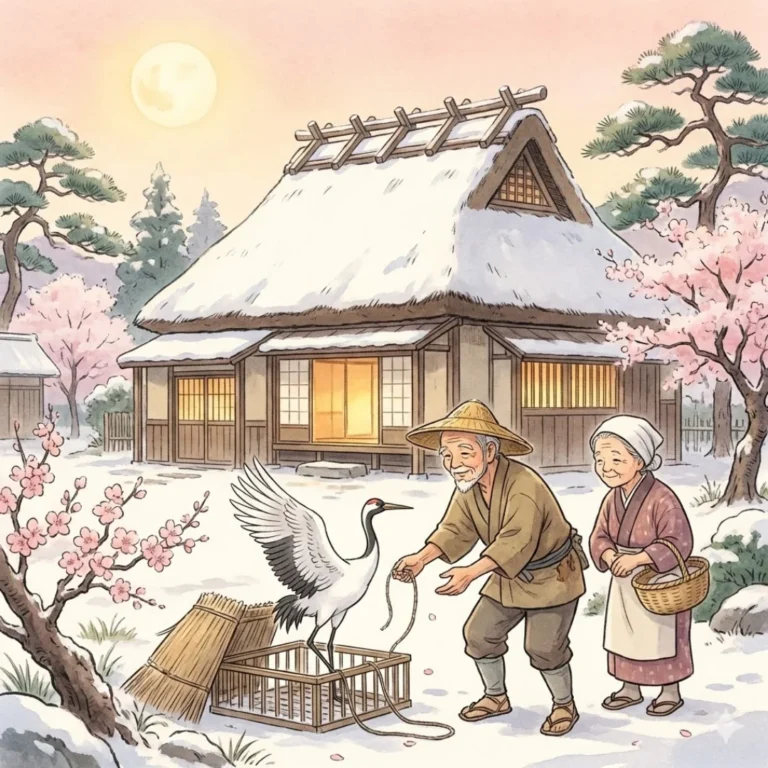
Following the sound, Yohei found a beautiful white crane trapped in a hunter’s snare. The rope bit deep into the bird’s leg, and blood stained its feathers like red ink on white paper.
“Oh, you poor creature,” Yohei whispered, kneeling beside the frightened bird. Despite his cold, aching fingers, he gently loosened the snare and freed the crane.
The bird looked at him with intelligent black eyes, then spread its wings and flew into the snowy sky, calling out as if to say thank you.
That night, a blizzard howled around Yohei’s cottage. As he huddled by his small fire, someone knocked at his door. Yohei opened it to find a beautiful young woman in a white kimono, shivering in the storm.
“Please, honored sir,” she said, bowing low. “I’ve lost my way. Might I shelter here until morning?”
“Of course!” Yohei said, ushering her inside.
The woman, who called herself Tsuru, asked to stay and keep house for him. She was kind and hardworking, and her presence brought warmth to Yohei’s lonely life.
One day, Tsuru said, “I wish to weave cloth to sell. But you must promise never to look in my room while I work.”
Though puzzled, Yohei agreed. “I promise.”
For three days and nights, Yohei heard the loom’s rhythmic clack-clack-clack. When Tsuru emerged, she was pale and thin, but she held the most beautiful cloth Yohei had ever seen—shimmering like moonlight on water.
At the market, a merchant paid a fortune for it. Yohei and Tsuru lived well for weeks.
But when Tsuru wove again, Yohei’s curiosity grew unbearable. On the third night, he crept to the door and peeked through a crack.
What he saw made him gasp. At the loom sat not a woman but a magnificent white crane, pulling her own feathers to weave into the cloth. With each feather plucked, she grew weaker.
Yohei stepped back, his heart heavy with shock and sorrow. He had broken his promise.
When Tsuru emerged, she looked at his face and knew.
“You looked, didn’t you?” she asked softly.
Yohei fell to his knees. “I’m sorry. Please forgive me.”
“I am the crane you saved,” Tsuru said, tears in her eyes. “I took human form to repay your kindness. But now that you’ve seen my true form, I cannot stay. That is the way of magic.”
“Please don’t go,” Yohei begged. “You’ve brought such joy to my life.”
Tsuru smiled sadly. “Your kindness saved me once, and I’ll never forget it. But I must return to my own world now.”
She walked outside into the moonlight and transformed into the beautiful white crane. With a powerful beat of her wings, she rose into the night sky.
“Live well, kind Yohei,” she called. “Thank you for your compassion.”
Yohei watched until she disappeared among the stars, his heart full of both sorrow and gratitude/” title=”More stories about gratitude”>gratitude.
From that day on, Yohei lived comfortably from the money the cloth had brought. He never forgot Tsuru and the lesson she taught: some gifts come with conditions, and keeping promises is more important than satisfying curiosity.
Sometimes, on winter nights, he would hear a crane’s call overhead and wonder if it was his old friend, checking to see he was well. And in those moments, Yohei would smile, remembering that true gratitude means honoring the trust others place in us.
Frequently Asked Questions
What is the moral lesson of The Grateful Crane?
What age is this story appropriate for?
How long does it take to read The Grateful Crane?
What culture does this story come from?
Can I use this story for teaching?
Frequently Asked Questions
What is The Grateful Crane story about?
The Grateful Crane is a Japanese-inspired bedtime story about an old man named Yohei who rescues a trapped crane. In return, the crane repays his kindness in a magical way. The story teaches children ages 6-12 important moral values like compassion, generosity, and gratitude.
What age group is The Grateful Crane bedtime story suitable for?
The Grateful Crane is ideal for children aged 6 to 12. The language is simple enough for younger readers while the moral themes are meaningful enough to engage older kids. It also works wonderfully as a read-aloud bedtime story for parents to share with their children.
What moral lesson does The Grateful Crane teach kids?
The Grateful Crane teaches children that kindness and compassion are always rewarded. When Yohei frees an injured crane despite his own discomfort, the act of selfless giving comes back to him. The story encourages kids to help others without expecting anything in return.
📚 Recommended Books
Handpicked for readers like you
As an Amazon Associate, we earn from qualifying purchases. These recommendations are personalized based on this story's themes and your reading history.
Is The Grateful Crane based on a traditional folktale?
Yes, The Grateful Crane is inspired by the classic Japanese folktale often called Tsuru no Ongaeshi, which means The Crane’s Return of a Favour. It is one of Japan’s most beloved traditional stories, retold here in a child-friendly format with clear moral values woven throughout.
Who is Tsuru in The Grateful Crane story?
Tsuru is a mysterious young woman who appears at Yohei’s door during a blizzard after he rescues the crane. She asks to stay and help keep his house. Her name means crane in Japanese, hinting at a magical connection between her and the bird Yohei saved earlier that day.